

By Tom Hicks | September 30, 2026
Editorial Note:
This is not an argument that federal judges should be free to say anything they damn well please about cases before them. They shouldn’t. It’s about what happens when an ethics dispute becomes a demand to remove judges from an entire category of cases.
Federal judges are supposed to call balls and strikes. Things get a little more complicated when the umpire points out that somebody keeps ignoring the calls.
The Justice Department filed a judicial misconduct complaint Wednesday against federal judges in Minnesota who spoke to The New York Times about what happened during the Trump administration’s immigration enforcement surge earlier this year. DOJ says the judges crossed an ethical line by publicly discussing matters that were, in some instances, still pending. That’s a legitimate question for the judicial misconduct process to answer. Justice Department
But DOJ didn’t stop there. It also wants the judges who participated in those interviews removed from every case involving the Department of Homeland Security, arguing that their comments create reasonable questions about their impartiality. Suddenly this isn’t simply a fight over whether federal judges talked too much to a newspaper. It’s also about whether a party that has repeatedly appeared before those judges can use the interviews to get different judges the next time around. Justice Department
That’s the part worth paying attention to.
What Happened in Minnesota
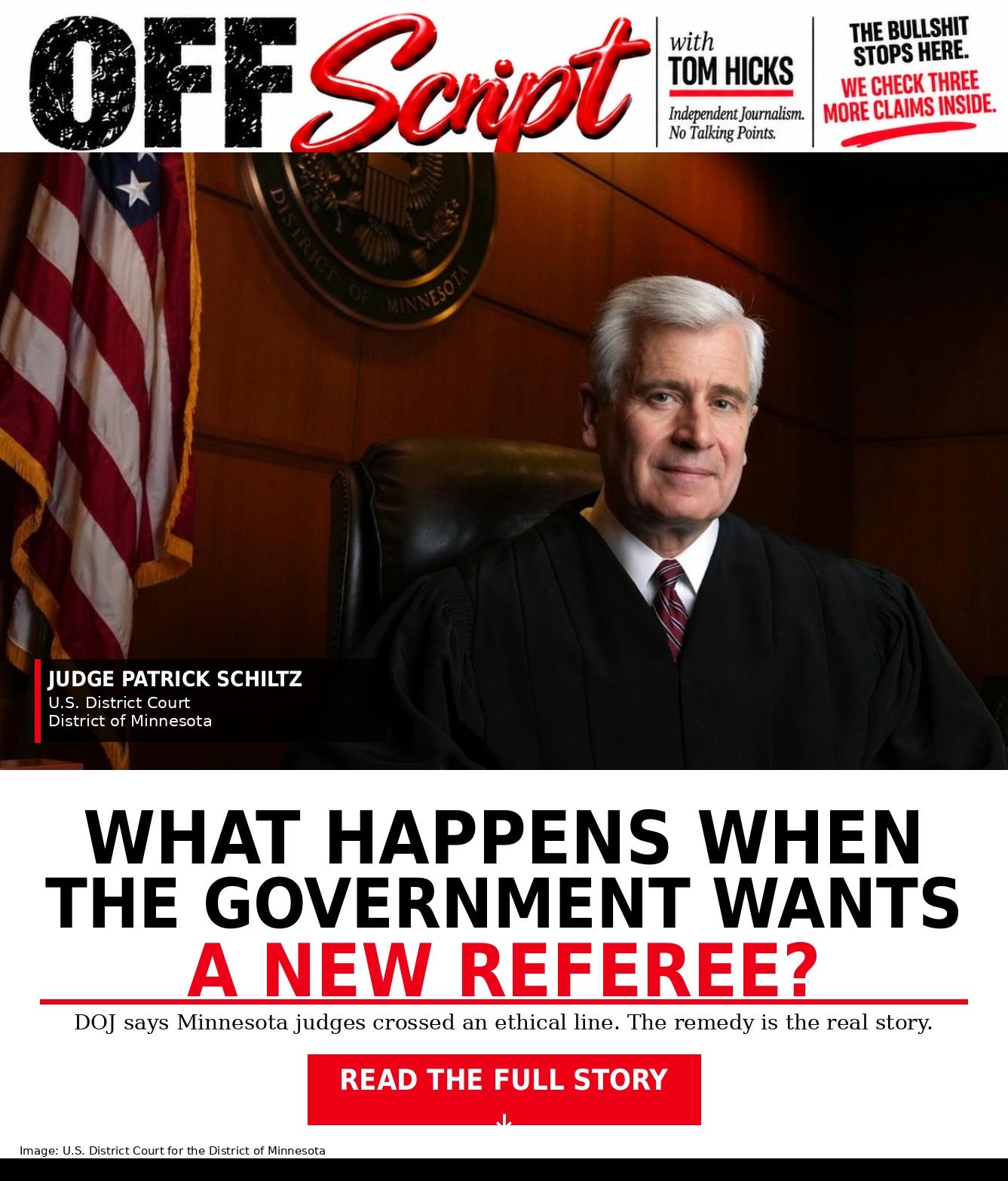
Judge Patrick Schiltz isn’t the obvious casting choice for some caricature of a left-wing activist judge. George W. Bush appointed him to the federal bench, and before that he clerked for Supreme Court Justice Antonin Scalia. Whatever else anyone wants to argue about what happened in Minnesota, dismissing this as another liberal judge picking a fight with a Republican administration doesn’t get you very far. Associated Press
Earlier this year, Schiltz said Immigration and Customs Enforcement had violated 96 court orders in 74 cases during the Minnesota immigration crackdown. His complaint wasn’t that the administration appealed rulings or challenged judges it believed were wrong. That’s what appeals courts are for. He complained that orders still in force weren’t being followed, and he wrote that “ICE is not a law unto itself.” Minnesota Reformer
That distinction matters. The executive branch has every right to tell a judge he’s wrong, appeal his decision, and ask another court to overturn it. What it doesn’t get to do is treat an order as optional while that argument plays out. A judicial order with which the government agrees and a judicial order it hates have exactly the same number of words in the phrase court order.
Schiltz and other Minnesota judges later spoke to The New York Times about the surge and its effect on the courts. Six of the seven judges who held active status during the surge participated in the newspaper’s reporting, according to DOJ. The group crossed presidential administrations and party lines rather than falling neatly into the political box somebody might prefer for this story. Justice Department
Then DOJ filed its complaint.
DOJ Has a Point
Here’s where this gets more interesting than another administration-versus-the-courts shouting match: DOJ has a point.
Federal judges aren’t pundits. Ethical rules restrict them from publicly commenting on pending or impending matters because people appearing before a judge are entitled to believe the case will be decided in court, not in a newspaper interview. If a judge is discussing a case publicly while one of the parties is still litigating before that judge, there’s a legitimate question about where the ethical line sits. Justice Department
So investigate it. Look at what each judge actually said, determine which cases were still pending and decide whether any particular comments violated the judicial code. If somebody crossed the line, the federal judiciary already has a process for dealing with that.
The problem is that DOJ’s complaint doesn’t end with they shouldn’t have talked.
It ends with they shouldn’t hear our cases anymore.
Independent journalism doesn’t work if every story begins with somebody’s talking points.
Off Script with Tom Hicks follows the documents, the court records, and the evidence first. Then we tell you what we found.
Subscribe for free, or help fund the research and tools we use to do this every day.
The Remedy Changes the Story
DOJ wants the Eighth Circuit to order the judges who participated in the interviews to recuse themselves from matters involving DHS. That would reach beyond the cases they discussed and affect future cases involving the agency as well. Justice Department
And here’s the part that makes the complaint particularly interesting: DOJ doesn’t restrict its argument to what the judges said to The New York Times. Its filing also goes after some of their decisions.
The complaint argues that Minnesota judges have exceeded their authority in immigration cases and points to an Eighth Circuit reversal involving an injunction arising from Operation Metro Surge. Near the end, DOJ says that if anything represents a “grave threat to the rule of law,” it is judges who exceed their authority and then publicly criticize the government. It then asks that the judges be removed from DHS cases. DOJ Judicial Misconduct Complaint
Read those pieces together, and the issue gets considerably messier. The government isn’t simply saying these judges violated an ethics rule by discussing pending litigation. The government is also saying they made bad rulings, criticized the government’s conduct, and should therefore stop hearing cases involving one of the departments appearing before them.
Maybe the Eighth Circuit ultimately agrees.
But that’s a hell of a lot more consequential than whether a judge should have given an interview.
The Judges Have an Argument Too
The judges aren’t claiming some magical judicial exemption that allows them to say anything they want once they put on a robe.
Their argument rests in part on guidance from the federal judiciary itself. In February, the Committee on Codes of Conduct issued an advisory opinion addressing judges’ ability to speak publicly about threats to the judiciary. It said judges may speak and write about matters central to the judicial function, including the rule of law and judicial independence, while remaining bound by other ethical restrictions. Committee on Codes of Conduct Advisory Opinion
Schiltz’s position is that the Minnesota judges were talking about exactly that: what happens to the rule of law when court orders aren’t followed.
DOJ sees something different. It says the judges discussed pending cases, attacked administration policy, and created the appearance that they had already chosen sides. Justice Department
There’s a real dispute there. Treating one side as obviously ridiculous would make for a louder article and a worse one.
The misconduct process exists to sort out where the boundary was crossed, if it was crossed at all. What deserves separate scrutiny is DOJ’s insistence that the appropriate answer should include taking these judges off DHS cases altogether.
There’s a Bigger Problem Hiding in Here
Courts have very little physical power. Federal judges don’t command troops, run agencies or control the Treasury. Their authority ultimately depends on the rest of the government accepting that when a court issues a lawful order, you obey it unless and until another court changes it.
That’s why the allegations about ignored orders matter more than the partisan identities of the people involved. If ICE believed those Minnesota judges were wrong, it had every right to appeal. DOJ’s own complaint points to an instance in which the Eighth Circuit did reverse a Minnesota court. That’s the system working exactly as designed. DOJ Judicial Misconduct Complaint
But now imagine the incentive created if the other path works too. An agency repeatedly appears before a judge. The judge rules against it and sharply criticizes its conduct. The judge later talks publicly about what happened. The government files an ethics complaint and asks that the judge no longer hear the agency’s cases.
You don’t have to believe the judge behaved perfectly to see the problem. And you don’t have to believe DOJ’s ethics argument is bullshit to see it either.
This Doesn’t Require Making the Judges Saints
Maybe some of these judges talked too much. Maybe a particular comment crossed the line from defending the judiciary into discussing a pending case in a way a federal judge shouldn’t. If the investigation finds that happened, then deal with it.
Judicial independence doesn’t mean judges are immune from ethical rules or criticism. Lifetime tenure isn’t a complimentary force field.
But executive accountability doesn’t disappear because a judge gave an interview either. Whether these judges violated ethical rules and whether the government should consequently be able to remove them from an entire class of cases are two different questions. DOJ’s complaint connects them. The Eighth Circuit now gets to decide whether that connection holds up.
That’s what I’ll be watching, because the precedent here isn’t really about six judges talking to a newspaper. It’s about what happens after the government gets angry with judges who have been reviewing its conduct.
A judge who violates ethical rules should answer to the process created for judicial misconduct. A federal agency accused of violating court orders should answer to the courts whose orders it allegedly violated. Neither proposition requires giving the other side a free pass.
But once a litigant starts saying that judges who ruled against it, criticized it and talked about what happened shouldn’t be allowed to hear its cases anymore, the question changes.
Now we’re talking about who gets to choose the referee.
And whichever party controls the White House, the answer can’t be the team that’s losing.
THE BULLSHIT DETECTOR
Three claims. Three checks. None of them has anything to do with today’s main story.
CLAIM 1: “Susan Collins voted to cover up the Epstein files, and Epstein’s business partner funneled $3 million to a super PAC supporting her.”
BULLSHIT LEVEL: 💩💩💩💩💩
The claim comes from a Democratic-aligned super PAC ad in Maine’s Senate race, and it manages to mangle two separate facts at once. Collins did vote in September 2025 to table an Epstein-files amendment attached to a defense bill, saying it didn’t belong there. But months earlier, the Appropriations Committee she chaired unanimously backed an amendment requiring DOJ to preserve the files and report to Congress. Then in November, Collins joined the Senate’s unanimous approval of the standalone Epstein Files Transparency Act. PolitiFact
The $3 million claim doesn’t survive inspection either. Blackstone CEO Stephen Schwarzman did give $3 million to a pro-Collins super PAC, and both Schwarzman and Epstein were early members of the same private New York club. PolitiFact found no evidence they were business partners. Apparently, belonging to the same club now makes two people business partners, which should come as exciting news to everyone who has ever joined Costco. PolitiFact
CLAIM 2: “A viral video shows masked officers walking through a polling place and watching people vote.”
BULLSHIT LEVEL: 💩💩💩💩💩
The video is fake. It circulated on social media as evidence of what voting could look like under Trump, showing masked officers moving among voters and apparently watching ballots being marked. The video itself was AI-generated, and the scene it depicted was fabricated. PolitiFact
There are legitimate questions about whether federal immigration agents could appear at polling locations this November. Trump administration officials have said there are no plans to send agents to precincts en masse, while not ruling out officers appearing at a voting site under particular circumstances, and lawsuits have been filed seeking legal boundaries before Election Day. Those questions are serious enough without passing around an AI video as though somebody caught the government doing it already. Fake evidence doesn’t strengthen a real concern. It gives everyone who wants to dismiss that concern an easy excuse to do it. PolitiFact
CLAIM 3: “Abdul El-Sayed supports defunding the police and emptying prisons.”
BULLSHIT LEVEL: 💩💩💩
Misleading enough to trip the detector.
Republican Michigan Senate candidate Mike Rogers made the claim about Democratic opponent Abdul El-Sayed. There is some real history underneath the attack: El-Sayed supported defunding police in 2020, arguing for moving some police funding toward health care, behavioral health, and other services. He also supported reducing prison populations during the COVID pandemic and said broader reductions should continue afterward. PolitiFact
But “emptying prisons” isn’t what he said, and his current position on police funding isn’t what Rogers’s present-tense claim suggests. During this year’s campaign, El-Sayed has called for funding police recruitment, retention, and retirement while continuing to argue that some situations should be handled by mental-health or social-service professionals. Attack the position he actually held if you want. Turning it into “empty the prisons” is campaign-ad Mad Libs. PolitiFact
ELSEWHERE AT TOM HICKS MEDIA
Lotus Purrspective
Life, humans and their many obvious defects, explained by the only member of the household qualified to do it.
Tom’s Number Ones
Six charts. One date. The music that owned America that day.
Panic Room Sports
Smart coverage with attitude. Everyone reacts. We’ll check the tape first.
Rabbit Ears Classic TV
The shows, stars and strange corners of television worth remembering.
The Backlot Ghost
Hollywood stories hiding behind the movies you already know.
COMING SUNDAY: WHAT THE HELL?
Something weird is coming to Tom Hicks Media. You're not going to believe this shit.
BUY ME A CUP OF TEA
If Off Script gives you something worth thinking about, you can help keep it going.
No corporate newsroom or billionaire owner. Just research, reporting, a laptop and an increasingly unreasonable amount of tea.
Buy me a cup and help fund the next story.
ONE QUESTION BEFORE YOU GO
If a federal judge publicly criticizes a government agency for ignoring court orders, should that judge still be allowed to hear future cases involving that agency?
Off Script with Tom Hicks would like your perspective.

#OffScript #JudicialIndependence #JusticeDepartment #RuleOfLaw #FederalCourts #ICE #Accountability #TomHicksMedia