

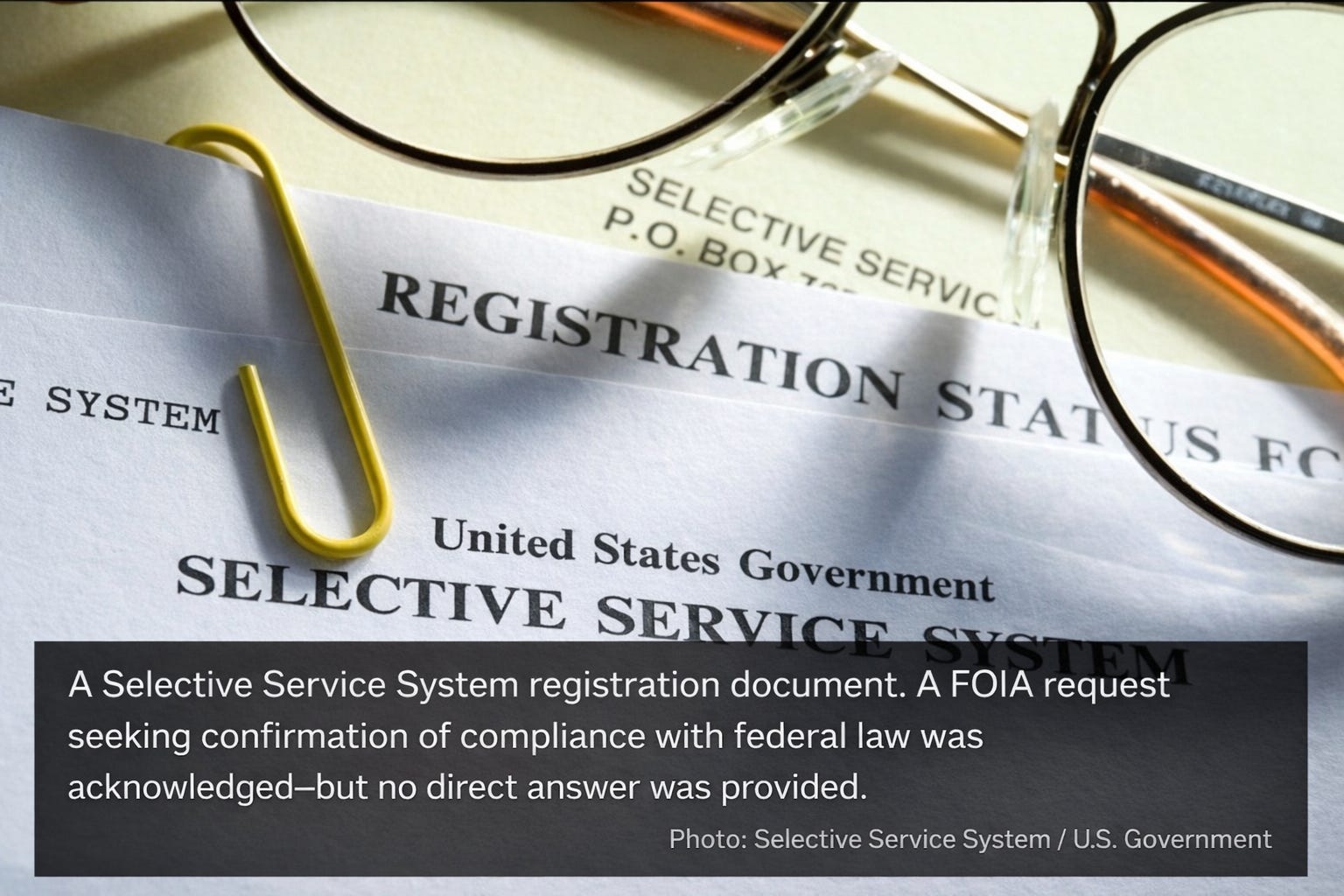


When a system refuses to show its work, it’s not protecting privacy. It’s protecting its ass.
Opening Statement
I filed a FOIA request. A clean one. Not a trap, not a fishing expedition, not a sprawling legal nightmare designed to make some clerk’s afternoon miserable. A single, specific, polite question about whether a named individual complied with a federal law that applies to millions of people.
And the federal agency responsible for that law wrote back and told me they couldn’t confirm or deny whether the answer exists.
Not that it’s private. Not that it’s protected. Not that records are sealed, and here’s the form to appeal.
That the answer itself might not exist. As a thing. In reality.
I’ve been doing this for fifty years, and I’ve seen agencies dodge, delay, bury, obfuscate, and pretend the fax machine ate the paperwork. But this one stopped me cold for a second. Because it’s not even a sophisticated dodge, it’s the government looking you in the eye and saying the question doesn’t deserve an answer, and dressing that up in language formal enough that you’re supposed to feel like you just bumped into a wall that was always there.
The wall wasn’t always there. They built it when I asked.
Charge
This case is about one thing: a system that selectively enforces the law and never verifies it.
Not because it’s overwhelmed. Not because the records don’t exist. Because the moment the question pointed somewhere specific and uncomfortable, the standard changed. The same agency that tells eighteen-year-old kids their federal benefits are on the line if they don’t register turned around and told a journalist the question itself was out of bounds.
That’s not bureaucracy. That’s a two-tiered system with better PR than most.
Exhibit A — The Law
The Selective Service registration requirement is not vague. Male U.S. citizens hit 18, they’ve got 30 days, and they register. That obligation doesn’t expire until 26, whether you got around to it or not. The penalties are right there in writing. Federal financial aid. Federal job training. Federal employment. Naturalization. All of it contingent. All of it is potentially gone if you didn’t check a box when you were supposed to.
The government built consequences serious enough to ruin someone’s shot at a student loan. They put those consequences in a law. They tell young men this matters.
On paper, this is not a suggestion.
Sidebar — Reality Check
In practice, enforcement is inconsistent as hell. Prosecutions are rare, penalties show up unevenly, and most people don’t even realize they’ve stepped on a landmine until something important gets denied years later. The law exists. The application of it depends heavily on context, timing, and circumstances that have nothing to do with the text.
That gap between what’s written and what actually happens is exactly where this story lives.
Exhibit B — The Request
So I filed a Freedom of Information Act request. Here is exactly what I submitted:
Freedom of Information Act Request Selective Service System FOIA Officer National Headquarters Arlington, VA 22209
Dear FOIA Officer:
Pursuant to the Freedom of Information Act, 5 U.S.C. § 552, I request access to any releasable records maintained by the Selective Service System that reflect whether Barron Trump has registered with the Selective Service System, or that otherwise reflect his registration status, exemption status, or any related compliance determination.
If any responsive records are exempt from disclosure in whole or in part, please release all reasonably segregable non-exempt portions and identify each withholding by the specific exemption(s) claimed.
If you determine that no responsive records can be released, please confirm that fact in writing. If this request is denied in whole or in part, please provide the basis for the denial and information about the appeal process.
Because this request is for a matter of public concern and journalistic use, I request a waiver or reduction of any applicable fees. If you believe a narrower description would improve the likelihood of a search, please contact me before processing.
Please provide the records electronically, if possible.
Sincerely, Thomas Hicks Publisher: The Unredacted Bastard and Lotus Purrspective
Read that again if you need to. There isn’t a trick in it. It does not ask for military strategy, classified intelligence, or anyone’s medical records. It asks whether a specific person followed a law that millions of other people are expected to follow, with consequences attached.
Any system operating in good faith answers that or explains clearly why it can’t. This one did neither.
Exhibit C — Acknowledgment
The agency responded as if everything was normal. Logged the request, handed me a tracking number, and gave me the standard “we’re processing this” language that makes it feel like the wheels are turning the way they’re supposed to.
“We are currently processing your request. Your reference number is 2026-40.”
Nothing unusual. System working as designed.
Exhibit D — The Response
I want to describe what it actually felt like to read what came back.
You file something like this, and a part of your brain is already drafting the follow-up. Already thinking about whether you’ll get records or a denial or a partial release with half the text blacked out. You’re prepared for bureaucratic friction. That’s the job.
What I was not prepared for was the agency responding as if the question itself had stepped out of bounds.
Here’s what they sent:
“The Selective Service System can neither confirm nor deny the existence of any records responsive to your request…”
I read it twice. Not because it was complicated. Because I kept expecting there to be more. Some explanation, some citation, some path forward. Something that acknowledged the actual question.
There was nothing else.
They didn’t say no. They didn’t say yes. They didn’t say the records exist but are protected under a specific exemption. They said you don’t get to know whether the answer to your question exists in the first place.
That’s not a FOIA denial. That’s a door that opens onto another door with a sign that says door does not exist.
Sidebar — What This Is Not
To be clear: this piece makes no claim about any individual’s compliance status. No conclusion has been reached, and none is being asserted. The request produced no records and no confirmation either way.
That’s not caution for its own sake. That’s the only position the system allows.
Which, if you think about it, is exactly the problem.
Sidebar — Translation
What they sent back has a name. It’s called a Glomar response, after a CIA operation where acknowledging whether certain records existed would itself have revealed classified information. Intelligence agencies use it. Black programs use it. In those contexts, it makes a kind of sense.
Using it for a Selective Service compliance question is like deploying a SWAT team because someone double-parked. Technically within the rules. Completely fucking unhinged given the circumstances. And a flashing sign that someone, somewhere, decided this particular question needed to be killed before it got anywhere.
If you’re not subscribed yet, you’re reading this the hard way. I do this daily. No sponsors. No filter. Subscribe if you want it in your feed instead of chasing it down.
Upgrade — Don’t Confuse Access With Understanding
You’ve got access to the story.
You don’t yet have the full picture.
The deeper cuts, the War Room pieces, the pattern recognition—that’s where this actually clicks into place.
Upgrade if you want to stop reading events and start understanding them.
KEEPERS ONLY BEYOND THIS POINT
