

Editorial Note
I’ve always been fascinated by the stories that don’t really become stories until everybody’s stopped paying attention. Those are usually the ones worth writing about.
Your subscription helps fund reporting, research, publishing, new features, and the continued growth of every Tom Hicks Media publication. If you appreciate independent journalism without talking points, I’d be honored to have you along for the ride.
I was watching the coverage this afternoon the same way millions of other people were. A jobs report comes out, the banners start flying across the bottom of the screen, politicians begin issuing statements before the numbers have had time to cool off, and every network suddenly digs up some economist who’ll explain exactly what it all means, with a straight face.
I’ve watched this dance for so many years I could probably call the next five minutes before they happen. Somebody says the economy’s stronger than expected, somebody else says it’s falling apart, one side starts celebrating and the other starts sharpening the knives, and cable news turns the whole thing into a prizefight before the first commercial break. By dinner everybody’s picked a corner.
Here’s the thing, though. I’ve never been convinced that’s the real story. Not because the jobs report doesn’t matter, because it absolutely does. Whether people are working or looking for work affects families, businesses, retirement accounts, elections, damn near everything we argue about. You’d have to be living under a rock to pretend employment numbers aren’t important.
What I’ve never understood is why we treat the first version like it’s the final version. That part has always struck me as a little fucking nuts.
Imagine watching the seventh inning of a baseball game, declaring the final score, and going home before anybody throws another pitch. That’s basically what we’ve trained ourselves to do every month. We treat preliminary estimates like somebody carried them down off the mountain on stone tablets, then we build an entire political argument around numbers that the government itself is telling us are subject to change. And that’s just how the reporting process actually works. Nothing broken about it.
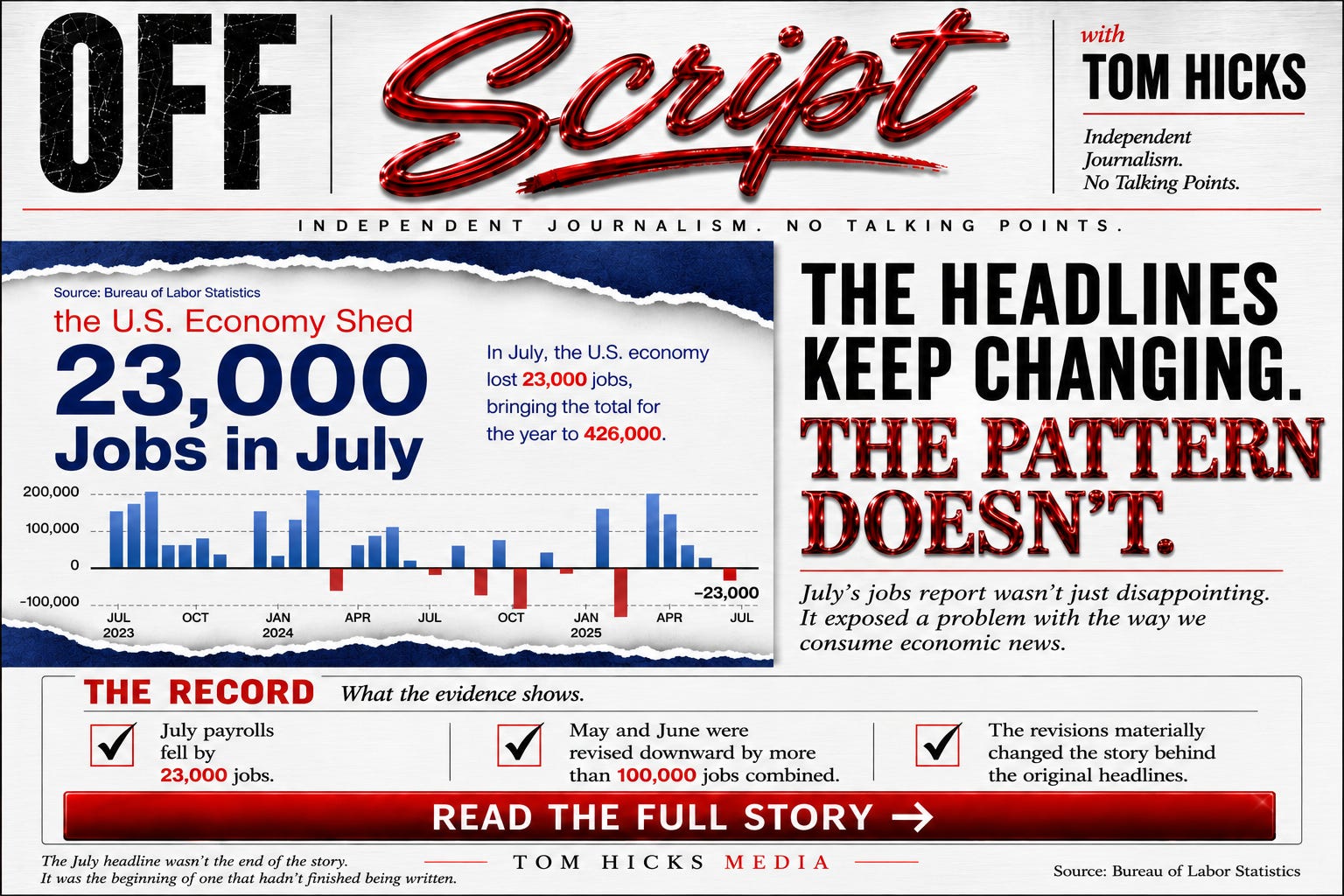
Today’s numbers were a perfect example. The headlines focused on July losing jobs, and that’s certainly news. It deserved the attention.
But buried underneath was the part that grabbed me by the shirt collar: the government also revised May and June downward by more than one hundred thousand jobs combined.
Think about what that actually means for a second. For the last couple of months, politicians, commentators, investors, and millions of ordinary Americans have been arguing over numbers that no longer exist.
Nobody cooked the books, nobody uncovered some giant conspiracy. More payroll information came in, statisticians did exactly what they’re supposed to do, and the picture got clearer. That’s how this is supposed to work. What’s actually strange is that almost nobody gives a shit once it happens.
We’ve somehow built a news culture where the first estimate gets a week of screaming headlines while the revised numbers quietly slip in the back door a month later. By then we’ve moved on to the next outrage, the next controversy, whatever shiny object is dangling in front of us, and the story we were dead certain about thirty days ago is already gathering dust in a drawer somewhere.
That’s what finally started bothering me this afternoon.
Half the time we’re not even arguing about facts anymore. We’re arguing about estimates that haven’t finished becoming facts yet.
If that doesn’t strike you as a little crazy, I don’t know what to tell you.
I’ve been around long enough to know uncertainty makes people uncomfortable. We like answers, we like certainty, we like being told the economy’s either humming along beautifully or headed straight off a cliff, because certainty gives us something to hold onto. Reality doesn’t cooperate like that. It tends to arrive in pieces, and sometimes those pieces fit together the way we expected and sometimes they don’t.
Today’s revisions suggest the labor market has been weaker than many of us believed. Not because somebody woke up this morning and changed the economy, but because enough additional information finally arrived to paint a more complete picture. That’s a very different conversation than the one most people are having tonight, and I can’t help wondering why.
“The revisions aren’t the footnote. They’re the part nobody wants you to notice because everyone has already moved on to the next argument.”
That question kept bouncing around in my head long after the television had moved on to something else.
Maybe it’s because revisions don’t make for very exciting television. You can’t build an entire afternoon around telling people the picture got a little more complicated than everybody thought yesterday. Politicians can’t hold a victory rally over revised numbers because the cameras are already gone. Networks aren’t about to interrupt programming a month later and announce, “Remember that story we all spent twelve hours arguing about? Well... turns out it wasn’t quite what we thought.” Social media’s no better. By then it’s already found something new to fight about.
We’ve built ourselves an information system that rewards being first and barely notices whether you were right.
Think about that for a second.
Somehow we’ve decided being first is more valuable than being accurate. That’s a hell of a trade to make, especially when we’re talking about the economy.
Before anybody fires off an email accusing me of wanting the government to sit on economic reports for three months, let me save you the trouble. That’s not what I’m saying. Preliminary estimates matter. Businesses need them. Investors need them. Policymakers need them. Waiting until every last payroll record gets verified would make the information damn near useless.
What actually bothers me is that we’ve forgotten they’re estimates in the first place.
Watch what happens after almost every major economic report. If the numbers make your side look good, suddenly they’re holy scripture. If they make your side look bad, they’re written off as unreliable, manipulated, rigged - take your pick. Change the party in the White House and watch how fast everybody swaps jerseys while swearing up and down they’ve always believed exactly what they’re saying today.
I’ve lived long enough to watch both parties pull that stunt more times than I can count. The names change, but the excuses don’t.
That’s why I don’t get excited anymore when somebody declares that one monthly report proves the economy is either soaring or collapsing. The economy’s a hell of a lot more complicated than that. It’s millions of people making millions of decisions every single day. Trying to reduce all of that to one headline and one afternoon of cable news strikes me as a pretty arrogant fucking thing to do.
What caught my attention today wasn’t the July number by itself. It was the pattern. Those downward revisions didn’t rewrite history; they revealed it. They told us the labor market had been softer than we’d been led to believe, not because anyone was hiding anything, but because collecting information across an economy this large takes time. The picture got clearer, and that clearer picture deserved every bit as much attention as the original headline. Instead, most of us had already moved on.
I think that’s become one of the biggest problems with the way we consume news. We’re always chasing the next headline, but we rarely come back to see whether the last one held up. We demand certainty from stories that are still unfolding, then wonder later why we feel like we’re constantly being told different things.
Maybe we aren’t being told different things. Maybe we’re just listening to the first draft and skipping the second.
“If you have to keep rewriting the scoreboard, maybe we ought to stop celebrating the score before the game’s over.”
I’ve been doing this long enough to know I’ll probably watch the same dance again next month, with everybody pretending all over again that they’ve got the whole thing figured out about five minutes after the numbers drop.
I can’t do much about the way cable news covers it, or the way politicians spin it.
What I can do is change the way I consume it.
I can stop treating the first draft like it’s the final verdict. I can get comfortable saying, “I don’t know yet. Let’s see where this goes.”
That’s patience, not weakness.
And patience is getting to be a pretty rare commodity these days.
THE RECORD
The Bureau of Labor Statistics reported that the U.S. economy lost jobs in July while also revising May and June payroll estimates downward by more than 100,000 jobs combined. Those revisions materially changed the picture of the labor market that had dominated headlines over the previous two months.
None of that means the original report was dishonest. Preliminary estimates are exactly what the name implies: preliminary. As more payroll information is reported by employers across the country, the data becomes more complete and the estimates are revised.
The revisions are evidence the system’s working, not evidence it failed. The question is whether the rest of us are paying attention when those revisions arrive.
Sources: U.S. Bureau of Labor Statistics • U.S. Department of Labor
THE BULLSHIT DETECTOR
Bullshit Claim: One monthly jobs report tells you everything you need to know about the economy.
Bullshit Rating: FULL OF SHIT
One monthly jobs report tells you what the best available estimate looked like on one particular day. That’s useful. It isn’t the final chapter.
The economy isn’t a football game where somebody blows the whistle after sixty minutes and everybody heads home. It’s millions of people making decisions every day, new information arriving, businesses revising payroll records, economists updating their estimates. Sometimes those revisions barely matter. Sometimes they completely change the picture.
Revising the numbers was never the mistake.
Pretending they never changed...that’s the actual bullshit.
The Bullshit Detector
If you’re tired of politicians, pundits, influencers, and social media trying to convince you they’ve got everything figured out five minutes after a story breaks, The Bullshit Detector was written for you.
It’s a practical guide to recognizing spin, emotional manipulation, logical fallacies, cherry-picked evidence, and the other tricks that pass for public debate these days.
Available in the Tom Hicks Media Store for $4.95 and free for Off Script subscribers.
From Around Tom Hicks Media
Tom’s Number Ones - Every morning we climb into the musical time machine to revisit one unforgettable day in chart history through the songs that defined it, the stories behind them, and the events that shaped the world around them.
Life through the eyes of a tuxedo cat who quietly understands humans better than humans understand themselves.
Football without manufactured outrage, hot takes, or people screaming just to hear themselves scream.
Buy Me a Cup of Tea
Independent journalism isn’t built on billion-dollar corporations around here. It’s built one reader at a time.
If today’s column made you stop and think, buying me a cup of tea is a simple way to help support the reporting, research, publishing, and continued growth of every Tom Hicks Media publication.
Thank you for reading.
One Question Before You Go
When a major news story breaks, do you ever go back a month later to see how much of it changed? Or have we all become so conditioned to chase the next headline that we rarely stop long enough to find out whether yesterday’s certainty survived today’s facts?
I’d really like to hear your answer.
#OffScriptWithTomHicks #TomHicksMedia #JobsReport #Jobs #Economy #EconomicNews #LaborMarket #Media #Journalism #IndependentJournalism #FactsMatter #Politics #NewsAnalysis #CurrentEvents #TheRecord