

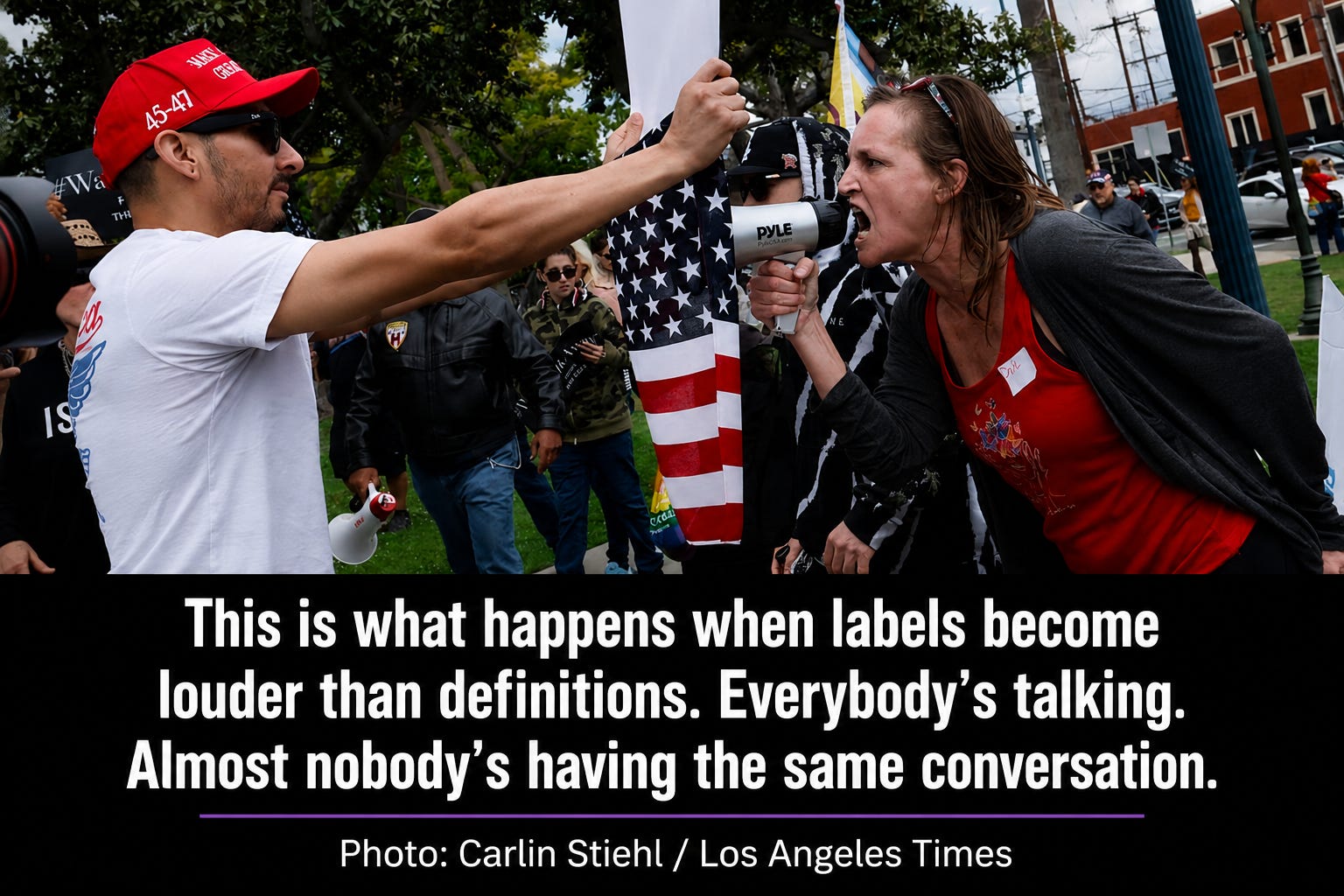
You know what finally pushed me over the edge?
Watching somebody call a politician a “communist socialist.”
I just sat there staring at the screen, wondering what the fuck he thought he’d just said.
Now, before anybody starts warming up the email machine, understand something. This isn’t about whether I agreed with his politics. For all I know, I might have agreed with every criticism he was trying to make. Doesn’t matter. He’d just accused somebody of believing something without giving me one shred of confidence he understood either word coming out of his mouth.
That bothers me more than it probably bothers most people, and here’s why. I spent twenty years as a paralegal, and one habit never leaves you: before you accuse somebody of breaking a law, you’d better know what the law says. Before you scream fraud, theft, or defamation, you’d better understand what those words mean. Every legal claim has elements. Miss one of them and your case doesn’t just get weaker.
It gets thrown out.
Politics decided none of that shit applies anymore.
We throw around socialist, communist, Marxist, fascist, and authoritarian like they all came out of the same vending machine. Collect them like baseball cards, slap three or four on whoever pissed you off today, call it analysis.
Once I noticed it, I couldn’t stop seeing it. Every scroll through social media turned into another rerun of Political Name-Calling: The Home Game. Somebody was a communist socialist. Somebody else was a Marxist fascist. Then I found a socialist Nazi, and by the time I hit an authoritarian libertarian, I wasn’t reading political discussion anymore. I was watching some asshole dump an entire political dictionary into a blender and hit purée.
Here’s the funny part. Some of those labels are related. Some are descendants of one another. Some share almost nothing except that cable news uses all of them to scare the hell out of the same terrified audience. A few of the combinations people casually throw around make about as much sense as calling somebody a vegetarian carnivore.
Nobody ever asks the obvious question.
What do you mean by that?
We’ve become so conditioned to react to political labels that we’ve stopped demanding definitions. Call somebody a socialist, and half the room cheers while the other half boos. Call somebody a fascist, and the exact same thing happens. The emotional reaction shows up first. The definition usually never shows up at all.
That’s backwards.
Walk into a courtroom and announce, “Your Honor, the defendant is guilty.”
The judge asks, “Guilty of what?”
Your answer is, “I don’t know exactly, but it’s something really bad.”
You don’t make it thirty seconds before you’re laughed out of the building.
The law doesn’t work that way.
Political debate shouldn’t either.
Words have meanings. Accusations have elements. If you’re going to accuse somebody of embracing an ideology, you’d better understand the ideology you’re pinning on them.
Instead, every government program is socialist now. Every opponent’s a fascist. Every progressive’s a communist. Every conservative’s an authoritarian. Every conversation eventually collapses into grown adults hurling labels across the room like it’s ideological dodgeball. What kills me is watching both sides do exactly the same thing while swearing only the other side is guilty of it.
Politicians love this shit. Cable news built an industry around it. Social media monetized it. Professional outrage merchants figured out years ago that it’s a hell of a lot easier to make people furious than it is to make them think.
Here’s what actually bothers me. I don’t think most people are deliberately butchering these words. I think we inherited a political vocabulary that’s been strained through campaign ads, cable news, talk radio, podcasts, memes, and years of partisan food fights until the original definitions got buried under a mountain of rhetoric. We’ve heard the labels so many times we stopped checking whether they actually fit.
That’s dangerous. Not because one ideology is necessarily worse than another. It’s dangerous because once words lose their definitions, they stop describing reality. They’re only good for manipulating it. And if somebody can redefine the words you’re using, eventually they redefine the argument you’re having.
That’s where this one starts. Not with who’s right or who’s wrong. Something much more basic.
Before you accuse anybody of being a socialist, communist, Marxist, fascist, authoritarian, or whatever the insult of the week happens to be, you ought to answer one simple goddamn question.
What does the word actually mean?
Because I have a feeling at least one of your favorite political insults doesn’t mean what you think it means.
War Room isn’t talking points. It’s enough facts that nobody bullshits you with theirs. If words still matter to you, and you think definitions should come before accusations, unlock the rest of today’s briefing.
Before we define a single one of these words, we need to agree on one ground rule…
Related doesn’t mean identical.
Every golden retriever is a dog, but not every dog is a golden retriever. Every square is a rectangle, but not every rectangle is a square. Political philosophies work the same way. Some overlap. Some evolved from one another. Some borrowed ideas from each other while disagreeing on almost everything else. A few spent a good chunk of the twentieth century trying to wipe each other off the face of the Earth.
That’s why stacking three labels together doesn’t automatically make an accusation more persuasive. Sometimes it just proves you’ve never bothered to learn the difference.
**Let’s start with socialism,** because it’s the heavyweight champion of abused political vocabulary. Ask a hundred Americans what the word means and you’ll probably get a hundred different answers. Some will tell you it’s government ownership. Others say high taxes. Somebody else points to universal health care. Another insists it’s anything Congress spends money on. The problem is those aren’t all describing the same thing.
At its core, socialism is an economic philosophy arguing that some or all of the means of production—major industries, productive resources, or key sectors of the economy—should be owned or controlled by society, usually through the state or other public institutions, rather than entirely by private individuals or corporations. Notice what that definition doesn’t say. It doesn’t say every government program is socialism. It doesn’t say every regulation is socialism. It doesn’t say every tax increase is socialism.
The United States has never been a purely capitalist economy. Most of our economic activity happens through private enterprise, but we’ve also decided there are things we’re willing to do together. We build highways. We fund public schools. We maintain police and fire departments. We created Social Security and Medicare. We regulate banks, airlines, food safety, securities markets, and a thousand other things. You can argue all day about whether we’ve drawn those lines in the right places. That’s a healthy debate. Simply yelling “socialism” every time government exists isn’t.
The better question is this: “Does the policy involve public ownership or public control of economic activity, or is it simply a government program?“ Those aren’t automatically the same conversation, no matter how badly somebody wants them to be.
Now, let’s go back to the phrase that started this whole mess: communist socialist.
Communism grew out of socialist thought, particularly the work of Karl Marx and later theorists. Classical communism envisioned a classless society where private ownership of the means of production disappeared altogether and, eventually, the state itself would no longer be necessary.
History didn’t cooperate.
Governments that called themselves communist generally became highly centralized one-party states with extraordinary concentrations of political power. That’s the history most people remember, and it’s impossible to discuss communism honestly without acknowledging it.
This is also where conversations usually derail. One person’s talking about political theory. Another’s talking about the Soviet Union. A third is talking about modern China. Nobody’s necessarily wrong for bringing up those examples—they’re simply answering different questions. One discussion is about an ideology. Another is about governments that claimed to follow it. The third is about countries that have evolved into something far more complicated than a textbook definition. Unless everybody agrees on which conversation they’re having, they’ll spend an hour arguing while never actually disagreeing about the same thing.
Marxism gets dragged into these conversations almost as often, though half the internet treats it like another word for communism. It isn’t. Marxism is the body of ideas Karl Marx developed about economics, class conflict, and the evolution of political systems. Some Marxists embraced revolutionary communism. Others didn’t. Plenty of people have found value in parts of Marx’s economic analysis while rejecting his political conclusions altogether. Agree with him or don’t—that’s your decision. Just don’t pretend his name means “every idea that pisses me off.” It doesn’t.
Fascism has become the mirror image of socialism. One side hears “socialism” and immediately stops thinking. The other hears “fascism” and does exactly the same thing. Historically, fascism is an authoritarian, ultranationalist political ideology built around a powerful state, a strong leader, suppression of political opposition, and the subordination of individual interests to what the regime claims are the interests of the nation.
It also historically opposed both liberal democracy and communism, which makes some of today’s political insults especially entertaining. I’ve watched people accuse the same politician of being both a communist and a fascist in the same paragraph. Could somebody govern with authoritarian tactics while borrowing ideas associated with different political traditions? Of course. History is messy. That still doesn’t make communism and fascism interchangeable any more than burglary and embezzlement become the same crime because they’re both illegal.
Authoritarianism is different because it isn’t really an economic ideology at all. It’s about power—who has it, how it’s exercised, and how difficult it becomes to challenge once it’s concentrated. That’s why you’ll find authoritarian governments on the political left and on the political right. The label describes the exercise of power, not the economic philosophy riding alongside it. Once you understand that distinction, a surprising number of political arguments become a lot easier to untangle.
Here’s where I’ve landed after years of watching this train wreck. Most Americans aren’t short on passion. They’re short on definitions. We’ve become so accustomed to using political labels as emotional triggers that we’ve forgotten they were ever supposed to describe ideas.
That’s dangerous—not because any ideology is above criticism. Every one of them deserves scrutiny. It’s dangerous because once definitions disappear, accusations become infinitely flexible. Today, your opponent is a socialist. Tomorrow he’s a communist. The day after that, he’s a fascist. Eventually, the labels stop describing your opponent and start describing your mood.
That’s not political analysis.
That’s performance art dressed up as political analysis.
The next time somebody throws one of these labels into a conversation, don’t argue first.
Ask one question.
”What do you mean by that?”
Then listen.
Odds are you’ll learn more about the person making the accusation than the person they’re accusing. And if they can’t answer, you’ve got your verdict.
Because if you can’t define the accusation, you’re not exposing someone else’s ignorance.
You’re advertising your own.
One Question Before You Go:
What’s the most abused political label in America today—and can you define it without looking it up?
If this kind of analysis helps cut through the noise, subscribe and join me every Sunday in the War Room. The shouting is free. Understanding takes a little more work.
Bastardonia Fact: In Bastardonia, every political argument begins with one mandatory question: “Define your terms.” It cuts meeting times in half.
#WarRoom #TheUnredactedBastard #PoliticalLanguage #CriticalThinking #Politics #DefinitionsMatter