


If you wall yourself off from the system that made you powerful, you don’t become stronger. You become easier to outmaneuver.
Opening Statement
“America First” sounds like strength. It’s engineered to. The phrase is built to hit a specific nerve. Protect your own. Stop getting played. Put yourself first for once. As a gut reaction, that’s not crazy. As economic policy, it’s a trap with a bow on it, and the people selling it know exactly what they’re doing.
Here’s what the global economy doesn’t do: give a damn about your slogans. It runs on incentives, cost structures, and something that takes decades to build and about eighteen months of chaos to destroy. Trust. Start yanking the levers of isolation hard enough, and you don’t just hurt your competitors. You rewrite the rules for yourself. Quietly. In ways that don’t show up until the damage is already well into the system and picking up speed.
What looks like control on the surface is a slow transfer of cost and risk onto the very people the policy claims to protect. You don’t see it all at once. You see a price that crept up without explanation, a contract that moved overseas without a press release, and an investment that picked somewhere with fewer variables and didn’t look back. By the time it’s visible, it’s been going on for a while. That’s not an accident. That’s the fucking design.
Exhibit A: The Mechanism Nobody Talks About
Strip the branding off isolationism, and what you’ve got left is tariffs. That’s the core tool. Everything else is set dressing.
The pitch is punishment for foreign producers. Force fairness back into a system that’s been rigged against American workers. And look, that framing has some truth in it, which is exactly what makes it such an effective con. But a tariff isn’t a punishment for anyone overseas. It’s a tax on imports. Taxes have one reliable habit: they move through the system until they find somewhere they can stick.
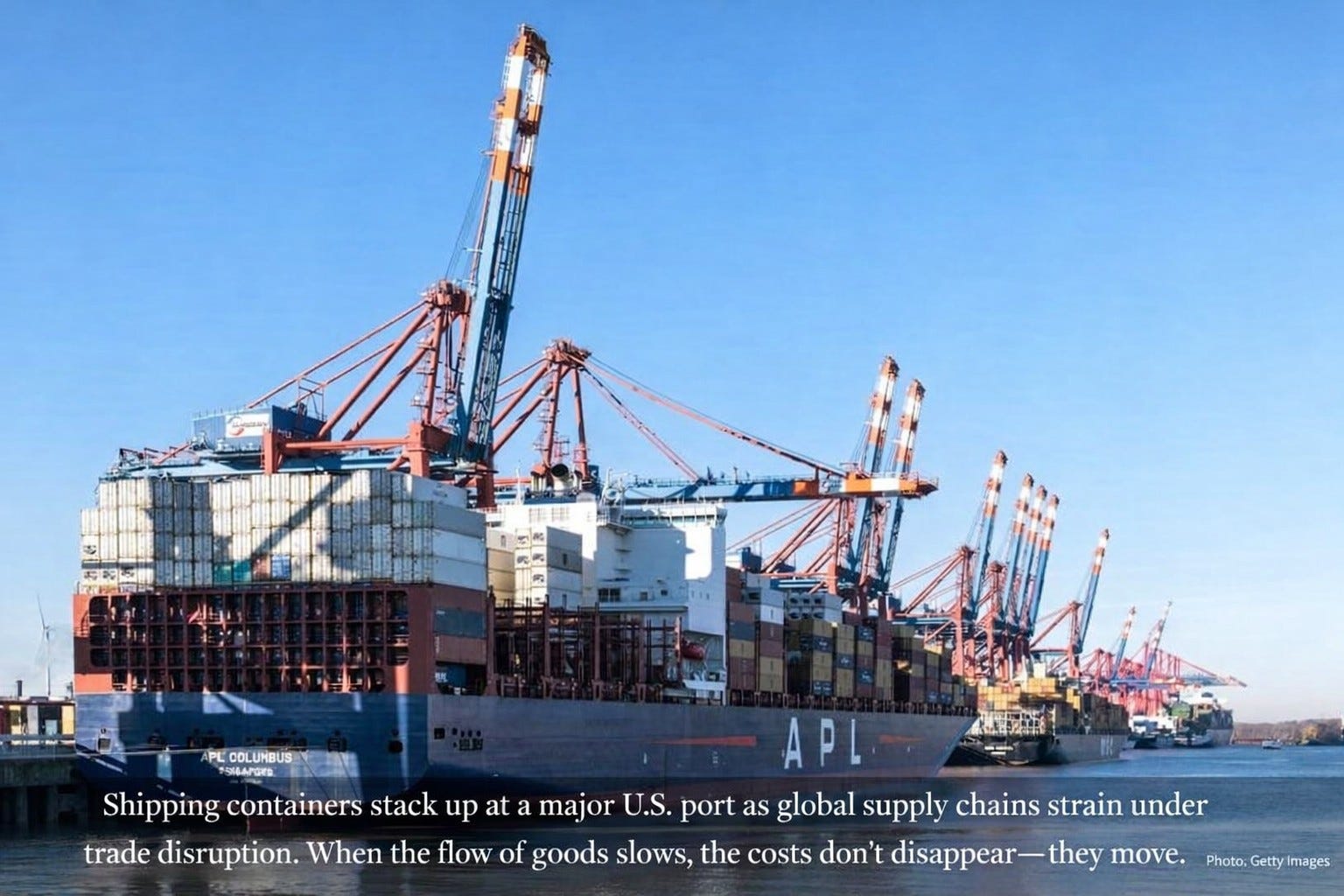
Companies don’t eat those costs. They pass them along because margins are the difference between operating and shutting down, and nobody absorbs a hit they can transfer. The cost doesn’t disappear. It flows down the chain, link by link, until it runs out of chain.
Until it lands on the consumer.
That’s the part that gets buried under every press conference about protecting American industry. The policy is sold as protection. The mechanism is cost transfer. The moment tariffs go up, the baseline price of doing business rises, and every part of the system adjusts to that new reality, whether you voted for it or not.
A tariff is a tax with better branding. That’s the whole fucking thing, and anybody telling you different is lying to your face.
Exhibit B: The Consumer Reality
Once those costs start moving, they don’t stay politely contained in one sector. That’s not how supply chains work, and anyone telling you otherwise is either lying or hasn’t looked at how anything actually gets made.
Modern supply chains are global by design. Not because corporations are disloyal, but because efficiency demanded it and nobody stopped them. Components for a single finished product can cross multiple borders before it lands on a shelf. Interrupt that flow and you don’t conjure up instant domestic alternatives. You create friction. Friction has a price, and that price is yours to pay whether you like it or not.
Higher prices on electronics. Vehicles. Food gets complicated fast because agriculture is tangled up in both imports and exports, so screwing with one end tends to blow back on the other in ways the people making the policy never seem to account for because accounting for it would complicate the fucking sales pitch. Sourcing takes longer when your usual channels just got more expensive or politically radioactive. Some options disappear entirely because they’re no longer economical and nobody’s bringing them back.
You don’t see the policy.
You see the number on the receipt.
“America First” shows up at checkout. It doesn’t show up cheap, and it sure as hell doesn’t come with an explanation.
Exhibit C: The Business Squeeze
The pressure hits businesses before consumers feel the full weight, which means the consumer pain is actually the second wave. By the time people notice, the damage upstream is already done and has been done for a while.
Businesses run on predictability. Hiring, expansion, capital investment, all of it gets built on assumptions about what costs are going to look like six months out. When trade policy turns erratic, those assumptions collapse overnight. Costs rise on one side of the ledger while demand gets shaky on the other, especially once export markets start pulling back their own orders because they’re dealing with their own version of this shitstorm and they’re not feeling particularly generous about it.
So businesses do what any rational actor does when costs and revenue both go sideways at the same time. They get defensive. Expansion stops. Investment gets deferred. Hiring freezes. When the freeze holds long enough, the cuts follow, and the cuts don’t come with a press release explaining which tariff caused them. They come with a carefully worded statement about market conditions and the need to right-size the organization, which is corporate for we fucked up and you’re paying for it.
This isn’t a worst-case scenario somebody invented to scare you. This is how systems respond to sustained pressure. It happens every time. The only variable is how long it takes to show up on the evening news.
The Part Nobody’s Pricing In Yet
Everything so far is the visible damage. Prices are climbing, supply chains are grinding, and businesses are locked in a defensive crouch. That’s the part that eventually makes the news, usually about six months after it started and right around the time somebody needs a headline.
What doesn’t make the news is what’s already shifting underneath. The quiet repricing of trade relationships. Other countries are running the math on whether America is still worth building around and coming up with a different answer than they used to. The moment markets stop assuming U.S. reliability and start charging us for the uncertainty.
That’s where this stops being a policy argument and becomes a structural problem. Structural problems don’t reverse because the messaging changes. Sometimes the window closes, and what you had before is just gone.
We’re not there yet. But the direction of travel is not ambiguous, and the people running this policy either don’t understand that or don’t give a shit.
What’s Behind the Paywall
The free section gave you the mechanism. The paid section is where it gets genuinely consequential.
Who’s already retaliating, where it’s hitting hardest, and why the next rounds are going to be significantly worse. Why the Fed is about to be stuck with no good options. What it actually costs when confidence erodes across the entire fucking economy at once. And the power transfer nobody in mainstream coverage wants to take seriously yet, where global influence doesn’t pause while we sort our shit out. It moves. Permanently.
This is the analysis you don’t get from outlets that need access or advertisers. I’m reader-funded. I have nothing left to lose by telling you exactly what I think is happening.
The next section is where it gets real.
Upgrade — Don’t Confuse Access With Understanding
You’ve got access to the story.
You don’t yet have the full picture.
The deeper cuts, the War Room pieces, the pattern recognition—that’s where this actually clicks into place.
Upgrade if you want to stop reading events and start understanding them.
