

By Tom Hicks | October 3, 2026
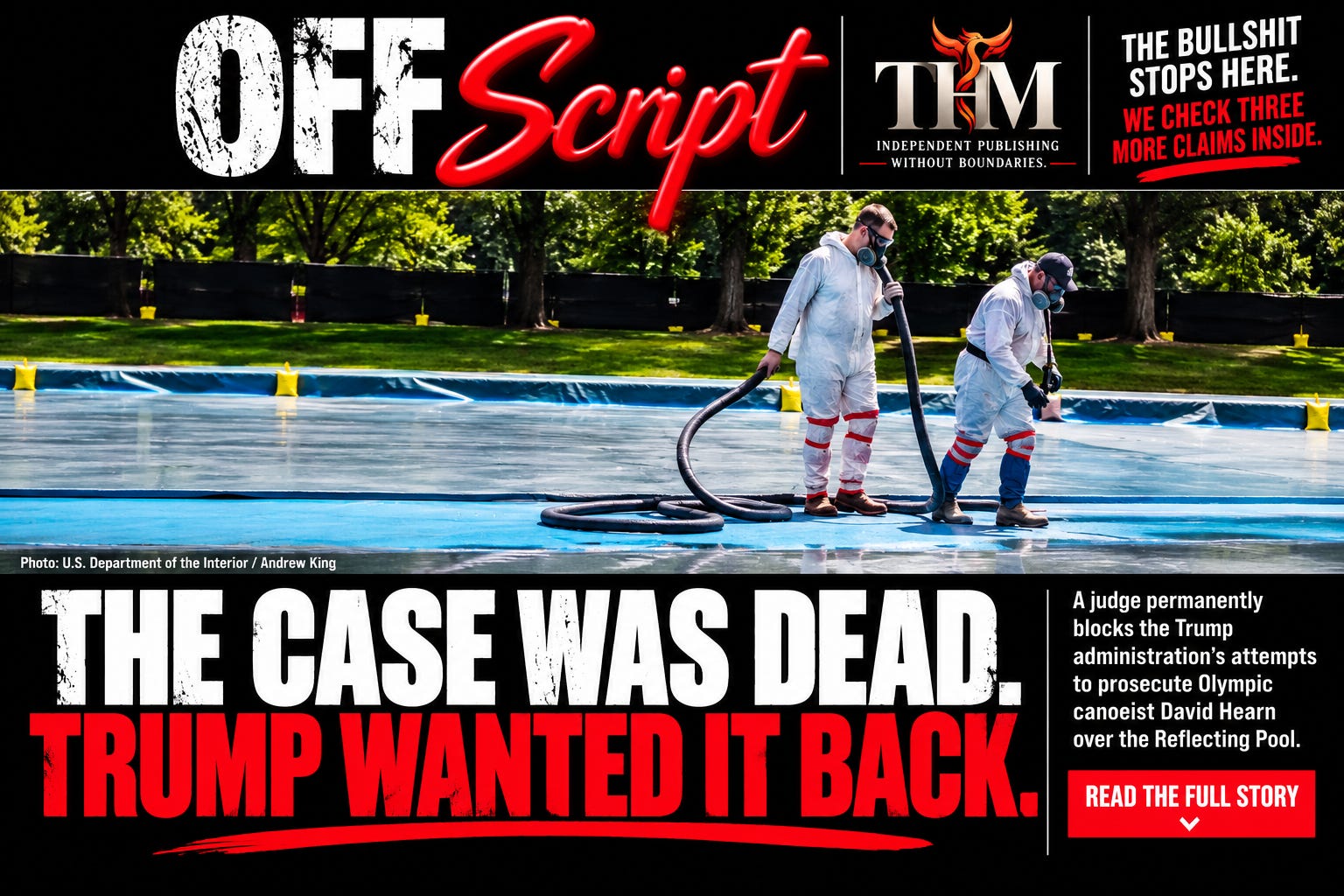
David Hearn’s prosecution should have ended quietly once the government discovered that its own case was wrong. Federal prosecutors had accused the 67-year-old former Olympic canoeist of damaging the Lincoln Memorial Reflecting Pool, only to receive government evidence showing that the damage came from a flawed and rushed installation rather than vandalism. Prosecutors acknowledged that the evidence no longer supported their case and asked the court to dismiss the charge.
Normally, that would have been the end of an embarrassing prosecution. Instead, Donald Trump publicly attacked U.S. Attorney Jeanine Pirro for dropping it, saying she had “choked” and “folded like an umbrella.” He continued insisting that vandals were responsible and pushed for the prosecution to be revived even after the government responsible for prosecuting Hearn had concluded otherwise.
That left D.C. Superior Court Judge Todd Edelman with a question considerably bigger than whether prosecutors should be allowed to abandon a case they no longer believed in. He had to decide whether the government should retain the power to bring the case back while the president was publicly pressuring the prosecutors who had concluded the case could not be supported.
Edelman decided it shouldn’t. And that is where this stops being another story about Donald Trump losing in court.
The Case Fell Apart
Hearn was arrested after an encounter with a loose section of the newly renovated Reflecting Pool lining during a June bike ride. Prosecutors subsequently charged him with felony destruction of government property, an accusation serious enough that Hearn faced as much as 10 years in prison.
Then prosecutors received information from the Interior Department that changed the case. The government acknowledged that Hearn had been indicted on “less than fulsome information” and that a flawed installation by a contractor and the rush to complete the project before America 250 undermined the vandalism theory.
There is nothing scandalous about prosecutors discovering that their evidence doesn’t support a charge and dropping it. Quite the opposite. That is exactly what prosecutors are supposed to do when the facts no longer support the case they originally brought.
The problem came afterward. Trump rejected the decision and went after Pirro publicly. Edelman later concluded that the president’s pressure created a genuine risk that Hearn could be prosecuted again even though the U.S. Attorney’s Office had determined its case could not proceed. The judge specifically identified the possibility that current prosecutors could yield to presidential pressure or be replaced by prosecutors more willing to pursue the case.
That is one hell of a thing to find in an American court ruling. A judge was considering whether an American citizen needed protection from the possibility that the president might succeed in getting prosecutors to bring back a case they had already determined was meritless.
Get Off Script
If you’re tired of political coverage that starts with the talking points and works backward, subscribe to Off Script.
It’s free, and so is the journalism. Come for the receipts. Stay because somebody still has to check them.
The Government Wanted to Keep the Door Open
The Justice Department wanted Hearn’s case dismissed without prejudice. That would end the prosecution while preserving the government’s ability to charge him again over the same alleged conduct, limited by a six-year statute of limitations. Hearn’s attorneys wanted dismissal with prejudice, which would permanently close that door.
The government argued that new evidence could conceivably emerge someday and justify another prosecution. At a September hearing, prosecutors argued that if such evidence appeared, a future grand jury should be allowed to decide whether Hearn should be indicted again. Edelman wasn’t persuaded that this hypothetical possibility justified leaving Hearn exposed to another prosecution when the government had already concluded that its original case lacked merit.
That distinction matters. This wasn’t a stalled investigation in which prosecutors suspected a crime but needed more time to find the missing evidence. The government had already moved to dismiss because the evidence it obtained changed its understanding of what had happened at the pool.
So what legitimate government interest was served by leaving Hearn under the possibility of another prosecution? Edelman concluded there wasn’t much of one.
Judges Aren’t Supposed to Do This Casually
This is the part of the story that separates Edelman’s ruling from an ordinary dismissal.
When prosecutors ask to dismiss their own criminal case, judges generally give them substantial deference. The normal result leaves prosecutors free to bring the charges again if circumstances legitimately change. A court permanently taking that option away is something else entirely.
The federal court in United States v. Poindexter explained why. Rule 48(a) still leaves charging decisions principally with prosecutors, but the court said judges have authority in “exceptional cases” to reject dismissal without prejudice when allowing another prosecution would result in harassment of the defendant or otherwise run contrary to the manifest public interest. Even then, the court emphasized the strong presumption in favor of dismissal without prejudice.
We got an almost perfectly timed demonstration of just how narrow that authority is only three weeks before Edelman ruled.
In United States v. Peña de la Cruz, decided September 11, the First Circuit considered a judge’s decision to dismiss a federal indictment with prejudice. The appellate court recognized that dismissal with prejudice can be justified when allowing prosecutors another shot would create a patent threat of unfairness, including prosecutorial harassment or bad faith. But it warned that those circumstances are “exceedingly narrow” and that judges must exercise careful restraint.
Then the First Circuit reversed the dismissal with prejudice because the circumstances before that court didn’t meet the standard.
That is useful context for what happened to Hearn. We don’t have to call Edelman’s action unprecedented, and we shouldn’t. Courts themselves describe the authority he exercised as reserved for exceptional cases and the circumstances permitting it as exceedingly narrow.
Edelman looked at this case and decided it qualified.
What Made This Case Exceptional?
It wasn’t newly discovered evidence suggesting Hearn might actually be guilty. Prosecutors had already moved in the opposite direction.
It was what might happen after they dropped the case.
Edelman wrote that Hearn faced the “unique possibility” that the government could revive a case it had already declared meritless because of political pressure from the president. He also concluded that the government’s legitimate interest in preserving another prosecution was marginal compared with the possibility that Hearn could nevertheless face a meritless, politically motivated prosecution.
That is why the distinction between with prejudice and without prejudice matters so much here. Edelman wasn’t deciding whether prosecutors had made a mistake. They had already acknowledged the problem themselves. He was deciding whether the government should retain the power to make the same mistake again after the president publicly demanded that it do exactly that.
His answer was unusually direct. Under the “exceptional circumstances posed by this case,” Edelman wrote that the government had no right to retain the ability to compound its errors or even threaten to do so at Hearn’s expense.
That’s the story. The president’s pressure didn’t have to produce another indictment before it mattered. As long as the case remained dismissed without prejudice, Hearn would know that prosecutors retained the ability to revisit a case they had already determined shouldn’t proceed while the president was publicly demanding its return.
Edelman took that ability away.
Hearn Gets the Last Word
Hearn appeared on Good Morning America Friday and said he was relieved. He called the decision a “victory for democracy” and said the experience left him with a warning that reaches well beyond a loose piece of material in the Reflecting Pool: “If it can happen to me, it can happen to anybody.”
He would also like an apology from Trump. Asked whether he thinks he’ll get one, Hearn answered, “If pigs fly, maybe.” His attorneys are now actively considering further legal action against Trump or the administration, with Norm Eisen saying that nothing is off the table.
So the criminal case is finished. The Reflecting Pool debacle may not be.
What we know now is remarkable enough. Prosecutors concluded their case against David Hearn couldn’t stand. The president publicly pushed against their decision. And a judge used a remedy courts themselves describe as exceptional because leaving the normal door cracked open created too much risk that political pressure could push it open again.
The government accused Hearn of damaging the Reflecting Pool.
By the time this was over, the court was protecting Hearn from the government.
THE BULLSHIT DETECTOR
Trump Says We Misunderstood His Iran Timeline
CLAIM: Trump now says his repeated prediction that the Iran conflict would take roughly four to six weeks referred to eliminating Iran’s nuclear threat, not to how long the war itself would last.
BULLSHIT: We didn’t misunderstand him. We heard him.
BULLSHIT LEVEL: 💩💩💩💩💩
WHY: The record is unusually uncomplicated. In March, Trump repeatedly described the war itself in terms of weeks. When a reporter specifically asked whether the United States would be “gone or done with the war in two or three weeks,” Trump answered, “I think two or three weeks, yes.” His own White House press secretary also described four to six weeks as the timeline for completing the military operation. Now Trump says the press made people think he had predicted a short war. The problem with rewriting videotaped history is the videotape.
Democrats Turn an Epstein Connection Into Something It Wasn’t
CLAIM: A Democratic super PAC attacking Republican Sen. Susan Collins says she voted to “cover up the Epstein files” and that Jeffrey Epstein’s “business partner” funneled $3 million to a super PAC supporting her.
BULLSHIT: There are real facts underneath the ad. The ad stretches them until they tell a different story.
BULLSHIT LEVEL: 💩💩💩💩
WHY: Collins did vote against attaching an Epstein disclosure amendment to a defense bill, but she subsequently supported standalone legislation requiring DOJ disclosure of Epstein-related records. The $3 million contribution to a pro-Collins super PAC is real as well, but the evidence doesn’t establish that the donor was Epstein’s “business partner”. Sharing membership in the same private club is a considerably different relationship, no matter how badly somebody wants the attack ad to work.
Rogers Says El-Sayed Wouldn’t Condemn a Synagogue Attacker
CLAIM: Republican Senate candidate Mike Rogers says Democrat Abdul El-Sayed “could not condemn” the man who attacked a Michigan synagogue where children were attending preschool.
BULLSHIT: El-Sayed condemned him. There is video.
BULLSHIT LEVEL: 💩💩💩💩
WHY: El-Sayed explicitly said, “I condemn what he did,” called it a heinous attack and said there was never justification for attacking innocent people or houses of worship. He also said “hurt people hurt people” while discussing violence suffered by the attacker’s family, comments that understandably drew criticism and for which El-Sayed later apologized. Rogers is perfectly entitled to hammer those remarks. He isn’t entitled to erase the condemnation El-Sayed actually made.
Want Less Bullshit in Your Life?
The Bullshit Detector: A Field Guide to Spotting Political Nonsense is available for $4.95 at the Tom Hicks Media Store, and it’s free for subscribers.
Think of it as preventive maintenance for the next time somebody sends you something that makes you say, “There’s no fucking way that’s true.”
Around THM
Blind Spot — Sunday: The Election Before the Election. Thirty days before the midterms, we’re going underneath the horse race to look at the machinery already shaping November: maps, election rules, lawsuits, money, counting, institutional authority and the renewed federal focus on voting machines.
COMING SUNDAY: WHAT THE HELL? True stories that sound completely made up. We’re starting with the federal government’s gloriously strange 1948 solution to moving beavers into the Idaho wilderness: put them in boxes and drop them out of airplanes. Subscribe for free before the first one lands.
Lotus Purrspective: Life, humans, and their inexplicable behavior as judged daily by a tuxedo cat who remains unconvinced we should be left unsupervised.
Chart Collision: Six charts. One date. A daily trip back to what America was actually listening to, with the records, artists, and surprises that owned the moment.
Panic Room Sports: Smart coverage with attitude. Everyone reacts. We’ll check the tape first, with the Panic Index, fantasy fallout, and what the week’s sports news actually means.
Rabbit Ears Classic TV: Television worth remembering, from the shows everybody still knows to the strange experiments, forgotten hits, and behind-the-scenes stories they don’t.
The Backlot Ghost: Movies have ghosts, and not all of them are on screen. Forgotten stories, strange casting choices, near disasters, and the Hollywood history hiding behind familiar films.
Buy Me a Cup of Tea
Off Script doesn’t have a newsroom, corporate owner or billionaire picking up the tab. If something you read here was worth your time, you can buy me a cup of tea and help cover the research, subscriptions, and tools that keep THM running.
No guilt trip. The journalism stays free either way.
One Question Before You Go
If prosecutors conclude the evidence doesn’t support a criminal case, should a president ever be publicly pressuring them to bring it back anyway?
#OffScript #DavidHearn #RuleOfLaw #JusticeDepartment #DonaldTrump #PublicTrust #BullshitDetector #THM