

For years, Trump’s biggest political superpower hasn’t actually been ideology, charisma, patriotism, or whatever fresh pile of bullshit cable news insists explains everything this week. His real superpower has been something uglier and a hell of a lot simpler: convincing people that fighting him costs more than surrendering to him.
That’s the whole fucking trick.
Congress folds because crossing Trump might mean a primary headache and six months of being called a traitor by @FreedomBonerPatriot, a guy whose profile picture somehow contains an eagle, three flags, Oakleys, and unresolved feelings. At the same time, his entire online personality consists of protein powder, flag emojis, and yelling READ THE CONSTITUTION in all caps under weather reports. CEOs suddenly rediscover the joys of strategic silence. Universities call lawyers before subpoenas even land. Foreign governments smile politely through meetings while privately thinking, Jesus Christ, let’s survive this asshole and get to dessert.
And here’s the thing people miss when politics turns into reality TV for people with blood pressure problems: intimidation doesn’t work because everybody loves you. Hell, it doesn’t even work because everybody agrees with you. It works because enough people quietly decide, You know what? I’m not picking that fight today.
That tiny calculation is where the power lives.
For years, saying “fine” felt cheaper than saying “fuck that,” and that little bit of math shaped damn near everything around Trump. Somebody pushed back, everybody braced for impact, pundits started sweating through television makeup, and Washington behaved like suburban dads who know there’s a raccoon in the attic but absolutely do not want to be the first dumbass sticking a hand into the darkness.
Better to ignore the scratching and pretend the ceiling isn’t moving.
Now, before anybody starts snorting industrial-grade hopium and screaming THE WALLS ARE CLOSING IN like it’s cable news karaoke night, calm the fuck down for a second.
This isn’t a story about Trump suddenly becoming weak. It sure as hell isn’t a story about Republicans discovering morality in a desk drawer somewhere between expired courage and donor spreadsheets. Democracy didn’t wake up Tuesday morning and decide to stop cosplaying as a hostage situation.
What’s happening is stranger than that and, honestly, more dangerous.
Because something weird has started creeping into the math. Quietly, awkwardly, and in ways most headlines are too busy screaming to notice, people are beginning to test whether fear still costs what it used to.
Not heroically. Not dramatically. Nobody’s filming Bravery: Season One for Netflix. This stuff’s smaller than that, which somehow makes it more important. Foreign governments are recalibrating instead of panicking. Congress is hedging in weird, nervous ways. Even Republicans, who’ve spent years acting like Trump personally owns the launch codes to their careers, are beginning to poke the electric fence and wonder whether saying “no” still costs what it used to.
That’s where this story starts.
For years, Trump’s foreign policy ran on unpredictability, tariff threats, public humiliation, and enough chaos to make diplomatic meetings feel like somebody handed the drunkest guy at poker a flamethrower and told him to run the fucking casino. The assumption underneath it all was brutally simple: eventually, everybody folds. Eventually, allies swallow the insult sandwich. Eventually, governments decide compliance costs less than conflict and quietly mutter, Fine, whatever the fuck you want.
Except lately, that equation’s started looking shakier.
Governments don’t survive by believing mythology. They survive by spotting patterns. They notice when tariff threats stall out, when courts complicate executive power, when domestic politics gums up follow-through, and when Congress suddenly looks less airtight than advertised. A government that fears you behaves one way. A government that thinks it understands your limits behaves differently. It negotiates harder. Delays. Pushes back. Waits you out. Starts treating you less like a force of nature and more like an exhausting boss everybody complains about after meetings.
That doesn’t mean countries suddenly stopped taking Trump seriously. It means they’re recalibrating.
And recalibration is really just a fancy political word for:
“Maybe this guy doesn’t hit as hard every damn time as everybody keeps pretending.”

Back home, Congress has started making the kind of nervous noises people make right before pretending they meant to question authority all along.
Not brave noises. Let’s not OD on hopium. Not heroic noises. Just weird little politically nervous noises that suddenly start showing up when people aren’t quite as scared shitless as they used to be.
The war powers friction matters because hesitation matters. When Republicans wobble around executive military authority, even temporarily, that tells you something. It doesn’t mean Trump lost the room. It means fear isn’t operating at full voltage.
Same with reconciliation fights. Same with spending battles. Same with visible pushback around Trump’s anti-weaponization fund and the broader discomfort surrounding grievance spending and the kind of ballroom slash slush fund optics that make even loyal Republicans quietly stare at the floor and suddenly rediscover fiscal responsibility.
And let’s be real for a second, Republicans didn’t wake up and discover principles like somebody found an old copy of the Constitution behind the couch cushions.
They discovered consequences.
That’s the crack in the windshield.
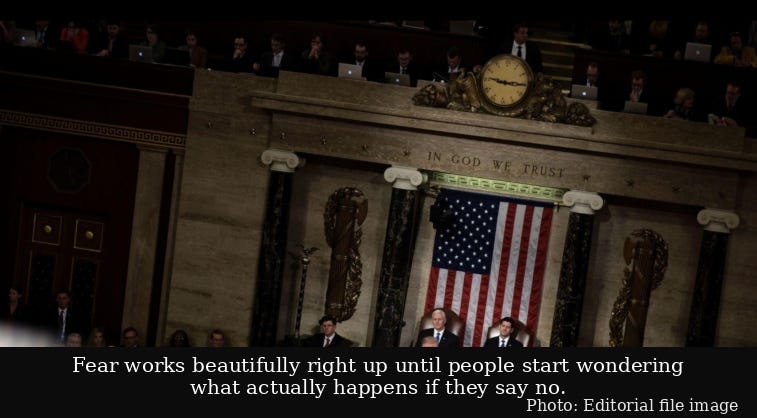
For years, resistance looked like career suicide. Now, at least in small ways, lawmakers seem to be stress testing the edges of disobedience and quietly asking:
Okay, but what actually happens if we say no?
Because here’s the dangerous little secret underneath strongman politics people love pretending doesn’t exist:
The moment people survive resistance in public, everybody else starts doing the math.
Foreign governments recalibrate harder. Lawmakers hedge. Donors get nervous. The media grows a little less terrified. The mythology starts taking tiny cracks, and suddenly, everybody notices the guy yelling loudest might not actually be able to punch everybody in the room at once.
What comes next is where this story gets genuinely uncomfortable.
The real danger isn’t resistance.
The real danger is what happens when somebody who built power on intimidation realizes people are starting to test whether the intimidation still works.
Upgrade to read the full War Room briefing. No sponsors. No billionaire sugar daddies. Just receipts, context, sarcasm, and somebody willing to say the quiet part out loud.
