

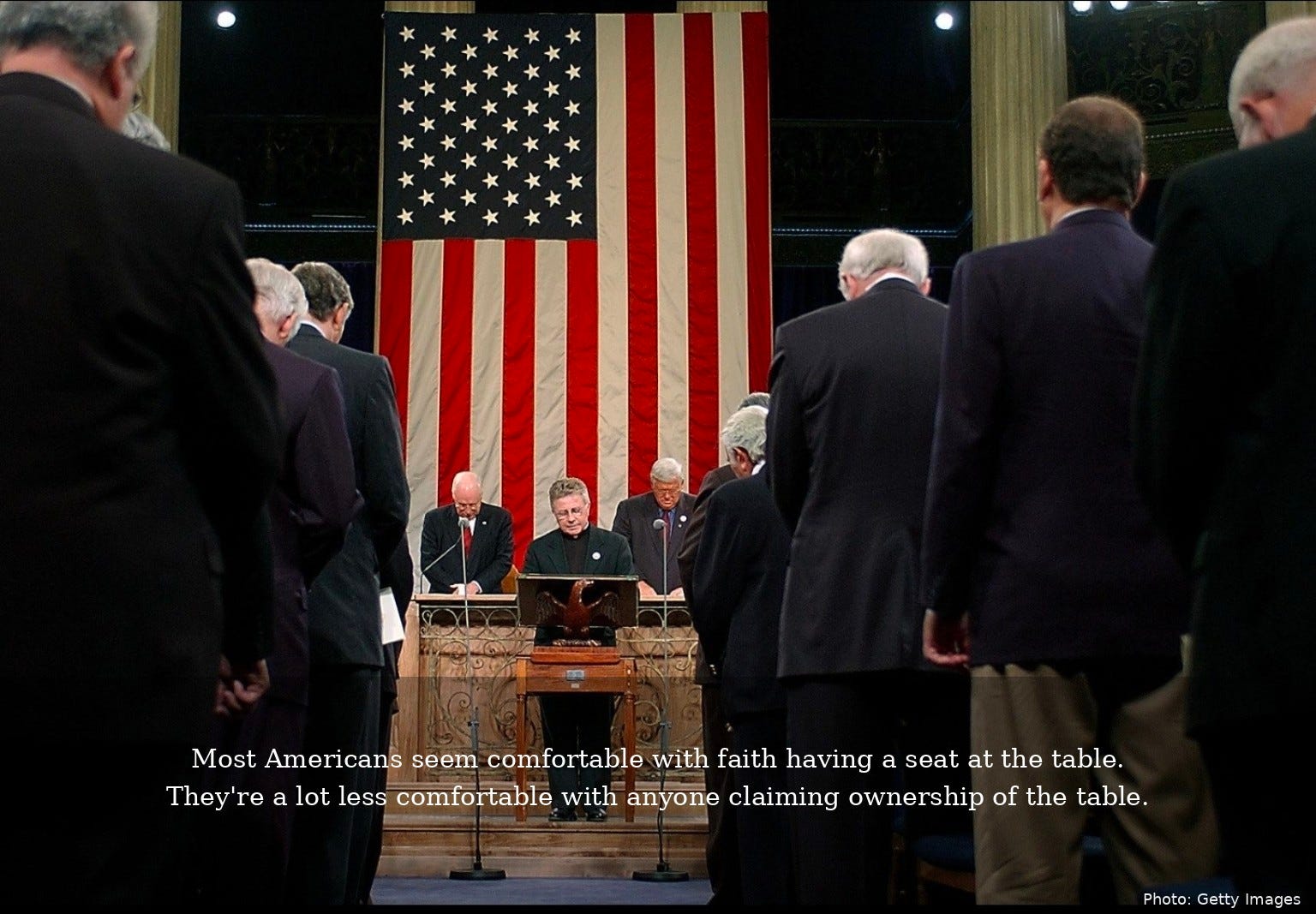

I wasn’t looking for a religion story this week.
Honestly, religion wasn’t even on my radar. There are plenty of other things competing for attention right now, and most of them involve politicians doing something stupid, dangerous, dishonest, or all three at the same time. Then I stumbled across a Pew survey, skimmed the headline, nodded, and was about to move on with my day. Is religion gaining influence in public life? Okay, probably. I’ve been conscious for the last few years. I’ve seen school board meetings. I’ve seen library fights. I’ve watched people turn curriculum debates into blood feuds and Facebook posts into constitutional crises. None of that seemed particularly shocking.
Then I kept reading.
That’s usually where the trouble starts.
The survey said more Americans believe religion is gaining influence than at any point since 2002. Fine. But it also found that most Americans still don’t want churches endorsing political candidates, don’t want houses of worship running roughshod through the political process, and don’t seem especially thrilled about religious institutions becoming full-on political power centers.
I read that section twice because it didn’t fit the bullshit I’ve been hearing for years.
The people who make a living arguing about religion tend to describe the issue as though influence and political authority are welded together at the hip. If one goes up, the other must go up. If religion becomes more visible, then political control must be right around the corner. That’s the story. That’s the fight. That’s the product these assholes are selling.
The survey wasn’t buying it.
What fascinated me wasn’t that the numbers seemed contradictory. It was that they only seem contradictory if you start with the assumption that religion and power are the same damn thing. They’re not. They never have been. But that particular piece of reality doesn’t generate clicks, so here we are.
The more I thought about it, the more it reminded me of every local government meeting I used to drag myself through. One thing you learn covering public hearings is that the issue people claim they’re arguing about is often just the vehicle carrying the issue they’re actually arguing about.
A meeting starts because somebody is pissed off about a book, a display, a policy, a prayer, a curriculum change, or a zoning request. Everybody comes in believing they’re there to discuss the thing on the table. Give it an hour, and the whole thing has gone completely off the rails. Now we’re talking about values. Then rights. Then fairness. Then authority. Before long, somebody is quoting the Founding Fathers, somebody else is threatening legal action, and Steve is explaining constitutional law despite having learned everything he knows from three Facebook memes and a guy named Randy with a podcast. By that point, the original issue has vanished under a pile of political debris, and what’s left is a fight about who gets to decide.
That’s why the survey kept nagging at me. It wasn’t telling a story about religion. Or at least not primarily. It was brushing up against something Americans have wrestled with forever: power. We have a long history of tolerating influence while getting royally pissed off at anyone who tries to turn it into authority. Those aren’t the same thing, and the fact that so many professional loudmouths can’t — or won’t — make that distinction tells you everything you need to know about what they’re actually selling.
If you’re not subscribed yet, you’re reading this the hard way. I do this daily. No sponsors. No filter. Subscribe if you want it in your feed instead of chasing it down.
Think about the churches you’ve known. Not the ones people use as props in political arguments. The actual churches. The ones trying to keep the roof from leaking, organize the holiday food drive, help a family after a house fire, raise money for somebody’s medical bills, or convince teenagers to put down their phones for fifteen minutes and interact with another human being. Whether you’re religious or not, you’ve probably seen organizations like that operating in your community. Most Americans don’t look at that and think the republic is hanging by a goddamn thread.
At the same time, Americans have become deeply, almost pathologically skeptical of powerful institutions, and it’s hard to blame them. Trust in government has cratered. Trust in media has cratered. Trust in corporations, political parties, universities — all of it, straight to hell, and good riddance to most of it. We’ve reached the point where half the country thinks the other half has completely lost its shit. Against that backdrop, why the fuck would religious institutions get some kind of special exemption from the suspicion Americans are directing at every other concentration of power? Because they’ve got nicer architecture? Because they serve donuts after the service?
That’s where I started getting genuinely pissed off at the reactions I knew this survey was going to generate. Before most people finished reading the damn thing, some were already celebrating it as proof that Americans want religion exerting more control over government. Others were treating it as evidence that the country is goose-stepping toward theocracy. Both interpretations felt less like honest observations and more like people cramming reality back into narratives they’d already decided on before their first cup of coffee. Pick your team. Buy the shirt. Don’t read past the fucking headline.
One thing years of legal research beat into me is that evidence doesn’t give a damn about your narrative. You can argue with it all day. Plenty of people do, loudly, on television, for money. The evidence just sits there waiting for you to catch up.
This survey feels like one of those moments.
Maybe the simplest explanation is that Americans are drawing a line that professional culture warriors desperately need to make disappear. They need every issue reduced to two screaming camps because that’s how outrage works. That’s how the money flows. That’s how you keep people too angry to think straight. “It’s complicated” doesn’t fit on a campaign sign, and it sure as hell doesn’t drive donations at three in the morning. But ordinary people live in the complicated part. They have neighbors who believe different things, coworkers who vote differently, and family members who attend different churches or no church at all. Real life forces a level of coexistence that ideology refuses to, and most people are tired of being told their actual lived experience is wrong.
That’s why I keep coming back to the possibility that Americans aren’t rejecting religion and they aren’t embracing religious political power. They’re making a distinction. They may not use the language political scientists would use. They may never articulate it cleanly in a survey response. But the distinction is there, and it’s been there the whole damn time, and the people working hardest to erase it are the ones with the most to gain from the confusion.
Influence is one thing.
Authority is something else entirely.
The more I sat with that, the more I realized how many of our political arguments eventually collapse into exactly the same question. Religion, government, corporations, media, universities, political parties — sooner or later, every fight becomes a fight about who gets to make decisions for everyone else. That’s where the tension lives. That’s where trust goes to die. That’s where people stop cooperating and start sharpening knives.
Maybe I’ll read the survey again next week and catch something I missed. That’s happened before. But right now, what strikes me isn’t that religion appears to be gaining influence. What strikes me is how desperately so many people want to ignore the distinction Americans themselves are making. The loudest voices keep insisting the country must choose — religion or freedom, faith or democracy, public belief or public neutrality, as if those are the only options. As if that’s even what’s being asked.
The survey suggests a lot of Americans looked at those choices and quietly said no.
That’s not a statement about religion. It’s a statement about power. And if that distinction sounds familiar, it fucking should.
It’s the same one we keep having to make about everything else.
I’m retired. No sponsors. No corporate leash. War Room is where the deeper patterns live. Not just what happened, but how it works and where it’s going next. If you want the full picture, upgrade.
If not, you’ll still get the headlines. Just not the part that actually explains them.
Same reality, different delivery. Go check out Lotus Purrspective. Less profanity. Sharper judgment.
LIKE • SHARE • SUBSCRIBE
BUY ME A CUP OF TEA, because yelling “what the fuck are we doing?” at the news doesn’t pay for itself.
#TheUnredactedBastard #ReligionAndPolitics #PewResearch #FaithAndPower #IndependentJournalism #Politics