

EDITORIAL NOTE
This article deals with two proposed Medicaid regulations, which means some provisions could change before becoming final. The estimates come from the Centers for Medicare and Medicaid Services, the Congressional Budget Office, KFF, and the regulations themselves. Hospital lobbyists have their own interests here, so we checked their warnings against the government’s numbers instead of taking anyone’s press release on faith.
Your subscription helps fund reporting, research, publishing, new features, and the continued growth of every Tom Hicks Media publication.
Congress already took a meat cleaver to Medicaid. The Republican tax and spending law enacted last year is expected to reduce federal Medicaid spending by $911 billion over ten years and leave about 7.5 million more people uninsured because of its Medicaid provisions. Republicans congratulated themselves, called it reform, and assured everyone that deserving Americans would remain protected. (KFF)
Now the Trump administration is back for another pass.
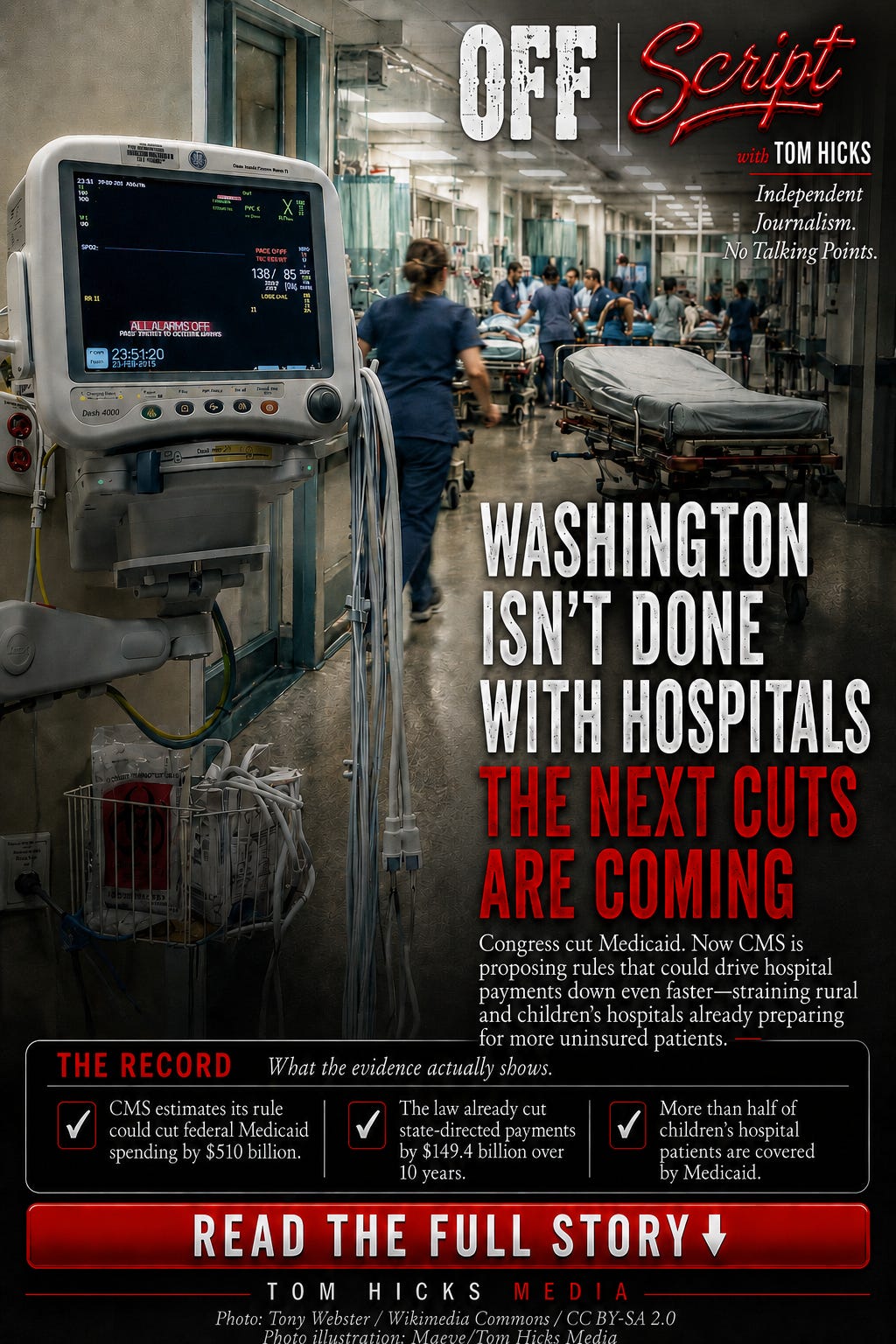
Hospitals are warning that the regulations being written to implement the law could hurt them even more than the cuts Congress approved. That sounds like something cooked up by an expensive lobbying firm until you read the government’s own estimates. CMS says one proposed payment rule would reduce federal Medicaid spending by $510.1 billion from 2026 through 2035. The same proposal puts the combined federal and state reduction at $774.8 billion. (Politico, Federal Register)
Those figures don’t describe money saved by negotiating cheaper surgical gloves or replacing a few administrators with a competent spreadsheet. They describe money that would otherwise flow through state Medicaid programs to hospitals, nursing facilities, academic medical centers, behavioral health providers, and other people who deliver actual care. (CMS, KFF)
THE PAYMENT SYSTEM NOBODY EXPLAINS
The fight centers partly on something called state-directed payments. Most Medicaid patients receive care through private managed-care companies, but states can instruct those companies to pay certain providers more for specific services. The payments help compensate hospitals and other providers because ordinary Medicaid rates often fall below the cost of delivering care. (KFF, MACPAC)
States frequently finance their share through taxes on hospitals, insurers, or other health-care providers. That money allows the state to claim matching federal Medicaid dollars, which then return to the health-care system through higher payments. Yes, the arrangement can look like Washington and the states built a Rube Goldberg machine out of tax forms, reimbursement formulas, and several warehouses of accounting bullshit. (KFF, Federal Register)
There are legitimate reasons to inspect it. The Medicaid and CHIP Payment and Access Commission found that annual state-directed payments grew from $69.3 billion to $110.2 billion between February 2023 and August 2024, an increase of nearly 60 percent. Public information about where every dollar goes remains incomplete, and researchers haven’t always been able to determine whether the payments produced measurable improvements in access or quality. (MACPAC, KFF)
Better oversight isn’t what CMS has proposed.
Congress capped state-directed payments for four categories of care, including inpatient and outpatient hospital services. The administration’s proposed rule would eventually extend those limits to every service covered by state-directed payments and certain targeted fee-for-service payments. It would also eliminate one of the main methods states currently use to distribute supplemental payments. CMS’s own summary says plainly that the rule reaches beyond the services Congress named.(CMS, Federal Register)
Your subscription helps fund reporting, research, publishing, new features, and the continued growth of every Tom Hicks Media publication.
THE $510 BILLION QUESTION
The Congressional Budget Office originally estimated that the state-directed-payment provisions passed by Congress would reduce federal Medicaid spending by $149 billion through 2034. CMS now projects a $510.1 billion reduction through 2035 under the law and its proposed rule. That’s more than three times the original estimate, although the difference isn’t entirely caused by the administration broadening the restrictions. (KFF, Federal Register)
CMS used newer information that included payment programs unavailable to CBO when it prepared its estimate. CMS also counted an additional year, 2035, when the annual reduction alone is projected to exceed $80 billion. KFF says CMS didn’t separately calculate the cost of every policy choice it added, leaving no reliable way to determine exactly how much of the difference comes from better data and how much comes from the administration stretching the law. (KFF)
That distinction matters because screaming that Trump secretly added exactly $361 billion in cuts would be dishonest. The honest version is damning enough. Congress named four service areas, CMS expanded the restriction to all of them, and the agency hasn’t disclosed how much its expansion contributes to the overall reduction. (CMS, KFF)
Then there’s the second regulation.
The Republican law also restricts the provider taxes states use to finance their share of Medicaid. CMS’s proposed provider-tax rule estimates a $245.8 billion reduction in federal Medicaid spending and another $138.2 billion reduction in state spending over ten years. The agency expects hospitals to suffer the largest payment losses because hospital taxes produce most provider-tax revenue. (Federal Register, CMS)
The two estimates can’t simply be added together because the policies interact. A state losing provider-tax revenue may already be forced to reduce the same payments affected by the other rule. The precise combined damage remains uncertain, but nobody can pretend these are a couple of harmless accounting adjustments.(Federal Register, KFF)
“THE STATES CAN FIND THE MONEY”
CMS assumes states will replace about 30 percent of their lost provider-tax funding with general revenue. That leaves roughly 70 percent unreplaced in the agency’s own projection. Somehow, the same regulation certifies that the rule won’t significantly affect a substantial number of small rural hospitals because states remain free to find money elsewhere. (Federal Register)
That’s one hell of an escape clause.
States can raise taxes, raid education and transportation budgets, reduce Medicaid benefits, cut provider payments, or tell Washington they found the couch cushions empty. Most states must balance their budgets, and Medicaid is already one of their largest expenses. Saying states are free to replace vanished federal money is like taking someone’s paycheck and reminding him that bank robbery remains an available source of income. (KFF)
KFF estimates that at least 37 states have hospital payment arrangements that exceed the new limits. About $60 billion in current annual federal spending on hospital services sits above those limits and could eventually disappear. More than half of the potential reduction falls on eight states: California, Illinois, Kentucky, Texas, North Carolina, Louisiana, Arizona, and Michigan. (KFF)
Red and blue won’t mean much when the closest maternity ward is an hour farther away.
HOSPITALS AREN’T THE HEROES
Hospital corporations have earned plenty of suspicion. Americans routinely receive bills that appear to have been calculated by a loan shark with access to medical coding software. Some large systems are highly profitable, executives receive absurd compensation, and consolidation has given hospitals enormous power to demand higher prices from private insurers.
That doesn’t make every payment cut painless. Medicaid accounted for 19 percent of all hospital spending in 2023 and covered roughly 41 percent of American births. In rural areas, Medicaid financed nearly half of all births. (KFF)
Hospitals don’t create separate emergency rooms, maternity wards, cancer centers, and nursing staff for each insurance program. When revenue falls, the institution cuts whatever it believes it can survive without. The maternity unit closes for everyone, the specialist leaves town, and the remaining emergency department gets busier for every patient who walks through its doors. (KFF, KFF)
I’ve spent enough time inside hospitals as a cancer patient to know how quickly all the political language disappears once somebody says the word cancer. At that moment, you don’t give a damn which reimbursement formula paid for the nurse, the operating room, or the machine keeping track of your vital signs. You care that the people and equipment are there when you need them. Washington can call the missing money “efficiency” all day, but the patient staring at a longer drive or a closed department will know what it really was.
THE SALES PITCH
The Trump administration says these payment systems have become excessive and reward providers instead of patients. CMS argues that tying Medicaid payments more closely to Medicare will restrain federal spending and stop states from using financing maneuvers to draw down larger federal matches. That argument deserves to be taken seriously because an opaque payment system growing by tens of billions a year shouldn’t receive a lifetime exemption from scrutiny. (CMS, MACPAC)
The administration goes further. An HHS economic report projects that reducing provider taxes and state-directed payments could lower prices paid outside Medicaid by as much as 3.5 percent. The theory is that hospitals will face lower provider taxes and shift fewer costs onto privately insured patients. (HHS)
“Could” is carrying that promise home on its back.
Hospitals could respond by lowering commercial prices. They could also eliminate services, cancel construction, reduce staffing, close clinics, or demand higher payments wherever they retain enough market power to get them. The government has produced a model of the reaction it wants, while hospitals are warning about the reaction they’re already preparing to make. (Politico, KFF)
PATIENTS ALWAYS ARRIVE LAST
The administration’s press release calls the $510 billion reduction “savings.” Hospitals call it lost revenue. States call it a budget hole. (CMS, KFF)
Patients will call it Tuesday.
They’ll discover the effect when a doctor stops accepting Medicaid, a nursing facility develops a waiting list, or a rural hospital quietly announces that babies will have to be delivered somewhere else. The uninsured will still show up in emergency rooms because illness doesn’t read congressional budget resolutions. Their care will become more expensive, more delayed, and more likely to be absorbed by the same hospitals Washington just squeezed. (KFF, KFF)
Republicans already passed the largest Medicaid reduction in the program’s history. Now the administration is writing regulations that extend the squeeze beyond the services Congress specifically named. The details are buried deeply enough that most voters won’t notice until the cuts have a street address. (KFF, CMS)
That was probably the idea.
THE RECORD
The 2025 Republican tax and spending law is expected to reduce federal Medicaid spending by $911 billion over ten years. (KFF)
CMS estimates its proposed state-directed-payment rule will reduce federal Medicaid spending by $510.1 billion and combined federal and state spending by $774.8 billion from 2026 through 2035. (Federal Register)
CMS estimates its proposed provider-tax rule will reduce federal Medicaid spending by $245.8 billion and state spending by $138.2 billion over the same period. (Federal Register)
KFF estimates that 84 percent of current federal state-directed-payment spending goes to hospital services. (KFF)
At least 37 states have hospital payment arrangements expected to exceed the new federal limits. (KFF)
FROM OFF SCRIPT: THE BULLSHIT DETECTOR
The day’s biggest story rarely travels alone. Here are four fresh pieces of bullshit currently trying to sneak past the velvet rope.
The expanded Bullshit Detector Guide is $4.95 at the Tom Hicks Media Store, and remains free for paid subscribers.
BLAME THE IMMIGRANTS FOR MEASLES
The claim: Florida Republican Byron Donalds says “rampant illegal immigration” under President Biden caused recent measles outbreaks.
Bullshit.
Why: Researchers found no immigration connection to the country’s largest outbreaks. Most cases resulted from domestic transmission in communities with falling vaccination rates, and 94 percent of confirmed 2026 cases involved people who were unvaccinated or had unknown status. When a politician answers a vaccination question by blaming immigrants, he’s changing the subject because the real answer might upset his voters. (FactCheck.org)
SHERROD BROWN CAUSED A DEADLY CRASH
The claim: A Republican Senate campaign ad says an Ohio crash that killed a family happened because Sherrod Brown “opened our borders to dangerous illegals.”
Bullshit.
Why: The accused driver was a naturalized American citizen, and federal officials haven’t established when he entered the country. Investigators found no connection between Brown’s votes and the crash, while the victims’ family objected to their photographs being used in the ad. Turning a dead family into unsupported campaign copy is especially rancid work. (PolitiFact)
TRUMP ALONE DROPPED DRUG PRICES
The claim: Trump says his policies produced the largest prescription-drug price reductions in American history.
Bullshit.
Why: Prescription prices did fall 3.1 percent over the past year, but experts point to several causes, including generic competition, falling GLP-1 prices, and Medicare negotiations authorized under President Biden. TrumpRx may help some cash-paying customers, although its claimed $700 million in savings represents less than 0.2 percent of annual national prescription spending. A real price decline doesn’t give one politician sole custody of the credit. (FactCheck.org)
GROWTH WILL TAKE CARE OF THE DEBT
The claim: Trump says economic growth will “very easily” handle America’s rising debt.
Bullshit.
Why: The national debt has crossed $40 trillion, federal spending has increased, and Trump’s second-term tax and immigration law is projected to add $4.7 trillion to the debt. His first-term tax changes added trillions more. Both parties helped build this mess, but claiming historic economic growth will magically erase it is a campaign slogan wearing an accountant’s visor. (Reuters)
MORE FROM TOM HICKS MEDIA
Blind Spot goes beyond the daily churn every Sunday with the deeper reporting and context the week’s loudest stories usually leave behind.
Lotus Purrspective offers daily life, household investigations, and occasional human-management advice from the only member of Tom Hicks Media who considers every closed cabinet probable cause.
Tom’s Number Ones travels through music history one day and six charts at a time, with the songs, stories, trivia, and time-capsule details that made each year sound like itself.
Panic Room Sports returns Friday with smart football coverage, checked facts, and the appropriate level of distrust for whatever everyone decided was unquestionably true five minutes ago.
Rabbit Ears Classic TV returns Thursday with another trip into the shows, stars, accidents, and strange decisions that built television history.
The Backlot Ghost is out today, walking through classic movie history after dark to find the stories Hollywood hoped would stay buried.
BUY ME A CUP OF TEA
Off Script remains independent because readers choose to support it. If today’s article gave you something useful, maddening, or worth passing along, you can help fund the next one by buying me a cup of tea. Every cup keeps the research going and the talking points out.
ONE QUESTION BEFORE YOU GO
Off Script with Tom Hicks would like your perspective:
Do you believe hospitals can lose this much Medicaid funding without patients losing access to care?
Leave your answer in the comments. I want to know whether Washington’s promise sounds any more believable from where you live.
#Medicaid #Hospitals #HealthCare #RuralHospitals #TrumpAdministration #CMS #OffScript #TomHicksMedia