

Tom Hicks | October 13, 2026
Editorial Note:
This column examines publicly reported financial disclosures, independent estimates of Donald Trump’s wealth, and the business interests that overlap with his presidency. Revenue, profit, and estimated net worth are different measures, and I’ll distinguish among them. Whether a transaction creates a conflict of interest is separate from whether anyone has broken the law.
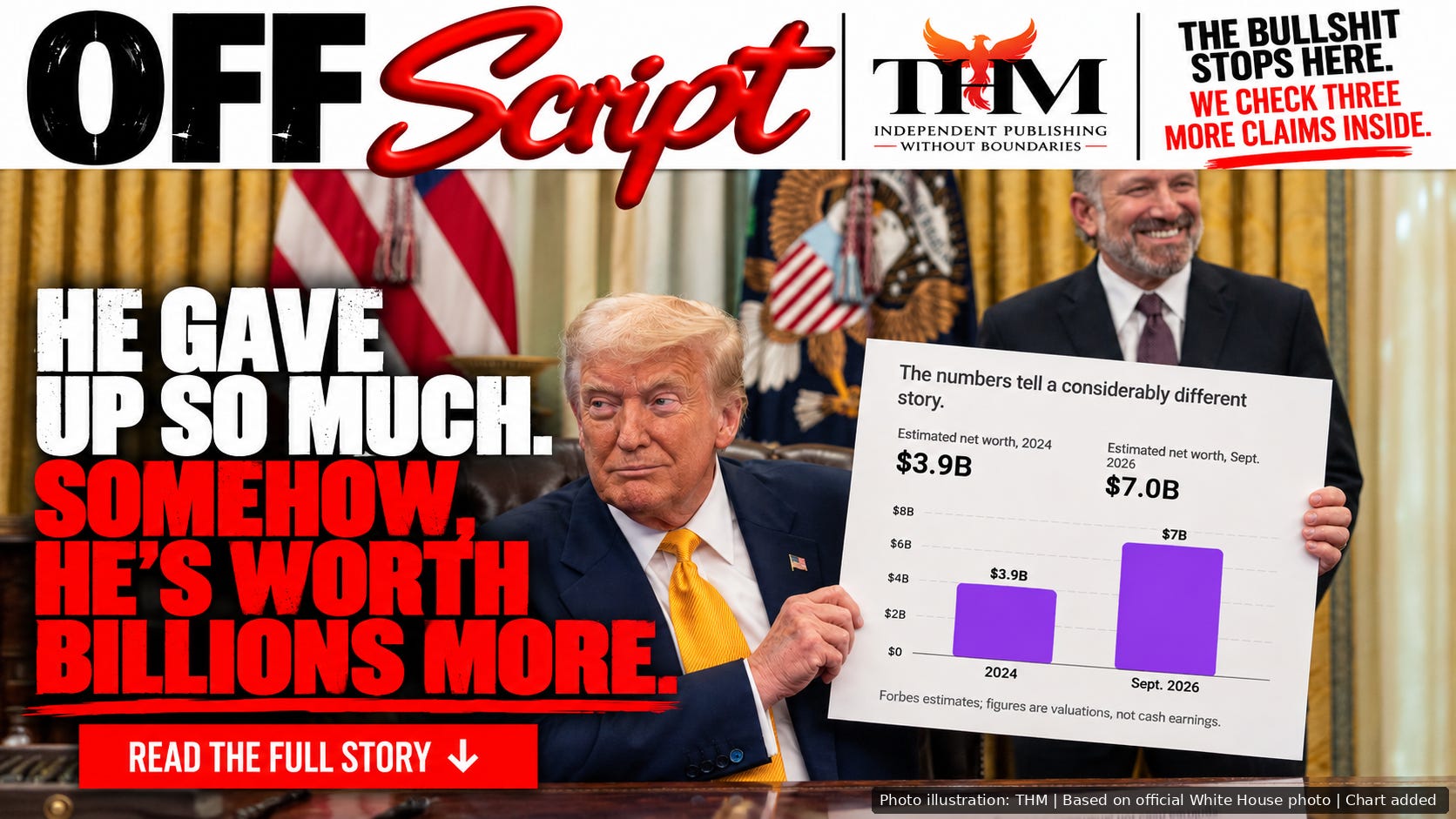
Somewhere in Oklahoma, Homeland Security Secretary Markwayne Mullin stood before a crowd and explained that Donald Trump was making a tremendous financial sacrifice by serving as president.
I suppose that depends on how you define sacrifice.
Personally, I’ve never had the misfortune of watching my net worth climb into the neighborhood of $7 billion. I imagine it’s difficult. There must be paperwork. Possibly some sleepless nights deciding which billionaire problem to tackle first. But before we organize a collection to help the president through these trying times, we ought to look at what his own financial disclosures say, because the numbers tell a story that bears remarkably little resemblance to the one Mullin was selling.
At an October 1 rally in Durant, Oklahoma, Mullin told the audience that Trump didn’t need to be president, that he wasn’t enjoying the financial rewards other presidents had received, and that holding the office had actually cost him money. That’s a remarkable claim, especially coming from someone whose job presumably requires a passing familiarity with the difference between a fact and something you say because the boss is standing nearby.
Fortunately, PolitiFact examined Mullin’s statement, and the results were not particularly flattering. Trump’s financial disclosure for 2025 showed at least $2.2 billion in revenue, compared with approximately $622 million in 2024. Forbes estimated in September that his personal fortune had increased by approximately $2.7 billion since the November 2024 election, putting his net worth around $7 billion.
That’s quite a financial beating. (PolitiFact, October 5, 2026)
Now, before someone rushes to the comments to explain that revenue isn’t profit, allow me to save us both some time. I know. Revenue is the money coming in before expenses. Profit is what’s left afterward. Net worth is an estimate of assets minus liabilities. You cannot simply substitute one for another and expect the arithmetic to behave. But that distinction doesn’t rescue Mullin’s claim. It just makes the actual evidence more interesting.
PolitiFact consulted financial and ethics experts who examined whether business expenses, presidential responsibilities, security arrangements or other costs could conceivably have swallowed the additional revenue. Their conclusion was that such an explanation wasn’t plausible based on the available information. And Forbes wasn’t measuring revenue when it calculated Trump’s growing fortune. It was estimating the value of what he owns. (PolitiFact’s financial analysis)
There’s something worth acknowledging here, because facts don’t become less important when they’re inconvenient to the argument you’re making. Trump really did lose considerable estimated wealth during his first presidency. Forbes put his net worth at approximately $3.7 billion in 2016 and $2.5 billion in 2021, and the White House pointed to those figures when PolitiFact asked about Mullin’s remarks.
Fair enough. That’s a real decline, and it’s part of the record. But we’re in 2026, and Mullin was talking about the president standing behind him, not delivering a retrospective on the financial challenges of 2021. If I told you I was going broke because I lost $1,200 five years ago, while neglecting to mention that I’d subsequently made several thousand dollars, you’d probably have a few questions. You might even ask whether I was hoping you wouldn’t notice the second part. (Forbes figures and White House response, via PolitiFact)
And here’s where the story starts getting considerably more interesting. A large share of Trump’s reported 2025 revenue came from cryptocurrency. His disclosure showed at least $1.4 billion from that sector alone, an extraordinary amount of money coming from an industry whose future depends heavily on decisions made by the federal government.
The president appoints regulators, influences enforcement priorities through his administration, and helps shape the government’s approach to financial markets, digital assets, and the rules governing companies operating in those markets. Meanwhile, businesses associated with Trump and his family have substantial financial interests in the same industry. (PolitiFact’s examination of the 2025 disclosure)
That arrangement doesn’t automatically establish wrongdoing. Presidents have held investments before, and the mere existence of a financial interest doesn’t prove that a government decision was made to benefit it. But the potential conflict is impossible to ignore. Suppose you’re running a company that stands to gain or lose millions depending on what Washington decides. Now suppose the president of the United States has a significant personal or family financial interest in that same business sector. Would you be comfortable relying entirely on his assurances that every decision was made exclusively in the public interest?
Maybe you would. I’d want considerably more than an assurance, and I’d want it regardless of whether the president was Donald Trump, Joe Biden, Barack Obama or somebody whose name we haven’t learned yet. The person entrusted with making decisions for the country shouldn’t leave the country guessing whether those decisions also happen to improve his own financial position.
Then Reuters followed the money.
In June, Reuters published an investigation into the Trump family’s cryptocurrency businesses. Its reporters examined blockchain records, corporate filings, company disclosures and interviews, and calculated that the family had generated at least $2.3 billion in profit from four major crypto ventures since Trump’s return to office. The investigation also found approximately $2.3 billion in combined net losses among investors in those ventures as of the end of April, including paper losses on investments that hadn’t been sold.
Those figures describe different groups and shouldn’t be mistaken for a simple dollar-for-dollar transfer from investors to the Trump family. But they reveal a striking contrast in who benefited and who bore the risk. (Reuters Special Report, June 9, 2026)
One investor interviewed by Reuters, a New York retiree, had put $60,000 of retirement savings into a company associated with the Trump family’s crypto ventures. By the end of May, the investment was worth approximately $5,300. A man puts a substantial chunk of his retirement savings into an investment partly because of its association with the president, watches most of it disappear, and meanwhile the family whose name helped attract investors has generated enormous profits across its cryptocurrency ventures. (Reuters investor interviews and financial analysis)
I’m not suggesting Trump personally took that man’s retirement money. That isn’t what the evidence establishes. But when a president’s celebrity and political position become part of the appeal of a financial product, we ought to be asking some serious questions about who is assuming the risk, who is collecting the money and whether the public understands the difference.
The Reuters investigation reported that the Trump family’s business arrangements often allowed it to profit from sales and transactions without taking on the same downside exposure as ordinary investors. That’s an important distinction. It’s one thing to get rich because an investment succeeds. It’s another to build an arrangement that can generate substantial revenue even when the people buying into it lose money. And it becomes a matter of public concern when the family involved happens to occupy the White House. (Reuters, Under the Trump Crypto Playbook, the Family Always Wins. Investors Don’t)
Here’s a development that makes the contrast even more interesting. In July, Reuters examined Trump’s financial disclosures and reported that his investment managers had substantially increased his holdings of conventional stocks and bonds while proceeds from his family’s cryptocurrency ventures were pouring in. The reported value of those holdings increased from a range of $225 million to $608 million at the end of 2024 to between $703 million and $2.6 billion at the end of 2025.
In other words, while buyers of Trump-associated crypto products were exposed to some spectacular losses, a substantial portion of the president’s reported investment portfolio was moving into more traditional financial instruments. There’s nothing inherently improper about diversifying investments. Financial advisers recommend it every day. But the contrast deserves attention, especially when the person promoting speculative financial products also happens to be the president of the United States. (Reuters, July 13, 2026)
The foreign money deserves its own conversation, because some of the financial relationships surrounding Trump-linked cryptocurrency ventures involve overseas investors and business interests. That adds another layer to the conflict-of-interest questions when the president also conducts foreign policy.
There is nothing inherently illegal about a foreign investor purchasing an interest in an American business. Foreign investment happens every day, and a foreign financial relationship doesn’t automatically prove that government policy has been bought. But it creates a legitimate question about access and influence when the business receiving the investment is connected to the sitting president.
What does an investor believe they’re purchasing? An ordinary commercial opportunity? The value of a recognizable brand? A relationship that might become useful when dealing with the American government? We can’t know someone’s intentions simply by looking at a transaction, which is precisely why transparency and independent oversight matter. The public should be able to examine these relationships without having to take the president’s word for it that everything is perfectly innocent. And it shouldn’t have to wait until somebody uncovers a criminal conspiracy before being allowed to question an arrangement that creates obvious opportunities for conflicting interests.
There’s another argument worth dealing with before it turns up in the comments. Presidents have made money from their fame before. Bill Clinton and Barack Obama earned substantial sums through books, speeches, and other activities after leaving office. The White House has also emphasized that Trump has forgone his presidential salary.
Those are fair points to raise, but earning money from a book contract after leaving office is different from earning revenue through businesses operating while you’re president, particularly when those businesses have interests affected by federal decisions. The timing matters, the source of the money matters, and so does the relationship between the business and the government’s responsibilities.
As for the presidential salary, the job pays $400,000 annually. Whether Trump has declined every payment during his second term has not always been independently documented, but even accepting the White House’s position, that figure is tiny compared with the financial activity disclosed for 2025. If someone told me he’d turned down a $400,000 paycheck while his estimated fortune increased by billions, I might admire his willingness to skip the salary. I wouldn’t automatically conclude that he’d sacrificed his financial well-being. I’d probably ask him to explain the billions. (PolitiFact’s comparison of presidential wealth and salary claims)
If this kind of reporting matters to you, this is a good place to subscribe. You can subscribe for free and keep reading, or become a paid subscriber to help fund the research and tools that go into every edition. Either way, I’m glad you’re here. Independent journalism needs readers who are willing to follow the evidence, even when the evidence complicates the story.
And this is where Mullin’s statement becomes more than a bad fact-check. What interests me isn’t merely that a cabinet secretary made a claim contradicted by the available financial evidence. Politicians do that often enough that fact-checkers could probably qualify for hazardous-duty pay. It’s the story the claim is trying to tell.
Trump isn’t simply wealthy, according to this version of events. He’s a wealthy man who has nobly endured financial suffering because he loves his country so much. That’s a powerful political narrative. It turns public service into a personal act of martyrdom and invites voters to feel grateful for the supposed sacrifice. But the financial evidence from his second presidency doesn’t support that narrative.
It shows a man whose fortune has grown substantially, whose family has profited from business ventures associated with his name, and whose administration exercises considerable influence over industries in which those ventures operate. (PolitiFact; Reuters Special Report)
You can believe Trump genuinely wants to serve the country. You can support his policies. You can even believe his business interests have been handled appropriately. But those beliefs don’t change the numbers, and they certainly don’t justify pretending that billions in additional estimated wealth somehow represent financial ruin.
Here’s what bothers me most. We spend an enormous amount of time arguing about the ethics of relatively small transactions involving public officials. A lawmaker’s stock trade becomes a controversy. A government employee’s outside income can trigger disclosure requirements. Officials are expected to recognize conflicts, report financial interests and, depending on their position, recuse themselves from certain decisions.
The president operates under a different legal framework. Federal conflict-of-interest restrictions that apply to many executive-branch employees generally do not apply to the president and vice president in the same way. That legal distinction makes transparency and voluntary safeguards especially important, because the question isn’t merely whether the president is technically permitted to retain a particular financial interest. The question is whether the public has sufficient information and meaningful safeguards to distinguish government decisions made for the national interest from decisions that might also benefit the president’s businesses.
And if the answer is that we’re simply supposed to trust him, I’d suggest we’ve set the bar considerably lower than it ought to be. You don’t have to dislike Donald Trump to see the problem. You only have to imagine the same arrangement involving a president you don’t trust. If that suddenly makes you uncomfortable, perhaps the issue isn’t the president’s name. Perhaps it’s the arrangement.
So let’s return to Oklahoma for a moment. Markwayne Mullin stood before a crowd and told them the presidency was costing Donald Trump money. The available evidence says something very different. His financial disclosures document enormous business revenue, independent analysts estimate substantial increases in his wealth, and major investigations have identified significant profits flowing to Trump family ventures. (PolitiFact, October 5; Reuters, June 9)
The first-term losses are real. The second-term gains are real, too. Pretending the first cancels out the second is an interesting approach to accounting, although I wouldn’t recommend trying it with the IRS.
And I keep coming back to that word Mullin used: cost. Because there is a cost worth examining here, and it isn’t necessarily being paid by Donald Trump. It’s the cost of asking Americans to trust that their government is making decisions for them while the president’s private financial interests remain intertwined with businesses affected by those decisions.
That cost can’t be calculated simply by opening a financial disclosure and adding up the numbers. But it’s one the public has every right to question, and unlike the president’s estimated fortune, it isn’t something Forbes can put a price tag on.
If this was worth your time, hit Like, Restack, or share it. That’s how independent work like this finds new readers.
THE BULLSHIT DETECTOR
Three more claims that deserve a closer look.
1. CLAIM: Chris Pappas voted to raise taxes 68 times, and every one of his tax votes was to raise taxes.
BULLSHIT: 💩💩💩💩
WHY: Former Republican Senator John Sununu made the accusation about Democratic Congressman Chris Pappas during New Hampshire’s Senate race. PolitiFact found that Sununu’s list inflated the number by counting procedural votes, including legislation that wasn’t primarily about taxes and ignoring occasions when Pappas supported tax reductions. Some of the supposedly damning votes even had overwhelming Republican support. Apparently, if you count the same legislative process enough times, you can make almost anybody look like a tax collector.
2. CLAIM: James Talarico’s campaign says Texas Republican Ken Paxton voted “to protect puppy abusers.”
BULLSHIT: 💩💩💩💩
WHY: Paxton did vote against a 2011 Texas bill involving people found responsible for animal cruelty. What the campaign conveniently leaves out is that the bill concerned the money required to appeal a court ruling, not whether animal abuse should be legal or whether abusers deserved punishment. Opponents raised procedural fairness concerns, although Paxton never publicly explained his vote.
Apparently, we’ve reached the stage of American politics where even puppies have to worry about being misrepresented in campaign advertising. There are plenty of legitimate reasons to scrutinize Paxton’s record. Turning a procedural vote into a declaration of solidarity with puppy abusers isn’t one of them.
PolitiFact rated the claim Mostly False on October 12, 2026.
3. CLAIM: Britain’s net-zero climate policies will cost twice as much as previously estimated.
BULLSHIT: 💩💩💩💩
WHY: Britain’s Conservative Party published a policy booklet suggesting that the cost of achieving net-zero emissions was dramatically higher than earlier estimates. Carbon Brief examined the calculations and found that a spreadsheet error appeared to have doubled the figure. The party’s document attributed nearly £1 trillion in costs to the government’s official climate adviser, even though the underlying estimate didn’t support that number. There’s something wonderfully unfortunate about publishing a document questioning government competence while apparently failing to check your own spreadsheet.
More from Tom Hicks Media
Blind Spot, our Sunday Off Script investigation, is following the machinery of the 2026 midterm elections in The Election Before the Election. We’re examining the rules, money, and political decisions that shape elections long before anyone casts a ballot. What The Hell? digs into actual history so ridiculous that fiction writers would probably be told to tone it down.
Lotus Purrspective offers daily observations from a tuxedo cat who has serious doubts about the intelligence of her human. Chart Collision revisits the songs, artists and chart battles that shaped our musical memories, including the hits some of us would happily have left behind.
Panic Room Sports tackles the NFL, fantasy football, NASCAR and the occasional sports-related absurdity. Rabbit Ears Classic TV goes behind the scenes of television’s earlier decades, while The Backlot Ghost explores the movies, personalities and production stories that Hollywood left behind.
Buy Me a Cup of Tea
Off Script is independent, and keeping it that way takes research, time and the occasional willingness to spend an afternoon buried in financial disclosures that could double as doorstops.
If you’d like to help cover those costs, you can buy me a cup of tea. I promise not to invest the proceeds in a presidential cryptocurrency.
One Question Before You Go
Should a sitting president be required to divest from businesses whose fortunes can be directly affected by decisions made by his own administration, or are financial disclosures and public scrutiny sufficient?
I’d be interested in hearing where you draw that line.
#OffScript #Trump #PresidentialEthics #ConflictsOfInterest #Cryptocurrency #GovernmentAccountability #PoliticalFactChecking #IndependentJournalism #THM