

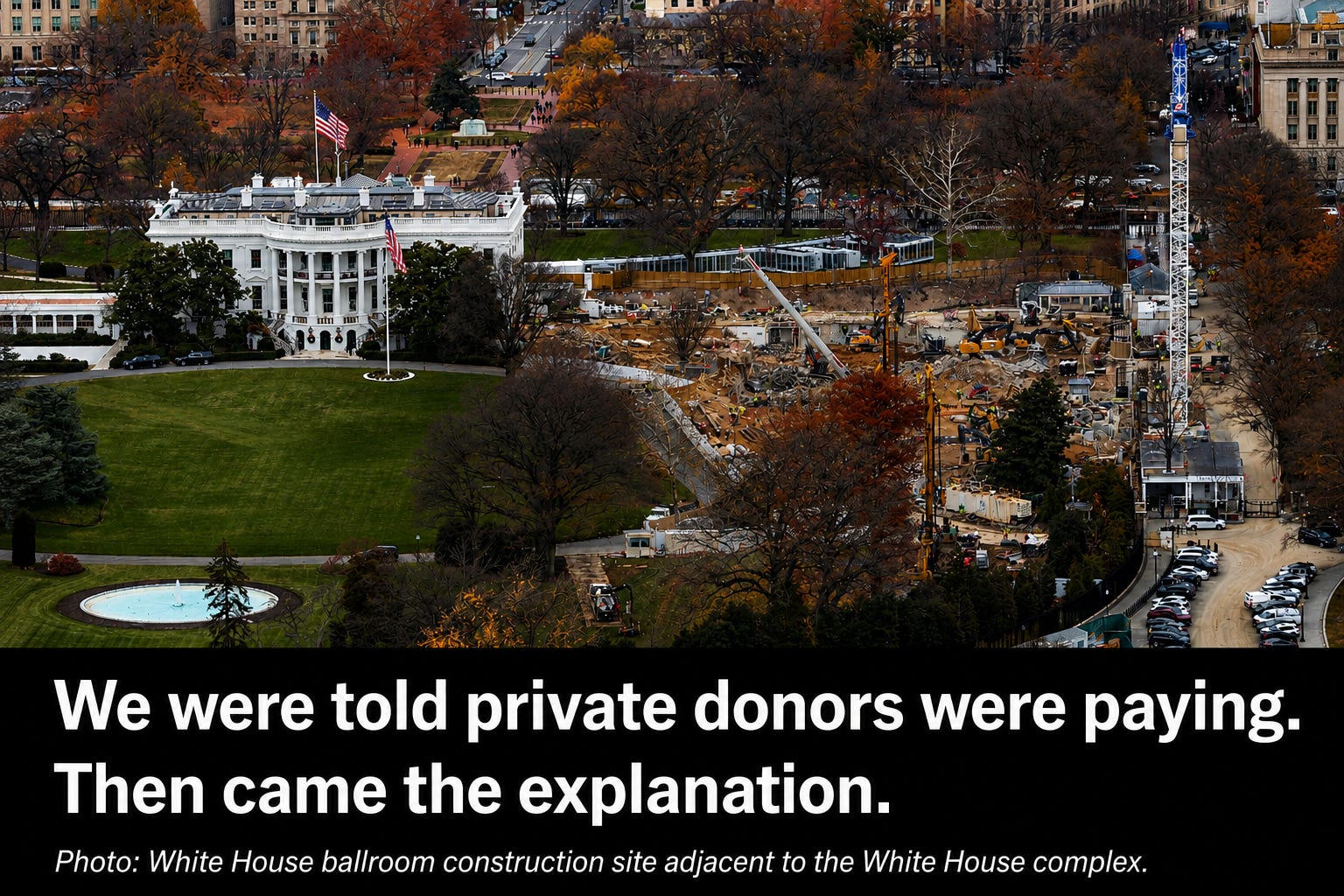

I am soooooo tired of this shit.
Not the ballroom. I don’t give a shit about the ballroom. Build it. Don’t build it. Turn the damn thing into a roller rink and host congressional karaoke nights in it for all I care. The ballroom isn’t what caught my attention. What caught my attention was the feeling I got the second I read the story, because it was the exact same feeling I’ve had about fifty times over the last few years.
“Oh, for fuck’s sake. Here we go again.”
We were told private donors were paying for it. That’s what people heard. That’s what people understood.
Now Reuters is reporting taxpayers may end up covering a substantial chunk of a project that could cost around $600 million, and before somebody fires up the industrial-strength bullshit generator to explain why what we heard isn’t actually what we heard, let’s acknowledge the part nobody wants to talk about.
This didn’t surprise anybody.
It should have. A story like this should knock people sideways. Hearing “private donors are paying” followed by “taxpayers may be covering a substantial portion of the cost” ought to set off alarm bells loud enough to wake the dead.
Instead, most people read it, shook their heads, and thought, “Yeah, that sounds about right.”
That’s a hell of a thing when you stop and think about it.
We’ve gotten so used to numbers moving around, promises changing shape, and explanations arriving after the fact that a huge chunk of the country can practically predict the next act before the curtain goes up.
The second somebody says, “Don’t worry, somebody else is paying,” a little voice in the back of your head immediately says, “Bullshit. Let’s see what the story looks like six months from now.”
And the really fucked-up part is that voice has earned the right to be there.
Nobody wakes up one morning and decides they don’t believe anything anymore. You get there the hard way. You get there after years of hearing one thing and getting another, after enough revised estimates, enough changed explanations, enough promises that somehow came with an invisible asterisk nobody mentioned at the beginning.
Eventually, you stop listening to the sales pitch and start looking for the catch, because experience has taught you there’s almost always a catch.
Join Us Every Morning
There’s going to be an explanation.
There’s always an explanation, and it’ll be delivered in that particular tone — calm, reasonable, faintly condescending — specifically engineered to make you feel like the unreasonable one for remembering what you were told six months ago.
The funding picture changed. The estimates were preliminary. The situation is more complicated than it initially appeared.
And the hell of it is, some of that might even be true.
Maybe the numbers genuinely shifted. Maybe the donor situation got complicated in ways nobody anticipated. I’m not saying it’s impossible.
What I’m saying is that it doesn’t matter anymore, and that’s the part that should bother everybody a lot more than the ballroom does.
We’ve reached the point where explanations land in a vacuum.
Nobody’s evaluating them on the merits anymore. They’re comparing them to the last explanation, measuring them against the last promise, trying to figure out whether this version of the story resembles the version they were sold at the beginning.
That’s a hell of a place for a country to end up.
The thing that gets me isn’t the money.
Six hundred million dollars is an obscene number, but obscene numbers have lost their ability to shock people, too, which is its own separate disaster.
What gets me is the phrase “somebody else is paying,” because that’s not a vague statement or a working estimate or a preliminary projection subject to revision.
That’s a promise with a very specific meaning: you don’t need to worry about the bill because somebody else is handling it.
And when that promise starts looking shaky, when reports start suggesting taxpayers may end up covering part of the cost after all, the problem isn’t just the money.
It’s that this is one more entry in a very long ledger that Americans have been keeping for years, whether they realize it or not.
Every time the story changes shape between the announcement and the accounting, that ledger gets a little heavier, and people have long memories for the things that cost them money.
Buy Me A Cup Of Tea: Keep the receipts hot, and the bullshit detector fully operational.
Nobody wants to become the person who automatically assumes they’re getting screwed.
It’s a shitty way to go through life, and I get why people resist ending up there.
But there’s a difference between healthy skepticism and the kind of bone-deep wariness that develops after you’ve watched enough promises quietly mutate into explanations, and a lot of Americans crossed that line a while ago without anybody announcing it.
That’s the real damage here, and it’s the kind that compounds.
Once people stop taking the opening statement of a project at face value, they stop taking any of it at face value.
Every future announcement starts with a credibility deficit before anyone’s even heard the details. Every estimate gets side-eyed before the ink is dry.
Every promise gets mentally discounted the moment it leaves someone’s mouth, because people have been doing the math on what promises are worth and the math keeps coming out the same way.
That’s not cynicism for the sake of cynicism.
That’s pattern recognition.
And the pattern has been consistent enough for long enough that people now expect the story to change, expect the estimate to move, expect the explanation to arrive later, expect the bill to end up somewhere closer to home than they were originally told.
So yeah. Six hundred million dollars. A White House ballroom. Private donors who apparently aren’t covering the whole tab after all. Another explanation on the way.
Maybe the explanation is completely legitimate. Maybe every number checks out. Maybe every decision makes perfect sense once all the details are laid out.
The problem is that millions of Americans are already past the point where explanations do much good.
They’ve heard too many of them.
That’s why this story landed the way it did. Not with shock. Not with outrage. With recognition.
People saw it and thought, “Yeah, that sounds about right.”
And if that doesn’t scare the hell out of the people making these promises, it should.
Because the most expensive words in America were never “White House ballroom.”
They were always “don’t worry, somebody else is paying.”
Maybe that’s why so many people seem exhausted all the time. Not because of this ballroom, but because being treated like a fucking mark year after year gets old.
A lot of Americans are already there.
The quickest way to bankrupt public trust is to keep sending taxpayers bills for things they were told somebody else would pay for.
One Question From The Bastard:
How many times do you have to be wrong about who’s paying before people stop believing you when you say it?
THE DAILY BASTARD IS FREE
War Room subscribers get the deeper investigations, expanded analysis, and the stories that don’t fit inside a single morning article.
Bastardonia Fact:
The official national pastime of Bastardonia is asking, “Okay, but who’s actually paying for this?”
#TheUnredactedBastard #Politics #GovernmentSpending #Taxpayers #WhiteHouse #Accountability #TrustInGovernment