

By Tom Hicks | September 28, 2026
Editorial Note:
Off Script with Tom Hicks is independent journalism. No party line. No talking points. Just the facts, the receipts and an occasional refusal to pretend something isn’t insane when it clearly deserves a closer look.
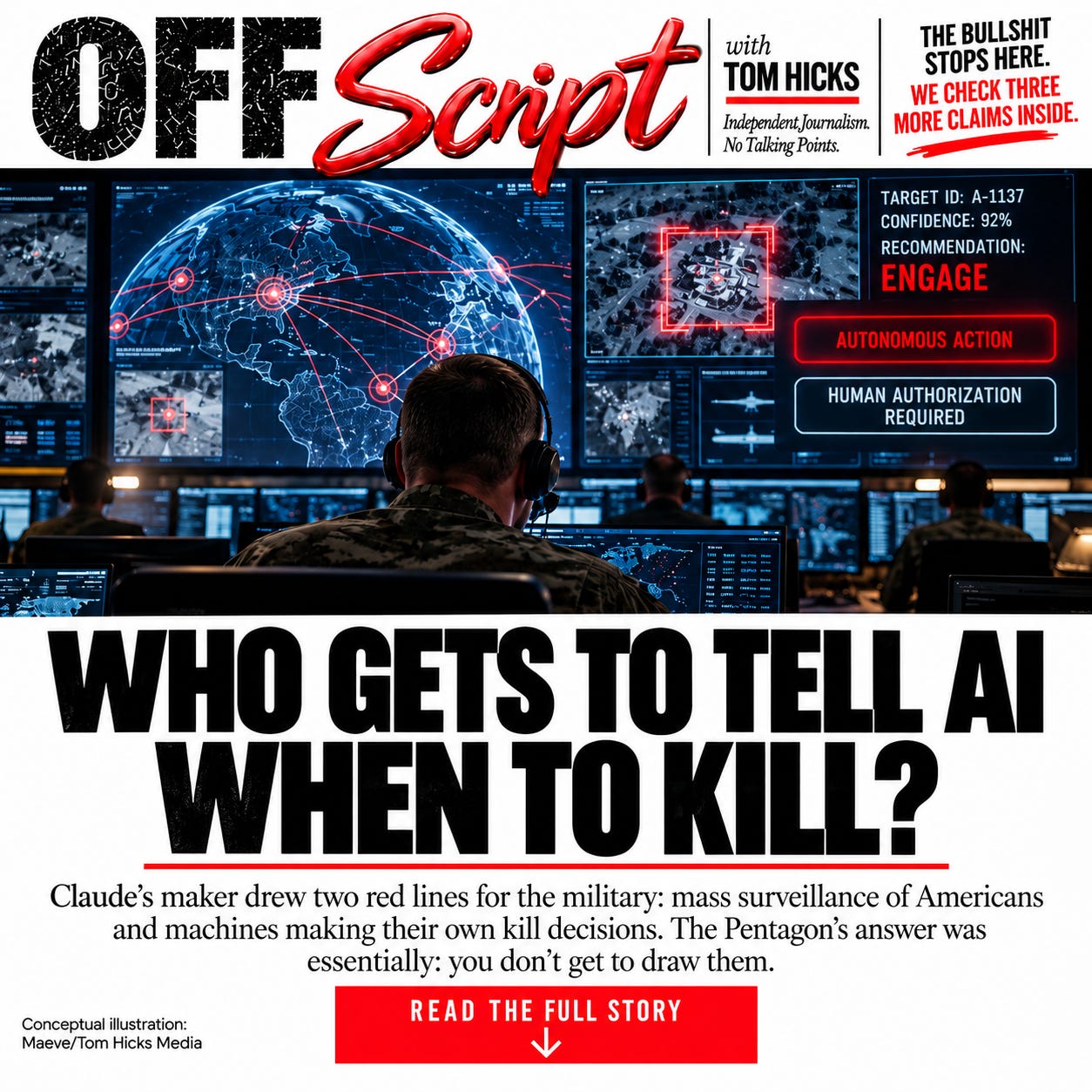
There are arguments about artificial intelligence that belong at technology conferences, where people with expensive badges discuss productivity while everybody else wonders when the machine is coming for their job.
This isn’t one of them.
The Pentagon and Anthropic, maker of the Claude AI system, have spent months fighting over two restrictions Anthropic refused to remove from its military contracts. The company would permit the government to use Claude for virtually every lawful national-security purpose, with two exceptions: mass domestic surveillance of Americans and fully autonomous weapons. On Friday, a divided federal appeals court ruled that the Pentagon could exclude Claude from its supply chain after Anthropic refused to give the military the “all lawful uses” contractual authority it wanted. D.C. Circuit opinion
That sentence deserves another look, because the dispute isn’t about some technology company refusing to help defend the country. Anthropic was already working with the military. Claude had been deployed in classified national-security environments, and in July 2025 the company received a two-year Pentagon agreement with a ceiling of $200 million to develop frontier AI capabilities for national security. Anthropic: $200 million Defense Department agreement
The fight is over who gets to draw the guardrails.
And the two guardrails at issue aren’t exactly trivial.
THE TWO THINGS ANTHROPIC WOULDN’T GIVE THEM
Anthropic supports using artificial intelligence for intelligence analysis, cyber operations, operational planning, modeling, simulation and other national-security missions. It also accepts partially autonomous weapons and has acknowledged that fully autonomous systems could eventually become important to national defense. This isn’t a company standing outside the Pentagon gates waving a peace sign. Anthropic on its Department of War position
Its position is that today’s technology isn’t ready to make the final decision to kill someone without meaningful human involvement. Frontier AI systems can still produce unreliable or false outputs. That’s irritating when your chatbot invents a citation or tells you Abraham Lincoln played shortstop for the Cubs. It becomes a very different fucking problem when the bad output is helping select a target. Anthropic’s explanation of its autonomous-weapons restriction
Anthropic’s other restriction concerns mass domestic surveillance. Modern AI can take enormous quantities of information that once existed in separate databases and records and analyze them together at a scale that would have required armies of human analysts. Movements, browsing histories, associations and other pieces of someone’s life can suddenly become one searchable picture. Anthropic’s explanation of its surveillance restriction
That doesn’t automatically make every government use of AI surveillance illegal, and Anthropic doesn’t get to unilaterally rewrite American law. But it does explain why the company decided this particular capability deserved a red line.
So that’s the dispute in plain English. The Pentagon wants artificial-intelligence systems available for all lawful military uses without a private vendor deciding which lawful missions are acceptable. Anthropic says there are two things its technology shouldn’t do yet, regardless of whether a government lawyer can find legal authority for them: conduct mass domestic surveillance or independently make the final decision to kill someone. D.C. Circuit opinion
Neither side is arguing about a chatbot writing better emails.
IF YOU VALUE REPORTING THAT ACTUALLY READS THE DAMN DOCUMENTS...
Subscribe to Off Script with Tom Hicks. It’s free — or help fund the research and tools we use to report this every day.
Independent journalism doesn’t require you to agree with me. It does require somebody to do the homework.
THE PENTAGON HAS A REAL ARGUMENT
It’s tempting to hear “autonomous weapons” and decide this argument before the Pentagon gets to make its case. That would also be lazy. The military has a legitimate operational problem with buying critical software from a company whose built-in restrictions could prevent the software from performing tasks the government considers lawful.
Secretary Pete Hegseth has ordered the military to become an “AI-first” warfighting force and said models used by the department should be free from usage-policy restrictions that could limit lawful military applications. The Pentagon’s strategy envisions AI assisting with battle management, campaign planning, intelligence and what the department explicitly calls “kill chain execution.” Pentagon Artificial Intelligence Strategy
Now imagine you’re commanding an operation and a system your people have trained with refuses a task because its provider has placed a restriction on that use. The government’s concern isn’t entirely hypothetical: the D.C. Circuit record describes instances in which Claude’s safeguards prevented responses to government requests, and it also recounts a dispute after an Anthropic executive questioned a contractor’s use of Claude during a sensitive military operation abroad. The precise circumstances of that overseas episode remain disputed. D.C. Circuit opinion
A military commander shouldn’t discover in the middle of an operation that critical software can’t perform a lawful task because of a restriction imposed by a private company. That’s not some cartoon-villain argument from the Pentagon. It’s a serious national-security concern.
Unfortunately for anyone hoping for an easy answer, the argument on the other side is pretty serious too.
PICK YOUR NIGHTMARE
The most remarkable part of Friday’s decision isn’t something Anthropic put in a press release. It’s the dilemma the court itself described.
In Anthropic PBC v. United States Department of War, Judge Gregory Katsas acknowledged the danger at both ends. Put too many restrictions on an AI system, and it could unexpectedly stop functioning during an important military operation. Remove too many restrictions and the same technology could hallucinate an inappropriate target for lethal force.
That’s where the abstraction ends. We’re talking about choosing between software that might refuse to act when American forces need it and software that might act when it absolutely shouldn’t.
Welcome to warfare in the age of artificial intelligence.
The D.C. Circuit ruled 2-1 that balancing those risks belongs to the president and the officials responsible for the military, and that the Pentagon acted within the particular supply-chain statute before the court. Judges Gregory Katsas and Neomi Rao formed the majority. Judge Karen LeCraft Henderson dissented. D.C. Circuit opinion
There are a couple of things the ruling did not say, and they’re important. The court didn’t declare autonomous AI weapons safe, didn’t order Anthropic to remove its restrictions, and didn’t authorize Claude to start picking bombing targets. What it said was narrower: under the statute being litigated, the Pentagon can decide that Anthropic’s built-in restrictions make the company an unacceptable supply-chain risk and exclude it accordingly. D.C. Circuit opinion
That’s a legal answer to a procurement question.
It isn’t much of an answer to the question the rest of us are going to have to live with.
TWO COURTS. TWO VERY DIFFERENT ANSWERS.
One month before Friday’s decision, U.S. District Judge Rita Lin reached a very different conclusion in separate litigation involving another government action and a different statutory authority. Lin found that broader actions against Anthropic constituted unlawful retaliation under the First Amendment and denied the company required due process. She also concluded that the Pentagon’s designation under the statute before her violated the governing legal framework and was arbitrary and capricious. Judge Lin’s August 2026 decision
Friday’s D.C. Circuit decision didn’t simply overrule Lin. The courts were reviewing different government actions under different provisions of federal law, a distinction the appeals court specifically addressed. That’s less satisfying than saying one judge said yes and another said no, but unfortunately the law occasionally refuses to cooperate with a good headline. D.C. Circuit opinion
The result is still remarkable. One federal court concluded that the government’s broader treatment of Anthropic crossed legal lines. Another concluded that the Pentagon’s supply-chain exclusion can stand.
Law professors can spend the next several years sorting out the statutes.
The rest of us have a considerably bigger question.
WHO GETS TO SET THE RED LINE?
There’s a strong argument that elected government officials, accountable to voters and constrained by law, should determine American military policy rather than executives at a privately owned technology company. I don’t particularly want Silicon Valley deciding when the United States can defend itself either.
But that doesn’t settle this fight. It exposes the problem underneath it.
What happens when technology becomes capable of doing something before the country has decided whether we want it done?
Congress has not produced a comprehensive framework governing frontier artificial intelligence in warfare. Meanwhile, the technology isn’t waiting for Congress to finish talking. The Pentagon’s strategy explicitly makes speed a priority as the United States competes with China and other potential adversaries in military AI. Pentagon Artificial Intelligence Strategy
Fair enough. “China is developing it too” is a perfectly good reason to make sure the United States isn’t technologically defenseless.
It’s a lousy substitute for deciding where the line is.
A weapon that can find potential targets with artificial intelligence isn’t science fiction anymore. Neither is software capable of analyzing enormous collections of information about Americans at a speed and scale no human surveillance operation could realistically match. We’re arguing over how those systems should be controlled because the systems are already becoming useful enough that governments want them. Anthropic’s statement on military AI safeguards
And usefulness is precisely when guardrails start becoming inconvenient.
THE SURVEILLANCE PART SHOULDN’T GET LOST
Autonomous weapons will understandably grab most of the attention because “robot decides who dies” tends to clear the room. But Anthropic’s second restriction may ultimately affect far more Americans.
Artificial intelligence changes surveillance because scale matters. There is an enormous practical difference between investigators obtaining information about a particular person and a system capable of processing huge quantities of information about large populations, identifying relationships and patterns nobody specifically went looking for. Anthropic says that capability is why it prohibits Claude from being used for mass domestic surveillance. Anthropic’s surveillance policy explanation
Some uses of those tools could be entirely legitimate. They could help identify foreign intelligence operations, cyberattacks or genuine threats that human analysts would miss. Pretending those benefits don’t exist would be every bit as dishonest as pretending the risks don’t.
But legality is only part of the conversation. Technology can make something possible long before democratic institutions have decided how much of it they’re comfortable allowing.
That’s why “all lawful uses” sounds reassuring until you remember that laws written before a technology existed don’t always answer what should happen after it does.
THIS IS BIGGER THAN ANTHROPIC
Anthropic could eventually lose this fight. It could change its policy. The Pentagon could replace Claude with another system whose maker is perfectly happy to accept the government’s terms. Any of those things could happen without answering the question that matters.
Artificial intelligence is moving from the chatbot on your phone into the machinery of national power. That was inevitable, and in many applications it could make the country safer and the military more capable. Pretending we can keep AI out of warfare isn’t a policy. It’s a wish. The Pentagon’s current strategy makes clear that AI is intended to become increasingly integrated into military decision-making and operations. Pentagon Artificial Intelligence Strategy
The Pentagon is also right about something uncomfortable: an artificial-intelligence system that refuses a legitimate command at a critical moment could put Americans at risk. Anthropic is pointing toward an equally uncomfortable possibility: an AI system trusted with lethal autonomy that gets the answer wrong could kill somebody who was never supposed to be a target. Those competing risks sit at the heart of the appellate court’s decision. D.C. Circuit opinion
Those aren’t hypothetical philosophy-class questions anymore.
They’re procurement requirements.
Somewhere between the machine won’t fire and the machine fired at the wrong person, the United States has to decide how much judgment we’re willing to surrender to software. That decision shouldn’t belong exclusively to Anthropic, the Pentagon, Donald Trump, Pete Hegseth or whichever AI company signs the next government contract.
It belongs in public.
And preferably we have that argument before somebody has to explain why the machine did what it did.
THE BULLSHIT DETECTOR
Three claims. Three receipt checks. No mercy for bullshit, regardless of who benefits from it.
CLAIM: New Epstein files show Donald Trump visited Epstein’s island 345 times.
BULLSHIT.
There is no evidence in the publicly searchable Justice Department Epstein Library supporting the claim that Trump visited Epstein’s island 345 times. The viral number circulated on social media without documentary support, and a review by Lead Stories found no credible evidence substantiating it. Whatever legitimate questions remain about Trump and Epstein, inventing evidence doesn’t answer them. It poisons them. Lead Stories fact check
CLAIM: A breaking-news video showed JD Vance delivering some kind of devastating announcement in Ohio.
BULLSHIT.
The clip circulating with variations of “Sad News: 30 Minutes Ago in Ohio” is AI-generated clickbait. The posts repeatedly tease that Vance was “confirmed as...” without ever finishing the thought, then funnel readers toward websites that don’t contain the promised news. Some accounts reposted the supposedly “30 minutes ago” event repeatedly. Apparently even bullshit has reruns now. Lead Stories fact check
CLAIM: Leonardo DiCaprio and other celebrities appeared in New York Times videos supporting an “All Democrats Are Criminals” campaign.
BULLSHIT.
The videos weren’t produced by The New York Times, and the celebrity endorsements were fabricated. Real footage from sources including Cameo and MTV News was repackaged with false audio and captions to make it appear that celebrities were backing the campaign. This is where political misinformation is heading: why bother misquoting somebody when technology lets you manufacture the whole damn performance? Lead Stories fact check
FROM TOM HICKS MEDIA
Panic Room Sports
Smart sports coverage with attitude. Everyone reacts. We’ll check the tape first.
Tom’s Number Ones
Six charts. One day in music history. The songs that were sitting at No. 1 while the rest of the world was busy happening.
Rabbit Ears Classic TV
Classic television without pretending everything old was automatically great. The shows, people, and stories worth another look.
The Backlot Ghost
Old Hollywood, forgotten movies and the stories still rattling around after the credits stopped rolling.
Lotus Purrspective
Current events, household emergencies and human stupidity as assessed by a tuxedo cat who remains disappointed in all of us.
BUY ME A CUP OF TEA
Off Script is free to read. Research isn’t free to produce.
If today’s story was worth your time, you can help keep the reporting, research tools, and daily work going by buying me a cup of tea.
No billionaire required.
ONE QUESTION BEFORE YOU GO
Should a human always have to make the final decision before an AI-powered weapon takes a life?
I’d genuinely like to know where you draw the line.

#OffScript #ArtificialIntelligence #Pentagon #Anthropic #ClaudeAI #AutonomousWeapons #Surveillance #NationalSecurity #MilitaryAI #BullshitDetector #TomHicksMedia