


The older I get, the more convinced I become that human beings almost never throw away a damn thing.
We tell ourselves we’re being practical. We call it planning ahead. We convince ourselves there’s a perfectly rational reason for keeping that tangled nest of charging cables, the mystery key that doesn’t seem to fit anything anymore, the half-empty can of paint left over from a home improvement project that happened sometime during a previous geological era. Then somebody suggests cleaning out the junk drawer, and suddenly everybody turns into a defense attorney arguing the case of Random Piece Of Crap v. The Trash Can.
“What if I need it someday?”
That’s always the argument. It doesn’t matter that the thing hasn’t seen daylight in ten years. It doesn’t matter that you forgot you owned it until five minutes ago. Somewhere deep inside the human brain is a little voice whispering that tomorrow might be the day the broken widget finally becomes useful, and that’s all it takes to keep the thing around for another decade.
The reason I’m thinking about junk drawers this week has absolutely nothing to do with home organization and everything to do with government power.
Congress recently allowed part of a foreign intelligence surveillance authority to expire after lawmakers couldn’t agree on what should happen next. If you listened to the debate, you heard arguments about terrorism, intelligence gathering, foreign threats, civil liberties, national security, government oversight, and enough legal jargon to knock a horse unconscious.
All of that matters. What struck me, though, was that the surveillance authority itself felt almost secondary. The deeper story wasn’t about one law, one administration, or one intelligence program. The deeper story was about a habit Washington has developed over the last couple of decades, so ingrained that most of us barely notice it anymore.
Governments collect powers the same way the rest of us collect junk.
They acquire them during emergencies. They explain why they’re necessary. They promise they’ll be used responsibly. Then the emergency fades, the headlines move on, and the authority remains sitting right where it was because somebody, somewhere, is convinced it might be needed again someday.
That’s not just a surveillance story. It’s one of the defining stories of modern American government.
Every emergency arrives with the same sales pitch. This threat is different. This threat is serious. This threat requires immediate action. The normal rules are too slow, too restrictive, or too cumbersome for the moment we’re facing. Extraordinary circumstances demand extraordinary measures, and anyone standing in the way is accused of failing to understand the urgency of the situation.
Here’s the uncomfortable truth: sometimes that’s completely fucking true.
If terrorists are planning attacks, I don’t want government officials sitting around conducting a six-month listening tour. If a pandemic is spreading, I don’t want leaders waiting for three committees, two consultants, and a focus group moderated by some asshole with a PowerPoint presentation. Real emergencies require speed. Real emergencies require flexibility. Real emergencies sometimes require authorities that would be inappropriate under normal circumstances.
The problem isn’t that emergency powers exist. The problem is that America seems to have developed a raging addiction to emergencies.
For more than twenty years, we’ve lurched from one crisis to the next. Terrorism was an emergency. The financial collapse was an emergency. COVID was an emergency. The border is an emergency. China is an emergency. Cybersecurity is an emergency. Depending on who’s holding the microphone, inflation is an emergency, immigration is an emergency, crime is an emergency, and occasionally somebody’s hurt feelings on social media appear to qualify as an existential threat to the republic.
Everything is an emergency now, and every emergency comes carrying another request for authority, another exception to the rules, another reason government should be allowed to do something it couldn’t do yesterday. What gets me isn’t how often those requests succeed. What gets me is how rarely anybody comes back later and says, “Okay, the crisis passed. Give the goddamn power back.”
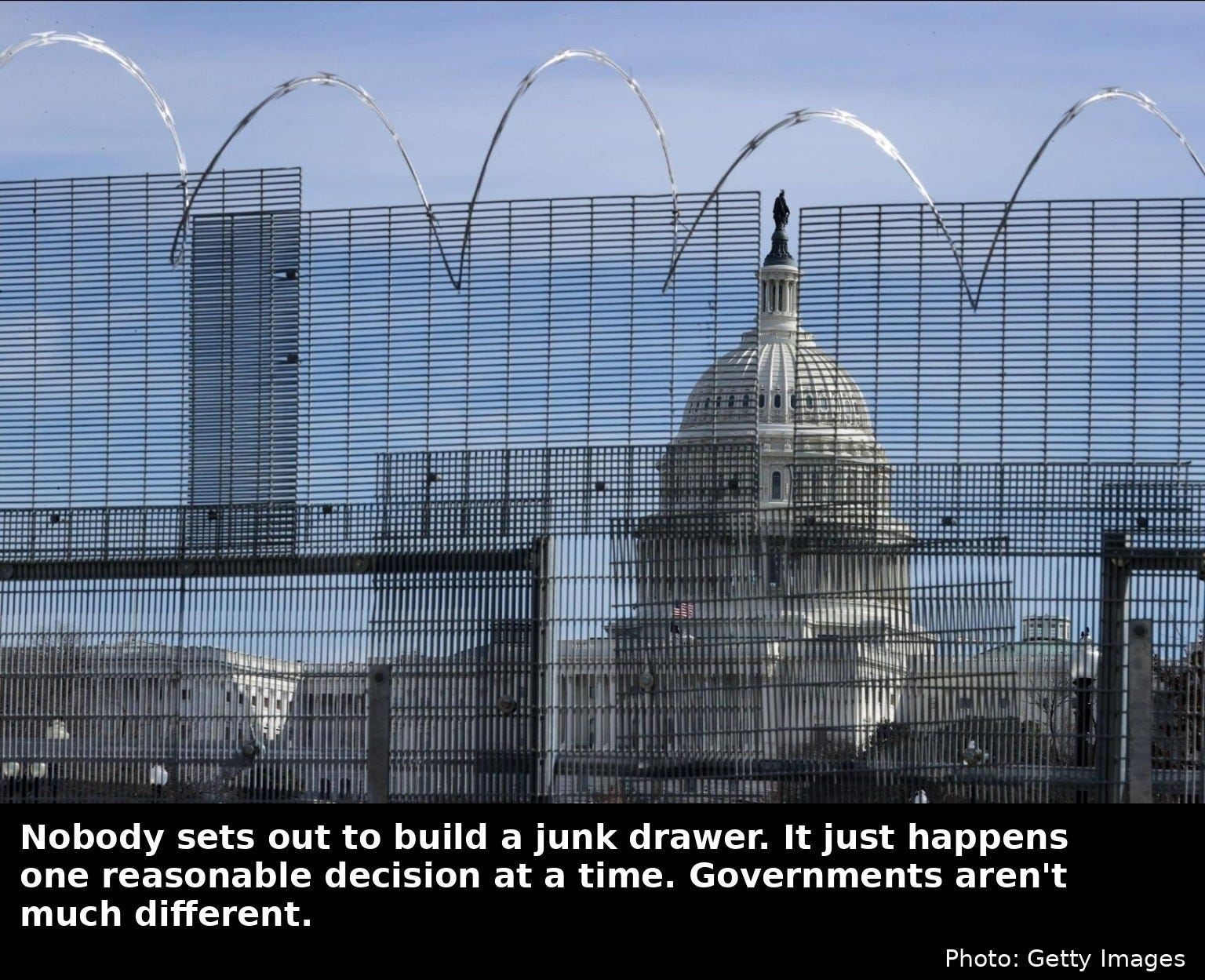
Nobody sets out to create a junk drawer. It happens one reasonable decision at a time. You keep one thing because it might be useful later. Then another. Then another. Before long, you’ve got a drawer full of dead batteries, mystery hardware, instruction manuals for products you no longer own, and enough random crap to confuse archaeologists for centuries.
Government power expands the same way.
Most of the authorities Americans argue about today weren’t created because some comic-book villain sat in a dark room plotting the destruction of democracy. They were created because somebody faced a legitimate problem and wanted a tool to address it. That’s what makes this issue so genuinely difficult. The original justification is often reasonable. The problem comes later, because once the government acquires a tool, every future threat becomes an argument for keeping it, every uncertainty becomes a reason not to throw it away, and every hypothetical danger becomes evidence that getting rid of it would be irresponsible.
If you’re responsible for preventing attacks, tracking foreign adversaries, disrupting espionage operations, or stopping cyber intrusions, surrendering a useful tool feels reckless. Nobody wants to be the poor bastard who threw away the fire extinguisher the day before the fire. That’s how temporary powers become permanent powers - not through some dramatic coup, not through a single villainous act, but through accumulation, habit, inertia, and a thousand individually sensible decisions that add up to something nobody actually voted for.
Every president eventually discovers the same thing: the Constitution is intentionally annoying.
Congress is supposed to move slowly. Compromise is supposed to be difficult. Different branches are supposed to get in each other’s way. The Founders built friction into the machine because they understood that government becoming too efficient can be just as dangerous as government becoming too weak.
The problem is that nobody gets elected promising to respect friction. They get elected promising results. And once you’re chasing results, emergency authority starts looking like the universal key hanging on the wall. Why spend months negotiating legislation when extraordinary authority gets you moving today? Why wrestle with Congress when a declaration, executive action, or emergency power offers a shortcut? Why fight through a process designed to slow you down when there’s a faster route sitting right there, and your opponents will absolutely use it if you don’t?
This isn’t really a partisan problem at all. Give people a shortcut, and eventually they’ll convince themselves the shortcut is necessary. Every administration falls in love with it. The current one has simply shoved the conflict into broad daylight, loudly and without apparent embarrassment.
Again and again, courts have found themselves examining claims of extraordinary authority and asking a question that sounds boring until you realize how important it is: Does the existence of a problem automatically grant the government the power it claims? Notice what judges are often not saying. They’re not necessarily arguing that the problem isn’t real. They’re asking whether the emergency justifies the response. That’s a completely different argument, and frankly, it’s one America seems increasingly uncomfortable having out loud.
Most Americans couldn’t explain the details of Section 702 if their mortgage depended on it. What they understand instinctively is the concern underneath it. If the government acquires a new power during a crisis, who decides when it’s time to give it back? More importantly, what happens when the people holding the power are the same people deciding whether they still need it?
Most people worry about the moment the government asks for more power. Fair enough. The part that should scare the hell out of us is what happens twenty years later, when nobody can remember where the emergency ended, nobody wants to surrender the authority, and every institution has developed a vested interest in keeping the whole damn apparatus running. Because that’s where this stops being a story about surveillance law and starts being a story about incentives, institutions, and human nature at its most predictable and most dangerous.
UPGRADE CTA
The real problem isn’t how governments acquire emergency powers. The real problem is that every institution involved has a reason to keep them, every future crisis becomes an argument for preserving them, and almost nobody gets rewarded for giving them back.
That’s where this story gets uncomfortable.
