

Bastard’s Law
You don’t get hijacked by a monster. You build it, name it, feed it for thirty years, and then hold a press conference about how shocked you are.
I want to tell you something about how political parties die, because the version of this story that’s been floating around is absolute horseshit, and it’s been doing a lot of work for people who’d really prefer not to get held accountable for what they actually did.
The Republican Party did not get taken over.
I know that’s the version they’re selling. The reluctant conservatives, the institutionalists, the guys who keep going on Meet the Press to explain how this isn’t really who they are. Poor helpless stewards of a proud tradition, blindsided by forces beyond their control. It’s a great story. It also has approximately the same relationship to reality as a WWE storyline, and at least WWE admits it’s scripted.
What actually happened is slower, uglier, and a hell of a lot more embarrassing for everyone involved. The Republican Party spent about forty years making decisions, one at a time, each one defensible in isolation, collectively catastrophic, that pulled out every internal wire that might have slowed or stopped what eventually came. And then what eventually came looked at the empty space where the guardrails used to be and said, yeah, this works for me.
That’s not a takeover. That’s a renovation that got completely out of hand because nobody wanted to admit what they were actually building.
The Myth That Was Already Cracking Before Anyone Said Anything Out Loud
There’s this version of the pre-MAGA Republican Party people pull out when they need a before picture. Disciplined. Principled. Serious people doing serious things. And that party existed, more or less, for a while, with enough asterisks attached that you’d need a second document just to list them.
Reagan gave the modern party its operating system and its most quotable bumper sticker:
“Government is not the solution to our problem; government is the problem.”
— Ronald Reagan
That line hit. It still hits. It taps into something real that every person who’s ever spent an afternoon trying to get a straight answer out of a federal agency understands in their bones. But it also planted something in the foundation that nobody wanted to dig up and look at. Because if the system is the problem, then distrust of the system isn’t a bug. It’s the whole point. And once you’ve told people that for long enough, you don’t get to walk it back when it stops being convenient.
Meanwhile, Reagan was running deficits like a guy who just found someone else’s credit card and decided to see how far it would go before anyone noticed. The branding said fiscal discipline. The behavior said something else entirely. That gap between what the party said it believed and what it actually did when governing got uncomfortable — that’s the original crack. Not dramatic. Not loud. Just a quiet, persistent distance between the message and the reality that got a little wider every single cycle.
Then Bush Sr. stepped up and delivered what might be the most famous self-destruct sequence in modern political history:
“Read my lips: no new taxes.”
— George H.W. Bush
And then raised taxes. Because he was trying to actually govern, and reality had opinions. In a functional system, you call that leadership. Inside a party already drifting toward absolutism, it became a cautionary tale with one very specific moral: never admit reality if it costs you politically. That’s not governing wisdom. That’s the first symptom of a party that’s slowly choosing the performance over the job. And once that choice gets made often enough, it stops being a choice. It just becomes how things work.
When the Principles Became Bumper Stickers
The real damage didn’t arrive with a brass band. It showed up the way termites do, quietly, systematically, until one day you lean on the wall and your hand goes through it.
Limited government was the slogan. The application depended entirely on what the government was being asked to do and for whom. Fiscal responsibility got invoked against Democratic spending like a priest invoking scripture, then quietly set aside the second Republican spending needed room to breathe. States’ rights were sacred, a cornerstone, an unshakeable principle, right up until a state made a choice the party didn’t like, at which point federal intervention was suddenly back on the table and nobody seemed to notice the contradiction.
Each of those moves had a rationalization. Pragmatism. The art of the possible. Necessary adjustments to political reality. Stack them on top of each other over twenty years, and something becomes visible that isn’t visible one decision at a time.
The principles stopped constraining behavior and started justifying it after the fact.
That’s the difference between a belief system and a prop. A real principle costs you something. It makes you do the harder thing when the easier thing is sitting right there. A principle that only shows up when it’s convenient isn’t a principle. It’s a talking point wearing a suit. And once your entire operating framework is built on talking points rather than actual constraints, you’ve removed the only thing that could have pumped the brakes when things started going sideways.
It’s like a casino that keeps quietly changing the rules of every game until the house always wins, and then acting genuinely bewildered when nobody trusts the table anymore.
👉 You’re reading this the hard way. Fix that:
The Machine That Rewired Everything
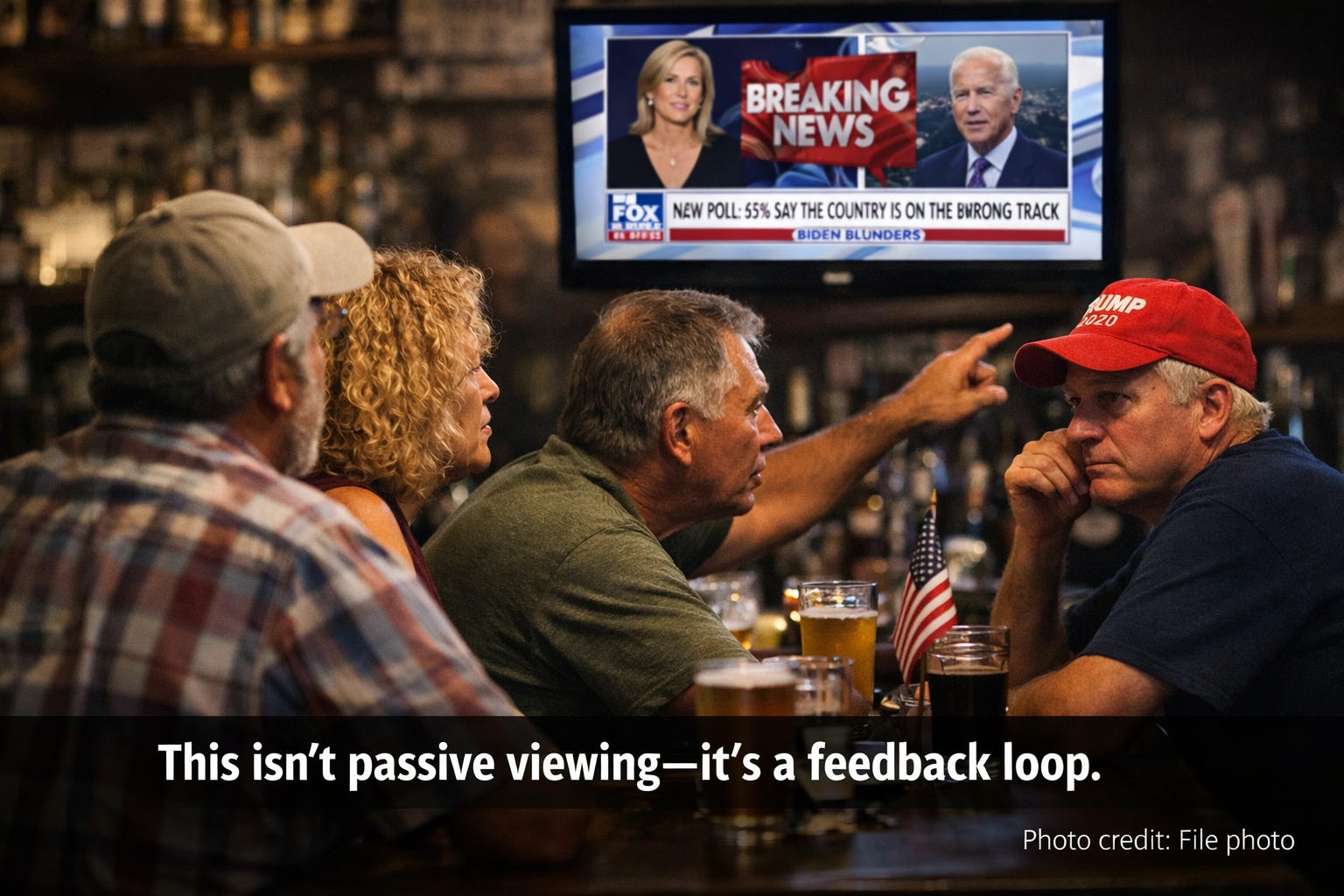
Once conservative media stopped being an amplifier and became the engine, the speed changed in ways the party either didn’t see coming or didn’t want to acknowledge it saw coming. I lean toward the second one, because the numbers were too good for nobody to notice what was happening.
Rush Limbaugh built the template and was at least honest enough to say so out loud:
“I am not a journalist. I am an entertainer.”
— Rush Limbaugh
That wasn’t modesty. That was the blueprint getting filed in public while everyone nodded and moved on. Glenn Beck turned it into a full theatrical production, like someone handed a cable budget to a guy who’d been alone in his garage with a corkboard and red string for a decade and said, "Go ahead, knock yourself out.” Sean Hannity made outrage into a nightly appointment, the political equivalent of a dinner bell, except the dinner was always the same meal and the meal was always anger.
The party didn’t push back on any of it. It adapted like someone who found a cheat code and couldn’t think of a single reason not to use it forever. The engagement was real. The loyalty was real. The votes were real. And every time it worked, the incentive calculus got a little more locked in.
What nobody wanted to look at was the other side of that ledger. Once your base starts rewarding volume over substance, you get more volume and less substance, not as an accident, but as a direct response to incentives. Once calm governance reads as weakness, the people who govern calmly stop winning primaries. Once compromise feels like betrayal, the people willing to compromise get primaried out of existence and replaced by people who aren’t, and the party slowly fills up with a very specific kind of person.
You don’t notice the drift while it’s happening because each step looks like a choice. And it is a choice. Just one made inside a context that keeps getting smaller. And by the time the context is small enough that you can feel the walls, you’re in a room you cannot back out of without paying a price the party had already decided it wasn’t willing to pay.
When No Became the Whole Personality
By the time Barack Obama took office, this thing wasn’t wobbling. It had a direction, a speed, and enough momentum that calling it drift was generous.
Opposition stopped being a strategy and became the entire identity of the party. Not policy disagreement. Not a governing alternative. Just no, reflexively, systematically, applied to everything coming from the other side, regardless of what it actually was, or where it originally came from. Healthcare reform built substantially on a Republican framework? No. Financial regulations designed to keep 2008 from happening again? No. A Supreme Court nominee who would have sailed through confirmation a decade earlier/ No, and also we’re simply not going to hold a hearing, which is a different category of no entirely, the kind that comes with real institutional damage attached.
Every time that obstruction paid off politically, it confirmed the behavior. Every time it didn’t, the lesson wasn’t to reconsider. The lesson was to go harder. Get louder. Be meaner about it. Which is exactly how you turn a governing party into a performance machine where the goal isn’t solving anything. The goal is to make sure the other side doesn’t get credit for solving anything.
Those are not the same goal. And pretending they are is how you end up with a legislative record that is essentially just a list of things you stopped, while the country kept accumulating problems that nobody in a position to address them gave a single damn about addressing.
That’s not a governing philosophy. That’s a guy who burns down his neighbor’s house and calls it home improvement.
The Line Nobody Wants to Own
There’s a quote that follows this whole story around because it’s too accurate to leave out:
“We created this monster — and now we can’t control it.”
— Anonymous Republican strategist, said by approximately one hundred Republican strategists, none of whom want their name attached to it
Yeah. No shit.
But here’s the part that quote conveniently leaves out. Creating the monster and losing control of it are two different problems. The party is occasionally willing, in quiet moments, to acknowledge the second one. The first one is where everyone suddenly gets very interested in their shoes.
You spend twenty years telling your voters the system is corrupt, the institutions are broken, and the whole apparatus exists to screw people like them. You build a media infrastructure that reinforces that message seven days a week. You run on obstruction and dress it up as principle. You reward the loudest voices and watch the quietest ones get primaried into retirement without lifting a finger to stop it.
And then someone shows up who actually believes every word of it…Who’s willing to take the logic all the way to the end of the road without flinching or hedging or pausing to wonder if things have gotten a little out of hand.
And the architects of all of it stand there with their mouths open like a guy who spent a year leaving the gas on and can’t figure out why the house is on fire.
That’s not a hijacking. That’s cause and effect. The rhetoric that built the coalition produced, over time and with depressing predictability, exactly the leader that the coalition had been trained to want. You don’t get to call that a surprise. You get to call it a result.
Verdict
The pre-MAGA Republican Party didn’t get ambushed. It got outrun by the thing it built.
Every shortcut made the next one easier. Every principle that bent for a short-term win became a principle that could bend again the next time something inconvenient came along. Every time the party chose what works right now over what we said we believe, it closed the distance between itself and a movement that doesn’t believe in anything beyond winning, staying aligned, and making sure anyone who stops doing both understands what that costs.
What you’re left with isn’t a party that just needs a course correction. It’s a party that would have to unlearn the exact behaviors that made it successful in order to be something different. And the incentives that keep it competitive in the short term are the same ones dragging it further from anything resembling long-term stability.
They weren’t taken over. They were inherited by the thing they raised.
And the people who raised it are still out there. Still explaining. Still finding new ways to frame themselves as reluctant bystanders in a story they wrote from the first page.
Which, honestly? Is the most Republican thing about any of this.
💣 TRUTH BOMB
You don’t accidentally build a movement that burns everything down. You build it on purpose, call it strategy, celebrate every time it works, and then act shocked when the fire doesn’t stop at the property line. The shock isn’t confusion. It’s the last lie in a very long series of them.
Next Autopsy: Democrats
The party that can have better ideas, better data, better demographics, and still manage to communicate like they’re asking permission to exist, then wonder why they keep getting steamrolled by people who govern like they’re running a protection racket.
That one drops next. And it’s going to hurt in a completely different direction.
Keep This Alive
I’m retired. Reader-funded. No sponsors, no corporate leash, nobody telling me to find a more balanced take or soften the landing.
Want the deeper dives? The War Room pieces? The stuff that doesn’t make the public feed? Hit upgrade and get inside.
☕ Fuel the next one: Buy Me A Coffee
Go check out Lotus Purrspective. Same world, sharper claws, zero profanity, maximum judgment.
Like it. Share it. Subscribe. Because understanding how this happened is the only way to stop being surprised every time it does.
#Republicans #PoliticalAutopsy #GOP #Democracy #AmericanPolitics #USPolitics #PartyCollapse #TheUnredactedBastard