

One of the things I enjoy most about writing Off Script is taking a story that sounds perfectly reasonable on the surface and asking, “Okay...does this actually make any damn sense?” Sometimes it does. Sometimes it doesn’t. This week’s comments about gas prices sent me down that rabbit hole.
Every once in a while I run across a political story that makes me stop and ask, “Okay...how the hell is that supposed to work?”
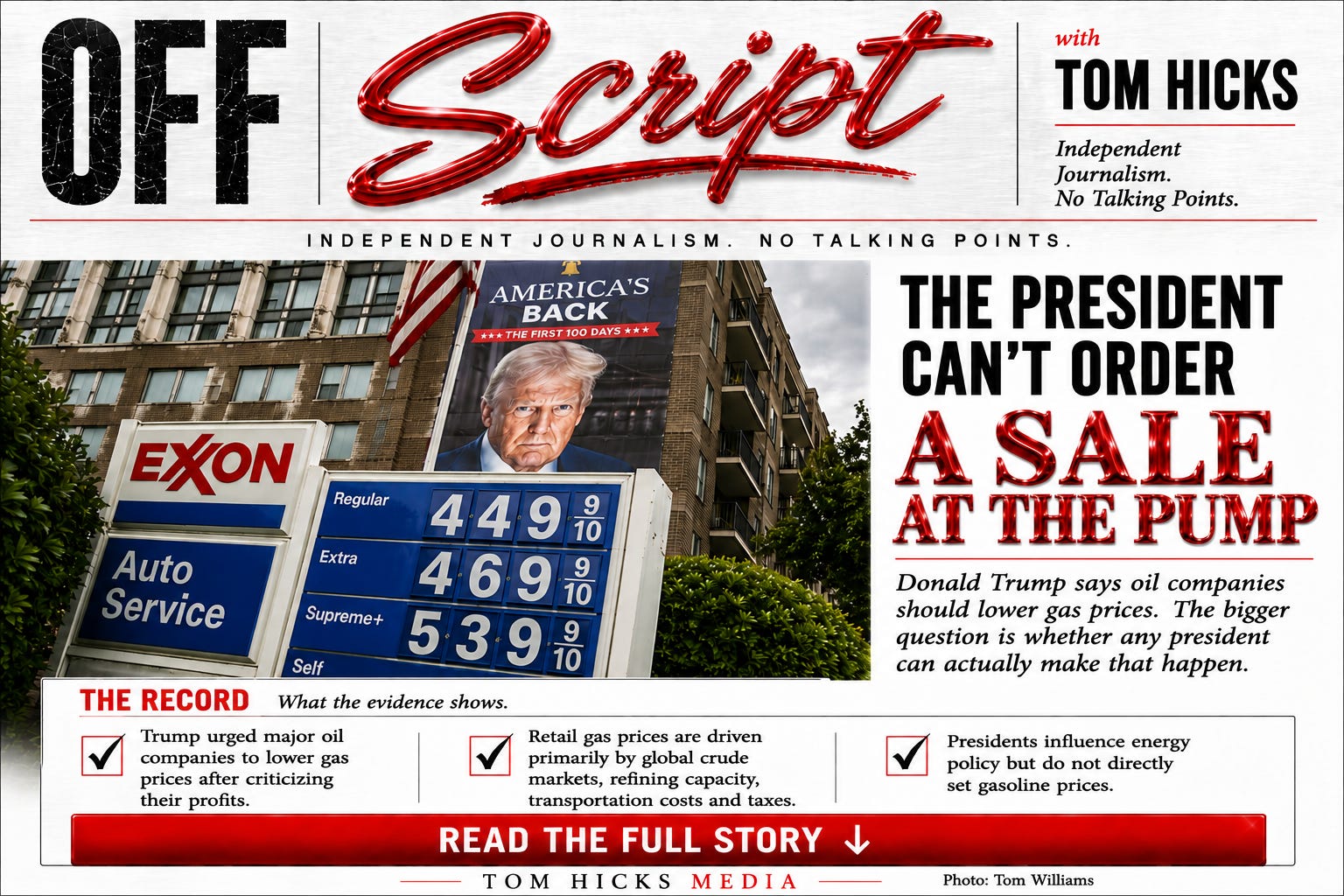
President Trump took oil companies to task for making “too much money” and said they ought to lower gasoline prices because Americans are getting hammered at the pump after oil prices jumped during the conflict involving Iran.
Now before anybody starts firing off angry emails, let me get something out of the way.
I don’t like paying four bucks a gallon any more than you do. Hell, if somebody wants to knock fifty cents off every gallon I buy for the rest of my life, I’ll be first in line to say thank you.
But after I got done nodding my head, I found myself asking the same question over and over.
How exactly is that supposed to work?
I’m serious.
Let’s pretend Exxon wakes up tomorrow morning and decides, “You know what? The president’s right. We’ve made enough money. Let’s give everybody a break.”
Then what?
Do they tell their shareholders they’re taking one for Team America? Do they ignore what every other company on Earth is charging because the White House asked nicely?
Maybe I’m the dumbass here, but that’s not how a single publicly traded company on this planet operates.
This isn’t about whether oil companies are greedy. Most giant corporations will squeeze every legal nickel they can out of a market, and if Exxon figured out a way to charge admission to walk into a gas station, some genius in a boardroom would probably pitch it by Friday.
That’s not the issue.
The issue is simpler than that.
Does anybody really believe Exxon is going to change its pricing strategy because the president held a press conference?
Because if that’s how this works now, somebody needs to explain when the hell we changed the rules.
If you’re enjoying Off Script, this is a good time to subscribe. Free subscribers get every public article, and paid subscribers help keep independent journalism independent while getting subscriber-only content and a complimentary copy of The Bullshit Detector.
Here’s where I think there’s a disconnect with how the real world actually works.
Oil companies don’t wake up asking what would make the president happy. They wake up asking how to make money. That’s the job. Their executives have a legal obligation to act in the best interests of the company's owners, not the people who occupy the Oval Office.
You can hate that system. You can argue it ought to change. You can make a damn good case that corporate America has too much power.
What you can’t do is pretend it magically stops working that way the second gasoline turns into bad politics, and that’s why this story caught my attention.
It isn’t really about Donald Trump. It’s about something every president eventually runs into.
Americans expect the White House to control prices it doesn’t actually control.
That’s a hell of a promise to make, because reality has a nasty habit of refusing to cooperate.
If you’ve been around politics for more than five minutes, you’ve probably noticed this isn’t just a Trump thing.
Joe Biden got blamed every time gas prices went up. Donald Trump got praised every time they went down. Obama heard it, Bush heard it, and hell, Jimmy Carter practically became the human face of the gas line.
Every president eventually gets handed responsibility for prices he doesn’t control because blaming one guy in Washington is a hell of a lot easier than explaining global oil markets over dinner.
That’s politics.
But here’s where I think politicians make it worse.
Instead of saying, “Look, there are things we can influence and things we can’t,” they start talking like there’s a thermostat in the Oval Office that controls inflation, gasoline, eggs, rent, airline tickets, and whatever else is making people miserable that week. It sounds great right up until you realize it’s setting people up to believe something that just isn’t true.
Now don’t misunderstand me.
Presidents aren’t powerless. They can encourage domestic production. They can change regulations. They can open or refill the Strategic Petroleum Reserve. They can negotiate with allies. They can sign or veto legislation that affects the energy industry. Those decisions matter, and sometimes they matter a lot. But none of them is the same thing as picking up the phone and saying, “Knock forty cents off unleaded by Friday.”
If it were that easy, every president would do it every single election year.
Here’s another part that doesn’t get talked about enough.
If these companies are truly making obscene profits because the market is broken, then make that argument. Investigate them. Enforce antitrust law if they’ve broken it. Propose a windfall profits tax if that’s your answer. Make the case to Congress and the American people. At least that’s a real policy discussion. Standing in front of a camera and publicly shaming companies into charging less might make a good sound bite, but it isn’t an economic strategy. It’s theater with a gas pump as the backdrop.
And before anybody accuses me of defending Exxon or Chevron, save your breath. I just think if we’re going to have this argument, we ought to have the real one instead of the one that plays better on cable news.
One of the things that worries me most about modern politics is how often we reward people for saying things that feel good instead of asking whether they make any damn sense once you think them through. We do it on the left. We do it on the right. We do it so often we’ve half convinced ourselves the economy runs on speeches.
It doesn’t.
Markets don’t care who got the loudest applause. The price of crude oil doesn’t watch cable news. Shareholders don’t vote based on campaign slogans. Reality keeps doing what reality does, no matter how many politicians promise otherwise.
Maybe that’s why this story stuck with me.
It wasn’t because Donald Trump said something I disagreed with. It was because the comments reflected something we’ve come to expect from presidents of both parties. We’ve turned them into America’s customer service department. When prices go up, we expect them to fix them. When they don’t, we assume they screwed up. Sometimes they do. Sometimes they deserve every bit of the criticism they get.
But here’s what I’d love to see.
The next time a president, any president, tells us somebody else just needs to lower prices, ask one simple question.
How?
Not the campaign answer or the applause-line answer… The real answer, because if the solution is that obvious, every president for the last fifty years would’ve already done the damn thing.
THE RECORD
Trump criticized ExxonMobil and Chevron for making “too much money” from higher oil prices linked to the conflict involving Iran and urged the companies to lower gasoline prices for consumers. Retail gasoline prices are influenced primarily by global crude oil markets, refining capacity, transportation costs, taxes, and regional supply and demand. Presidents can influence energy policy through regulation, diplomacy, and legislation, but they do not directly set gasoline prices.
The Bullshit Detector
THE MOVE:
Appeal to common frustration.
WHAT THEY WANT YOU TO HEAR:
“Oil companies are making too much money. They should just lower gas prices.”
WHAT THEY HOPE YOU WON’T ASK:
How?
More specifically, how are they supposed to lower prices while operating in a global oil market, answering to shareholders, and competing with companies selling the same commodity? If the claim is that they’re violating the law or colluding to keep prices artificially high, that’s a legal argument that deserves evidence. If the claim is simply that they’re making a lot of money, that’s a different conversation entirely.
THE QUESTION THAT BREAKS IT:
“Exactly what mechanism would force or persuade private companies to lower gasoline prices, and what would happen if they didn’t?”
Until that question gets a real answer, you’re looking at a political message, not an economic plan.
The Off Script Bullshit Detector
Political spin doesn’t care whether it comes from the left or the right. The Off Script Bullshit Detector is a practical guide to spotting propaganda, loaded language, missing context, and rhetorical sleight of hand before it fools you.
All Off Script subscribers receive it free. It’s also available for $4.95 in the Tom Hicks Media Store.
If you enjoy what I do and would like to help support independent journalism, buying me a cup of tea is a simple way to help keep the lights on. Every contribution helps.
More from Tom Hicks Media
Tom's Number Ones revisits the songs that topped America's charts on this date in history, complete with chart trivia and a trip back in time.
Panic Room Sports covers the NFL with analysis, not hot takes, and plenty of help for fantasy football players.
Lotus Purrspective proves that living with humans may be the strangest assignment any cat has ever accepted.
One Question Before You Go
What’s one thing Americans routinely blame the president for that you don’t think a president can realistically control?
One Last Thing
I keep coming back to this thought.
Most Americans blame the president when gas prices go up, regardless of who’s in office or what’s actually driving the market that week. I don’t think that’s because people are stupid. I think it’s because it’s easier to be mad at one person than at a complicated global market.
I get it because I’ve done it myself, but maybe we’d all be a little better off if we spent less time asking presidents to perform miracles and more time demanding they tell us the truth about what they actually can and can’t do.
#OffScript #Politics #Economics #GasPrices #Energy #DonaldTrump #PublicPolicy #IndependentJournalism
All true points. I just don’t understand how the prices on groceries keep going up nearly every week. How to change that? Asking for a friend. 😊