
Tom Hicks | October 28, 2026
I’ve been doing this journalism thing for a long time, and I thought I’d seen just about every variety of political ass-kissing imaginable. I’ve watched grown adults praise politicians they couldn’t stand, applaud speeches they didn’t believe, and suddenly discover previously unknown depths of admiration whenever somebody powerful walked into the room.
But apparently, kissing the president’s ass isn’t enough anymore. Now you have to give it a trophy, preferably something gold and shiny that he can hold up while everybody applauds like he’s just cured cancer.
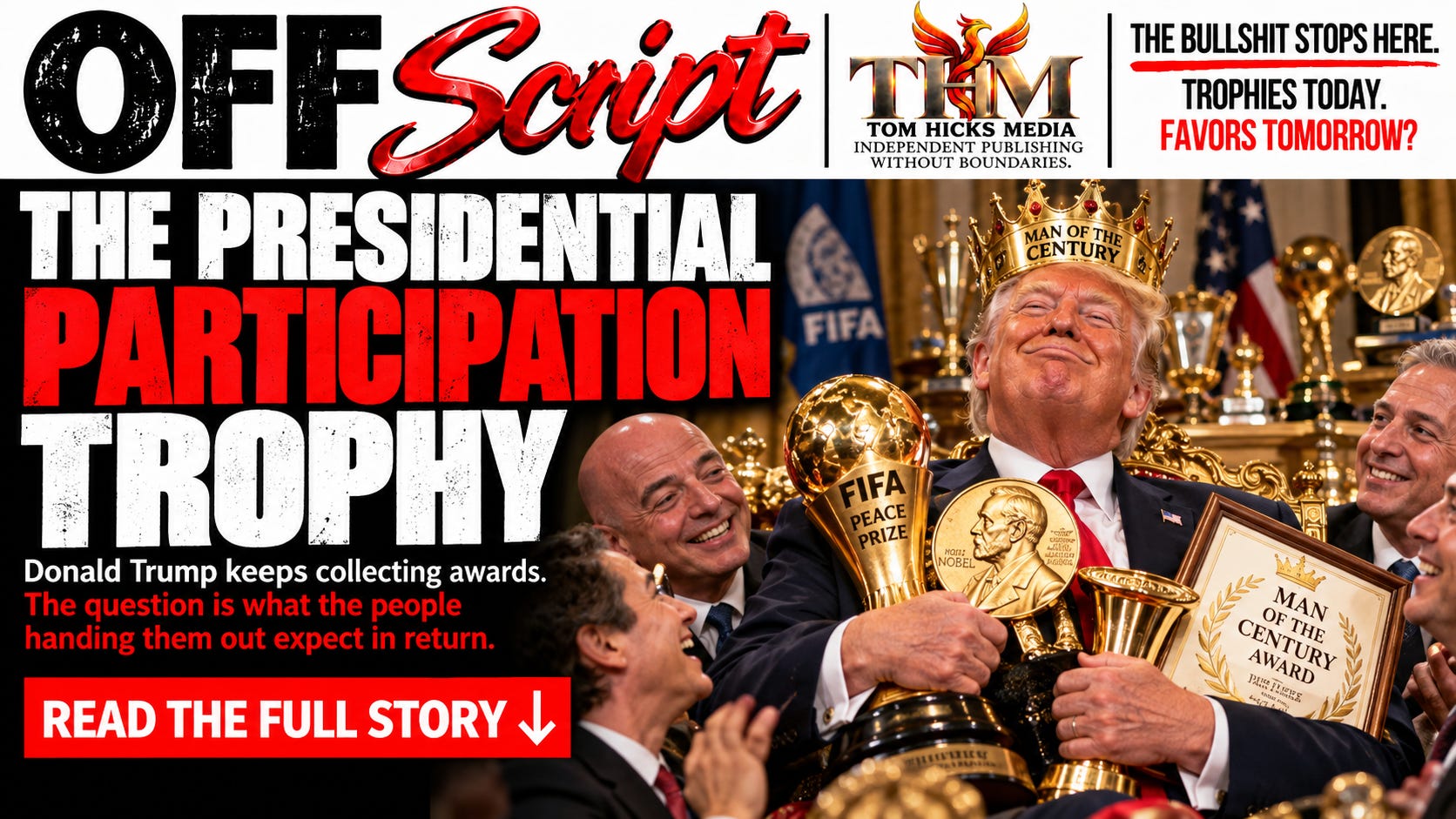
Last Thursday, Republican congressional candidate Joe Mitchell stood beside Donald Trump at a rally in Sioux City, Iowa, and presented him with something called the Man of the Century Award. Mitchell explained that Trump had been unfairly denied the Nobel Peace Prize, so he’d come up with an honor of his own. No distinguished selection committee, no internationally respected institution, no historians spending months reviewing the candidates. Just a politician with a framed certificate and an apparently bottomless supply of admiration for the man whose political support could help his career.
Jesus Christ. We’ve reached the point where losing an award means somebody can just invent another one.
I suppose it beats showing up with flowers and a box of chocolates, although chocolates might have been more useful. At least you can eat those. The whole performance looked like something you’d expect at a company banquet where the boss gets Employee of the Year for the seventeenth consecutive time, and everybody pretends the voting was close.
But underneath all that gold-colored bullshit is a question considerably more important than whether Trump has enough room left on his shelves. What happens when people who want something from the president discover that flattering him might be one of the easiest ways to get his attention?
And what happens to the rest of us if they’re right?
Before Somebody Starts Yelling About Obama
Let’s get the inevitable whataboutism out of the way before somebody pulls a muscle typing it.
Yes, Barack Obama received the Nobel Peace Prize in 2009 after less than a year in office, and plenty of people questioned whether he’d earned it. Obama himself acknowledged the controversy. Presidents have accepted honorary degrees, ceremonial medals, elaborate gifts, and awards for generations. Some deserved them, some probably didn’t, and a few should have come with a complimentary bottle of embarrassment.
Nobody invented presidential vanity in 2017. Politicians have been inhaling applause like oxygen since somebody figured out that running for office was easier than getting an honest job.
But there’s a difference between accepting an established award, receiving a diplomatic gift, and having somebody manufacture a new honor because the president didn’t get the one he wanted. There’s also a difference between genuine appreciation and calculated flattery from somebody who needs a favor.
If Joe Biden had accepted another person’s Nobel medal, or if Barack Obama had received a newly invented peace prize from an organization dependent on his administration’s cooperation, I’d expect journalists to ask questions. And if they didn’t, I’d want to know what the hell they thought their jobs were.
The issue isn’t whether Trump enjoys being praised. The man has spent decades making that abundantly clear. What concerns me is whether people with political, financial, or diplomatic interests believe that praise can influence the decisions of the president of the United States.
Because if they believe it works, they’ll keep doing it. And if they’re right, the consequences could be considerably more expensive than the trophy.
Pull Up a Chair
This is Off Script, where we look past the political theater and examine who’s operating the machinery backstage. Subscribe and join the conversation.
I can’t promise to improve your blood pressure, but I’ll do my damnedest to make sure you understand what’s happening—and who’s trying to sell you a steaming pile of bullshit.
FIFA Discovers World Peace
Last December, FIFA, the international governing body of soccer, decided the world needed another peace prize. Apparently, managing the world’s most popular sport wasn’t keeping everybody busy enough, so FIFA President Gianni Infantino presented Trump with the organization’s inaugural Peace Prize during the World Cup draw in Washington.
The presentation included a golden trophy, a medal, a certificate, and enough ceremony to make a royal coronation look like a courthouse wedding. Trump described it as a tremendous honor, which must have been a relief for FIFA. Imagine going to all that trouble and discovering the president would rather have a gift card.
FIFA credited Trump with diplomatic efforts involving international conflicts, and those efforts can be examined on their merits. But the organization never publicly explained a transparent selection process for choosing its first winner. That’s particularly interesting when you consider that the United States was preparing to host most of the 2026 World Cup, an enormous international event requiring federal cooperation on security, immigration, transportation, and countless logistical arrangements.
Infantino didn’t need Trump to be his best friend. He needed an administration willing to work with FIFA, and maintaining a favorable relationship with Washington was clearly in the organization’s interest.
Now, that doesn’t establish that the Peace Prize was some sort of under-the-table transaction. But when an organization with enormous interests before the federal government suddenly creates a prestigious new honor and hands it to the president, asking about its motives isn’t exactly a radical act of investigative journalism.
It’s the kind of question reporters are supposed to ask before everybody gets distracted by the buffet.
And here’s where the whole business gets even more ridiculous. Earlier this month, members of FIFA’s governing council reportedly called for the Peace Prize to be abolished or changed so it couldn’t be awarded to politicians, and FIFA’s social responsibility committee is reviewing its future.
Think about that. They invented a peace prize, gave it to Trump, and now they’re discussing whether they should stop giving it to people like Trump.
Somewhere there’s a trophy manufacturer wondering whether to put the molds on eBay.
The Trophy Cabinet Is Getting Crowded
The FIFA Peace Prize wasn’t Trump’s first unusual encounter with soccer hardware. During the 2025 Club World Cup, the championship trophy wound up on display in the Oval Office, and Trump said FIFA had told him he could keep it while another would be made.
The actual arrangement was more complicated. FIFA later explained that the original engraved trophy remained at its headquarters in Switzerland, Chelsea received a replica as tournament champion, and Trump had a third version recognizing the United States as host.
So no, Trump didn’t steal Chelsea’s trophy. He did, however, wind up with his own version of a trophy awarded for winning a tournament in which he hadn’t played a single minute.
There was also that much-discussed moment when Trump tucked a Club World Cup winner’s medal into his jacket pocket, prompting accusations that he’d stolen it from a player. Fuller footage showed Infantino had given him the medal, which is an important distinction. We have enough actual nonsense in American politics without manufacturing additional nonsense to keep ourselves entertained.
Still, I can’t help wondering what the players thought about the president becoming such a prominent part of their championship celebration. These guys spend their lives training, competing, and getting kicked in places most of us would prefer not to discuss. They win the tournament, and suddenly the president has hardware too.
Then there’s the Nobel medal, which takes this whole traveling trophy show into considerably stranger territory.
In January, Venezuelan opposition leader María Corina Machado visited the White House and presented Trump with her actual 2025 Nobel Peace Prize medal. Not a replica or a commemorative plaque. Her medal, awarded for her work in Venezuela’s struggle for democracy.
The Nobel Committee reiterated that the prize itself cannot be transferred, meaning Machado remains the laureate regardless of who possesses the gold. You can hand somebody your wedding ring, too, but that doesn’t make them married to your spouse.
Machado was perfectly entitled to give away the physical medal, and she had compelling reasons to seek Trump’s support during Venezuela’s political upheaval. She also expressed genuine appreciation for his actions against Nicolás Maduro, and there’s no reason to assume her gratitude was insincere.
But consider the image. A political leader seeking American support hands over the physical symbol of her own international recognition to the president of the United States. Trump accepts it, and everybody is left to debate what the gesture meant.
Somewhere in Norway, I imagine somebody developed a headache.
The Shiny Object Problem
Now we get to the part that genuinely pisses me off.
I don’t care how many trophies Trump has sitting around the Oval Office. If he wants to spend his evenings polishing medals, rearranging plaques, and admiring himself in the reflection, that’s his business. The presidency has survived plenty of oversized egos, and I’m reasonably certain the furniture can withstand another one.
The problem begins when other people start treating those medals and plaques as potential instruments of influence, especially when the people handing them out have interests that depend on decisions made in Washington.
Foreign governments have always used ceremony and flattery in diplomacy. Lavish state dinners, military parades, elaborate gifts, and carefully chosen compliments are part of the business. Every president encounters them, and anybody who believes world leaders spend their evenings exchanging heartfelt compliments out of pure affection probably still thinks the tooth fairy operates a legitimate financial institution.
But the presidency isn’t supposed to be a popularity contest conducted by people who have business before the federal government.
Here’s what worries me. Suppose you’re a foreign leader seeking favorable trade terms, military assistance, or relief from economic sanctions. You’ve got experienced diplomats, policy experts, and intelligence analysts working on your behalf, but you’ve also watched the American president enthusiastically accept awards and public recognition.
Wouldn’t you at least consider whether a little extravagant praise might help your cause?
You’d be foolish not to consider every lawful diplomatic advantage available to you. And that’s precisely why the president needs to recognize when somebody is trying to butter him up.
Notice that I’m talking about what people believe might work. We don’t have to pretend we can read Trump’s mind, and we shouldn’t claim that a particular medal caused a particular policy decision without evidence connecting the two. We can examine what people do, what they say, what they’re seeking, and what happens afterward.
That’s journalism. Making shit up because it sounds good is a different profession, although Washington seems to employ plenty of specialists.
The potential consequences reach far beyond an embarrassing photograph or another trophy gathering dust. We’re talking about military deployments, international sanctions, trade agreements, diplomatic recognition, and decisions affecting millions of people who will never set foot inside the Oval Office. A foreign government doesn’t need to purchase a president outright to gain an advantage. Sometimes it merely needs to make its requests seem more appealing, its representatives more welcome, or its interests more worthy of consideration.
That’s why the United States has institutions, advisers, ethics safeguards, and procedures intended to keep presidential decisions from becoming purely personal transactions. Those safeguards aren’t perfect, and they never have been, but they exist because the office is too powerful to operate like a customer loyalty program.
The president isn’t supposed to be collecting points toward a free toaster while the rest of us wonder who’s paying for the electricity.
The People Handing Out the Hardware
There’s another side to this story that deserves attention, because the people presenting these awards aren’t necessarily idiots. Some are experienced politicians, sophisticated diplomats, and executives who understand exactly how power works.
Joe Mitchell is a politician trying to advance his career. Gianni Infantino runs an international organization with enormous commercial interests. María Corina Machado is navigating an extraordinarily difficult struggle over her country’s political future. Their situations are different, and their motivations shouldn’t be treated as interchangeable, but each had a reason to value a favorable relationship with Donald Trump.
That’s the common thread worth examining.
People who understand power also understand that making somebody feel appreciated can sometimes be easier than persuading them with a stack of briefing papers. It’s why salespeople compliment your taste, lobbyists remember your birthday, and politicians suddenly become fascinated by whatever happens to interest the person standing in front of them.
Flattery isn’t new. Neither is manipulation. But when the person receiving the attention controls American foreign policy, the stakes are a hell of a lot higher than whether somebody gets talked into buying a leather sofa.
I don’t know whether Trump’s decisions have been changed by any of these particular awards. But I do know that waiting until somebody produces a smoking-gun memo before asking whether presidential decisions are vulnerable to personal influence would be a spectacularly stupid way to protect the country.
We investigate potential conflicts because they can become actual problems. We ask questions because the answers matter. And we don’t stop asking just because somebody waves a shiny certificate in front of a television camera and announces that everything is wonderful.
One Question
When somebody gives the president an award while seeking something from his administration, where should we draw the line between harmless flattery and an attempt to influence government policy?
I’d particularly like to hear from people who believe these presentations are entirely innocent. What standard would you apply, and would you apply it to a president from the other party?
The Real Price of an Award
Maybe none of these presentations changed a single presidential decision. Maybe every award was offered sincerely and accepted without any expectation of special treatment. That’s possible, and I’m not going to manufacture evidence to argue otherwise.
But protecting presidential judgment requires more than proving corruption has already occurred. It means recognizing vulnerabilities before somebody exploits them, and expecting the person occupying the Oval Office to understand the difference between somebody honoring the presidency and somebody trying to use it.
I turned 70 this summer, and I’ve watched enough presidents come and go to know that ego isn’t exactly a rare commodity in Washington. Hell, a politician without an ego would probably need a doctor’s note. But there’s a difference between enjoying applause and allowing applause to become a substitute for judgment, particularly when the people applauding have something they want from you.
The United States doesn’t elect a president to collect compliments on our behalf. We elect one to make decisions that serve the country, including decisions that may disappoint people who have been exceptionally generous with their praise.
So the next time somebody hands Donald Trump another medal, trophy, or framed certificate declaring him the greatest something-or-other in human history, go ahead and laugh. Some of this stuff is genuinely ridiculous, and God knows we could use a laugh.
Then ask yourself who paid for the trophy, what they wanted from the president, and whether they got it.
Because the dangerous part isn’t the shiny object. It’s what somebody might get in exchange for handing it over.
The Bullshit Detector
Three fresh specimens from the misinformation sewer. Bring boots.
The Official Bullshit Detector Stink Scale
RatingClassification💩A Little Whiff — Misleading, with some truth💩💩Something Smells — Distorted or missing context💩💩💩Steaming Pile — A seriously deceptive claim💩💩💩💩Full-Blown Bullshit — Major fabrication💩💩💩💩💩Weapons-Grade Bullshit — Maximum deception or potential harm
1. Trump Wins an Election That Hasn’t Happened
Claim: A Truth Social post supposedly showed Trump declaring a Republican sweep of the 2026 midterms, dismissing ballot counting, and warning that any Democratic victories would be challenged.
Bullshit: The post was fabricated. Fact-checkers found no matching statement on Trump’s account or in an archive of his posts. The fake even claimed Republicans had won every Senate seat, although only a portion of Senate seats are contested in a regular midterm election.
💩💩💩💩💩 — Weapons-Grade Bullshit
Why: Apparently, waiting for Americans to vote was too much trouble. Somebody decided to invent the election results, manufacture a presidential declaration, and throw in a Supreme Court warning for dramatic effect. When people are already being told not to trust elections, fake presidential statements about imaginary results are more than ordinary internet stupidity. They’re gasoline looking for a match.
2. Beyoncé Takes an Imaginary Flight
Claim: Newly leaked Epstein files supposedly contained photographs of Beyoncé aboard an aircraft with Jeffrey Epstein and a shirtless Donald Trump.
Bullshit: Fact-checkers assessed the images as highly likely to be AI-generated and found no corresponding photographs in the searchable Epstein files.
💩💩💩💩 — Full-Blown Bullshit
Why: Apparently, the actual Epstein scandal wasn’t ugly enough, so somebody decided to throw Beyoncé into the picture and remove Trump’s shirt. The internet has reached the point where photographic evidence can be manufactured faster than somebody can ask whether the photograph exists. And once the fake circulates, the damage is already underway.
3. The Refugee Supporter Who Supposedly Got What She Deserved
Claim: A woman who had publicly welcomed refugees later watched those same people loot her Paris store.
Bullshit: Reuters traced the supposed protest photograph to a digitally altered image from a 2016 London demonstration. The woman confronting looters in the Paris video was a different person, and the store’s parent company said she wasn’t an employee.
💩💩💩💩 — Full-Blown Bullshit
Why: Somebody manufactured a little morality play about a compassionate woman receiving her punishment. The photograph was altered, the identity was false, and the supposed poetic justice never happened. But why let reality interfere with a perfectly good opportunity to make strangers hate one another?
There’s a New Neighbor. You’ve Been Warned.
Meet Eve N. Tempere, the newest voice at Tom Hicks Media. Her new publication, Eve Next Door, debuted today with “Well, Hello There. I See I Have Company.”
Eve’s 52, has a coffee mug, a sharp tongue, and an unfortunate habit of noticing things the neighbors would rather keep to themselves. She’s also considerably more welcoming than I am, although that’s not exactly a high bar.
She’s put the coffee on, and you’re invited to stop by. Just don’t assume she won’t ask questions.
There’s a New Woman in the Neighborhood. God Help Us.
Eve N. Tempere has officially opened her front door at Eve Next Door. Her debut, “Well, Hello There. I See I Have Company,” is live, and she’s already serving coffee with a side of unsolicited observations.
Meet Eve and read her first column here.
Around Tom Hicks Media
Plenty is happening beyond the political circus. Blind Spot, our Sunday companion to Off Script, gets underneath the election machinery and examines the rules, money, and institutions that shape what happens after voters cast their ballots. Panic Room Sports brings smart coverage with attitude to the games, decisions, and occasional officiating disasters that make sports fans question their sanity.
If you’d rather take a break from Washington, Chart Collision offers six songs, six clues, and a mystery Bonus Track every day. Rabbit Ears Classic TV revisits the programs that once brought everybody into the living room, while The Backlot Ghost explores memories of movies and performers, as well as Hollywood stories that refuse to stay buried.
Our resident feline authority holds court in Lotus Purrspective, where the household continues operating under questionable human management. What the Hell? digs up the real stories that sound like somebody made them up, and Frank N. Krancke is now dispensing his particular brand of irritation in Is It Just Me?. For a little neighborhood conversation, Eve N. Tempere has opened the door at Eve Next Door, where Wednesday coffee comes with opinions nobody necessarily requested.
And Then There’s Lucy…
She’s four and a half. Not four. Four and a HALF. And she has some serious questions about the way grown-ups run this world.
Just Lucy is coming soon to THM. God help the adults.
Come Argue With Us
The Tom Hicks Media Discord is open. Bring an argument, a question, an interesting story, or just yourself. We have room for people who disagree without treating every conversation like a televised congressional hearing.
Know somebody who thinks every presidential award is a sacred honor? Or somebody convinced every trophy comes with a secret deal? Send them this column and see whether they can agree on the difference. I’ll be over here with the coffee, watching the argument unfold.
#OffScript #DonaldTrump #PoliticalAccountability #PresidentialPower #FIFA #NobelPeacePrize #PoliticalSatire #MediaLiteracy #BullshitDetector
Thank you for your good works to help right the ship of state, which is decidedly on a tipping keel these days.
Lotus is great, and looking forward to Lucy—doncha know that “and a half” is what makes all the difference in kids’ race to adulthood? (:-)))