

EDITORIAL NOTE
Let’s get two things straight before anybody starts screaming that I’m accusing Donald Trump of something I can’t prove. The Office of the Comptroller of the Currency has given World Liberty Trust Company preliminary conditional approval, not final approval, for a national trust bank charter, and I have found no evidence that Trump personally ordered the OCC to approve it.
That matters. It also doesn’t make what follows smell any better.
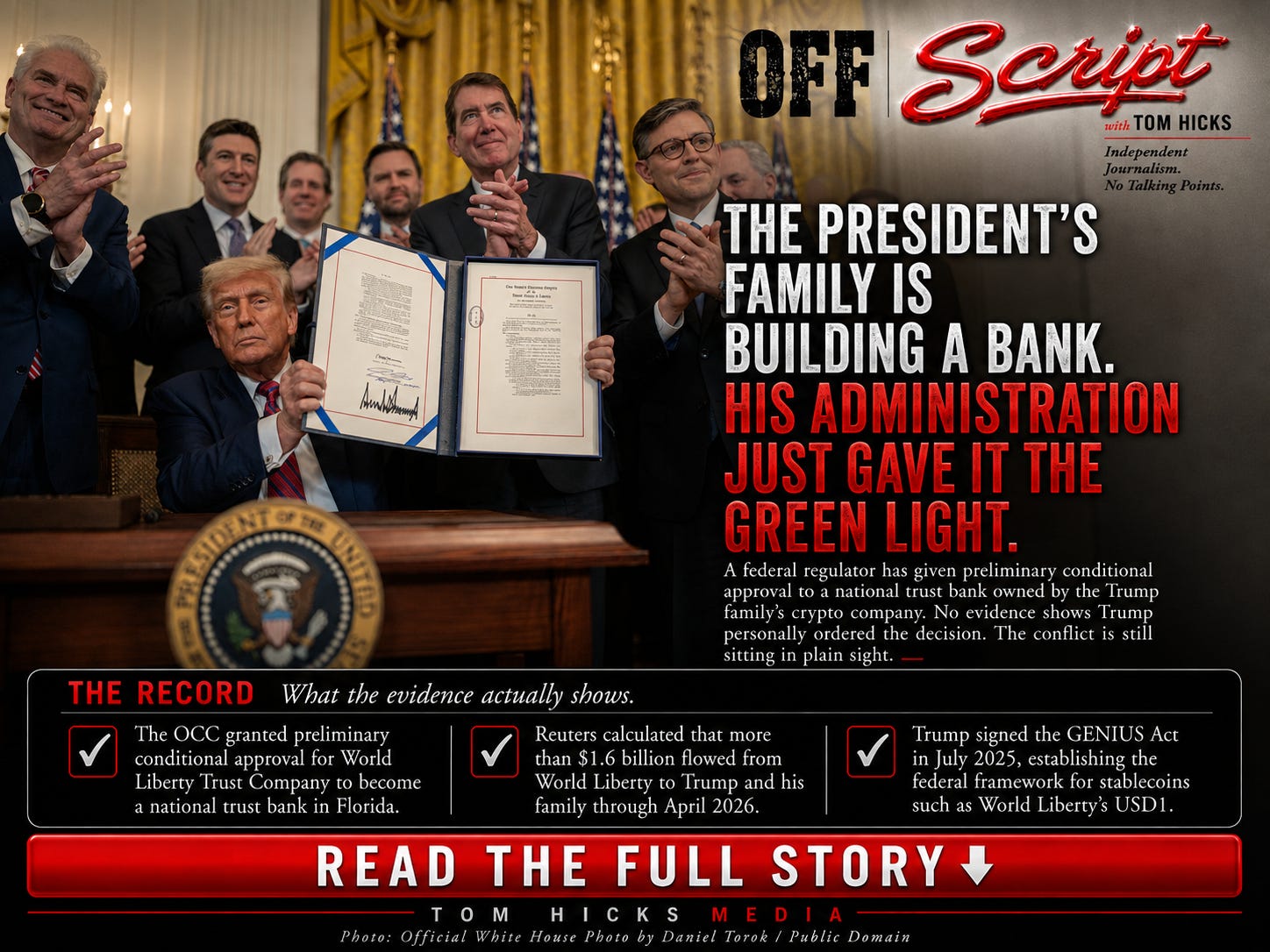
Imagine we’re sitting at a bar and I tell you that the president’s family has a business that has already made them a shitload of money. Then I tell you that business needed approval from a federal regulator inside the executive branch, and the regulator said yes. You’d probably put your drink down and ask me the same question I had: How in the hell is this even allowed to happen?
On Friday, August 14, the Office of the Comptroller of the Currency issued Corporate Decision No. 1385. The decision gives preliminary conditional approval for World Liberty Trust Company, National Association, to become a federally chartered national trust bank in Florida. If it clears the remaining conditions, the bank will be able to issue and redeem the USD1 stablecoin, maintain its reserves and provide digital-asset custody services nationwide.
This isn’t JPMorgan with a new sign out front, so let’s not bullshit about what kind of “bank” we’re talking about. A national trust bank generally doesn’t take ordinary deposits or make consumer loans the way the bank down the street does. What this charter does is allow World Liberty to bring important parts of its stablecoin business under its own roof instead of relying on BitGo to handle them.
And World Liberty Financial isn’t some company Trump once shook hands with at a golf tournament. It is the Trump-family-backed crypto operation launched with members of the Trump and Witkoff families, and Trump has been listed as a co-founder emeritus while his sons have remained closely associated with the venture. Eric Trump even signed one of the passivity commitments attached to the OCC decision on behalf of a Trump-affiliated investment entity.
SUPPORT INDEPENDENT REPORTING
Your subscription helps fund reporting, research, publishing, new features, and the continued growth of every Tom Hicks Media publication. If you’re already a subscriber, thank you — you’re helping me do this without having to pretend bullshit is merely “an alternative perspective.” If you’re not, this would be an excellent time to fix that.
The money involved here isn’t pocket change, even by Trump standards. Reuters calculated that World Liberty had funneled more than $1.6 billion to Trump and his family through April 2026, while Trump’s 2025 financial disclosure showed enormous income from his broader crypto ventures. Reuters separately reported nearly $800 million connected to World Liberty in that disclosure, while AP calculated that Trump took in nearly $1.2 billion from his crypto businesses overall during 2025.
So now we arrive at the part that would cause Washington to spontaneously combust if the names were different. The president’s family is making enormous sums in an industry his administration has aggressively embraced, and a federal regulator under that administration has conditionally approved a charter that could make one of the family’s most important crypto products easier to expand. That does not prove the application was improperly approved, but pretending there is no conflict worth discussing requires a level of willful blindness that should qualify as a preexisting condition.
Trump didn’t exactly inherit a government indifferent to crypto and reluctantly sign the paperwork. In January 2025, he issued an executive order directing the government toward a friendlier digital-asset regulatory framework, and later that year he signed the GENIUS Act establishing a federal framework for stablecoins. The White House openly says it wants to make the United States the “crypto capital of the world.”
To be fair — and this part matters — World Liberty isn’t the only crypto company getting this treatment. The OCC has granted similar conditional approvals to other digital-asset companies, including Ripple, BitGo and others, as the regulator opens the federal banking system to more crypto firms.
That’s an argument that World Liberty may have received the same regulatory opportunity other companies received. It is not an answer to the much simpler question of why the sitting president’s family should be in a position to benefit financially from decisions made by a government he runs. Those are two different questions, and Washington has become awfully talented at answering the first one whenever somebody asks the second.
The OCC anticipated the problem. Its decision says Comptroller Jonathan Gould and agency staff acted consistently with their statutory and ethical duties, and Reuters reports the application was handled by career employees who would also supervise the bank. The agency also required passivity commitments from several investors saying they would not attempt to control or influence the bank’s decisions.
Fine. Good. That’s exactly how the OCC should handle an application if it believes the applicant qualifies.
But it still leaves us with the president of the United States standing on one side of the federal government while his family’s financial interests stand on the other. You can build every procedural firewall available and still have a goddamn fire hazard.
There’s another complication, because apparently this story wasn’t complicated enough already. Democratic senators earlier asked for a national-security review after reports that interests linked to the United Arab Emirates’ national security adviser purchased a $500 million stake in World Liberty Financial. The OCC’s decision acknowledges concerns about foreign investors and says relevant investors made passivity commitments, but the existence of those financial relationships only raises the stakes when the family business sits this close to American public policy.
Again, there is no evidence in the material I reviewed proving a quid pro quo between that investment and any decision by the Trump administration. That sentence needs to be here because evidence matters more than whatever conclusion makes us feel good. What is documented is a foreign-linked investment in a business financially tied to the president’s family, followed by that business seeking and receiving preliminary federal regulatory approval.
Here’s where the whole thing gets almost absurd. The primary federal criminal conflict-of-interest laws that would ordinarily restrict executive-branch officials from participating in matters affecting their financial interests do not legally apply to the president or vice president, according to the Office of Government Ethics.
Read that again if you need to. The problem isn’t that there’s some magical law declaring a president incapable of having a conflict of interest; the problem is that the law leaves the president outside restrictions that apply to other executive-branch officials. Even the Office of Government Ethics has made the distinction that exemption from the statute does not mean a president is somehow incapable of having an actual conflict.
The White House says there is no conflict because Trump’s assets are held in a trust managed by his children and that the president acts only in the public interest. But a traditional blind trust is managed by an independent trustee precisely so the officeholder doesn’t know what the hell is being bought, sold, or managed on his behalf. A trust managed by your own children doesn’t make your financial interests disappear simply because somebody stapled the word “trust” to the paperwork.
And that’s why I’m less interested in whether somebody can eventually produce an email reading: Dear Comptroller, please approve my family bank. Love, Donald. That would certainly simplify the story, but we don’t need it to identify the problem in front of us. Ethics rules exist partly because public officials shouldn’t put citizens in the position of having to investigate whether government decisions benefited them accidentally or on purpose.
For decades, Americans have argued about presidential corruption as though the hard part were catching somebody slipping an envelope across a table. We’ve apparently reached the more efficient model where the financial interest can sit in plain sight, the government can make a decision affecting it through ordinary channels, and everyone can announce that the proper forms were filled out. Nothing hidden, nothing whispered, nothing under the table.
Hell, we moved the table.
I don’t know whether the OCC would have approved World Liberty’s application if Donald Trump were selling insurance in Florida instead of sitting in the Oval Office. Maybe it would have, and the fact that other crypto firms have received similar charters gives the agency a legitimate argument that World Liberty was treated like everyone else.
But that’s precisely why presidents historically were expected to put meaningful distance between public power and private money. The purpose wasn’t merely to prevent provable corruption after it happened; it was to keep Americans from having to wonder whether presidential power and presidential profit were sharing the same checking account. Trump has spent years demonstrating how much of that system depended on presidents voluntarily respecting boundaries Congress never thought it needed to nail to the floor.
And maybe that’s the real story here. We keep waiting for a siren to go off when something crosses the line, only to discover that the line was a norm, the alarm was voluntary, and the guy standing next to the switch owns part of the building.
THE RECORD
The approval is real, but it is not final. The OCC granted World Liberty Trust Company preliminary conditional approval on August 14 and explicitly retained the authority to modify, suspend, or rescind that approval before the bank begins operations. The company still must satisfy preopening requirements before receiving final authorization.
This is a national trust bank, not an ordinary retail bank. Its proposed business centers on the USD1 stablecoin, reserve management, digital-asset custody and related conversion services rather than ordinary checking accounts, consumer deposits and mortgages. The charter nevertheless gives World Liberty the ability to perform important functions itself that are currently handled by BitGo.
The Trump family’s financial connection is substantial. Reuters calculated that more than $1.6 billion flowed from World Liberty to Trump and his family through April 2026, and federal disclosure documents show crypto became one of Trump’s largest sources of income. Whatever you think of cryptocurrency, this isn’t some distant investment buried on page 847 of a mutual fund statement.
The OCC says its process was proper. Agency officials say career staff reviewed the application under established procedures and that the comptroller and staff complied with their ethical obligations. That deserves to be included in the record right next to the equally undeniable fact that the beneficiary is a company financially connected to the sitting president’s family.
THE BULLSHIT DETECTOR
The Crime Drop Started When Trump Took Office? Nice Try.
Trump used the FBI’s new 2025 crime numbers Friday to argue that his law-and-order policies produced America’s dramatic decline in violent crime. The decline is real — homicide fell 18.1% in 2025 and violent crime fell 9.3% — but the trend started before Trump returned to office, with violent crime already falling in 2023 and 2024. Experts also say there is no single proven explanation for the nationwide decline. Taking credit for a good number is politics; rewriting when the number started moving is bullshit.
The Sex-Trafficking Crackdown That Somehow Produced Fewer Cases
The Trump administration has repeatedly called fighting sex trafficking a priority, but Reuters found federal sex-trafficking charges running at their slowest pace since 2010. Through June, the Justice Department charged 73 people, about 22% below the average for the same period during the previous three years, while investigators and advocates described staffing losses, resource shortages and agents diverted toward immigration enforcement. You can call something a priority at every press conference in Washington. Eventually somebody is allowed to look at what you actually did.
No, Maricopa County Did Not Find 74,000 Mystery Ballots
A recycled 2020-election claim is making the rounds again, alleging that Maricopa County received more than 74,000 mail ballots for which there was no record of ballots ever being sent. Reuters traced the claim to a misinterpretation aired during Arizona’s 2021 Senate election review; the number did not represent 74,000 mysterious or invalid ballots. Five years later, the corpse of this bullshit apparently still refuses to stay buried. At this point, the 2020 election has had more sequels than Rocky.
FROM OFF SCRIPT: THE BULLSHIT DETECTOR
The daily Bullshit Detector catches the lies, distortions, and recycled nonsense that don’t need 2,000 words to take apart. The Bullshit Detector goes further, showing you how to spot the tricks before somebody else has to explain why they’re bullshit.
It’s $4.95 at the Tom Hicks Media Store, or free to all Off Script subscribers. Consider it a pocket-sized defense against people who are counting on you not checking their work.
AROUND TOM HICKS MEDIA
Lotus Purrspective — Lotus continues her daily investigation into human behavior, a field in which we keep providing her with an almost irresponsible amount of material. Read her before she decides the species needs outside management.
Tom’s Number Ones — The daily music time machine keeps digging through the charts, the songs and the odd little cultural moments surrounding them. Sometimes the fastest way out of 2026 is three minutes and a good chorus.
Panic Room Sports — Football season is getting close enough for everybody to start overreacting again, which means the Panic Room is officially entering its natural habitat. Everyone reacts; we’ll check the tape first.
BUY ME A CUP OF TEA
Off Script doesn’t have corporate sponsors standing over my shoulder deciding which conflicts are too awkward to discuss. If you value independent reporting with enough room to call bullshit when the facts justify it, you can help keep the kettle going. Every cup helps pay for the research, tools, and publishing costs behind Tom Hicks Media.
ONE QUESTION BEFORE YOU GO
Forget Trump for a second and make the rule apply to everybody. If a sitting president’s family owns a business that needs approval from an agency inside that president’s administration, should the family be allowed to keep that financial interest while the president is in office? I’m curious where you draw the line — and whether that line changes depending on which party controls the White House.
#DonaldTrump #WorldLibertyFinancial #Crypto #Banking #ConflictOfInterest #GovernmentEthics #IndependentJournalism #OffScript #TomHicksMedia