

Tom Hicks | November 17, 2026
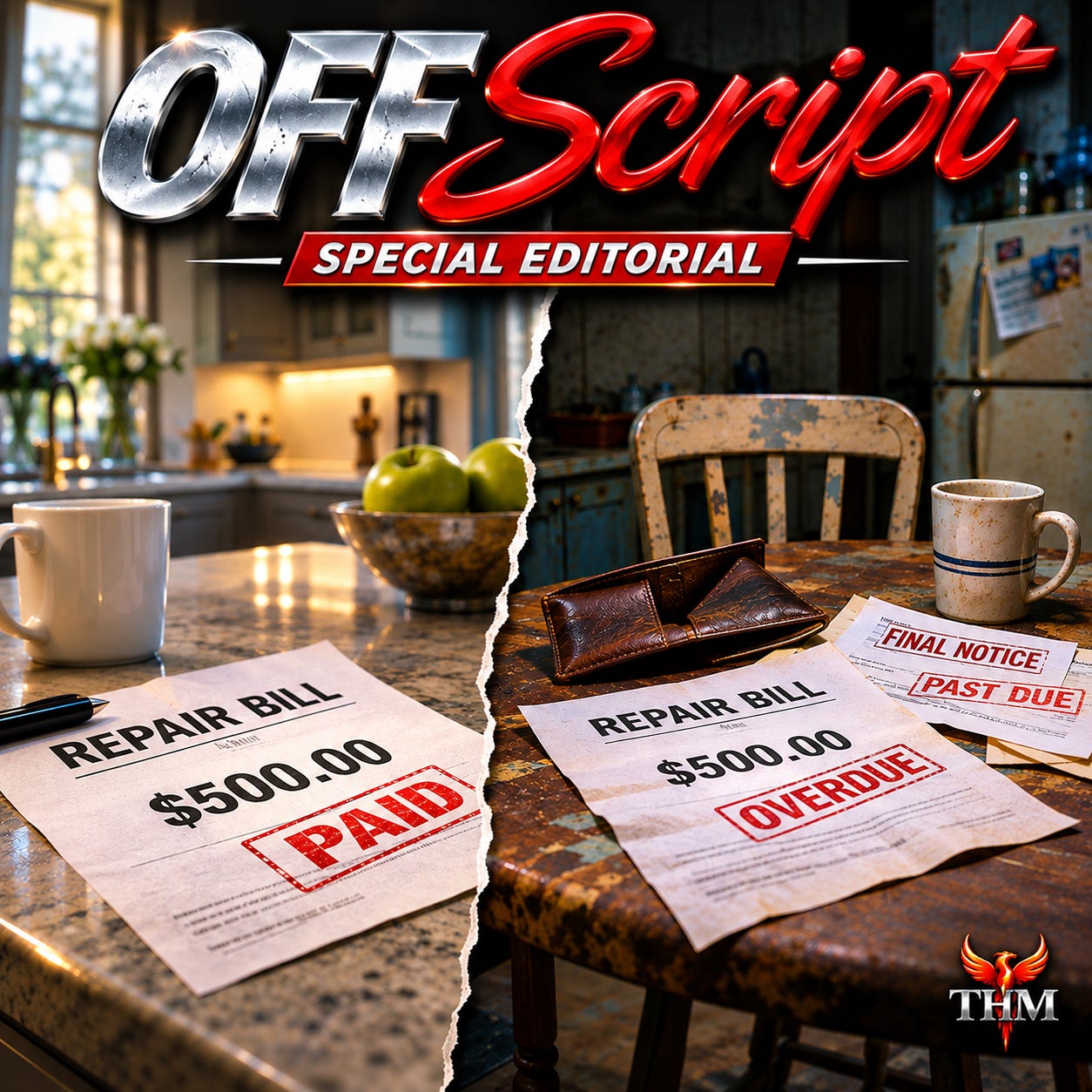
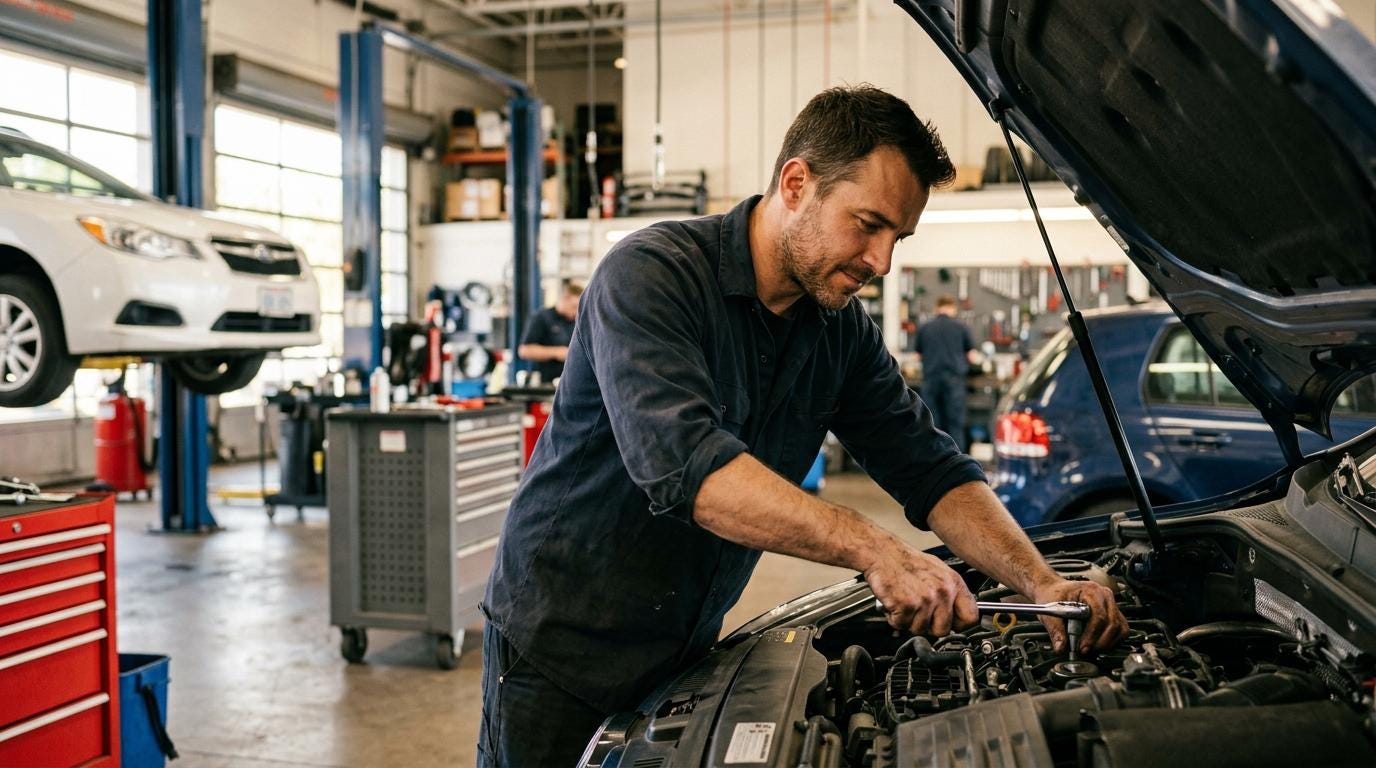
Two Americans get hit with the same $500 car repair bill. Neither expected it, neither particularly enjoys handing over the money, and both would have preferred spending their Tuesday doing just about anything else.
The first guy pulls out a credit card, pays the mechanic, and drives home mildly irritated. He might complain about the price of auto repairs over dinner, but by Wednesday the whole thing is behind him. The second guy has $83 in checking, rent due Friday, and a boss who doesn’t consider a broken-down car an acceptable excuse for missing work. He needs the car to get to the job that pays for the car, which is a pretty neat little arrangement until the damn thing stops running.
Same repair. Same $500. Two entirely different financial disasters, depending on which side of the checking-account balance you happen to live on.
And here’s the part that really pisses me off: the second guy is considerably more likely to get a lecture about financial responsibility.
Apparently, the American Dream comes with a deductible.
EVERYBODY’S AN EXPERT WHEN IT’S SOMEBODY ELSE’S MONEY
We’ve developed a remarkable national talent for telling people who don’t have enough money what they ought to be doing with it.
Build an emergency fund. Save six months of expenses. Buy reliable transportation. Improve your skills. Invest in your future. Stop living paycheck to paycheck.
Wonderful advice. While we’re at it, perhaps we should tell drowning people to consider buying a boat.
I’m not arguing against saving money. Of course people should save when they can. I’m arguing against the smug assumption that everybody has the same opportunity to do it, and that anyone who hasn’t must be an irresponsible idiot.
The Federal Reserve’s latest household economic survey found that 63% of American adults could cover an unexpected $400 expense using cash, savings, or a credit card they could pay off with the next statement. That leaves 37% who would need another way to handle it, including borrowing, selling something, carrying credit card debt, or simply being unable to pay right away.
The same survey found that 16% of adults hadn’t paid all their bills during the preceding month. Another 26% had skipped some medical care because of the cost during the previous year.
Think about that last number. More than a quarter of adults passed up some medical care because they couldn’t afford it. We tell people to take care of themselves, then act surprised when they don’t rush to a doctor’s office with money they don’t have.Source: Federal Reserve, Economic Well-Being of U.S. Households in 2025, May 2026
If this kind of independent commentary matters to you, subscribe to OFF SCRIPT. We follow the facts, call out the bullshit, and occasionally ask questions that make people in expensive suits uncomfortable. Free subscriptions are welcome, and paid subscriptions help keep the lights on.
THE SAME MISTAKE DOESN’T COST EVERYBODY THE SAME
Let’s return to our two drivers.
The guy with money pays $500 and gets his car back. The guy without money might have to borrow the repair cost, possibly at an ugly interest rate. If he can’t get the car repaired immediately, he might miss a shift. If he misses a shift, his paycheck shrinks. If his paycheck shrinks, the rent might be late. If the rent is late, there’s another charge waiting to introduce itself.
And if he finally catches up, congratulations. He’s now exactly where he was before the car broke down, except he’s exhausted, probably behind on something else, and wondering what fresh financial ambush next Tuesday has planned.
People sometimes call this a cycle of poverty. That’s accurate, but it makes the whole thing sound almost mechanical, as though nobody designed or benefits from the penalties that keep piling up.
Banks charge fees. Lenders collect interest. Landlords may impose late-payment penalties. Service providers charge reconnection fees. Each institution can explain its particular charge, and some charges cover genuine costs or risks. But from the perspective of the person paying them, the combined effect is brutally simple: the less money you have available when something goes wrong, the more expensive recovering from it can become.
There’s something spectacularly screwed up about that.
ONE QUESTION
Have you ever watched a relatively small financial problem snowball into something much worse?
I’m interested in the real experiences here, whether they happened to you, someone in your family, or somebody you worked with. You don’t have to share anything private. Sometimes the simplest examples explain more than another politician’s speech about economic opportunity.
THE LUXURY OF MAKING A BAD DECISION
Here’s something we don’t say nearly often enough: having money doesn’t necessarily mean you’re better at making decisions. Sometimes it means you can afford to make worse ones.
A financially comfortable person can buy a lousy car, take an unsuccessful career gamble, invest in something foolish, or quit a miserable job without immediately putting dinner or housing at risk. Those decisions may still hurt, but there’s a cushion underneath the landing.
Someone without that cushion has to calculate everything differently.
Should I take a better-paying job if it means losing reliable transportation or affordable childcare? Should I spend money on preventive dental work now or wait until the pain becomes unbearable? Should I replace the worn-out tires before winter or make sure the heating bill gets paid?

These aren’t always choices between good and bad. Sometimes they’re choices between two bad possibilities, and the person making them is trying to figure out which one will hurt less.
That’s why I have very little patience for people who look at somebody else’s financial problems and announce that they would have made better choices.
Maybe they would have. Maybe they wouldn’t.
But unless they’ve faced the same circumstances, with the same resources and the same consequences, they’re grading a test they never had to take.
And before somebody accuses me of suggesting that personal responsibility doesn’t matter, save your breath. It matters enormously. People should think carefully, plan ahead, honor their obligations, and avoid unnecessary debt when possible.
But personal responsibility isn’t a magic trick. You can’t responsibly save $300 out of a paycheck that has $12 left after the essentials are covered. You can’t budget your way around every emergency, and you can’t always shop your way into a better deal when the cheaper choice requires money you don’t have upfront.
A person who buys a cheap pair of work boots every year because he can’t afford a durable pair isn’t necessarily careless. He may understand the economics perfectly well. Understanding them doesn’t put another hundred bucks in his pocket.
That’s the difference between knowing the right decision and being able to afford it.
POVERTY IS EXHAUSTING, AND THAT MATTERS
We tend to discuss financial hardship as though it were primarily a math problem. Income comes in, expenses go out, and if the numbers don’t work, somebody must be doing the arithmetic wrong.
But financial insecurity also consumes time and attention.
Imagine spending every week calculating which bill can wait, which creditor might grant an extension, whether there’s enough gasoline to get to work until payday, and whether the grocery money will stretch through Sunday. Now add a sick child, a broken appliance, or an unexpected reduction in working hours.
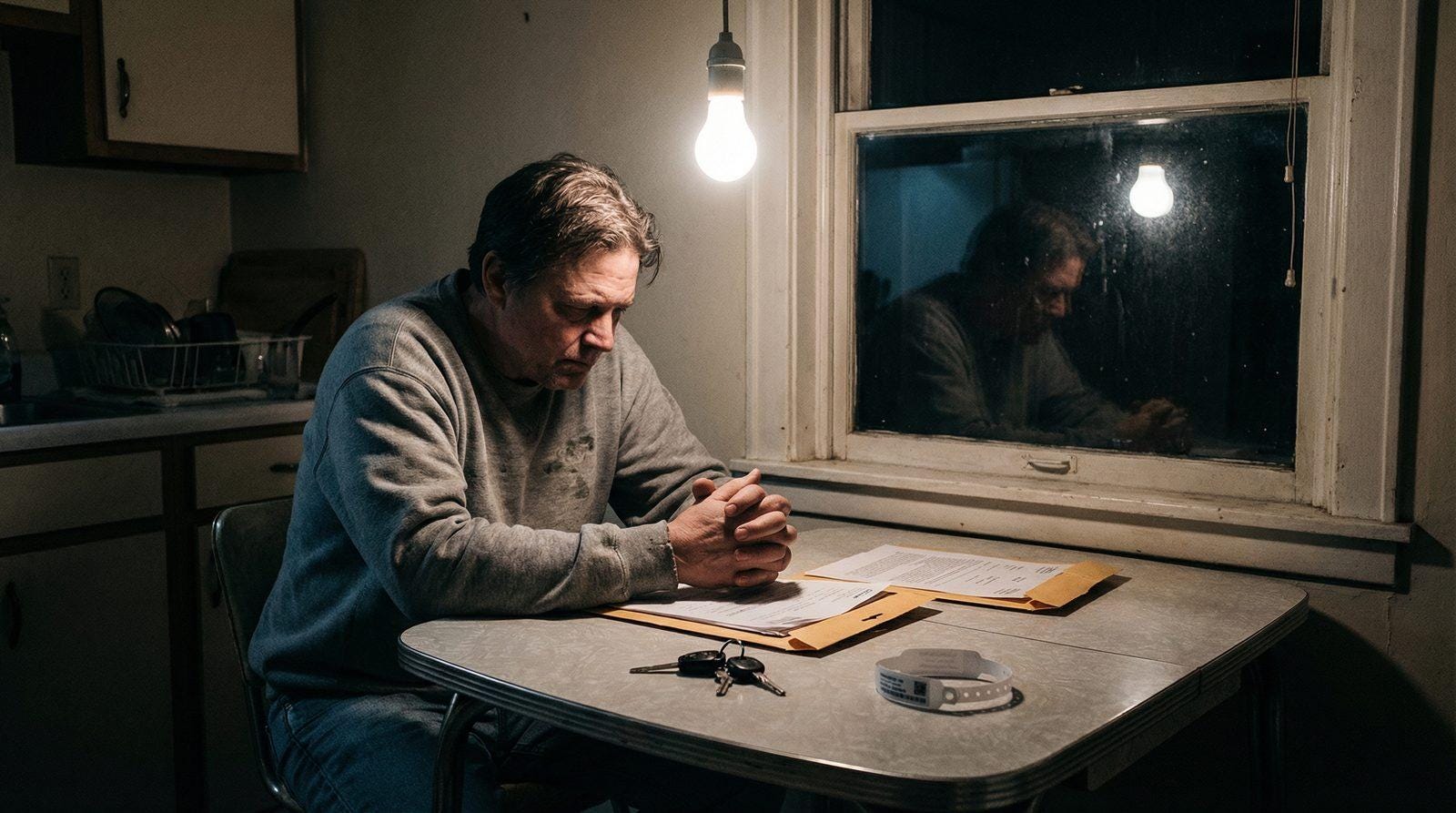
Somebody living that way isn’t necessarily making fewer decisions than a comfortable person. They may be making dozens more, every single day, with consequences attached to nearly all of them.
And they have to keep making those decisions while going to work, raising children, caring for relatives, and dealing with the same ordinary aggravations everybody else faces.
That’s another reason the personal-responsibility lectures get under my skin. We routinely confuse financial security with competence and financial struggle with failure.
Some people with money are extraordinarily disciplined. Others are walking collections of bad decisions protected by inherited wealth, high salaries, or generous safety nets. Likewise, some struggling people are careless, while others could teach a graduate seminar in making seventeen dollars last until Thursday.
The size of somebody’s bank account doesn’t tell you which one you’re looking at.
Source: Federal Reserve, Savings and Investments, 2025 household survey
SHARE THIS EDITORIAL: If you know somebody who has ever been told to simply budget better while trying to survive an impossible month, send this their way. I’d particularly like to hear from people who have experienced both sides of the financial divide.
WHAT WOULD ACTUALLY HELP?
I don’t expect government to eliminate every bad decision or unexpected expense. Nobody can do that, and pretending otherwise would be bullshit of a different variety.
But we could stop making ordinary setbacks unnecessarily destructive.
We could take a harder look at fees that punish people for temporarily running short of money. We could improve access to affordable short-term credit rather than leaving desperate borrowers at the mercy of the most expensive options. We could make benefits and assistance programs easier to navigate, especially for people who are working and don’t have half a day to spend filling out forms or waiting on hold.
Employers could recognize that transportation problems and childcare emergencies aren’t always signs of a lousy work ethic. Policymakers could pay more attention to how healthcare costs, housing instability, and unpredictable work schedules interact, instead of treating each as an unrelated problem.
And yes, individuals should keep doing what they can to build savings, avoid financial traps, and plan for emergencies. Those are worthwhile goals. But advice becomes insulting when it ignores the obstacles standing between people and the advice they’re being given.
There’s a difference between encouraging responsibility and using responsibility as an excuse to stop caring.
The real question isn’t whether people should be accountable for their decisions. Of course they should. It’s whether the consequences of an ordinary mistake ought to be so wildly disproportionate to a person’s ability to pay.
A society that prides itself on opportunity should have a serious problem with a system in which a broken alternator can threaten somebody’s livelihood.
Because that isn’t much of an opportunity. That’s a trap with a motivational poster hanging over it.
THE BULLSHIT DETECTOR
Three fresh claims. Three fact-checks. No free passes.
THE STINK SCALE
💩 A Little Whiff — Misleading, but relatively minor.
💩💩 Something Smells — Important context conveniently missing.
💩💩💩 Steaming Pile — A substantial distortion of the facts.
💩💩💩💩 Full-Blown Bullshit — A demonstrably false claim being circulated as truth.
💩💩💩💩💩 Weapons-Grade Bullshit — A particularly outrageous falsehood with serious potential consequences.
1. WISCONSIN HAS MILLIONS MORE REGISTERED VOTERS THAN ADULTS
CLAIM: Wisconsin’s voter records contain more names than the state’s adult population, proving widespread voter fraud.
BULLSHIT: The claim treats inactive voter records as though they were active registered voters. They aren’t.
💩 STINK RATING: Full-Blown Bullshit
WHY: Reuters examined the figures and found approximately 3.63 million active registered voters as of November 1. The state’s database also retains millions of inactive records for administrative and legal purposes. Those records can include people who moved, died, or otherwise became ineligible, and they do not represent active registrations or votes cast.
Counting every historical database entry as a current voter is like counting every customer who ever walked into a restaurant and claiming they’re all still sitting at the tables. It’s impressive arithmetic if your goal is to scare people who won’t check the numbers. Source: Reuters Fact Check, November 13, 2026
2. A NEW COVID STRAIN WAS DISCOVERED IN NORTHAMPTON, ENGLAND
CLAIM: Video of people wearing protective equipment outside a Northampton home showed a newly discovered COVID strain, possibly signaling another lockdown.
BULLSHIT: The footage was unrelated to a new COVID outbreak.
💩 STINK RATING: Full-Blown Bullshit
WHY: Reuters traced the claim to a satirical social media post. Local officials explained that the protective equipment was used during a welfare-related response, while the UK Health Security Agency reported no discovery of a new strain in Northampton.
Apparently, seeing somebody in protective clothing is now enough to declare a public health emergency. By that standard, every exterminator in America is one photograph away from triggering a national panic. Source: Reuters Fact Check, November 16, 2026
3. VIRAL AIRPORT VIDEO SHOWS REAL PASSENGERS SLEEPING THROUGH A GROUND STOP
CLAIM: A widely circulated video showed actual passengers sleeping on the floor of an American airport during the November 13 aviation disruption.
BULLSHIT: The video was apparently AI-generated.
💩 STINK RATING: Steaming Pile
WHY: Lead Stories examined the clip and identified visual inconsistencies indicating artificial generation. The video was presented as real footage from the disruption, but the imagery couldn’t be trusted as documentation of what happened.
We already have enough genuine travel nightmares without computers inventing new ones. Next we’ll have AI-generated footage of an airline serving an edible sandwich, and that’s when I’ll know we’ve crossed completely into fantasy. Source: Lead Stories Fact Check, November 14, 2026
THE PRICE WE DON’T TALK ABOUT
I keep coming back to those two drivers and their $500 repair bills.
One gets an inconvenience. The other gets a crisis. The first has the freedom to forget about the problem almost immediately, while the second may spend months paying for it in money, time, anxiety, and opportunities he couldn’t afford to take.
And when the dust settles, the person who paid the highest price may still be told he should have planned better.
Maybe he should have. Maybe there were things he could have done differently. I’m perfectly willing to have that conversation.
But I’d also like to have a conversation about why we accept a system that turns relatively small setbacks into financial avalanches for people who can least afford them.
Because there’s something deeply wrong with a country that talks endlessly about second chances while making them a luxury item.
Everybody makes mistakes. Everybody gets unlucky. Everybody eventually has a day when the car won’t start, the paycheck doesn’t stretch, or life decides to kick them squarely in the teeth.
The difference is that some Americans can write a check and move on.
Others get a bill for the privilege of falling behind.
And then some comfortable son of a bitch tells them to make better choices.
KEEP THE CONVERSATION GOING
What’s the smallest unexpected expense you’ve ever seen create the biggest financial headache? I’d love to hear your experience in the comments, particularly if you’ve found yourself on both sides of this divide.
SHARE THIS EDITORIAL: Send it to somebody who understands the difference between being financially irresponsible and being financially trapped. They’re not always the same thing, no matter how often we’re told otherwise.
If you appreciate independent journalism with some bite, subscribe to OFF SCRIPT. Paid subscriptions and voluntary coffee contributions help support the work, but the conversation is open to everyone.
MORE FROM TOM HICKS MEDIA
If this editorial made you think about the larger systems shaping ordinary lives, Blind Spot takes those questions deeper. What the Hell? explores the astonishing things people and institutions have actually done, and Is It Just Me? lets Frank N. Krancke say what the rest of us occasionally mutter under our breath.
👓 Just Lucy — I DON’T HAVE FOUR EYES. I COUNTED.
Some icky boy made fun of Lucy’s pink glasses. She’s four and a half, her feelings are hurt, and she’s reconsidering her marriage plans.
You can find all ten regular publications, along with occasional special surprises, at Tom Hicks Media — The Complete Collection.
#OffScript #SpecialEditorial #Poverty #EconomicInequality #WorkingAmericans #PersonalResponsibility #CostOfLiving #TomHicksMedia