

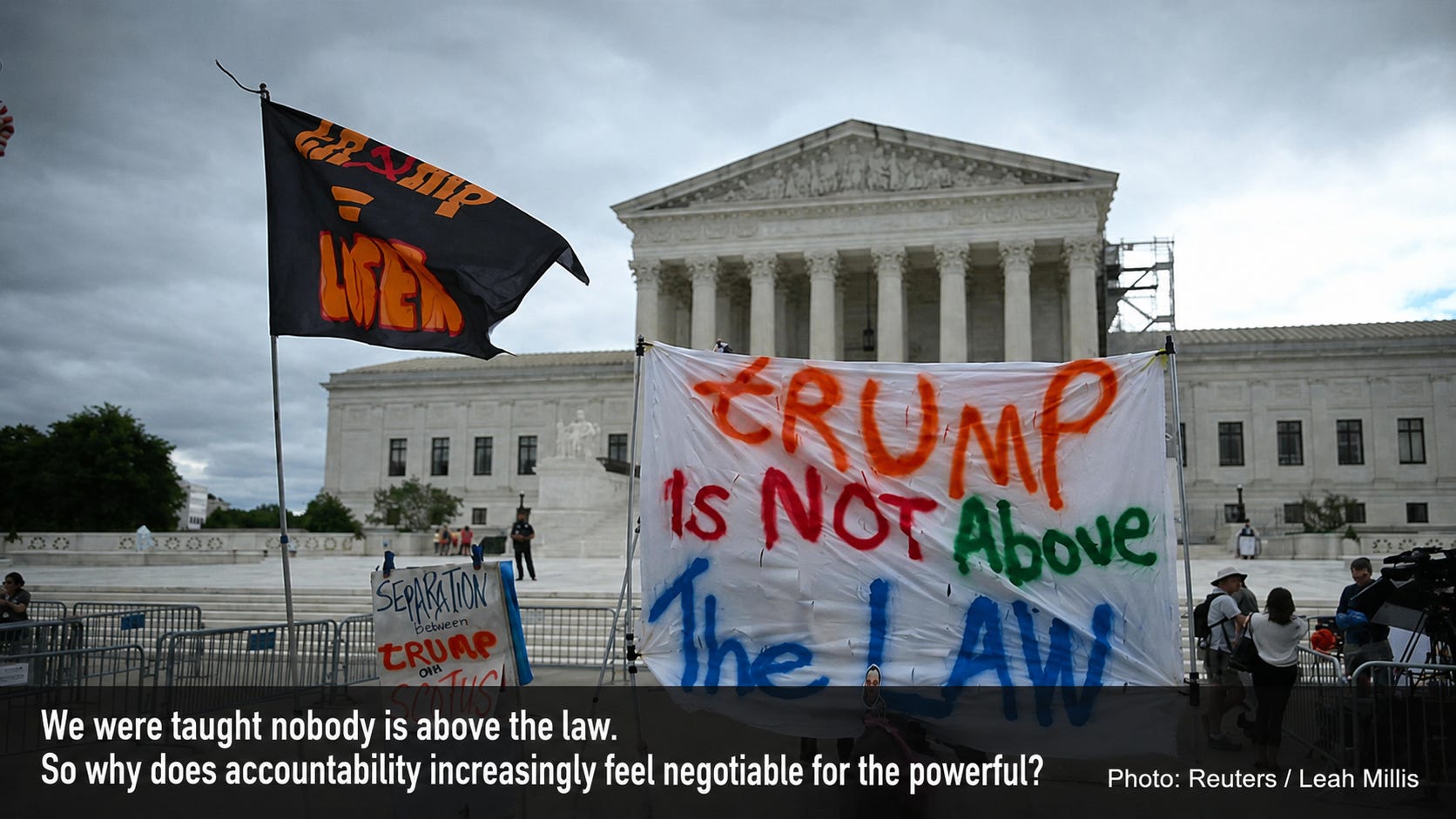


The moment power can negotiate with accountability, justice stops being justice and starts being customer service.
Remember when we told kids nobody is above the law? Cute fucking story.
Somewhere along the line, America stopped treating that phrase like a rule and started treating it like decorative wall art. Something politicians say at podiums, judges nod toward in speeches, and cable-news panels repeat with the exhausted sincerity of people trying to convince themselves the restaurant still has standards while the kitchen is visibly on fire.
Because look around for five goddamn seconds.
The Supreme Court handed presidents sweeping immunity protections for “official acts,” blowing a hole through what accountability can even mean for someone in the Oval Office. President Trump now governs inside a legal reality that looks very different from the civics-class version of checks and balances most Americans grew up with. At the same time, Reuters reported that Acting Attorney General Todd Blanche signed an addendum tied to Trump’s IRS lawsuit settlement stating the government would be “forever barred” from auditing or pursuing certain claims involving Trump, his family, and affiliated companies for tax matters that were or could have been raised before May 18, 2026.
Read that sentence again slowly.
Not delayed. Not paused. Not revisited later if new facts emerge…forever barred.
And before somebody starts hyperventilating into a Facebook comment section about Trump Derangement Syndrome, calm the hell down for a second. Trump matters here because he’s the loudest, most impossible-to-ignore example of a deeper disease, not because the disease begins and ends with him. What happens when institutions slowly teach a country that rules still exist, but somehow keep becoming negotiable for the same class of people — that’s what we’re actually talking about.
If you or I screw up our taxes, the government suddenly develops the investigative persistence of Liam Neeson in Taken. Miss enough payments, and they’ll garnish wages, tack on penalties, freeze accounts, and turn your mailbox into a recurring reminder that bureaucracy never sleeps. But if you’re rich enough, powerful enough, politically connected enough, accountability starts sounding suspiciously like customer support: delays, interpretations, procedural complexity, carefully lawyered explanations for why consequences suddenly require “additional review.”
That’s the scam hiding in plain sight: ordinary people experience the law as enforcement, while powerful people experience it as negotiation.
If you’re not subscribed yet, you’re reading this the hard way. I do this daily. No sponsors. No filter.
Subscribe if you want it in your feed instead of chasing it down.
The dangerous part is that this doesn’t arrive looking like a dictatorship you see in the movies. Hollywood trained us to expect tanks in the streets, giant banners, angry speeches, and dramatic orchestral music while some villain with fascist lighting screams about destiny. Real democratic erosion is sneakier than that and, frankly, boring enough to slip right past exhausted people trying to survive the week.
It looks administrative.
It sounds technical.
It arrives wearing a tie and carrying paperwork.
A court decision here. A conveniently narrow interpretation there. A federal agency is suddenly reluctant to act. A political ally was quietly installed somewhere important. A legal mechanism reframed as a routine process. None of it individually feels apocalyptic, which is exactly why it works.
Because institutions start changing behavior long before the public notices.
At first, the question inside the government becomes: Can we stop this? Eventually, the question quietly shifts into: Can we survive saying no?
That difference matters more than people realize. When institutions stop functioning as referees and start functioning like risk managers for power, democracy begins picking up structural damage nobody notices until the ceiling collapses on their heads.
And media language — Jesus Christ, media language — deserves its own trial.
Watch what happens every time something alarming enters public view. Suddenly, every sharp edge gets sanded down into bureaucratic mush. Accountability concerns become “controversies.” Institutional capitulation becomes “norm erosion.” Deals that might make your eyebrows fly off your forehead become “settlements” or “administrative resolutions.”
Calling democratic erosion “norm-breaking” is like calling a house fire an unexpected heating event.
Language matters because language shapes emotional urgency. If the public hears “paperwork dispute,” they emotionally file it next to a Comcast billing error instead of a democratic warning sign. If journalists describe extraordinary institutional behavior using the verbal equivalent of beige wallpaper, people stop feeling the weight of what’s actually happening.
And once you notice it, you cannot unsee it.
The same country that tells ordinary people ignorance of the law is no excuse acts like power deserves endless procedural grace periods. Miss a court date? Consequences. Miss taxes? Consequences. Screw up a benefits form? Bureaucratic hellscape. But powerful people? Suddenly, the conversation becomes complicated enough to require twenty legal analysts and a soothing chyron reminding everyone not to jump to conclusions.
Funny how the conclusions always seem harder to reach when wealth, status, or political power enters the room.
Authoritarianism rarely announces itself. It teaches people to stop expecting consequences.
That sentence matters because the real damage here is not one politician, one presidency, or one outrageous headline. The real damage is psychological.
They stop trusting courts, journalism, and elections. Eventually, they stop believing the institutions belong to them at all.
And when enough people lose faith that rules apply equally, societies drift toward something uglier. Some disengage entirely because why bother participating in a rigged system? Others decide the only answer is finding their own strongman who promises to rig it back in their favor. History’s batting average on that strategy is absolute dogshit.
Rome learned it.
Hungary flirted with it.
Democracies rarely explode all at once. They erode, slowly and quietly, while people convince themselves they’re overreacting if they notice the walls cracking.
Because the law was supposed to be a referee.
Imperfect? Sure.
Slow? Constantly.
Occasionally, dumb as a sack of wet hammers? Absolutely.
But still a referee.
Not a concierge service for the wealthy.
Not a loyalty program for the politically connected.
Not some velvet-rope nightclub where accountability depends on status, access, or who happens to know the manager.
A country stops being a democracy long before it stops holding elections. It stops when people stop believing rules apply equally.
That’s the danger hiding underneath all of this. Not merely corruption, because corruption has always existed. The more serious threat is normalization. Every time power negotiates consequences while everyone else absorbs them, another little piece of civic trust dies. Eventually, people stop hearing “nobody is above the law” as a promise.
They hear it as a punchline.
And once citizens stop expecting accountability, power stops fearing it.
That’s when things get really fucking dangerous.
Upgrade
I’m retired. This is reader-funded. No sponsors. No corporate leash. No one telling me to tone it down.
Paid subscribers get bonus rants, full archive access, priority Q&A, and deeper dives that don’t make it into the free feed.
Upgrade and support independent work that doesn’t play nice.
If you want the same reality with a quieter voice and sharper claws, go check out Lotus Purrspective.
That’s where the judgment is calmer, cleaner, and somehow even more brutal.
Buy Me A Coffee
If this hit, consider supporting the work—because yelling “what the fuck are we doing?” at the news doesn’t pay for itself.
#TheUnredactedBastard #RuleOfLaw #Democracy #Trump #ExecutivePower #Politics #MediaCriticism #Authoritarianism #CivilRights #Accountability