

Editorial Note
Every fall, the government hands out a number and calls it good news. Seniors are supposed to nod, say thank you, and go back to stretching a fixed income across a world that keeps getting more expensive.
I’ve got a problem with that ritual. So this week I’m picking it apart, all the way down to the formula nobody wants to talk about.
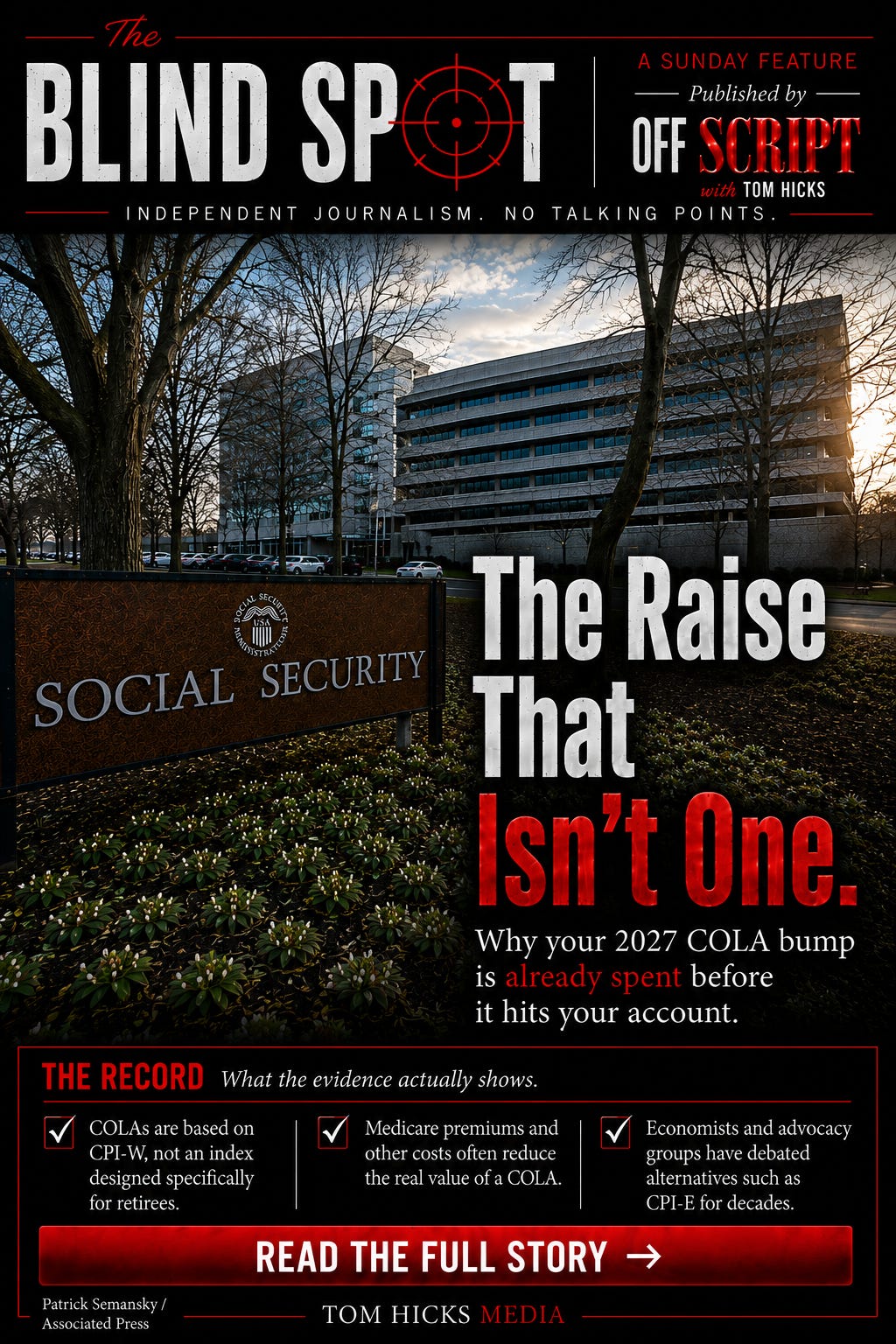
Here’s what’s coming. Sometime around the middle of October, the Social Security Administration is going to stand up in front of a microphone and announce the 2027 cost-of-living adjustment. The early math out of the Senior Citizens League has been climbing all year. Back in March, they were guessing 2.8%. Now the number being thrown around is 3.8%, and it might land higher still depending on what inflation does over the next couple of months.
On the surface, that’s a good number. A 3.8% COLA would take the average monthly benefit from $2,084 up to roughly $2,163. Call it seventy-nine bucks. The average spousal benefit finally crosses four figures, hitting about $1,023 for the first time ever. Somebody in Washington is going to stand at a podium in October and act like they just handed millions of seniors a gift.
I want you to sit with that seventy-nine dollars for a second, because that number is about to get run through a meat grinder, and I don’t think most people watching the announcement understand how many places it gets cut on the way to their mailbox.
First cut: the reason you’re getting a bigger check at all. COLAs only get big when inflation gets ugly. You don’t get a fatter raise without a meaner year sitting behind it. Seniors have watched actual costs - groceries, insurance, the whole miserable list - run hotter than 3.8% through most of 2026. The raise is chasing damage that already happened. It doesn’t undo it; it just shows up a year late and calls itself help.
Second cut: Medicare’s already got its hand in the check before you do. Part B premiums get pulled straight out of that benefit automatically, and they’re projected to climb again in 2027. So the seventy-nine dollars you were promised in October shows up smaller in January, sometimes a lot smaller, and you won’t find out exactly how much smaller until your personalized notice lands in December. Conveniently, that’s right after the news cycle has already moved on and stopped asking questions.
And here’s the part that should really piss you off. This isn’t a one-time glitch in an otherwise fair system. It’s the system working exactly as designed, every single year, on a schedule you could set a watch to. There’s a reason the math never quite lands in your favor, and it isn’t bad luck. It’s the formula Congress chose decades ago, and the real question is whether it’s still the right one today.
If you’re not already a paid subscriber, upgrade to keep reading. So far we’ve talked about what happens to your COLA after it’s announced. The next question is the one that really matters: why does it keep happening? The answer starts with a forty-year-old inflation formula that many experts believe has never accurately reflected how retirees actually live.
The formula’s called the CPI-W, the Consumer Price Index for Urban Wage Earners and Clerical Workers. It’s what Social Security has used to calculate every COLA since the 1970s. And here’s the part that should stop you cold: it was built to track the spending habits of working-age people with jobs. Gas. Groceries. Apparel. General household goods. It was never built to track how a seventy-eight-year-old on a fixed income actually spends money.
Seniors spend differently, and not by a small margin. Healthcare eats a far bigger share of a retiree’s budget than it does a thirty-five-year-old’s, and healthcare costs have outpaced general inflation for years running. So the index deciding how much your check grows is systematically underweighting the exact expense category eating you alive. That’s not a rounding error. That’s a structural mismatch, baked into the math since before most of today’s retirees were even collecting.
There’s a fix that’s existed for years. It’s called the CPI-E, the Consumer Price Index for the Elderly, and the Bureau of Labor Statistics has been calculating it experimentally since the 1980s specifically because lawmakers wanted a way to check whether COLAs were keeping pace with what seniors actually spend. In most years, CPI-E has run higher than CPI-W, meaning seniors have been under-compensated for decades by the government’s own alternate math.
So why hasn’t it been swapped in? Because switching the formula that drives a program forty million Americans depend on is expensive, and it’s politically radioactive in both directions. Bump the index up and you’ve got a bigger long-term price tag on a program everybody already fights about funding. Leave it alone and nobody has to answer for it on camera this year. It’s a lot easier to let the shortfall land quietly on retirees than to own a headline that says “we made Social Security cost more.” So it stays broken, budget cycle after budget cycle, administration after administration, because inertia is cheaper than honesty.
Now here’s what that shortfall actually costs a real person. Take a benefit around today’s average, run it forward twenty years under CPI-W instead of CPI-E, and the gap compounds. Even relatively small differences in annual inflation adjustments can compound over a long retirement. That’s why advocates for the CPI-E argue that many retirees gradually lose purchasing power over time, even when they receive a COLA every year. Nobody sends you a notice explaining that. You just feel it, slowly, in a budget that keeps getting tighter for reasons that never quite add up.
So when the announcement comes around the middle of October and the number comes in around 3.8%, and somebody stands at a podium calling it good news for seniors, remember this: a bigger COLA isn’t proof the system is taking better care of retirees. It’s proof retirees needed a bigger COLA just to keep up. Those are two very different things.
More from Tom Hicks Media
Lotus Purrspective — a tuxedo cat’s observations on the strange creatures she allows to live in her house.
Tom’s Number Ones — every day, one week in music history and the songs that topped the charts.
Panic Room Sports — football-first analysis that cuts the noise.
The Off Script Bullshit Detector
The world doesn’t need more information. It needs better filters. Paid subscribers get The Bullshit Detector, a field guide to spotting weak arguments and manipulation before they waste another minute of your day free. Everybody else can grab it for $4.95 through the Tom Hicks Media Store .
If you enjoy these daily trips through music history and would like to help keep the turntable spinning, you can Buy Me a Cup of Tea. Every cup helps support Tom’s Number Ones and the rest of Tom Hicks Media.
One Question Before You Go
Did your last COLA actually cover what it was supposed to, or did it disappear before you noticed it arrived?
One Last Thing
Seventy-nine dollars sounds like real money until a forty-year-old formula and a Medicare premium finish splitting it up before you ever see it.
#SocialSecurity #COLA #Retirement #TomHicks #OffScript #PointBlank
COLA has never made a bit of difference to my financial well being.