

Tom Hicks | November 6, 2026

I’ve been watching Republicans fight with Republicans since Barry Goldwater was telling the party’s moderates to get the hell out of his way. I’ve watched Richard Nixon leave the White House, Ronald Reagan remake the party, Newt Gingrich turn Congress into a contact sport, and the Tea Party decide that even conservative Republicans weren’t conservative enough.
So I’ve learned two things about Republican civil wars. They can get ugly, and the people everyone declares politically dead have an irritating habit of showing up again.
Which brings us to the aftermath of Tuesday’s midterms, when Republicans lost control of Congress and suddenly found themselves facing a question that can’t be answered by calling Democrats socialists or blaming the news media.
What the hell happens now?
Because the Republican Party has spent the better part of a decade organizing itself around Donald Trump. His endorsements became political currency. His grievances became party priorities. His enemies became everybody’s enemies, at least if they wanted to keep their jobs.
And now that voters have handed Republicans a rather spectacular ass-kicking, the people who spent years insisting they were all on the same team have some uncomfortable decisions to make.
I’ve got the popcorn.
Let’s see who’s hungry.
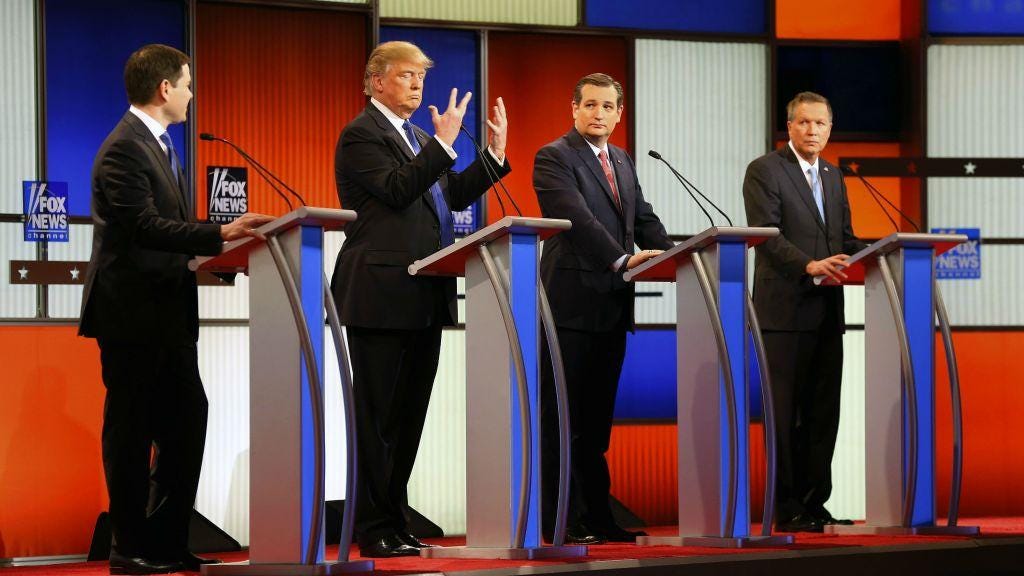
Before Trump remade the Republican Party, he had to defeat the Republicans who thought they were running it.
BEFORE TRUMP, THERE WAS ALREADY A FOOD FIGHT
There’s a popular version of Republican history that goes something like this: Once upon a time, the GOP was a respectable conservative party, Donald Trump arrived, and everybody suddenly lost their fucking minds.
It’s a convenient story. It’s also missing several decades.
The tensions were there long before Trump came down that escalator in 2015.
Goldwater’s 1964 nomination exposed deep divisions between conservative activists and the party’s moderate establishment. Reagan eventually helped consolidate a new conservative coalition, but the fights over taxes, social issues, immigration, and the federal government’s role never entirely disappeared.
Then came Gingrich and the Republican Revolution of 1994. Congressional politics became more confrontational, compromise increasingly became something politicians accused their opponents of doing, and ideological combat turned into a fundraising opportunity.
The Tea Party took that a step further after 2009. Republicans who had spent careers calling themselves conservatives suddenly discovered that other conservatives considered them insufficiently conservative.
Apparently, there’s always somebody standing farther to the right, yelling that everybody else is a communist.
Trump didn’t invent those divisions. He recognized an opportunity in them.
He understood something the Republican establishment had badly underestimated: millions of Republican voters were furious with their own party’s leadership. They believed Washington Republicans had promised conservative government for decades while delivering excuses, compromises, and invitations to the next fundraiser.
Trump offered them something different. He promised to smash the establishment rather than negotiate with it.
And when he won in 2016, the party began changing around him.
Not overnight. Not without resistance. But steadily enough that the Republicans who once questioned Trump’s character, temperament, or commitment to conservative principles increasingly found themselves explaining why they were supporting him anyway.
Some genuinely embraced his agenda. Others made political calculations. Still others left public office or lost influence.
The important point is that Trump’s dominance didn’t eliminate the party’s internal disagreements.
It made challenging him politically expensive.
And that’s a very different thing.
THE CRACKS WERE SHOWING BEFORE TUESDAY
Here’s something worth remembering while everybody argues over the election results.
Some Republican candidates were already trying to create distance between themselves and Trump before voters went to the polls.
In October, Reuters examined 62 competitive congressional races and found that Republican candidates in 41 had broken with Trump on at least one policy or played down their association with him.
Forty-one out of sixty-two.
That doesn’t mean two-thirds of Republicans had joined some secret resistance movement. Most were making limited adjustments rather than repudiating Trump’s broader agenda.
But it does tell us that vulnerable Republicans were already thinking carefully about how much Trump they wanted attached to their campaigns.
Some disagreed with his Iran policy. Others criticized particular economic decisions. A dozen candidates had removed his name, image, or endorsement from campaign websites.
One Republican candidate in Florida replaced a homepage prominently featuring Trump with one featuring his own family.
Which is quite a political transformation.
One day, you’re practically standing on the White House lawn waving a giant foam finger. The next, you’re introducing voters to the wife and kids and hoping nobody remembers who used to be in the picture. Reuters — Republican candidates distance themselves from Trump]
The Republican distancing act
Reuters review of 62 competitive congressional races, October 2026
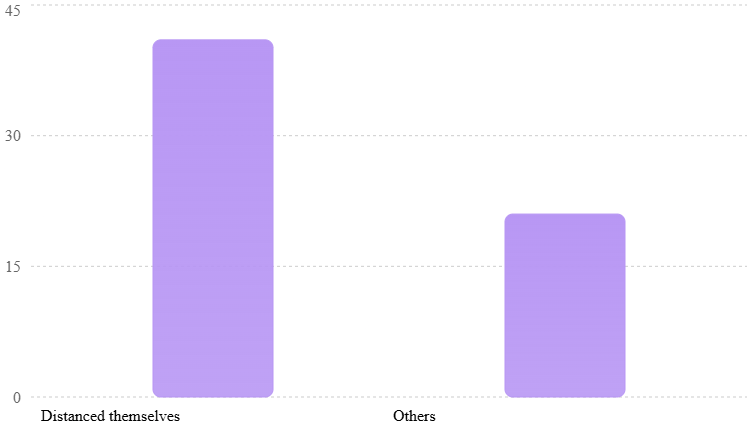
The effort to create political distance from Trump began before Election Day, not afterward. Reuters counted policy disagreements or efforts to downplay association, not necessarily outright opposition to Trump.
Now, politicians distancing themselves from an unpopular president isn’t some revolutionary development. Democrats have done it, too. It’s practically a Washington survival instinct.
But in a party where public disagreement with Trump can provoke primary challenges and furious attacks, even small acts of independence become politically revealing.
And Tuesday gave Republicans another reason to reconsider the arrangement.
THE VICE PRESIDENT JUST PUT SOMETHING INTERESTING ON THE TABLE
If you want to see how complicated this could become, take a look at JD Vance.
For most of his vice presidency, Vance has been one of Trump’s most prominent defenders. He’s supported the administration’s agenda, attacked its critics, and generally behaved like somebody who understands that the boss doesn’t particularly enjoy being contradicted.
Then the midterms happened.
And Vance started talking about Iran.
On Wednesday, the vice president publicly blamed the war for much of the Republican defeat. He pointed to voters who had supported Trump in 2024 but rejected Republican candidates in 2026, citing the war, the cost of living, and concerns about America’s priorities.
Trump, meanwhile, continued defending the decision to go to war, even while acknowledging that the conflict and higher gasoline prices had contributed to Republican losses.
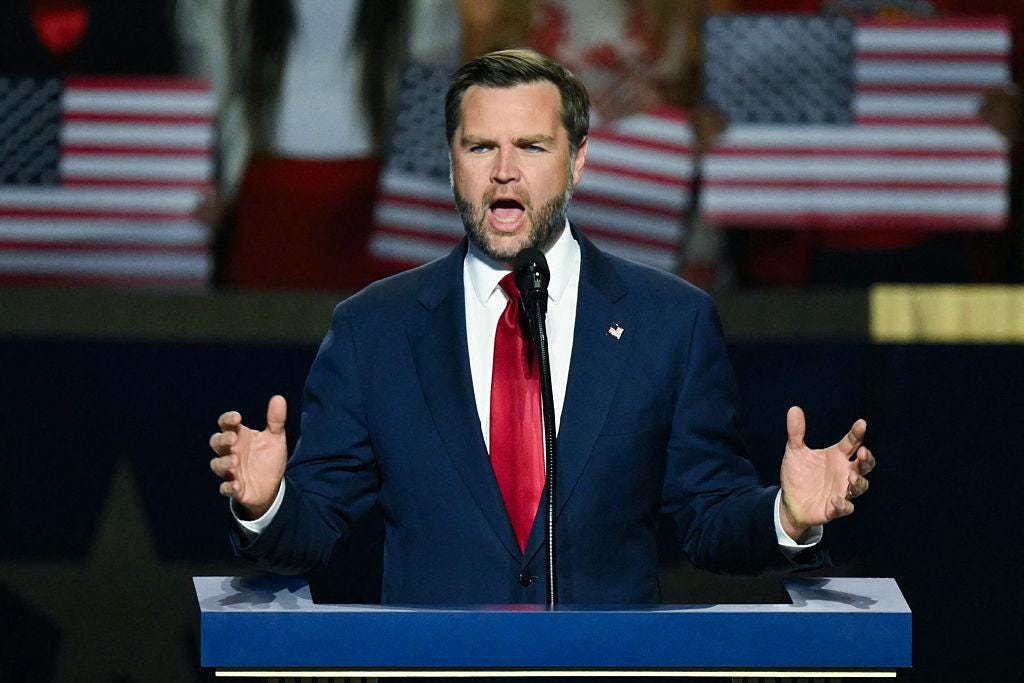
Vice President JD Vance has identified the Iran war as a major reason for Republican losses, putting him at odds with Trump’s defense of the conflict.
Now, let’s not get carried away.
Vance hasn’t declared war on Trump. He hasn’t announced that he’s abandoning MAGA, and he hasn’t suddenly become the patron saint of bipartisan cooperation.
But he has publicly identified one of the administration’s defining decisions as a major electoral liability.
That’s significant because Vance is also a potential 2028 presidential candidate.
He faces a delicate problem. He needs to maintain credibility with Trump’s supporters while establishing his own political identity. He also has to answer questions about policies he helped defend.
And there’s an obvious complication.
If the Iran war was such a disastrous political decision, where exactly was the vice president while it was happening?
That’s a fair question. Vance can argue that he supported the administration while privately expressing reservations, or that the war’s consequences became clearer over time.
But voters and Republican rivals are entitled to ask what he believed, when he believed it, and what he actually did.
The Republican succession fight may eventually become a contest over who can preserve the parts of Trumpism that remain popular while explaining away the parts that don’t.
Good luck with that.
If you enjoy political analysis that doesn’t require pretending politicians are smarter than the rest of us, subscribe to Off Script. We examine the facts, ask uncomfortable questions, and occasionally use language that would get us thrown out of a church social.
AND NOW MIKE JOHNSON IS LEAVING THE TABLE
While Vance was explaining why Republicans lost, House Speaker Mike Johnson was making a rather significant announcement of his own.
He’s not seeking another term as Republican leader.
Johnson won reelection to his Louisiana congressional seat, but he’ll return to Washington in January as a rank-and-file Republican rather than the man holding the speaker’s gavel.
That leaves the party facing another internal contest, with Steve Scalise and Jim Jordan among the leading figures.
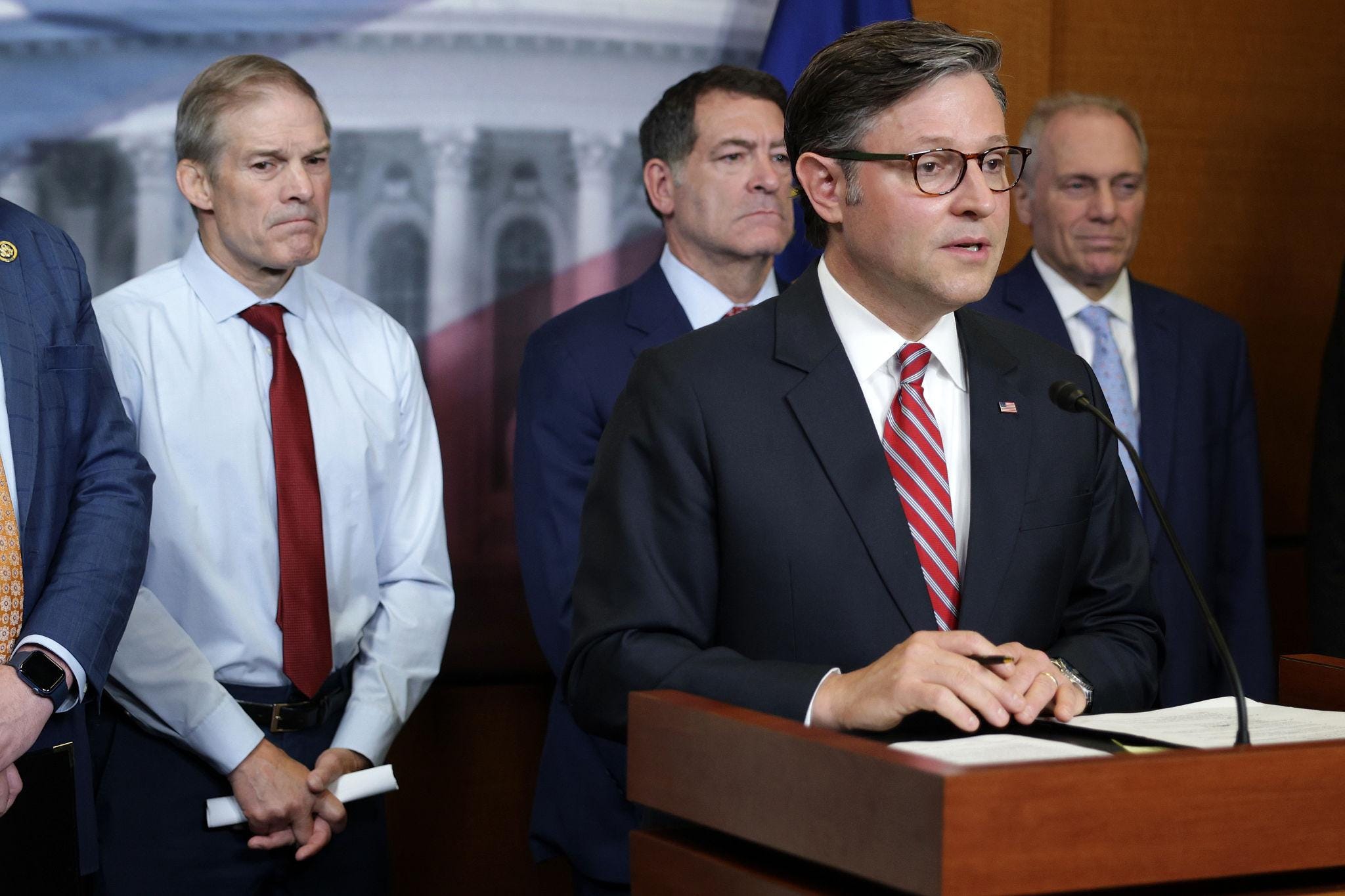
Mike Johnson’s decision to step aside opens another contest over Republican leadership, with Steve Scalise and Jim Jordan representing different constituencies within the party.
Remember the last time Republicans tried to choose a speaker?
In 2023, Kevin McCarthy was removed, Steve Scalise couldn’t assemble enough support, Jim Jordan couldn’t get the votes, and the party eventually settled on Johnson after weeks of congressional dysfunction.
It was a fascinating demonstration of what happens when a political party discovers that everybody wants to be in charge and nobody can agree on who should hold the damn gavel.
Now Republicans have another opportunity to demonstrate their talent for internal cooperation.
To be fair, the circumstances are different. They’ll be choosing a minority leader rather than a speaker, and that changes the job considerably. The leader won’t control the House floor or the legislative agenda.
But the choice still matters.
Scalise has longstanding relationships with more traditional Republican constituencies. Jordan has built his reputation as a combative conservative closely associated with the party’s confrontational wing.
The contest could reveal whether House Republicans want continuity, confrontation, or some uneasy arrangement between the two.
And there’s an important distinction here.
A leadership election isn’t automatically a referendum on Trump. Both men have worked with him. Neither represents a clean break from the MAGA era.
But the people choosing between them may have different ideas about what went wrong Tuesday and what Republicans should do next.
That’s where the interesting arguments begin.
EVERYBODY WANTS TO INHERIT THE KINGDOM. NOBODY WANTS THE MORTGAGE.
Then there’s 2028.
Trump is constitutionally barred from being elected to another presidential term. Whatever he says about his political future, the Republican Party has to confront the question of who comes after him.
And that may be the most consequential argument of all.
Vance has an obvious advantage in name recognition and proximity to power, but he also carries responsibility for the administration’s record. Ron DeSantis has already offered a competing interpretation of the midterm losses, describing the results as approaching an extinction-level event for Republicans while pointing to Florida’s relative electoral strength.
Other Republicans may eventually argue that the party needs a different approach to foreign policy, economics, or its relationship with Trump. Axios — Vance, DeSantis and the developing Republican succession fight]
And that’s where the political inheritance gets complicated.
Whoever follows Trump may want his voters, his fundraising network, his endorsements, and the enthusiasm he can generate.
But what about the controversies? The policy failures? The unpopular decisions? The voters who supported him in 2024 and rejected Republican candidates two years later?
You don’t get to inherit the family fortune while pretending the debts belong to somebody else.
At least, that’s how things work outside Washington.
The Republican Party could find itself with several politicians claiming to represent the true meaning of MAGA, each insisting that the others have misunderstood what Trump was really trying to accomplish.
And Trump will still be sitting in the White House, perfectly capable of complicating everybody’s plans.
Imagine trying to audition for the lead role in a play while the current star keeps wandering onto the stage and reminding everybody that the show is named after him.
FOUR POSSIBLE ENDINGS. NONE COMES WITH A REFUND.
Here’s where I think we need to resist the temptation to declare the Republican Party finished.
We’ve heard that before. After Goldwater. After Watergate. After George W. Bush. After Trump’s defeat in 2020.
The party survived those setbacks, although its identity changed along the way.
There are several plausible directions Republicans could take from here.
They could double down on MAGA. The argument would be that the movement’s core principles remain popular among Republican primary voters and that the midterm defeat reflected particular policy decisions, unpopular candidates, or dissatisfaction with the administration’s performance. That approach would preserve much of Trump’s political identity while leaving unresolved the question of how to regain support outside the base.
They could attempt a course correction. Republicans might retain conservative positions on taxes, regulation, immigration, and cultural issues while adopting a different tone or changing unpopular policies. The challenge would be persuading voters that those changes were meaningful without alienating the people who still strongly support Trump.
They could experience prolonged internal conflict. Competing factions might fight over foreign policy, economic priorities, congressional leadership, and the presidential nomination. That wouldn’t necessarily produce a formal party split. It could simply mean years of expensive, ugly primaries and a lot of Republicans accusing other Republicans of betraying conservatism.
Or Trump could reassert his authority. The president retains substantial influence over the party, and Republicans may conclude that maintaining unity around him serves their interests better than open confrontation. A disappointing midterm election doesn’t automatically erase the loyalty he’s built.
None of those possibilities is guaranteed. And some could occur simultaneously.
A party can remain loyal to its president while fighting bitterly over who succeeds him. It can change its economic message without changing its political identity. It can even conduct a very public civil war and eventually emerge with a new coalition.
History has demonstrated all of those possibilities.
The question is what Republicans actually do over the next two years.
THE POPCORN IS READY. THE MAIN EVENT HASN’T STARTED.
I don’t know whether the Republican Party is about to tear itself apart.
Neither does anybody else, no matter how confidently they’re announcing its funeral.
But the first signs of disagreement are already visible. Vulnerable candidates were distancing themselves from Trump before the election. Vance has publicly questioned the political consequences of the Iran war. Johnson is stepping away from House leadership. And the question of who inherits the Republican Party in 2028 is moving closer to the center of the conversation.
That’s enough to make the next chapter worth watching.
And here’s the part that interests me most.
For years, Republicans could disagree about policy while ultimately rallying around Donald Trump. His political dominance gave the party a central figure around whom competing factions could organize.
Now they’re approaching a future in which Trump cannot be their next presidential nominee.
The people who want to succeed him will have to decide which parts of his political legacy they intend to preserve, which parts they want to change, and how much disagreement they’re willing to tolerate along the way.
That could be a serious debate about the future of American conservatism.
Or it could become an extraordinarily expensive contest to determine who gets to wear the biggest red hat.
I’ve been around long enough to know better than to predict which one we’re going to get.
But I do know this.
The Republicans have spent years arguing about who belongs at the table. Now they’re starting to argue about who’s on the menu.
Pass the popcorn.
THE BULLSHIT DETECTOR 💩
Three more reasons to question what the internet puts in front of your face.
THE STINK SCALE: A Little Whiff 💩 | Something Smells 💩💩 | Steaming Pile 💩💩💩 | Full-Blown Bullshit 💩💩💩💩 | Weapons-Grade Bullshit 💩💩💩💩💩
CLAIM #1: A Tesla Roadster jumped off the Golden Gate Bridge, flew back up, and landed safely.
BULLSHIT: 💩💩💩💩 — Full-Blown Bullshit
WHY: A viral video supposedly captured a Tesla Roadster performing an aerial stunt off the Golden Gate Bridge, complete with thrusters and a triumphant driver.
Unfortunately for the people who believed it, the video was AI-generated. Fact-checkers found no credible reports of the stunt, and an automated detection tool rated the footage 99.9% likely to be AI-generated.
Apparently, gravity has been suspended until further notice, and nobody thought to tell the California Department of Transportation. Lead Stories — Tesla bridge stunt fact-check]
CLAIM #2: Elon Musk is developing an app where bored billionaires pay ordinary people’s bills.
BULLSHIT: 💩💩💩💩 — Full-Blown Bullshit
WHY: A viral Facebook post claimed Musk had announced an app allowing ordinary people to upload their bills so wealthy strangers could choose which ones to pay.
Sounds wonderful. Put up your electric bill, swipe right, and wait for some billionaire to rescue you from the power company.
One small problem: Musk never made the supposed announcement. Fact-checkers found no corresponding post on his X account and no credible reporting confirming the project.
Personally, I’d be more interested in an app that makes billionaires pay their fucking taxes. Lead Stories — The imaginary billionaire bill-paying app]
CLAIM #3: A viral photograph shows the actual wreckage of a Learjet that crashed in Florida.
BULLSHIT: 💩💩💩 — Steaming Pile
WHY: A photograph circulated after the November 1 crash of a Learjet in Palm Beach County, showing severe damage to the aircraft, including what appeared to be a missing wing.
Except the image had been digitally altered using AI.
Fact-checkers compared it with actual video footage and found that the real aircraft still had both wings visible. A digital watermark detector also identified AI modification.
A real plane crashed. Real people were affected. And somebody apparently decided the wreckage needed a little extra Hollywood treatment.
Because God forbid reality be dramatic enough on its own. Lead Stories — AI-altered Learjet crash photograph]
ONE LAST QUESTION
Is the Republican Party heading toward a genuine ideological fight, or will its leaders eventually decide that staying loyal to Trump is still their safest political option?
And if you consider yourself a conservative who isn’t particularly enthusiastic about Trump, what would you want the Republican Party to become?
BEFORE YOU GO
For more political analysis with a healthy disregard for Washington’s bullshit, visit Off Script / Blind Spot. For history’s more improbable adventures, there’s What the Hell?. And if you’re wondering whether everybody has completely lost their minds, Frank N. Krancke has been asking that question over at Is It Just Me?
The entire collection is available at Tom Hicks Media — The Complete Collection.
If you’d like to support independent journalism, you’re welcome to Buy Me A Coffee. I promise not to spend it on another political consultant.
#OffScript #Republicans #MAGA #Trump #Midterms2026