

Tom Hicks | October 21, 2026
Editor’s Note:
This is Part Two of our Off Script investigation. Part One, “Whose Side Is He On?”, examined Trump’s recent Russia policies. Today, we’re looking at the history behind the suspicions, the evidence that supports scrutiny, and the facts that complicate the story.
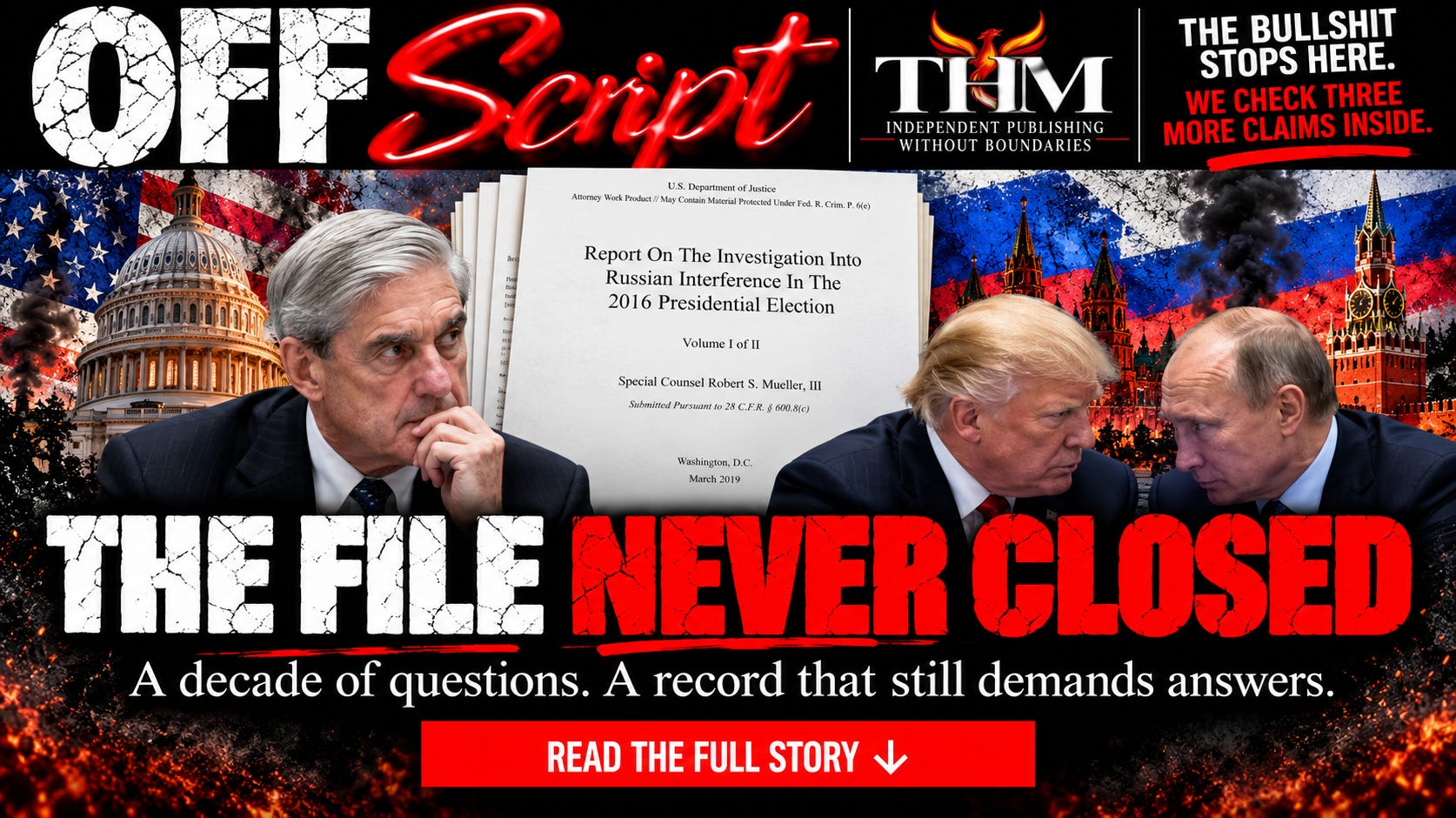
If you’re old enough to remember the Cold War, you probably remember what we were taught about the Russians.
I certainly do.
Growing up, I absorbed the idea that Russia was dangerous, Russians couldn’t be trusted, and the whole business was something we ought to be afraid of. By the time I served in the Air Force, those ideas were already pretty firmly planted.
Looking back, I wonder how much of what I believed came from what I actually knew and how much came from what I’d been taught to believe.
That’s an uncomfortable question, especially when you’re about to examine another one: What happens when your suspicions about somebody start influencing how you interpret everything they do?
Because that’s a danger in examining Donald Trump’s relationship with Russia. If you begin with the assumption that he’s somehow working for Moscow, practically everything can start looking like confirmation. If you begin with the assumption that the entire subject is a political hoax, you can dismiss evidence before you’ve even examined it.
Neither approach gets us very far.
Yesterday, we looked at the decisions that brought the Russia question back into the headlines. Today, I want to revisit the history behind it, because after ten years of investigations, accusations, denials, and political shouting, the actual evidence has gotten buried under everybody’s preferred version of the story.
And there’s been enough shouting to power a small city.
The interference wasn’t imaginary
Let’s get something straight before going any further.
Russia interfered in the 2016 American presidential election.
American intelligence agencies concluded that Vladimir Putin ordered an influence campaign intended to undermine confidence in American democracy, damage Hillary Clinton, and help Donald Trump’s electoral prospects. A bipartisan Senate Intelligence Committee investigation subsequently supported the intelligence community’s assessment.
The Senate committee’s review wasn’t some Democratic campaign document. Republicans participated in examining the underlying intelligence.
Russian interference was real. The argument begins when people try to establish what Trump and his campaign knew, what they did, and whether their actions constituted coordination with Moscow.
Those are different questions. Unfortunately, political television discovered years ago that shouting collusion or hoax was considerably easier than explaining the distinction.
What Mueller found, and what he didn’t
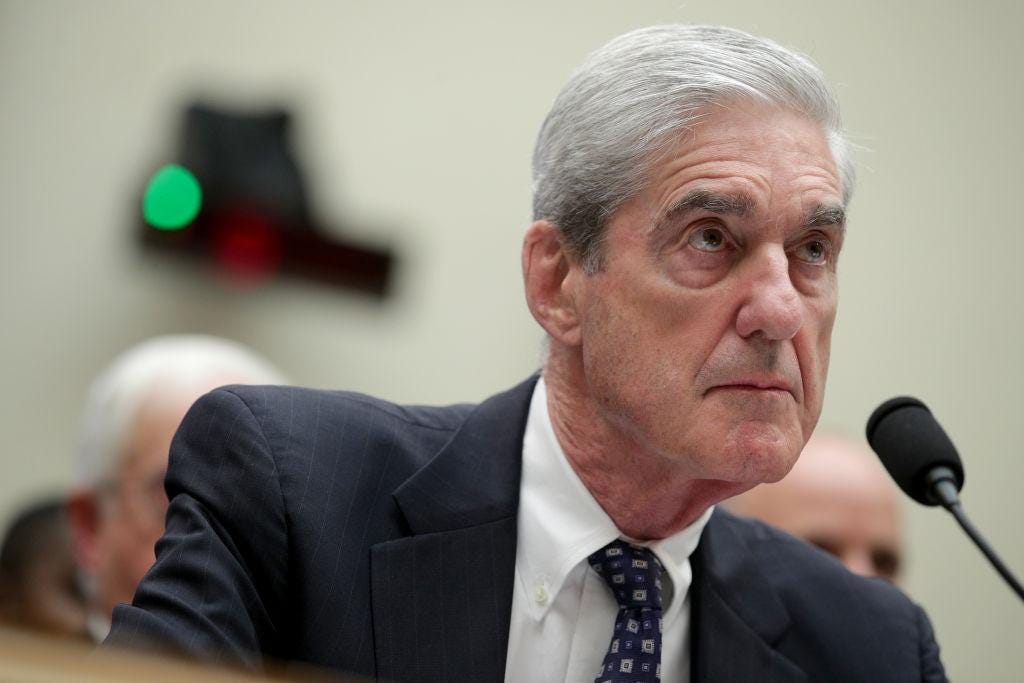
Robert Mueller testifies before Congress in July 2019, following his investigation of Russian election interference.
Robert Mueller’s investigation documented Russian hacking operations, social media manipulation, and numerous contacts involving Trump campaign associates and people connected to Russia.
But it did not establish that Trump campaign members conspired or coordinated with the Russian government in its election interference operations.
That’s important. So is what the report said about the investigation’s limitations, including deleted communications, false testimony, and difficulties obtaining certain evidence.
Those problems don’t prove a conspiracy existed. They also don’t justify pretending the investigation uncovered nothing.
You can read the Justice Department’s Mueller report and judge the findings yourself.
My old paralegal instincts start kicking in here. I’ve seen enough legal work to appreciate the difference between something that looks suspicious and something you can establish with evidence.
Sometimes that distinction is maddening, particularly when your instincts are standing on the furniture, waving their arms.
But it’s necessary.
And the next investigation uncovered reasons to keep asking questions.
The Senate’s uncomfortable findings
In August 2020, the Senate Intelligence Committee released the final volume of its bipartisan Russia investigation.
Among its findings were serious counterintelligence concerns involving Paul Manafort, Trump’s former campaign chairman, and Konstantin Kilimnik, whom the committee identified as having Russian intelligence ties.
Manafort’s campaign position and access created opportunities for Russian intelligence services. The committee examined the sharing of campaign information and the potential vulnerability of Trump’s political operation.
That doesn’t establish that Trump personally directed a conspiracy. It establishes that investigators found genuine national-security concerns involving people close to his campaign.
The committee also examined the June 2016 Trump Tower meeting, arranged after campaign representatives were offered damaging information about Clinton presented as connected to Russian government support. Investigators did not establish that useful information was delivered at the meeting or that Trump personally knew about it beforehand.
The Senate’s Volume Five report is worth reading because it refuses to fit neatly into either political camp’s preferred narrative.
What bothers me about this entire argument is how often people demand that the evidence do something it can’t.
One side wants every questionable contact to establish a secret conspiracy. The other wants the absence of a proven conspiracy to erase every legitimate counterintelligence concern.
Neither gets us very far.
Worth passing along?
And then came Helsinki
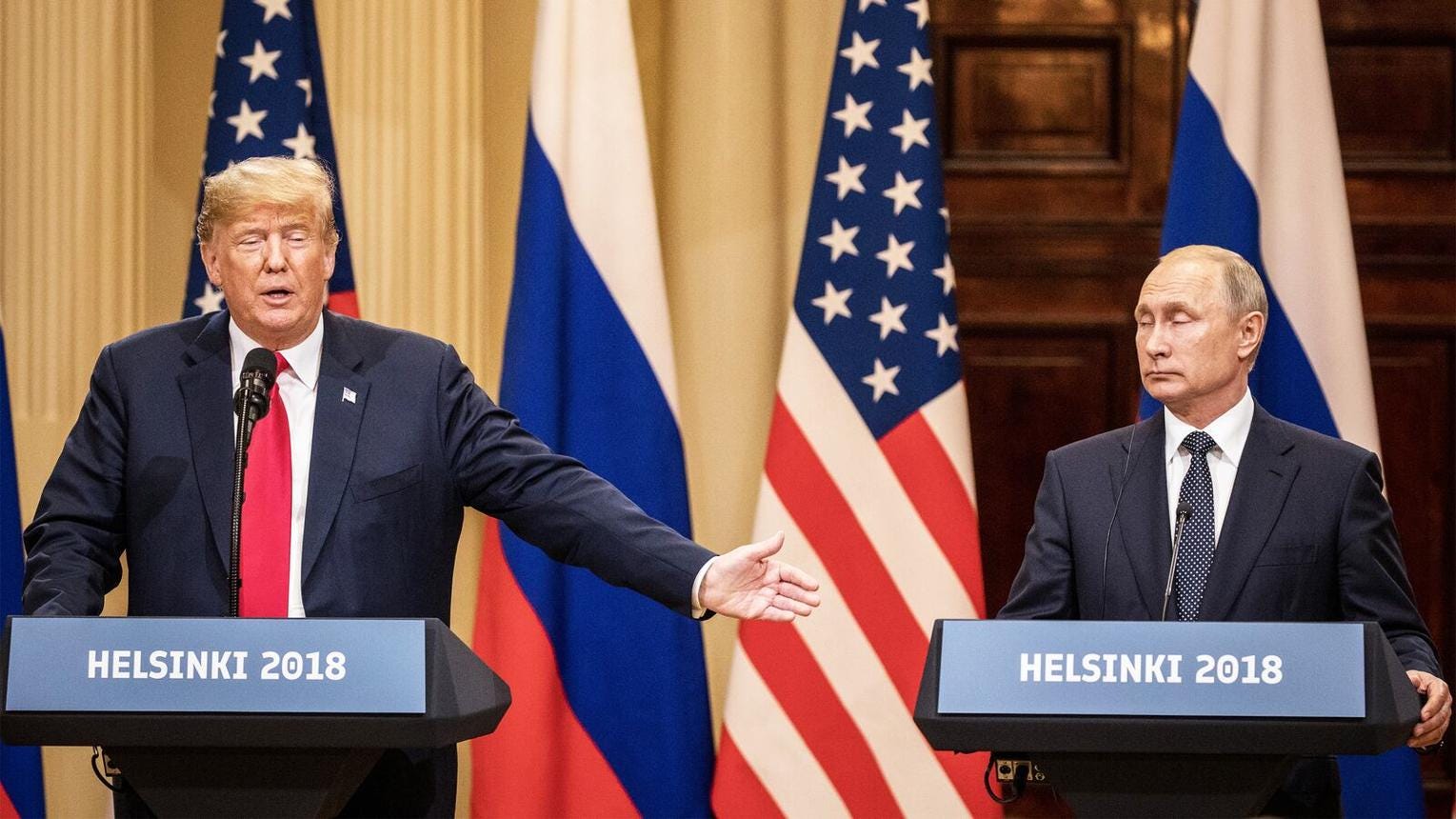
Trump and Putin at their July 2018 Helsinki summit.
I still find Helsinki one of the most revealing episodes in this history.
At their July 2018 joint news conference, Trump was asked about Russian election interference. Standing beside Putin, he discussed the Russian president’s denial in a way that appeared to place it alongside the conclusions of American intelligence agencies.
He later said he had misspoken and accepted the intelligence community’s findings.
That correction belongs in the record.
But so does the original moment, when an American president appeared reluctant to challenge a foreign leader over interference that his own intelligence agencies had documented.
Was Trump protecting the legitimacy of his election victory? Trying to improve relations with Russia? Acting according to his personal style of diplomacy?
Those are possible explanations. The public exchange itself doesn’t establish his private motives.
Still, you didn’t need a classified document to understand why the moment caused concern. You could watch it happen.
And when a president’s public statements repeatedly raise questions about his willingness to challenge an adversary, Americans are entitled to expect an explanation.
Ukraine wasn’t a side issue
In 2019, Trump’s administration withheld congressionally appropriated security assistance to Ukraine, which was already confronting Russian aggression.
The episode became central to his first impeachment. The Senate acquitted him, and arguments about his motives continued.
But there’s a separate finding that doesn’t depend on those arguments.
The Government Accountability Office concluded that the Office of Management and Budget violated the Impoundment Control Act by withholding the assistance for policy reasons.
That’s a federal oversight finding, explained in the GAO’s January 2020 decision.
The assistance mattered to Ukraine’s security. Withholding it had consequences regardless of which political explanation somebody accepts.
And that brings us to a distinction that matters today: we can evaluate the effects of presidential decisions without claiming to know everything that motivated them.
The evidence that doesn’t fit neatly
Now, before somebody starts typing an angry response, there’s something else we need to talk about.
Trump has also taken actions that hurt Russian interests. Real ones.
During his first administration, the United States approved Javelin anti-tank weapons for Ukraine. His administration imposed sanctions on Russian individuals and entities. In October 2025, the Treasury Department sanctioned Rosneft and Lukoil, two of Russia’s largest oil companies.
Those actions belong in this investigation.
They don’t automatically explain away other decisions that benefit Moscow, but we can’t erase them because they complicate the argument.
And there’s another problem with the word asset.
People use it casually to describe someone whose actions benefit a foreign power. In intelligence work, the term can imply a relationship involving recruitment, direction, or cooperation.
Those are very different meanings.
The public investigations we’ve examined did not establish that Trump was recruited or controlled by Russian intelligence. That finding doesn’t settle every question about his judgment or policies. It tells us what the available evidence can support.
Which is precisely why we need to keep examining the decisions themselves.
You can subscribe for free and keep reading, or become a paid subscriber to help support the work that goes into every edition. Either way, I’m glad you’re here.
The question that survives
So where does all of this leave us?
In October 2026, we’re once again examining decisions involving Russia, sanctions, and Ukraine. The administration offers economic and diplomatic explanations. Critics argue that some of those decisions reduce pressure on Moscow.
The historical record gives us reasons to scrutinize those choices. It also warns against assuming we know the motives behind them.
And I keep coming back to what I believed about Russians when I was younger.
Back then, the world seemed easier to divide into good guys and bad guys. We knew whom we were supposed to fear, and we didn’t spend much time questioning the labels.
Age has made me considerably less comfortable with that kind of certainty.
I don’t hold ordinary Russians collectively responsible for their government’s decisions. And I don’t believe skepticism about Trump requires assuming the worst possible explanation for everything he does.
But I also don’t think the absence of proof of a secret relationship means Americans should stop examining policies that may benefit an adversary.
Congress ought to demand clear explanations. Journalists ought to examine whether the administration’s stated objectives match the results. The public ought to know what concessions, if any, the United States receives in return for easing pressure on Russia.
Maybe the administration’s approach will produce meaningful diplomatic results. If it does, those results deserve scrutiny.
If it doesn’t, Americans deserve to know what was gained, what was surrendered, and why.
After two installments and a considerable amount of history, I find myself less interested in trying to read Donald Trump’s mind than in asking a question we can actually answer.
What has his Russia policy accomplished for the United States, and how do we measure whether it was worth the cost?
That seems like a reasonable standard for any president.
Even one who would probably prefer we stopped asking.
If this was worth your time, hit Like, Restack or share it. That’s how independent work like this finds new readers.
Copy article share text
THE BULLSHIT DETECTOR
Three more claims that didn’t survive a meeting with the facts.
1. The great American refinery disappearance
Claim: JD Vance said approximately 20% of America’s refining capacity went offline under Joe Biden, largely explaining today’s high gasoline prices.
Bullshit: 💩💩💩💩
Why: PolitiFact checked Vance’s October 17 claim and rated it false. California lost roughly 20% of its refining capacity; the nation as a whole did not. National capacity has remained relatively stable, and energy experts identified the Iran war and disruptions to oil supplies as much larger contributors to current prices.
Apparently, someone misplaced the entire country while reading California’s numbers.
2. Medicare’s alleged demolition
Claim: Democratic campaign advertisements accuse Republicans of gutting Medicare through Trump’s major domestic policy law.
Bullshit: 💩💩💩
Why: FactCheck.org found that the ads exaggerated the Medicare provisions. The law does make changes affecting some vulnerable beneficiaries, but its much larger healthcare spending reductions involve Medicaid. The potentially enormous automatic Medicare cuts under federal budget rules were subsequently waived by Congress.
Those distinctions matter, especially when politicians are frightening older Americans about their healthcare.
Medicare and Medicaid aren’t interchangeable just because they both start with M.
FactCheck.org — October 16, 2026
3. Paris apparently had an uprising nobody noticed
Claim: A viral photograph shows crowds waving Palestinian flags beneath the Eiffel Tower while fireworks explode overhead.
Bullshit: 💩💩💩💩💩
Why: Full Fact examined the circulating image and found an invisible SynthID watermark associated with AI-generated content, along with visual inconsistencies. The photograph wasn’t authentic.
Somebody manufactured an enormous political demonstration without having to organize a single protester.
At least fake news has finally found a way to eliminate parking problems.
Elsewhere in Tom Hicks Media
If politics has left you wondering whether reality has always been this ridiculous, What The Hell? has historical evidence suggesting the answer might be yes. Rabbit Ears Classic TV takes us back to classic television, when entertainment didn’t require fourteen streaming subscriptions and a password reset.
Chart Collision explores the songs, performers, and musical memories that never quite leave us. The Backlot Ghost revisits movies and the stories behind them, while Lotus Purrspective offers daily observations from a cat who remains unconvinced that humans are the superior species.
And when politics isn’t providing enough anxiety, Panic Room Sports has football, basketball, racing, and plenty of opportunities to question your life choices.
Buy Me a Tea
Independent journalism takes time, research, and the occasional argument with a paragraph that refuses to cooperate. If you’d like to support the work, you can help keep Off Script going through Buy Me a Tea.
One Question
After everything investigators uncovered about Russian election interference, what questions about Trump’s relationship with Moscow do you believe still deserve answers?
I’m interested in where you draw the line between reasonable suspicion and convincing evidence.
#OffScript #TomHicksMedia #TrumpRussia #VladimirPutin #MuellerReport #Ukraine #IndependentJournalism #PoliticalAccountability