

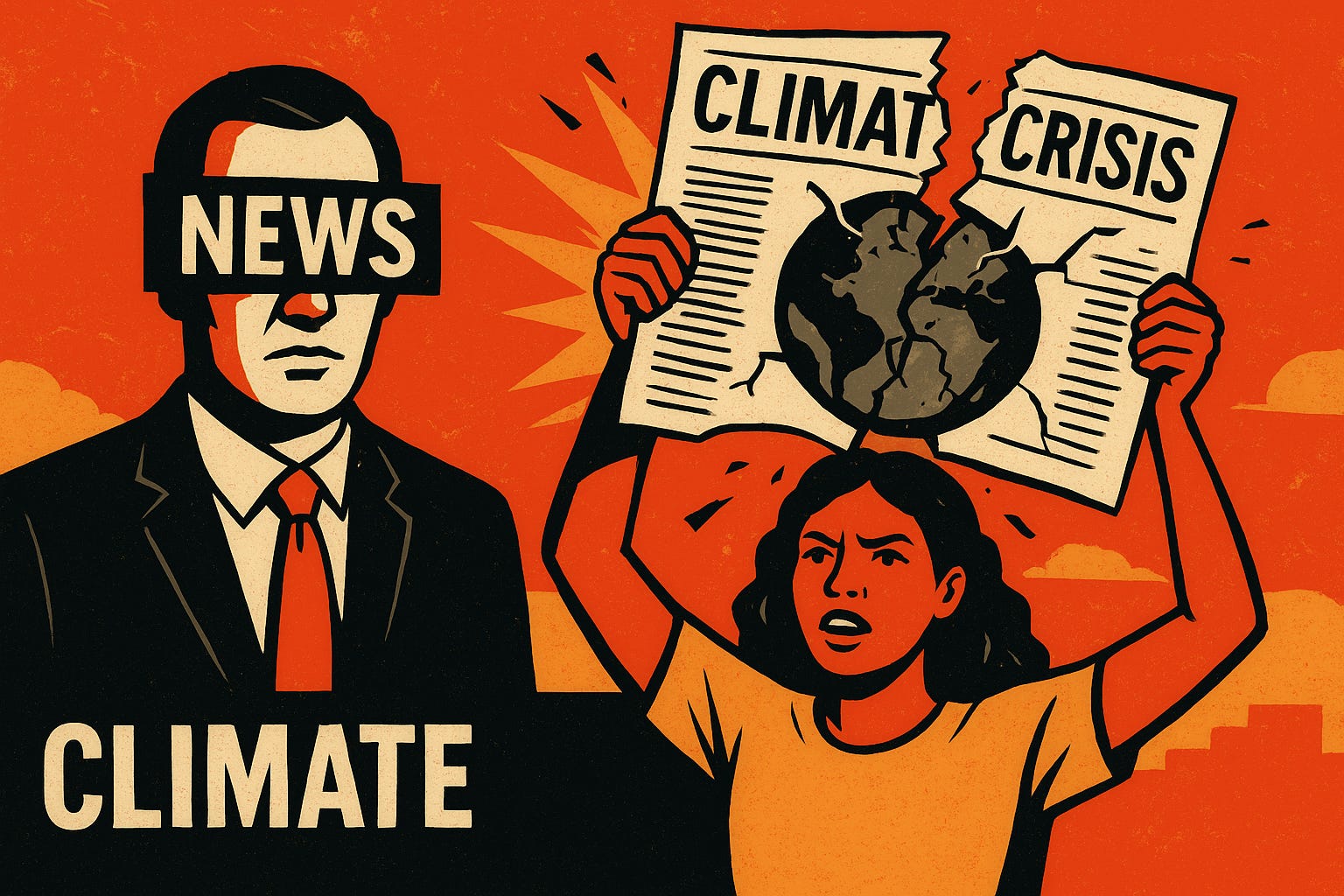
“We talk about hurricanes and heat waves like they’re the whole story — but the storm is more than weather.”
🌪️ The Big Lie in Climate Coverage
Let’s be real: the media loves a good disaster shot. A flooded street in Miami. A cracked, dusty farm in Arizona. A blazing forest in California. That’s the money shot, the B-roll, the headline.
But here’s the thing nobody bothers to tell you: the hurricane isn’t just wind, the heatwave isn’t just numbers on a thermometer, and the wildfire isn’t just flames. The real story — the one you rarely hear — is about who pays, who profits, and who’s left without a voice when the waters rise.
This isn’t just about science. It’s about power.
⚖️ Climate Change = Social Justice
Every time a newsroom treats climate change like a “weather story,” they erase the people who can’t just buy an air conditioner, rebuild their homes, or relocate to higher ground.
Poor and working-class neighborhoods are the first to flood, the last to get relief funds, and the easiest for developers to “clear out” when the land gets valuable again.
Indigenous and frontline communities often have the solutions — sustainable farming, land stewardship, water justice campaigns — but their voices get sidelined in favor of “expert panels” featuring corporate lobbyists.
Globally, the South suffers while the North debates. Rich countries argue over carbon credits while small island nations literally vanish.
As environmental justice leader Mustafa Santiago Ali put it:
“Climate change is the greatest civil rights issue of our time.”
— Mustafa Santiago Ali, National Wildlife Federation
But does that make the nightly news? Hardly ever.
📰 Sensationalism vs. Reality
We’ve all seen it: the breathless coverage of a “record-shattering” storm, followed by the obligatory snowstorm headline a month later: “So much for global warming!”
That whiplash comes from the media’s obsession with extremes instead of long-term data. Scientists talk about decades of warming trends, confidence intervals, and attribution studies. News anchors want a splashy moment: “Is this hurricane the proof of climate change?”
This creates what researchers call a perception gap:
Most Americans actually do care deeply about climate and support bold action.
But surveys show they think they’re in the minority.
Why? Because the media either drowns them in apocalyptic hype (which leads to despair) or downplays urgency (which leads to apathy).
That’s not journalism. That’s malpractice.
🥊 The False Balance Scam
Here’s one of the most destructive tricks in the media playbook: false equivalence.
In the name of “objectivity,” reporters will put a climate scientist with 30 years of peer-reviewed research next to… a fossil fuel lobbyist with a slick haircut and a check from Exxon. And then they present them as equals.
As Northwestern University researchers put it:
“When both sides of an argument are presented, people tend to have lower estimates about scientific consensus.”
— Northwestern News, July 2022
Translation: giving oil lobbyists airtime makes people think the science is less settled than it really is.
That’s not balance. That’s sabotage.
📲 Digital Media: The Double-Edged Sword
Now, here’s where things get interesting. Traditional media drops the ball, but digital media has changed the game.
On one hand, social platforms let activists tell their own stories, in real time, with interactive maps, live feeds, and testimonies. Grassroots climate justice campaigns can bypass the gatekeepers and speak directly to the public.
On the other hand… welcome to the Wild West of misinformation. Conspiracy theories, cherry-picked memes, and flat-out lies spread faster than facts. Studies show contrarian voices coordinate bursts of disinfo around every major climate event, and thanks to echo chambers, they find ready audiences.
But there’s hope: researchers also show that “prebunking” — exposing people to weakened versions of misinformation before they encounter it — actually builds resistance. That means activists can fight fire with fire.
🚨 What Needs to Change
If we want media to stop sleepwalking through the apocalypse, here’s what needs to happen:
Stop platforming lobbyists like they’re scientists. Present the consensus, then mention the fringe — not the other way around.
Tell long stories, not just breaking ones. Climate change doesn’t happen on a 24-hour news cycle. It’s decades in the making.
Center justice, not just drama. Cover who gets hit hardest, who’s building resilience, who’s demanding accountability.
Give us agency. Show solutions, not just destruction. Despair doesn’t build movements; empowerment does.
✊ The Insurgency Take
Look — the fight against climate change isn’t just about CO₂ molecules in the air. It’s about narrative power. And right now, that power is still tilted toward the corporations, the lobbyists, and the newsrooms that confuse balance with truth.
But here’s the thing: you are not powerless.
You can demand better coverage. You can amplify grassroots stories. You can refuse to let false equivalence pass unchallenged. And most importantly, you can organize.
Because the real climate war isn’t against the storm. It’s against silence, distortion, and injustice.
🔥 If this piece lit a fire under you, share it. Let’s push past the noise, demand better media, and build a movement that connects the dots.
📢 And if you haven’t yet — subscribe to The Insurgency. We’re shooting for 1,000 subscribers by October 31st, and every new voice strengthens the fight.
#ClimateJustice #MediaFailure #TheInsurgency