

If you’ve been trying to predict this Supreme Court by asking whether it’s “pro-Trump” or “anti-Trump,” how’s that working out for you?
Seriously. I’d love to know.
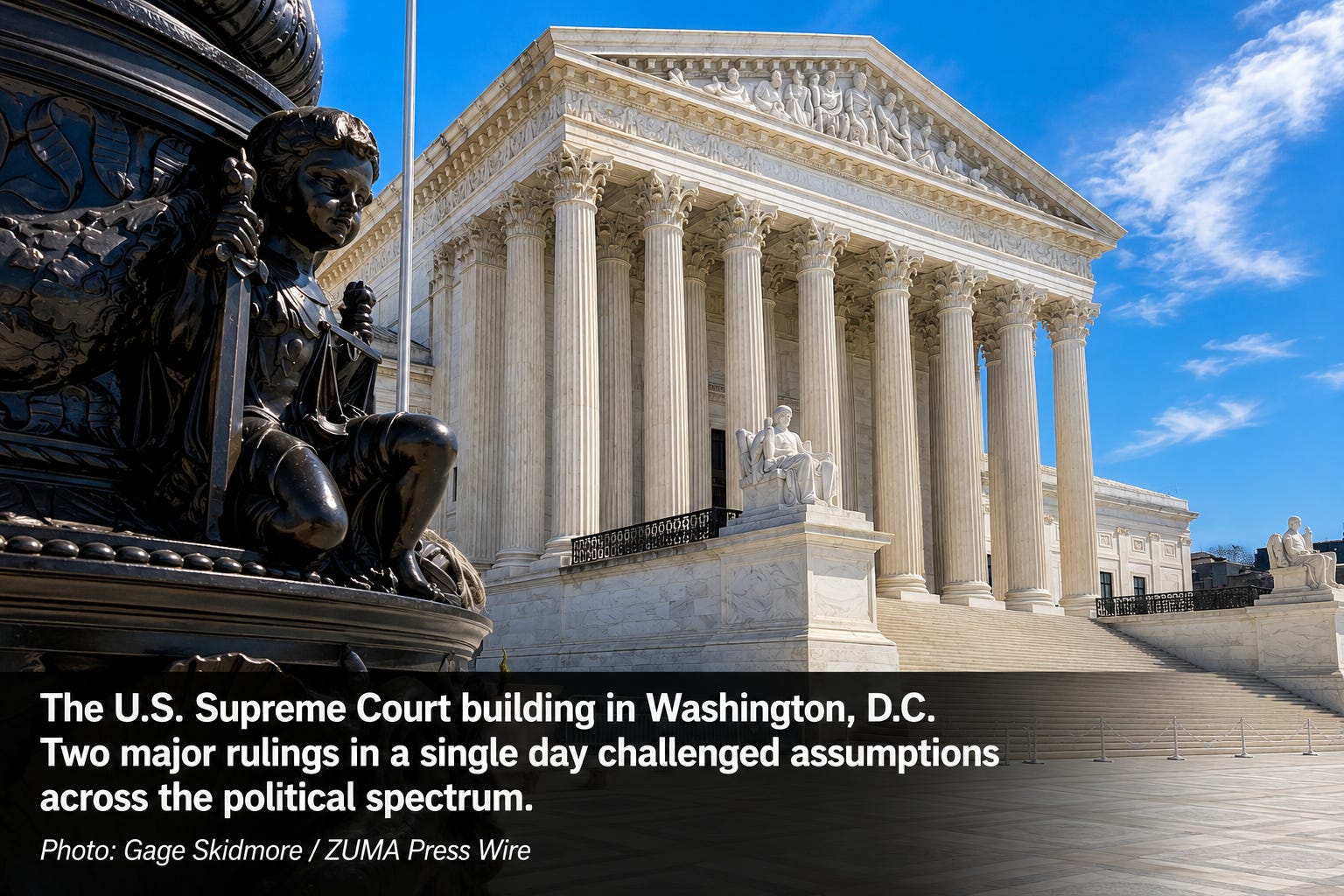
Because within the span of a single goddamn day, the same Court that’s been accused of bending over backward for Donald Trump also rejected his administration’s effort to limit birthright citizenship through executive action while striking down long-standing limits on coordinated campaign spending between political parties and candidates.
Half the country looked at one headline and cheered. The other half looked at the next one and lost its collective shit. By lunchtime, everyone was convinced the Court had either saved democracy or auctioned it off.
Welcome to another Tuesday in America.
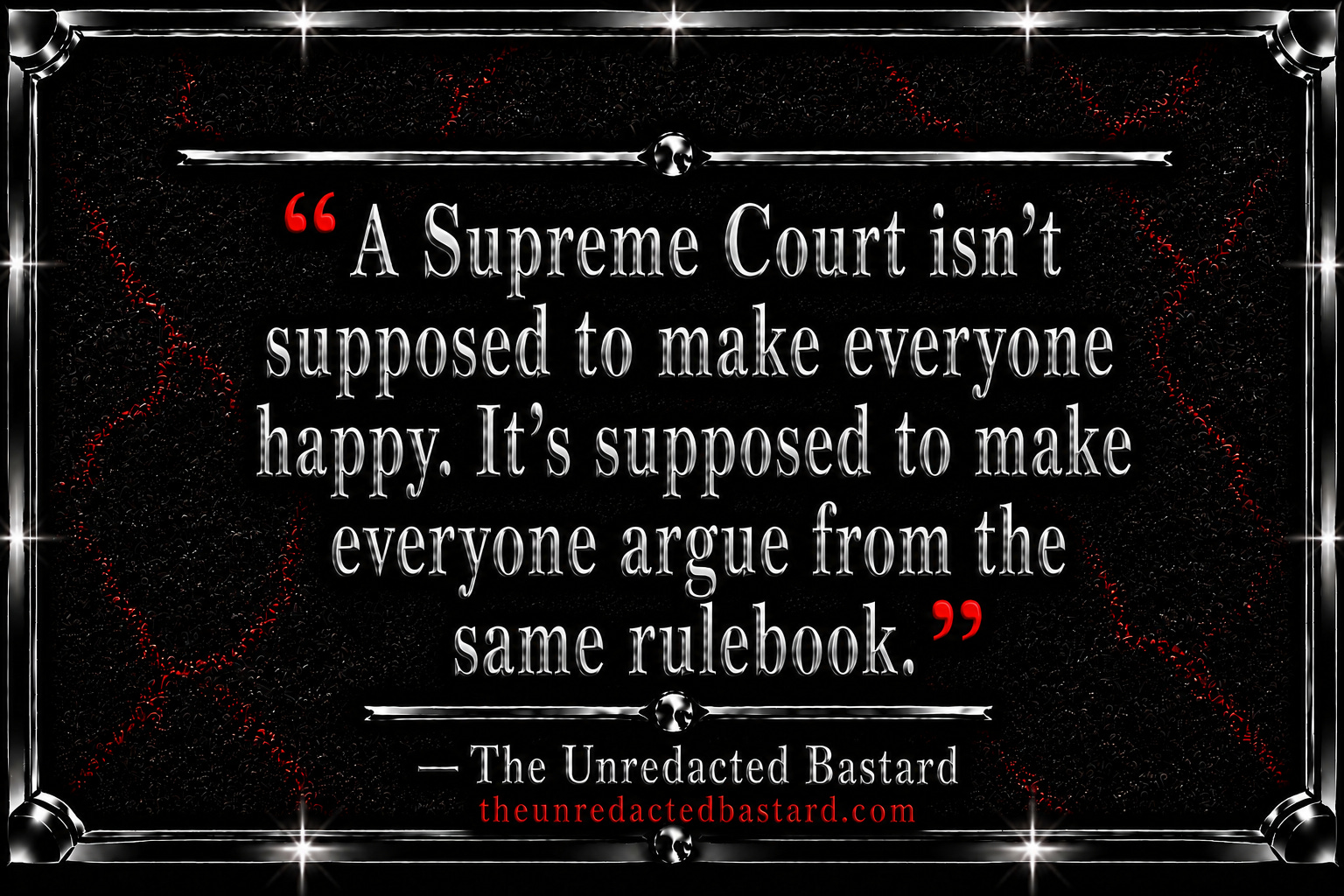
The problem isn’t that the Supreme Court is impossible to understand. The problem is we’ve started treating it like a political campaign instead of what it actually is: nine people reading a rulebook that’s almost 240 years old while the rest of us scream at the TV like it’s a goddamn football game.
Now, before anyone starts firing off angry emails, let’s get one thing straight. That doesn’t mean the Court always gets it right. It doesn’t mean every decision deserves applause. And it sure as hell doesn’t mean the justices magically leave their judicial philosophies at the courthouse door like coats at a fancy restaurant.
But if every decision gets filtered through nothing more than “my team won” or “my team lost,” we’re missing the actual story unfolding right in front of our faces.
Join Me Every Morning
Constitutional law isn’t baseball. There’s no box score, no MVP, and no postgame highlight reel.
There are nine people interpreting a document built to outlast presidents, parties, and whatever political fever dream is gripping the country this week. Sometimes those interpretations produce results conservatives love. Sometimes liberals get to throw the parade. Sometimes, everybody walks away needing a stiff drink and a Tylenol.
Today’s decisions are a perfect example.
On one hand, the Court left birthright citizenship intact, rejecting the administration’s effort to narrow a constitutional protection that’s been recognized for more than a century. On the other hand, it struck down federal limits on coordinated campaign spending between political parties and candidates, ruling those restrictions violated First Amendment protections for political speech.
Those outcomes don’t seem to belong in the same conversation if you’re looking through a purely political lens. They make a hell of a lot more sense if you’re looking through a constitutional one.
That distinction matters because Americans have gotten addicted to reading Supreme Court opinions like they’re election returns. We immediately ask who won, who lost, and which cable network is having the bigger meltdown. What we seldom ask is the question that actually matters:
What constitutional principle did the Court think it was protecting?
That’s where the real story lives. Everything else is just noise dressed up as analysis.
The birthright citizenship case is a perfect illustration.
The birthright citizenship case is a perfect illustration.
For months, the public conversation centered on immigration politics. Supporters framed the executive order as necessary border enforcement. Opponents called it a flat-out attack on the Fourteenth Amendment. Those arguments dominated the headlines, but the constitutional question was a hell of a lot narrower than the shouting match suggested.
Can an executive order override a constitutional guarantee that’s been understood the same way for generations?
The Court’s answer was no.
Notice what that answer wasn’t. It wasn’t a declaration that every immigration policy this administration touches is unconstitutional. It wasn’t an endorsement of open borders. And it sure as hell wasn’t a campaign speech, no matter how badly cable news wanted it to be one.
It was a reminder that presidents inherit the Constitution. They don’t get to take a Sharpie to it like it’s a White House visitor log.
That ought to be one of the least controversial statements in American government. Instead, it’s somehow become a partisan Rorschach test where everybody sees exactly what they walked in wanting to see.
Some people saw the ruling and immediately declared the Court had “turned against Trump.” Others insisted the justices had sold out conservatives. Both reactions missed the point entirely.
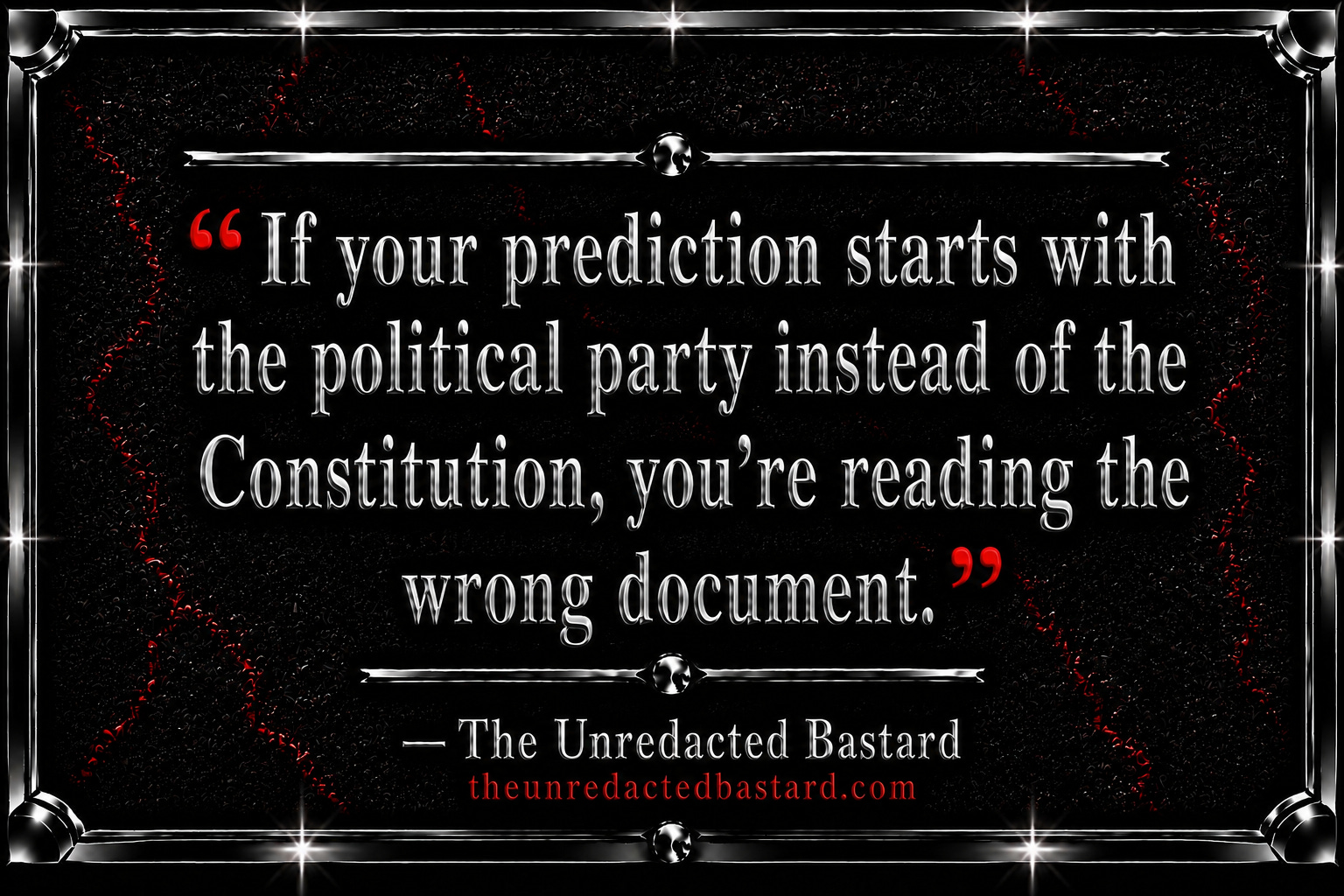
If the Constitution only mattered when it produced outcomes we personally liked, it wouldn’t be a Constitution. It’d be a Yelp review.
The entire purpose of constitutional guardrails is to keep certain decisions out of reach of whoever’s currently sitting in the Oval Office, throwing a tantrum. If a president could issue an executive order every time the Constitution became inconvenient, we wouldn’t have a rule of law anymore. We’d have the rule of whoever happened to be in charge.
That’s a hell of a dangerous precedent, regardless of whose name is on the door.
Then, just as everyone was congratulating themselves for finally cracking the code on what this Court “really is,” the next decision landed and blew the whole theory up.
The Court struck down long-standing federal limits on how much political parties can spend in coordination with their own candidates.
If your gut reaction was, “Great, because politics definitely needed more money sloshing around,” congratulations—you have a pulse. Mine wasn’t much different.
Let’s not kid ourselves. Most Americans already think there are obscene amounts of cash flooding Washington. Every election costs more than the last one, every commercial break comes with another fundraising text begging for eleven dollars, and every campaign ad somehow finds a new way to make you hate this country a little more.
So yeah, it’s understandable that removing another campaign finance restriction makes people want to throw their phone across the room.
That doesn’t automatically mean the constitutional reasoning is bullshit.
The Court has spent decades treating political spending as protected speech under the First Amendment. Whether you think that philosophy is brilliant or batshit, this ruling didn’t fall out of a clear blue sky. It’s the next domino in a line of cases that consistently treated restrictions on political spending with deep suspicion.
You can think that philosophy produces garbage practical outcomes while still recognizing the Court believes it’s applying the same principle it’s applied for decades. Those aren’t mutually exclusive ideas, no matter how much Twitter wants them to be.
Too often, we collapse legal analysis into pure political emotion. Outcome we like? The reasoning must be brilliant. Outcome we hate? Suddenly, the Constitution’s optional, and the justices are bought and paid for.
That’s not analysis.
That’s a crowd doing the wave and calling it jurisprudence.
One of the weirder side effects of modern politics is that we’ve started expecting the Supreme Court to behave like Congress.
We want voting blocs. We want predictable alliances. We want a neat little scorecard telling us who won the day so we can go back to doomscrolling in peace.
That’s comforting because it makes the world easier to digest.
It’s also a lousy way to understand a court.
Judges aren’t elected to horse-trade legislation over steak dinners. They’re asked to interpret statutes, precedent, and constitutional text. Sometimes those interpretations land perfectly consistent with a justice’s judicial philosophy while looking completely batshit through a partisan lens.
That’s exactly why this Court can piss off liberals in one case and torch conservatives in the next without contradicting a single thing about itself.
Does that mean every decision is beyond criticism?
Hell no.
Some deserve fierce criticism. Loud, sustained, righteous criticism. Some deserve applause.
Most deserve something Americans don’t seem to have the patience for anymore:
A careful goddamn reading before declaring the republic either saved or buried.
About two-thirds of the way through every Supreme Court term, social media turns into the world’s loudest law school, staffed almost entirely by people who’ve never once opened the opinion they’re screaming about.
Somebody posts a headline. Someone else posts a meme. Within minutes, millions of Americans have formed a rock-solid opinion based on twelve words and a cropped photo.
That’s a hell of a way to evaluate decisions that’ll shape this country for the next fifty years.
Keep the receipts hot and the bullshit detector fully operational.
If these morning reality checks help you cut through the noise, consider buying me a tea. Every cup keeps the receipts coming and the bullshit detector calibrated.
Here’s the irony, and it’s a thick one.
The people who complain loudest that Americans don’t understand the Constitution are usually the first ones to shut up about it the second a ruling benefits their side. When that happens, constitutional principle quietly slips out the back door while political tribalism kicks the front one down.
We’ve gotten so conditioned to viewing every institution through a partisan lens that we’ve damn near forgotten what those institutions are even for.
Congress is supposed to write laws.
The president is supposed to execute them.
The Supreme Court is supposed to decide whether they fit inside the constitutional framework.
Those jobs overlap. They collide. Sometimes they produce decisions that leave absolutely everyone furious.
Good.
If every Supreme Court ruling perfectly matched one side’s political wish list, that wouldn’t be a principled court. It would be a predictable political actor wearing a black robe and pretending it’s not just Congress with extra steps.
That doesn’t mean this Court is beyond criticism. Far from it. There are decisions from this Court that piss me off, that I think are reasoned like garbage, and I’ll keep saying so. Criticizing the judiciary is part of a healthy democracy, not an act of treason.
But criticism carries more weight when it’s aimed at the reasoning instead of the scoreboard.
Saying, “I think the Court misapplied the First Amendment,” is an argument.
Saying, “They ruled against my side, so they’re corrupt,” is a toddler throwing a plate on the floor.
America has enough plate-throwing already.
What it needs are more citizens willing to separate legal reasoning from political preference, even when the two collide head-on.
Because here’s the uncomfortable truth nobody wants to sit with.
One day, the constitutional principle protecting someone you despise might be the exact same principle protecting you.
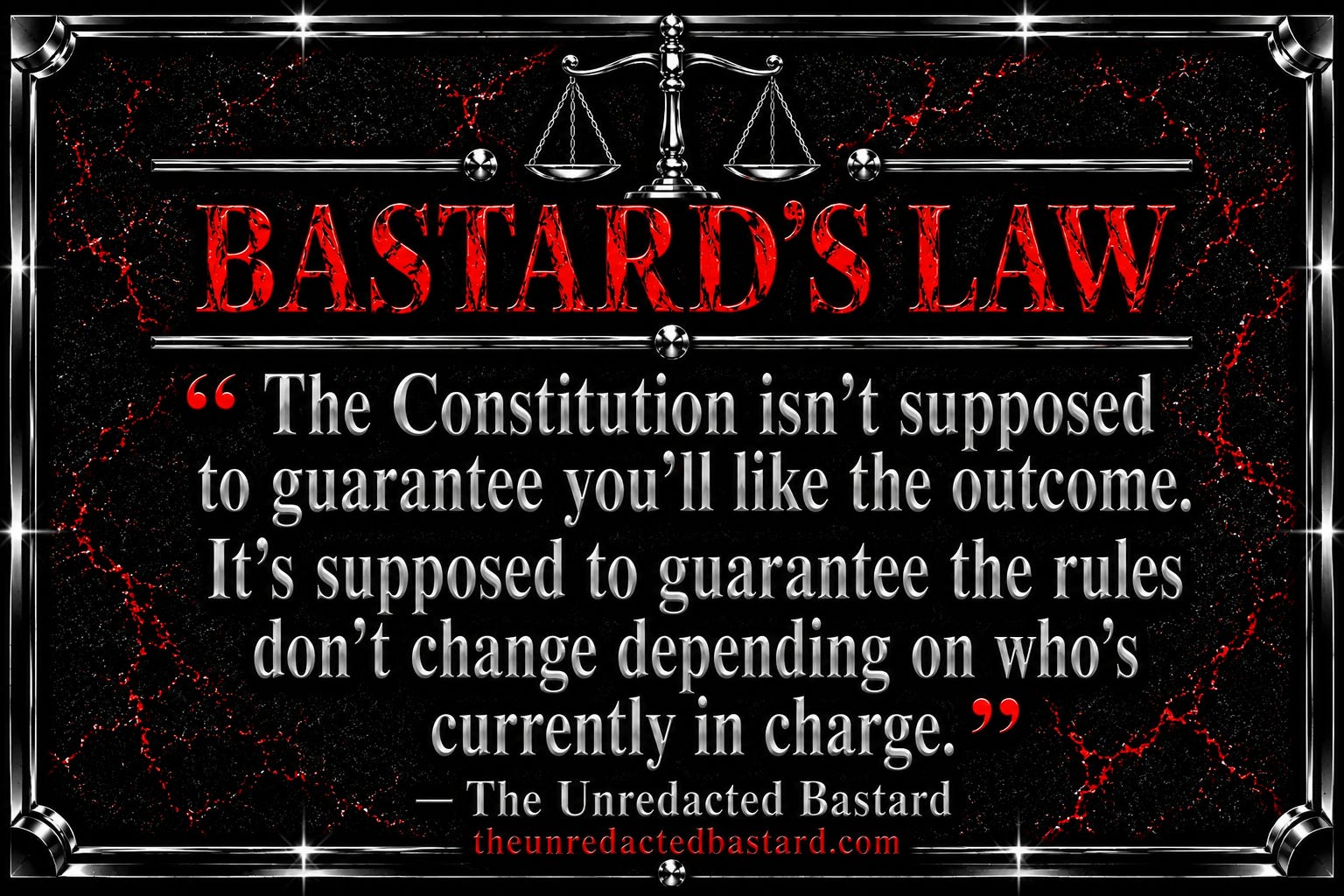
That’s why constitutional rights matter. They’re not rewards for good behavior. They’re not campaign promises. And they sure as hell aren’t supposed to flip every four years depending on which party’s throwing the inaugural ball.
The Constitution was written to outlive presidents.
The least we can do is stop treating it like a Groupon that expires every Election Day.
One Question Before You Go
If a Supreme Court decision lands the outcome you wanted, do you still care whether the constitutional reasoning behind it was actually sound?
If you’re tired of headlines without context and outrage without analysis, subscribe and join me every morning. We’ll keep following the facts, even when they piss off everybody equally.
BASTARDONIA FACT
The Ministry of Constitutional Headaches reminds citizens that reading the actual ruling burns more calories than reposting the headline. Only one of those activities does a damn thing for democracy.
#SupremeCourt #SCOTUS #Constitution #RuleOfLaw #BirthrightCitizenship #CampaignFinance #Politics #Democracy #TheUnredactedBastard