
By Tom Hicks | The Unredacted Bastard Independent Journalist • Democracy’s Fire Alarm • Professional Shit-Stirrer
Bastard’s Law
When threats become routine, reality becomes optional.
We used to treat threats of war like fire alarms. Not metaphorically -- I mean the actual physiological thing, where your chest tightens, and your brain stops doing whatever it was doing. Something real might happen. Pay attention.
Now we treat them like app notifications.
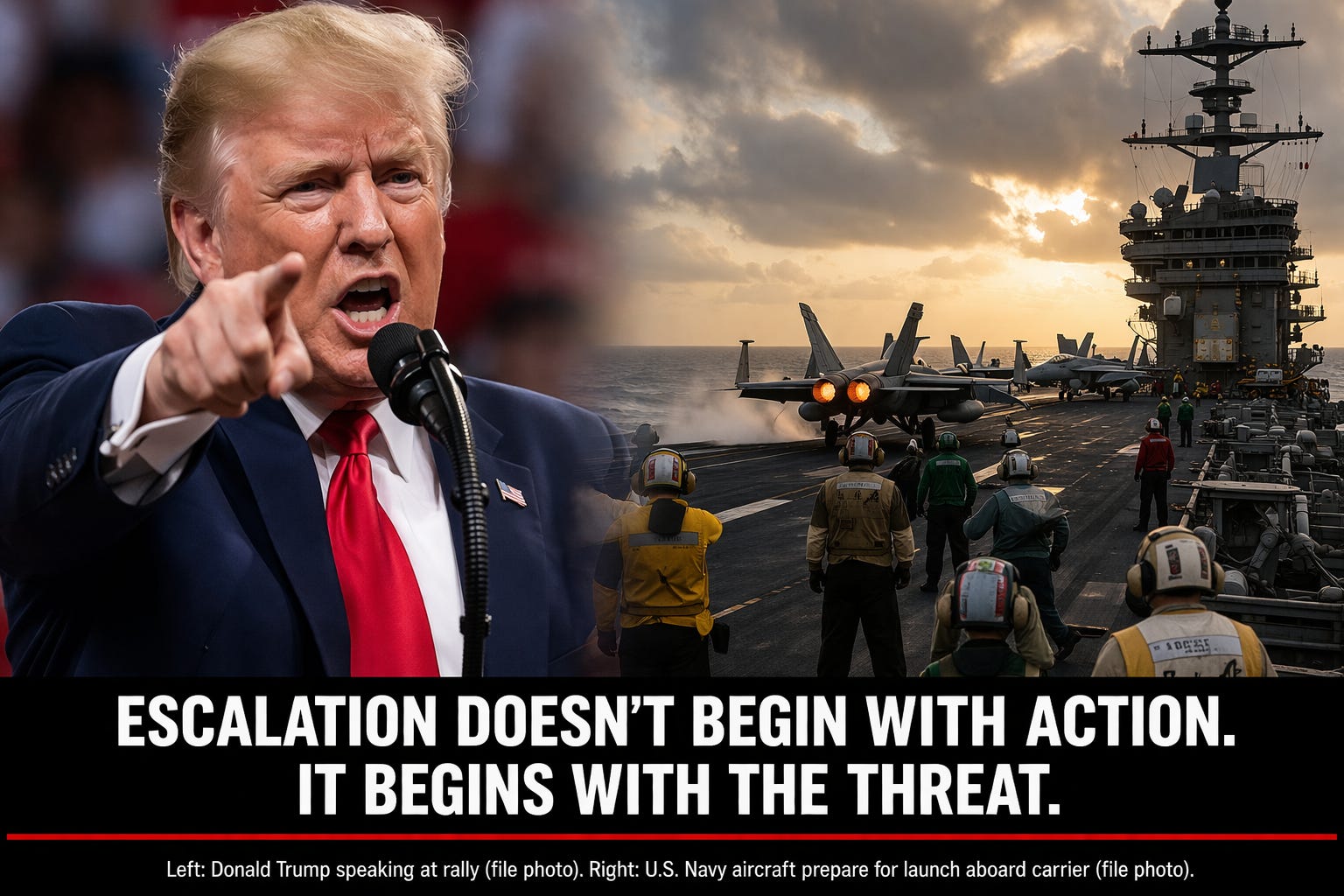
A headline drops that Trump might bomb Iran into rubble, and the country doesn’t freeze -- it scrolls. We refresh. We argue about whether he means it. We wait for the next update like it’s a fucking weather advisory, and somewhere in the middle of that routine, we stopped noticing that the building already smells like smoke.
That’s the problem. Not the threat. The routine.
Because here’s what we keep getting wrong: we’re talking about this like it’s a cliff we might fall off someday. It’s not. We’re already halfway down the face of it, grabbing at whatever looks like a handhold, and the conversation we’re having is still about whether to take a step closer to the edge.
There’s already conflict. Already positioning. Already pressure building in ways that don’t make the scroll. What we’re watching isn’t whether something starts. It’s how far something that’s already moving is willing to go.
If you’re not subscribed yet, you’re reading this the hard way.
The Pattern Everyone Sees -- and Still Misses
This isn’t new. It’s not even rare anymore. Threaten tariffs. Threaten crackdowns. Threaten to turn someone’s capital into a parking lot. Walk some of it back, double down somewhere else, shift the spotlight before anyone finishes processing the last one, and repeat until the whole thing starts to feel like weather.
And every time, the same machinery spins up on cue. Markets twitch like it’s 2008, and nobody knows which institution is about to go sideways. Allies scramble like it’s the opening days of Iraq and they’re still figuring out which calls to return. Cable panels start running war scenarios like it’s the NFL Draft, except instead of quarterbacks, they’re picking targets and calling it analysis.
“The supreme art of war is to subdue the enemy without fighting.” — Sun Tzu
We’ve turned that inside out into something a lot uglier. This isn’t strategic restraint. This is performative escalation -- where the threat itself is the product, the audience is the entire world, and the show never actually has to end to keep running.
The Problem Isn’t What You Think
The easy version of this story is a personality take. He bluffs. He backs down. He escalates and then chickens out, or doesn’t, depending on which hour you’re watching. Pick your lane and run with it for a few cycles.
That’s comfortable.
It’s also wrong.
The problem isn’t whether he follows through. It’s that nobody knows when he will. And that uncertainty -- that’s not a bug. It’s not some failure of communication or strategic incoherence. It’s the whole fucking point. It forces every government, every market, every institution, every newsroom, every person trying to figure out what’s real -- it forces all of them to react to the possibility of action as if it’s already underway.
And it’s working inside a conflict that’s already active. The threat doesn’t start the fire. It pours accelerant on something that was already burning before you saw the headline.
When the Threat Does the Work
By the time any real decision gets made, the consequences are already unfolding. They don’t wait for the order. Diplomats reposition. Adversaries prepare responses. Markets price in risk like they’re bracing for a hit they can see coming but can’t time. The public shifts into this low-grade anticipation mode -- not quite panic, not quite calm, just this permanent state of waiting for the other shoe.
None of that requires a strike.
None of it requires a decision.
The threat alone is enough to move the pieces.
“The greatest trick the Devil ever pulled was convincing the world he didn’t exist.” — Charles Baudelaire, though most people know it from The Usual Suspects
We’re watching the inverse in real time. The trick now is convincing everyone that something might happen -- and then letting that possibility reshape the board before anyone fires a shot.
Policy used to be what got announced after decisions were made. Now the threat is the policy. It creates movement, pressure, and leverage without the legal exposure, the congressional fight, the body count, or any of the other constraints that come with actual action. You get most of the effect with a fraction of the accountability.
Which is -- and I want to be precise here -- a pretty fucking elegant racket, if you’re the one running it.
The Incentive Problem Nobody Wants to Admit
There is almost no political downside to making the threat.
If nothing changes on the ground, you call it strength or strategic patience, depending on who’s spinning it for you. If something escalates, you call it decisive leadership. If it goes sideways, there’s always someone else’s desk to leave it on.
Every outcome is frameable as a win. Every outcome. That’s not an accident of good messaging -- that’s a system that’s been tuned to produce exactly that result.
“Power tends to corrupt, and absolute power corrupts absolutely.” — Lord Acton
What we’re watching now is a version of that corruption where power doesn’t even need to act to be effective. It just needs to threaten, and the system does the rest. The markets move. The allies flinch. The adversaries calculate. And whoever’s holding the microphone gets to stand in the middle of all that motion and say: see what I did?
💣 TRUTH BOMB
We’re not watching a decision about whether to escalate. We’re watching an escalation decide how far it’s willing to go.
The Real Danger Isn’t the Strike
This is not how you drift into conflict.
This is how you escalate one that’s already underway -- step by step, headline by headline, until the point of no return doesn’t register as a decision because it doesn’t feel like one. It feels like momentum. It feels like things that were always going to happen are happening.
There’s a thing that happens when a fire alarm goes off in a building enough times for nothing. People stop leaving. They look up, they wait a beat, they go back to what they were doing. And eventually, when it’s real, they hesitate just long enough for it to matter.
That hesitation. That’s where the mistakes happen. That’s where contained situations expand into something nobody actually chose.
And by the time the line is clearly, undeniably crossed -- it doesn’t feel like anyone crossed it. It feels like it crossed itself. Like the thing just happened, the way things happen, and now here we are.
Verdict
This isn’t strength. It isn’t restraint. It’s volatility wearing leadership’s clothes, inside a system that’s been rewarding the threat more than the action for long enough that the threat became the action.
We’re not waiting to see if he’ll act.
We’re already reacting like he has. We’ve been reacting for a while now.
That’s the shift. That’s the actual danger. And once you see it operating that way -- as a feature, not a glitch -- it’s a lot harder to tell yourself this is just politics doing what politics does.
I’m retired, reader-funded, and not taking a dime from sponsors, which means this stays blunt, independent, and exactly as unfiltered as it needs to be.
Want the deeper breakdowns? The War Room pieces? The stuff that doesn’t make it into the public feed? Hit upgrade and get inside.
For a cooler, sharper, and considerably more judgmental take on the human condition, delivered by someone with four paws, zero tolerance for nonsense, and a vocabulary that puts most op-ed writers to shame, check out Lotus Purrspective.
If this hit home, like it, share it, subscribe.
☕ Buy Me A Coffee because yelling "what the fuck are we doing?" at the news doesn't pay for itself.
#Politics #Trump #Iran #War #Geopolitics #ForeignPolicy #GlobalSecurity #USPolitics #Military #WorldNews