

By Tom Hicks | September 24, 2026
Editorial Note:
Off Script with Tom Hicks is independent commentary built on reported facts. This article distinguishes between actions the Trump administration has taken, proposals being pushed by people outside the administration, and ideas administration officials have discussed. Those distinctions matter. So does the pattern connecting them.
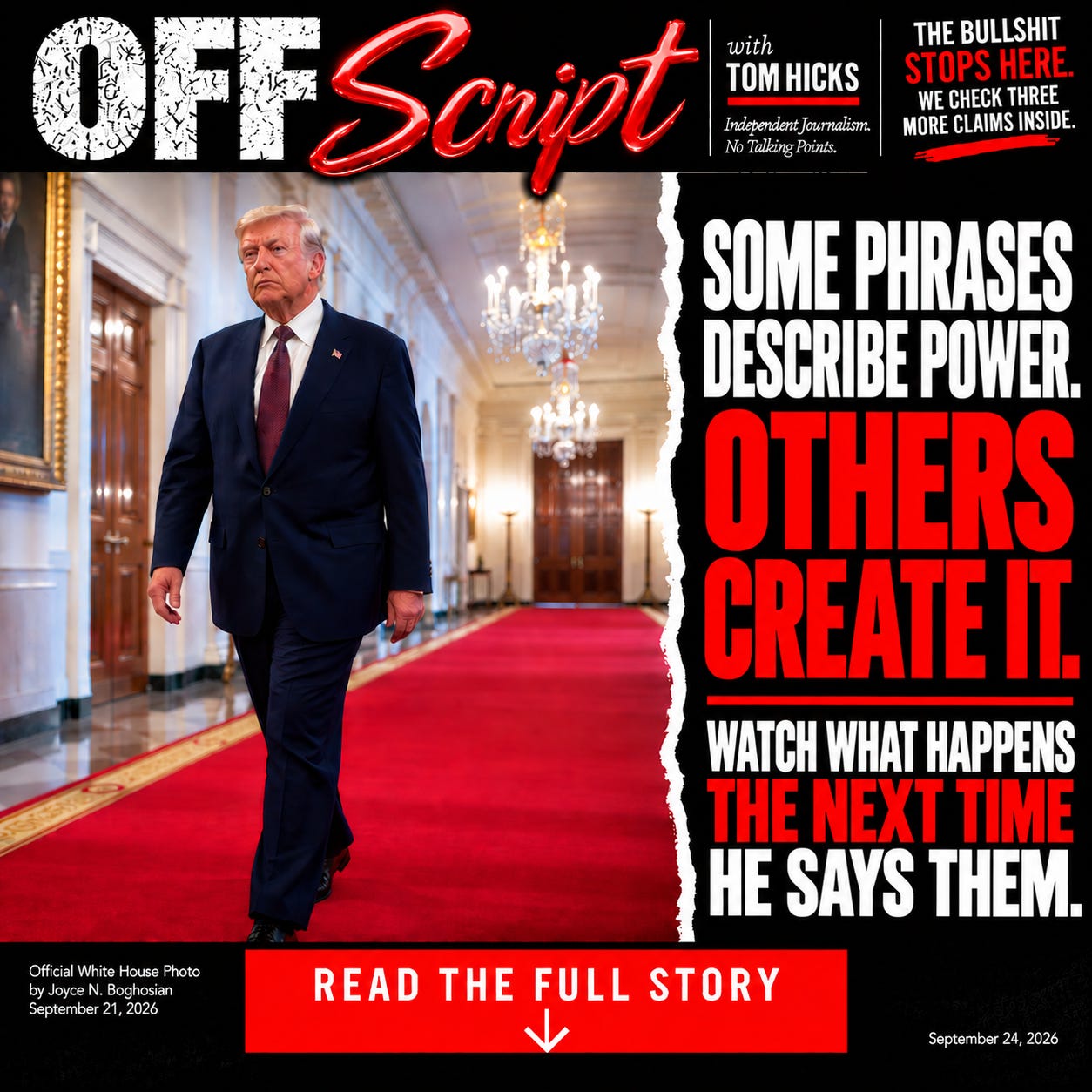
Apparently, America has developed one hell of an emergency problem. A $400 million White House ballroom has become a military complex. So has a proposed 250-foot triumphal arch. Offshore wind projects, tariffs, and restrictions on reporters have all been defended using the same extraordinary justification. The subjects change. The words don’t.
The two words are national security.
And those words matter because they aren’t merely political decoration. Presidents have historically received substantial latitude when genuine national-security questions are involved, while emergency declarations can unlock statutory powers unavailable under ordinary circumstances. That doesn’t give a president unlimited authority, but it can change the legal battlefield considerably.
IT’S WORKING
Reuters examined the administration’s expanding use of national-security arguments this week and found them attached to an increasingly unusual collection of presidential priorities. When Trump’s proposed triumphal arch near Arlington National Cemetery ran into resistance, he described it as a military complex that would include drones, snipers and ammunition. The White House ballroom has also been characterized as a military facility as legal challenges and congressional resistance have mounted.
The same rationale has reached far beyond construction projects. Trump has invoked national security in connection with tariffs and offshore wind projects, while his administration is using national-security concerns in federal court to defend its decision to bar CNN, MS NOW and Politico from the White House. The three organizations argue that the ban violates the First Amendment and their due-process rights.
A senior White House official gave Reuters an unusually candid explanation of the strategy. The official acknowledged that expanding national security this broadly was less than ideal, then supplied the sentence that should make everybody pay attention:
“It’s working.”
That’s worth sitting with because Trump didn’t invent emergency powers, presidential deference, or creative lawyers looking for ways around obstacles. Presidents of both parties have stretched executive authority and invoked national security when doing so strengthened their hands. What stands out now is the sheer range of subjects being brought beneath that umbrella, including matters that would ordinarily seem far removed from defending the country.
A ballroom and an arch can sound almost comical in that context. They’re considerably less funny if they establish a useful lesson inside the White House: when ordinary presidential authority encounters a wall, try the national-security door.
Because there is another door ahead.
It has a polling place behind it.
If you want more reporting like this, subscribe.
Off Script is free to read. If that’s what works for you, you’re welcome here.
If you can afford to become a paid subscriber, you’re helping fund the research, reporting tools, and source access it takes to dig past the day’s headlines and publish this work every morning.
Read for free. Help fund the work if you can. Either way, come back tomorrow.
NOW COME THE MIDTERMS
For months, people outside the administration have been urging Trump to declare a national emergency involving the 2026 midterm elections. ProPublica documented a Washington summit in February where activists pushed for an emergency declaration and greater federal control over elections. White House lawyer Kurt Olsen and DHS election-integrity official Heather Honey attended, although a White House official told ProPublica that their presence should not be interpreted as administration support for such a declaration.
That distinction became even more important Wednesday. The Atlantic reported that Trump supporters outside the administration continue pressing him toward extraordinary action involving the midterms, including proposals for martial law. The magazine also reported that White House and Cabinet advisers have spent months trying to pull Trump’s attention away from baseless election-fraud theories and the outsiders promoting them.
So there is no responsible basis today for slapping TRUMP IS ABOUT TO DECLARE MARTIAL LAW across a front page. There is, however, plenty of reason to ask why a proposal that extraordinary has traveled far enough to require people around the president to push back against it.
The administration has also explored federal involvement around polling places. At a classified Senate briefing last week, Defense Undersecretary Elbridge Colby faced questions about discussions concerning possible National Guard deployment at polling locations during the midterms. Senators from both parties emerged complaining about the Pentagon’s lack of answers on several issues, including those discussions.
None of that proves Trump will declare an emergency, invoke the Insurrection Act or attempt martial law before November. Treating speculation as established fact would make it easier to dismiss the documented story sitting right in front of us.
And that story is strange enough without embellishment. Extraordinary proposals concerning federal power over an American election have moved beyond social-media chatter and into meetings, congressional questions, and conversations involving people with access to the administration. The fact that people inside the White House are reportedly resisting some of those proposals is reassuring. The fact that there’s something to resist deserves attention too.
WHAT A PRESIDENT CAN’T SIMPLY DO
The president does not ordinarily run congressional elections. The Constitution gives states responsibility for establishing the times, places, and manner of House and Senate elections, while giving Congress authority to make or alter those regulations. There is no presidential switch marked TAKE OVER ELECTION.
Declaring a national emergency doesn’t erase that constitutional structure. Emergency declarations can activate specific powers Congress has already placed in federal law, but the declaration itself doesn’t allow a president to invent whatever authority he wants. The statute being invoked, the power it actually grants, and whether a particular use survives judicial review all matter.
The Insurrection Act presents a different issue. Under specified circumstances, it permits a president to deploy federal military forces domestically to enforce federal law or respond to insurrection and certain forms of domestic violence. That’s extraordinary authority, but it isn’t the same thing as martial law.
Martial law generally describes something more extreme: military authority displacing civilian government. The legal boundaries surrounding it have never been perfectly resolved, but no federal statute simply hands a president an unrestricted power to declare martial law whenever he chooses. That’s why throwing around the phrase as though a president merely has to say the magic words creates more heat than understanding.
There are guardrails.
The important question is what happens when people start looking for ways around them.
THE HABIT IS THE STORY
The ballroom, the arch, the wind farms, tariffs and the fight with the press can look like separate controversies. Taken together, they show something more useful: the same justification appearing whenever presidential ambitions collide with legal, political or institutional resistance. Sometimes a national-security argument may be legitimate and sometimes a court may agree with it. That’s precisely why the phrase carries weight.
When a president encounters resistance and an ordinary dispute suddenly acquires a national-security dimension, the argument changes. Courts may confront different claims of presidential authority. Congress may find itself dealing with powers designed for extraordinary circumstances. The public hears words associated with war, terrorism and threats to the country attached to something that looked considerably more ordinary yesterday.
That’s what makes the Reuters reporting so revealing. Someone inside the White House acknowledged reservations about stretching the rationale this broadly and then explained the practical attraction in three words: “It’s working.”
Now put that habit next to November.
People outside the administration are advocating extraordinary presidential action involving the midterms. Pentagon officials have faced Senate questions about discussions concerning National Guard troops at polling places. At the same time, administration officials are reportedly trying to steer Trump away from some of the people and theories pushing him toward more extreme action. Those facts belong in the same paragraph because leaving out either side would give readers a distorted picture.
Maybe those advisers prevail and the most extreme proposals never get anywhere near implementation. Maybe November comes and goes with the constitutional division of election authority intact. Nothing currently established by the reporting allows anyone to state as fact that Trump will declare martial law, cancel the midterms or seize control of voting.
But journalism doesn’t become responsible by waiting until something happens and then explaining all the warning signs everybody ignored.
There is a difference between predicting an abuse of power and recognizing the conditions that could make one easier. One requires knowing what Donald Trump will do six weeks from now. The other requires looking at what his administration has already discovered about two remarkably useful words.
Emergency powers exist because genuine emergencies sometimes require government to move faster and further than ordinary circumstances allow. That bargain depends on the word emergency retaining some meaning, and on national security describing something more substantial than whatever obstacle happens to be standing in a president’s way.
Once those definitions become elastic enough, the biggest danger isn’t any single ballroom, arch, wind farm, newspaper or even one election dispute.
It’s discovering that finding an emergency has become easier than accepting a limit.
THE BULLSHIT DETECTOR
CLAIM: America has more ammunition than it could ever possibly use.
BULLSHIT.
WHY: Trump told the United Nations Tuesday that the United States has more munitions than it could ever need and is producing them at unprecedented levels. Military officials and defense experts have been warning about the opposite problem: depleted stocks of key weapons, including Patriot and THAAD interceptors and Tomahawk missiles, some of which could take years to replenish. AP reported last month that shortages of advanced missile interceptors in Europe had become “beyond critical.”
CLAIM: U.S. strikes have destroyed 97% of the drugs coming into America by sea.
BULLSHIT.
WHY: Trump made that claim at the United Nations too. There is no credible measurement showing that 97% of drugs headed toward the United States by sea have been destroyed, and experts point out an obvious problem: nobody knows the total amount traffickers attempt to move through an illegal black market in the first place. Drug seizures can be measured. The mythical pile of drugs that never gets caught can’t.
CLAIM: The United States and Venezuela have more than 60% of the world’s oil.
BULLSHIT.
WHY: Not particularly close. Trump told the UN that combining the two countries puts the figure above 60%. PolitiFact found that the United States and Venezuela together account for about 21.9% of proven global oil reserves and roughly 23.2% of current production. Venezuela does hold enormous reserves, but apparently oil doesn’t become three times more plentiful just because somebody puts it in a speech.
MORE FROM TOM HICKS MEDIA
Lotus Purrspective
Politics getting exhausting? Lotus has opinions too. Hers mostly involve food, territory, and the questionable judgment of humans.
Tom’s Number Ones
Six charts. One date. A trip back to the music that was actually ruling the world that day.
Panic Room Sports
Smart football coverage with attitude. Everyone reacts. We’ll check the tape first.
Rabbit Ears Classic TV
The shows, stars, and strange little pieces of television history that refuse to stay in the past.
The Backlot Ghost
Movies don’t die when the credits roll. Some of them get more interesting afterward.
BUY ME A CUP OF TEA
Off Script is free, and I intend to keep it that way.
If today’s piece was worth your time and you’d like to help pay for the research, source access, and tools behind it, you can buy me a cup of tea. It helps keep the lights on and the Bullshit Detector calibrated.
ONE QUESTION BEFORE YOU GO
When should a president be allowed to call something a national-security emergency?
Where would you draw the line?

#DonaldTrump #NationalSecurity #Midterms #Election2026 #EmergencyPowers #MartialLaw #PressFreedom #USPolitics #OffScript