

EDITORIAL NOTE
Off Script is independent commentary built from source-linked reporting, legal documents, and the occasional necessary profanity. The point isn’t to tell you what to think. The point is to show you where the trapdoor is.
There’s a certain kind of person who doesn’t want to win an argument.
Winning an argument still leaves the other person standing there with a brain in their head. They might come back tomorrow with better facts. They might notice the weak spot. They might tell somebody else. They might read the policy, check the statute, ask the next question, and generally behave like the kind of nuisance civilization keeps around because sometimes the nuisance is right.
The real goal is cleaner than that, and it’s a hell of a lot uglier once you say it plainly.
Stop people from using judgment in the first place.
That’s the thread running through more of this moment than we’ve been willing to admit. The fight isn’t only about universities, grants, law firms, civil servants, scientists, public health, immigration, trans policy, or the courts. Those are the rooms where the fight is breaking out. The fight itself is over whether trained people are still allowed to apply standards without waiting for political permission.
That sounds abstract until you see how often the same move keeps showing up.
A lawyer takes the wrong client.
A university refuses the wrong demand.
A researcher uses the wrong phrase.
A civil servant applies the wrong statute with too much honesty.
A judge reads the wrong limit into presidential power.
A grant reviewer thinks merit matters more than loyalty.
Then the punishment arrives wearing a government badge and calling itself accountability. Bullshit, dressed up and given a podium.
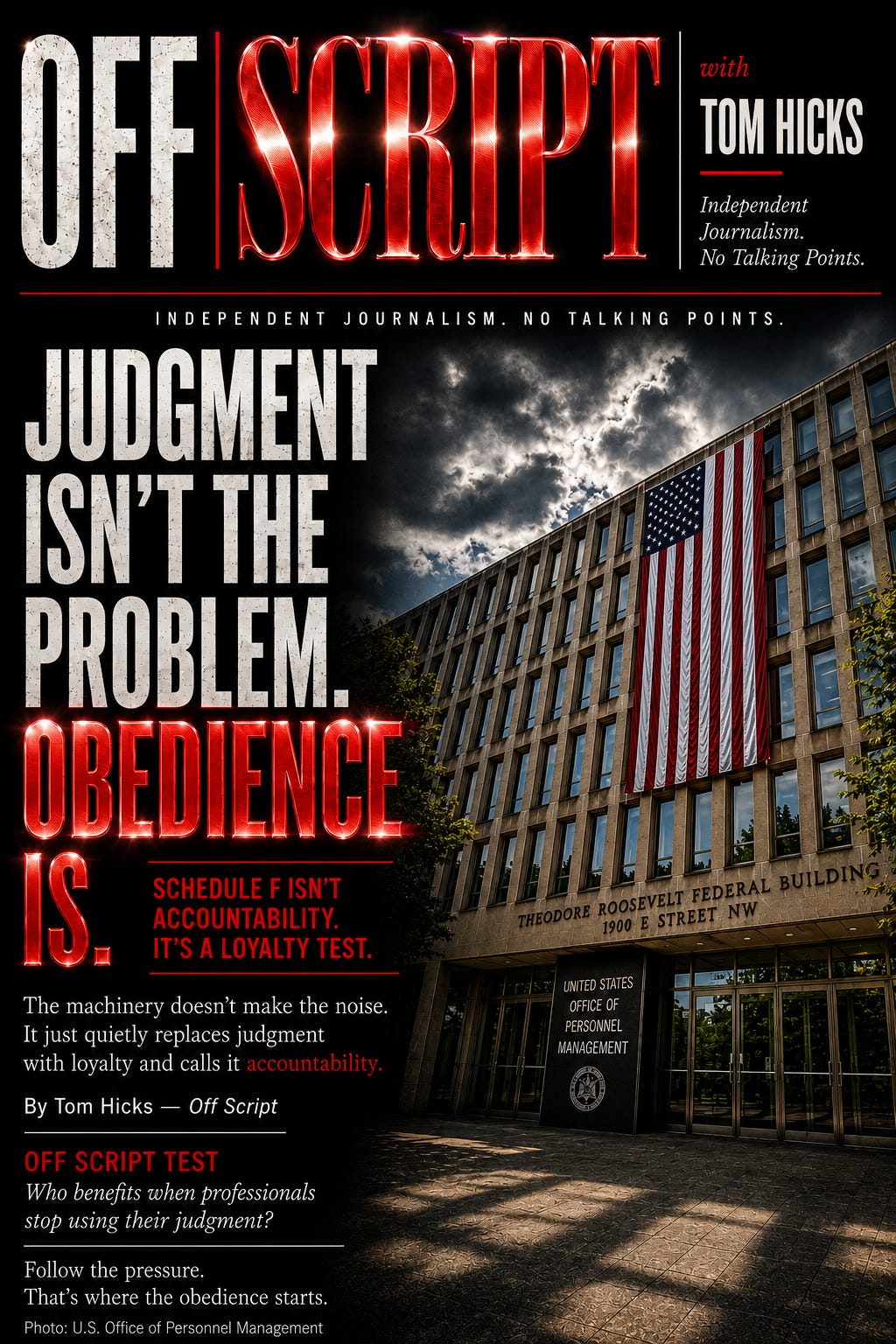
The Trump administration reinstated the old Schedule F framework on January 20, 2025, under the title “Restoring Accountability to Policy-Influencing Positions Within the Federal Workforce.” The White House order brought back a system designed to move certain federal employees into a category with fewer civil-service protections, aimed at workers in “policy-influencing” roles. The administration’s language was all about responsiveness and democratic control. The practical message to the workforce was harder to miss: your professional judgment may now be judged by your political usefulness. (White House)
That’s where this story starts making more sense.
Because the target isn’t merely “the bureaucracy.” That word has become a handy garbage bag for everything people dislike about government. Too slow, too smug, too many acronyms, too many forms, too many people who can say no without seeming even mildly sorry about it. Fine. Some of that’s deserved. I’ve met paperwork that should’ve been taken out back and humanely composted.
Civil service exists for a reason. It’s supposed to put some distance between law and personal command. It’s supposed to give the government people who can say, “No, the rule doesn’t allow that,” even when the president, governor, secretary, mayor, sheriff, or deputy assistant king of the toner cartridge wants a different answer.
That’s judgment.
It isn’t glamorous. It doesn’t trend. It’s not a resistance hashtag. Most of the time it looks like somebody in a bad office chair reading a paragraph very carefully while drinking coffee that tastes like the building’s given up.
But it matters like hell.
A government without independent judgment becomes a chain of command with nicer stationery.
Subscribe to Off Script with Tom Hicks
Join me every morning for independent commentary, sourced arguments, and the occasional paperwork autopsy before breakfast.
Subscribers also get the Off Script Bullshit Detector free. Non-subscribers can grab it from the Tom Hicks Media Store for $4.95, which is cheaper than one bad pundit habit and a lot easier to carry.
The same pressure showed up in the campaign against law firms. In 2025, the White House targeted firms including Paul Weiss and Perkins Coie with executive orders or related actions that threatened security clearances, federal contracts, and access to government business. Reuters reported that the Paul Weiss order suspended security clearances while agencies reviewed whether those clearances were consistent with the national interest, and it also directed agencies to examine contracts involving the firm. (Reuters)
Perkins Coie fought back. In Perkins Coie LLP v. U.S. Department of Justice, No. 1:25-cv-00716 (D.D.C. 2025), the firm won permanent relief after challenging an executive order aimed at the firm. The court record described an order designed to hamper the firm’s work before federal agencies and noted the connection between the order and clients pulling back from the firm. (GovInfo)
Susman Godfrey fought back too. In Susman Godfrey LLP v. Executive Office of the President, No. 1:25-cv-01107 (D.D.C. 2025), the firm won a permanent injunction against sections of the executive order targeting it. Reuters later described that ruling as part of a string of court victories for law firms targeted over legal work, diversity programs, and political associations. (Justia)
Don’t let the BigLaw names make this feel remote. The principle’s brutally simple.
If the government can punish lawyers for representing the wrong people, supporting the wrong causes, hiring the wrong associates, or belonging to the wrong political universe, it can make the right to counsel exist mostly on paper. You’ll still be allowed to hire a lawyer. The lawyer will just have to wonder whether taking your case costs the firm its federal clients, clearances, contracts, reputation, and sanity.
Call it what it actually is: leash training with a Justice Department letterhead.
The administration hasn’t let the matter die. Reuters reported this week that the Justice Department asked a federal judge to disqualify Susman Godfrey from representing the American Bar Association in its lawsuit against the White House, where the ABA alleges the administration unlawfully targeted firms over their legal work, hiring practices, diversity policies, and political affiliations. (Reuters)
The Financial Times also reported that firms that reached deals with Trump are now facing demands for depositions and internal communications connected to those agreements, while the ABA case accuses the administration of operating an unlawful “law firm intimidation policy.” (Financial Times)
That phrase lands because it names the thing plainly.
Intimidation policy.
The goal isn’t to beat every lawyer in court. It’s to make everyone else watch what happens to the lawyers who don’t bend fast enough.
Once you see the pattern there, the university fights look less like isolated culture-war episodes and more like another front in the same goddamn war. Reuters reported on July 20, 2026, that the Justice Department opened a probe into Harvard over financial-aid programs tied to China, part of the administration’s broader scrutiny of elite universities. That scrutiny’s included federal funding threats tied to protests, diversity efforts, transgender policies, and climate initiatives. Harvard has described earlier federal actions as politically motivated attacks on academic independence. (Reuters)
Some people will hear “Harvard” and immediately stop caring. I get it. Harvard isn’t exactly a Dickensian orphan shivering beside a soup pot. It’s got money, lawyers, prestige, and enough institutional self-regard to power a small moon.
Still, the issue isn’t whether Harvard’s lovable.
The issue is whether the federal government can turn academic independence into a hostage negotiation.
A university can be investigated for real violations. It can lose funds for unlawful discrimination. It can be audited, sued, embarrassed, and made to answer for actual misconduct. Nobody serious should object to that.
The warning sign is when enforcement starts looking like viewpoint management. When funding, tax status, foreign-student access, grant eligibility, and civil-rights investigations all become part of one pressure system, the target’s no longer a single violation. The target is institutional judgment itself.
Teach this.
Don’t teach that.
Investigate this.
Don’t study that.
Say the right thing about protests, diversity, gender, Israel, climate, China, history, admissions, donors, faculty, students, and America itself, or the federal government may discover a sudden and passionate interest in your paperwork.
Funny how that happens.
The grant fight fits here too, though it shouldn’t be allowed to swallow the whole story. The Office of Management and Budget has proposed revisions to the rules governing federal financial assistance. The Federal Register notice says the changes are meant to improve transparency, accountability, oversight, and compliance. It also frames past federal awards as vehicles for “woke” policy and proposes pre-issuance review for discretionary awards, with senior agency appointees reviewing whether awards advance the president’s policy priorities. (Federal Register)
Peer review survives in that structure, technically.
It just gets shoved into the advisory chair.
That distinction is everything. Expert review can still exist. Panels can still meet. Scores can still be assigned. Forms can still be filled. The whole thing can keep the shape of merit while moving the final power to political appointees whose job is to judge alignment with the president’s priorities.
That’s how judgment gets replaced without announcing its death.
No bonfire. No ban. No cartoon censor with a stamp.
Just a new approval layer, quiet as a filing cabinet.
A federal judge in Massachusetts recently blocked one version of the administration’s grant-cutting strategy. In State of New Jersey v. U.S. Office of Management and Budget, No. 1:25-cv-11816-IT (D. Mass. July 17, 2026), Judge Indira Talwani barred the administration from using a disputed clause to terminate grants that no longer aligned with “program goals or agency priorities.” AP reported that the challenged cuts affected areas including public safety, disaster preparedness, and scientific research. (Associated Press)
That ruling matters, but it also shows why the deeper move is so dangerous.
Courts can sometimes stop a grant from being pulled after it’s been awarded. They can review the record, examine the clause, compare the agency’s action to the law, and say no. Good. That’s still a living system doing what living systems do.
But what happens when the pressure moves earlier?
What happens when researchers never propose the study because the topic feels politically radioactive?
What happens when nonprofits rewrite their mission statements before applying?
What happens when public-health officials stop using accurate words because accurate words have become funding hazards?
What happens when a young scientist looks at the political weather and decides to study something safer, smaller, less useful, and less likely to get somebody in Washington twitching?
There’s no court docket for the question that never gets asked.
That’s the quiet part of the war on judgment. It doesn’t only punish decisions after they happen. It changes the decisions people are willing to make in the first place.
The AI science push makes this bigger, not smaller. Reuters reported on July 22, 2026, that the administration plans to spend $5 billion on AI-powered research across fields including health, construction, drug discovery, and building materials, with 15 federal agencies involved and researchers using Energy Department supercomputers, AI tools, and datasets. (Reuters)
Again, AI in science isn’t the villain. Used honestly, it can help researchers see patterns, test hypotheses, and move faster through problems that would otherwise take years. I’m not against giving smart people better tools. Give them the big computers. Give them the clean datasets. Give them the ridiculous blinking dashboard if it helps them cure something before I need it.
The danger’s who gets to aim the machine.
If federal science is increasingly built around central datasets, supercomputing access, AI models, national missions, and politically reviewed grants, then the front-end judgment call becomes enormously powerful. Decide which questions are worthy, and you decide which data gets assembled. Decide which data gets assembled, and you decide which models get trained. Decide which models get trained, and eventually the public gets told the output is evidence.
By then, the missing questions are invisible. Nobody misses a question nobody remembers asking.
That’s how obedience puts on a lab coat.
And this is the piece we keep missing when we treat each fight as its own headline. Schedule F is a civil-service story. The law-firm orders are a legal-industry story. Harvard’s an education story. Grant review is a science-policy story. AI research is a technology story.
No.
They’re all judgment stories.
They’re all about whether people with training, standards, evidence, professional ethics, legal obligations, and institutional roles can still say, “This is what the facts require,” without first checking whether the answer flatters power.
That’s why authoritarian politics always goes after intermediaries. Lawyers, judges, inspectors general, scientists, auditors, professors, librarians, journalists, doctors, civil servants, election officials, and grant reviewers all have one thing in common: they stand between raw power and the public. They’re annoying by design.
A healthy government has to tolerate annoying people.
A sick one starts calling them enemies.
The administration’s defenders will say elections have consequences. They do. A president gets to set priorities. Agencies aren’t independent planets. Federal money should be accountable to the public. Bad grants should die. Waste should be cut. Universities shouldn’t get blank checks. Law firms shouldn’t be immune from scrutiny. Civil servants shouldn’t treat elections as mild weather events occurring somewhere outside their cubicles.
All true.
Also incomplete as hell.
Accountability means decisions can be explained, reviewed, challenged, and tied to law. Obedience means decisions have to satisfy the person at the top.
Accountability and obedience aren’t cousins. They’re enemies who occasionally borrow each other’s suits.
This is where the bullshit detector starts screaming. Every time the government says it wants “accountability,” ask who’s being made accountable to what. Accountable to statute? Fine. Accountable to evidence? Good. Accountable to transparent criteria? Wonderful. Accountable to the president’s mood, political needs, ideological vocabulary, personal grudges, and preferred television segment?
Call it what it actually is: courtier training with an accountability press release stapled to the front.
The most dangerous version of this doesn’t arrive with tanks in the street. It arrives as a personnel category, an executive order, a compliance review, a funding condition, a grant notice, a civil-rights probe, a security-clearance review, a subpoena, a settlement demand, a dataset policy, a procurement rule, and a memo from someone whose title has too many goddamn syllables.
It looks boring because boring is camouflage.
That’s why this article matters more than another day of outrage over whichever official said the dumbest thing into the nearest microphone. The dumb thing is bait. The structural thing is the trap.
A country can survive bad presidents, bad policies, and bad speeches. It’s done so with grim enthusiasm for a very long time. What it can’t survive for long is the steady removal of independent judgment from every institution that needs it.
When lawyers are afraid to represent.
When scientists are afraid to study.
When universities are afraid to teach.
When civil servants are afraid to say no.
When judges are treated as obstacles instead of constitutional officers.
When agencies stop asking what the law requires and start asking what the leader wants.
At that point, the republic still has buildings, flags, seals, hearing rooms, websites, acronyms, and forms.
It just has fewer adults, and a whole lot more paperwork pretending to be courage.
And that may be the real project here: not winning every dispute, not proving every critic wrong, not even controlling every institution directly. The real project is teaching everyone inside those institutions to pre-clear their own judgment.
No order needed.
They’ll learn.
They’ll soften the phrase, avoid the case, drop the client, rewrite the grant, delay the study, bury the finding, flatter the boss, dodge the topic, and call it prudence because prudence sounds a hell of a lot better than fear.
That’s how a free country learns to speak in a whisper.
And once that habit sets in, getting the courts to block one bad order won’t be enough. The paperwork can be rewritten. The title can be changed. The policy can be moved to another office. The threat can be implied instead of printed. Power’s very creative when it wants to avoid leaving fingerprints.
The defense has to be cultural as much as legal.
Professional judgment has to become something people are proud to use again. Not expert arrogance. Not credential worship. Not the fake priesthood of people who think a degree makes them immune from being wrong.
Real judgment.
The kind that reads the rule, checks the facts, listens to the evidence, knows the limits, admits uncertainty, and still has enough backbone to say, “No, that’s not what this means.”
That sentence is doing more work than most campaign slogans.
Because the opposite of democracy isn’t only dictatorship.
Sometimes the opposite of democracy is a room full of people who know better and have been trained to keep their damn mouths shut about it.
ONE QUESTION BEFORE YOU GO
Which institutions still have people willing to say “no” when power wants them to pretend the answer is yes?
BUY ME A CUP OF TEA
If this helped sharpen the picture, you can always Buy Me A Cup Of Tea and help keep this little independent operation caffeinated.
HASHTAGS
#OffScript #TomHicks #RuleOfLaw #CivilService #AcademicFreedom #FederalGrants #SciencePolicy #FreeSpeech #Accountability #Authoritarianism