

By Tom Hicks | September 18, 2026
Editorial Note:
This is a developing story. President Trump announced the ban Friday afternoon, but the White House had not publicly explained exactly how it would be enforced when this article was published. Off Script will update the story as necessary.
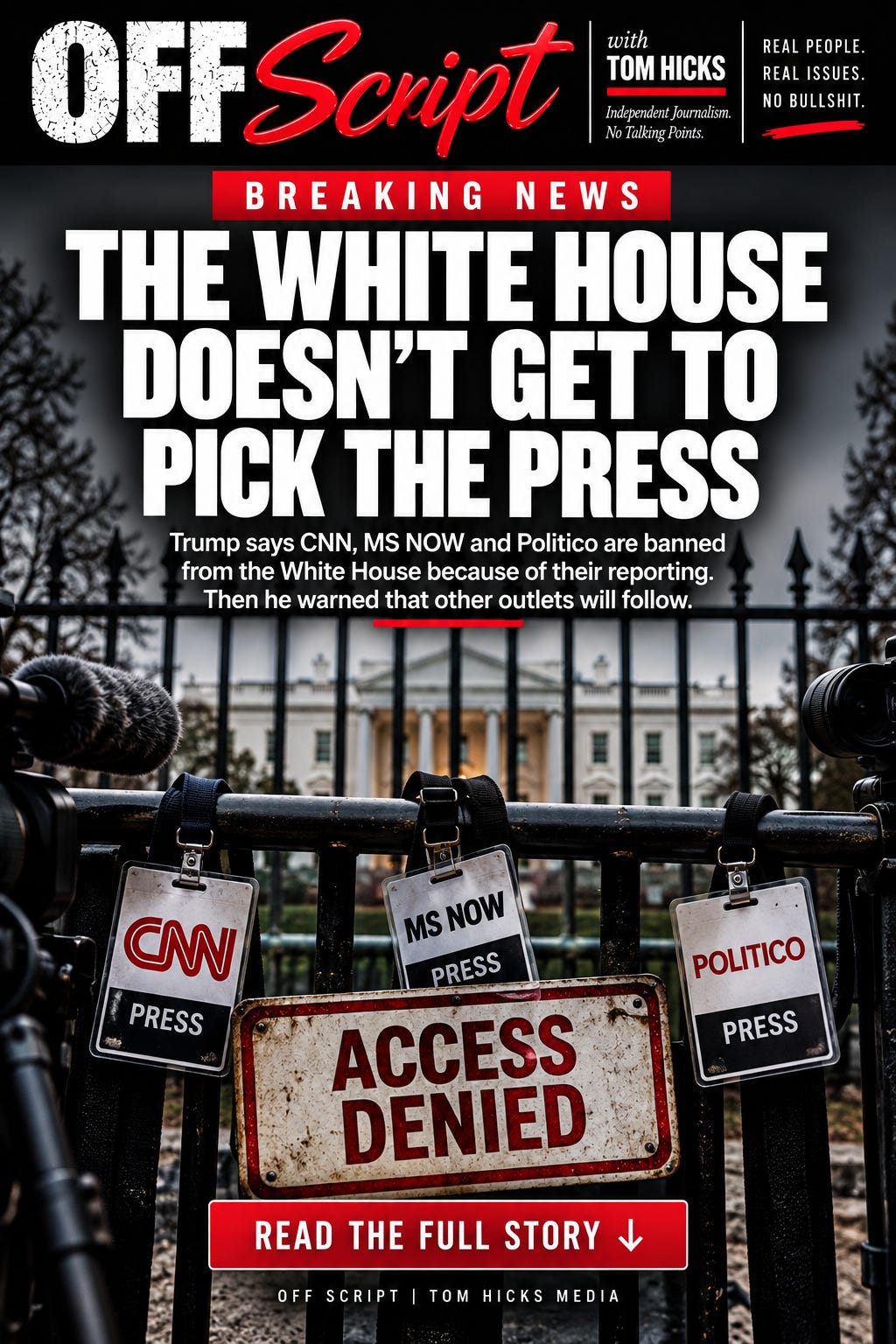
President Donald Trump announced Friday afternoon that CNN, MS NOW and Politico are banned from the White House, effective immediately. He didn’t accuse their reporters of breaching security or announce some new credentialing standard they had violated. Trump gave a much simpler reason: he doesn’t like what they’re reporting. Reuters | Wall Street Journal
In a Truth Social post, Trump accused the three organizations of constantly reporting “FAKE NEWS” and said media outlets shouldn’t be able to report what he called “FICTION and LIES” about the president, his administration or the United States. Then he added the sentence that turns a fight with three news organizations into something considerably bigger: “Other Fake News Media Outlets to follow.” CBS News | Washington Post | Financial Times
Exactly what “banned from the White House” means remained unclear Friday afternoon. The White House hadn’t publicly explained whether credentials would be revoked, reporters would be excluded from briefings or presidential events, pool access would be affected, or some combination of those things. Reuters reported that CNN’s team remained at the White House working normally after Trump’s announcement, while Bloomberg reported that it wasn’t immediately clear how the president intended to enforce the ban. Reuters | Bloomberg
Your subscription helps fund reporting, research, publishing, new features, and the continued growth of every Tom Hicks Media publication.
THE PRESIDENT SAID WHY HE WAS DOING IT
Cases involving alleged government retaliation can turn into complicated arguments over motive. This one begins with an unusual piece of evidence: the president’s own explanation. Trump said the outlets were being banned “as a result of” what he described as their constant reporting of fake news, while the White House hadn’t provided Axios or The Washington Post with a further explanation when their reports were published. Whatever legal arguments eventually emerge about presidential authority over White House access, there’s very little mystery about the reason Trump publicly gave for exercising it Friday. Axios | Washington Post
That doesn’t automatically make the ban unconstitutional because journalists don’t possess an unlimited First Amendment right to enter every room where the president happens to be. The White House can impose legitimate security and credentialing requirements; limited space inevitably means limited attendance, and presidents remain free to choose whom they grant interviews. Judge Trevor McFadden recognized those limits in Associated Press v. Budowich, No. 1:25-cv-00532 (D.D.C. Apr. 8, 2025), while considering the Trump administration’s earlier fight with the AP.
But McFadden drew another line in the same decision. Once the government opens an event to some journalists, his preliminary ruling said, it cannot exclude otherwise comparable journalists because it objects to their viewpoint. That reasoning fits within the D.C. Circuit’s longstanding decision in Sherrill v. Knight, 569 F.2d 124 (D.C. Cir. 1977), which held that White House press access couldn’t be denied arbitrarily and required procedural protections surrounding credential denials. Those cases don’t automatically answer every question created by Friday’s announcement, but they explain why the reason for the exclusion matters.
WE HAVE SEEN THIS FIGHT BEFORE
The current legal battle began after the Associated Press refused to adopt Trump’s preferred “Gulf of America” terminology in place of Gulf of Mexico. The White House responded by restricting AP journalists from limited-access presidential events, including the Oval Office and Air Force One. The AP sued, arguing that the government was retaliating against the organization because of an editorial decision protected by the First Amendment. Associated Press | CBS News
In April 2025, McFadden, himself appointed by Trump, granted the AP a preliminary injunction in Associated Press v. Budowich. His ruling didn’t give the AP permanent access to the president or guarantee it a seat at every event. Instead, he concluded that the government couldn’t disadvantage the AP compared with similarly situated outlets because officials objected to the organization’s editorial choice. Associated Press
That wasn’t the end of the legal story. A divided D.C. Circuit panel subsequently stayed much of McFadden’s preliminary injunction while the government’s appeal proceeded, allowing the White House greater control over AP access to smaller presidential events while the case continued. CBS reported Friday that the legal dispute remains ongoing, an important distinction because there is no final appellate decision neatly settling how the courts would treat Trump’s new announcement. CBS News | Associated Press
There’s no need to oversell what the law tells us. We already have an administration fighting in federal court over its ability to restrict a news organization’s presidential access after objecting to an editorial decision. Now the president has announced another restriction and publicly tied it to the journalism produced by three additional organizations. That doesn’t tell us how another lawsuit would end, but you’d have to work pretty hard to miss the family resemblance. Reuters | CBS News
CNN MAKES THIS BIGGER THAN A CREDENTIAL FIGHT
CNN’s inclusion adds another wrinkle because White House coverage depends heavily on press pools. The Oval Office, Air Force One and other presidential settings can’t accommodate every credentialed journalist, so a smaller group covers those events and shares reports, photographs, audio and video with the broader press corps. McFadden described that pool in Associated Press v. Budowich as the “eyes and ears” of the full press corps and, ultimately, the public.
CNN has traditionally participated in the television pool, so depending on how Trump’s announcement is implemented, this could become about considerably more than whether one CNN correspondent gets through the White House gate. The Associated Press reported Friday that blocking CNN could disrupt the traditional five-network television pool that travels with the president and provides independent coverage of his activities. The New York Post separately reported that CNN is an important part of the television pool system used to broadcast presidential remarks live. Associated Press | New York Post
And there is already a larger fight over who controls that machinery. In February 2025, the White House moved to take greater control over the composition of the presidential press pool, reducing the role traditionally played by the independent White House Correspondents’ Association. That dispute became part of the broader fight over whether the administration can choose which journalists receive privileged access to the president. Associated Press
Now put that history next to Friday’s announcement. The president named three organizations, explicitly attacked their journalism as false, announced that they were being banned, and promised that more organizations would follow. That’s considerably different from a neutral announcement that the White House is changing the size or structure of its press operation. Reuters | Wall Street Journal
YOU DON’T HAVE TO LIKE CNN
This is where the argument will inevitably get stupid if we let it. Someone will say CNN is biased. Someone else will point to something Politico got wrong. Plenty of people wouldn’t watch MS NOW if you duct-taped them to the couch and hid the remote.
Fine.
None of that answers the question in front of us.
The First Amendment doesn’t protect only journalism that government officials consider accurate, responsible, or fair. Trump is free to attack CNN’s reporting, call Politico terrible, complain about MS NOW, refuse interviews and tell Americans that all three organizations treat him unfairly. Associated Press v. Budowich itself distinguished between the government’s considerable authority over presidential access and the constitutional problem created when access is withheld because of a news organization’s viewpoint.
Friday’s announcement matters because Trump himself connected the punishment to the coverage. He said the organizations were being banned “as a result of” what he called their constant reporting of fake news. There isn’t much reading between the lines required when the president supplies the lines himself. Wall Street Journal | Axios | Financial Times
“OTHER FAKE NEWS MEDIA OUTLETS TO FOLLOW”
That’s the sentence I can’t get past.
CNN, MS NOW and Politico are three organizations. “Other Fake News Media Outlets to follow” sounds considerably more like the beginning of a policy, and Trump offered no public standard Friday for determining who might be next. Reuters, CBS, Bloomberg, The Wall Street Journal and The Washington Post independently reported the announcement and Trump’s warning that additional organizations could follow. Reuters | CBS News | Bloomberg | Wall Street Journal | Washington Post
So what gets a news organization added to it? Is it a story Trump disputes, an investigation that embarrasses the administration, a headline he considers unfair or a reporter asking a question he doesn’t want to answer? If “fake news” becomes an actual standard for government access rather than political rhetoric, somebody in government has to decide what qualifies.
According to Friday’s announcement, the president who’s being covered appears to be making that call.
That’s a hell of a conflict of interest.
THIS IS THE LINE
There is still plenty we don’t know, and a breaking story is exactly the wrong place to pretend otherwise. We don’t know precisely how the White House intends to enforce Trump’s announcement. We don’t know whether CNN, MS NOW or Politico will sue, whether the administration’s lawyers will narrow the policy, or which organizations Trump meant when he said others would follow. Bloomberg | Washington Post
But we know what the president said. He named three news organizations, said they were banned from the White House “effective immediately,” explicitly connected the decision to their reporting and promised that additional outlets would follow. That central account is independently reported by Reuters, AP, CBS, Bloomberg, the Financial Times, The Wall Street Journal, and The Washington Post. Reuters | Associated Press | CBS News | Financial Times | Wall Street Journal
Trump has every right to call their journalism garbage. He can challenge stories, attack reporters, refuse interviews and spend every waking hour telling Americans that the press treats him unfairly. That’s his speech.
Using the power of the presidency to decide which journalists get access because of what they report is where the constitutional question begins.
A free press isn’t free because the president likes what it publishes.
It’s free because the president doesn’t get to choose the press.
BUY ME A CUP OF TEA
Breaking news doesn’t wait for the publishing schedule. Neither does independent journalism.
If you’d like to help keep Off Script independent, you can buy me a cup of tea.
ONE QUESTION BEFORE YOU GO
Forget whether you like CNN, MS NOW or Politico. Should a president be able to deny a news organization White House access because he believes its reporting is false or unfair?
#OffScript #BreakingNews #PressFreedom #FirstAmendment #WhiteHouse