
DUCK SOUP — VOL. 1
Tom Hicks | November 8, 2026
Donald Trump has appointed Stephen Miller his new White House chief of staff, effective Monday, November 9. Susie Wiles is moving to Trump’s political operation, and Republicans have just lost control of both houses of Congress.
I’d call it an interesting management decision. When the voters send your party packing, most people ask what went wrong. Trump asked who’s been loudest about being right and handed him the keys.
I’ve been imagining Miller’s first Monday on the job. In my version, I show up to ask a few questions and get drafted to write the administration’s official explanation of the election. I object, naturally. I’m a journalist, not a spokesman, and I have standards, although I’ve been trying to lower them for years without much luck.
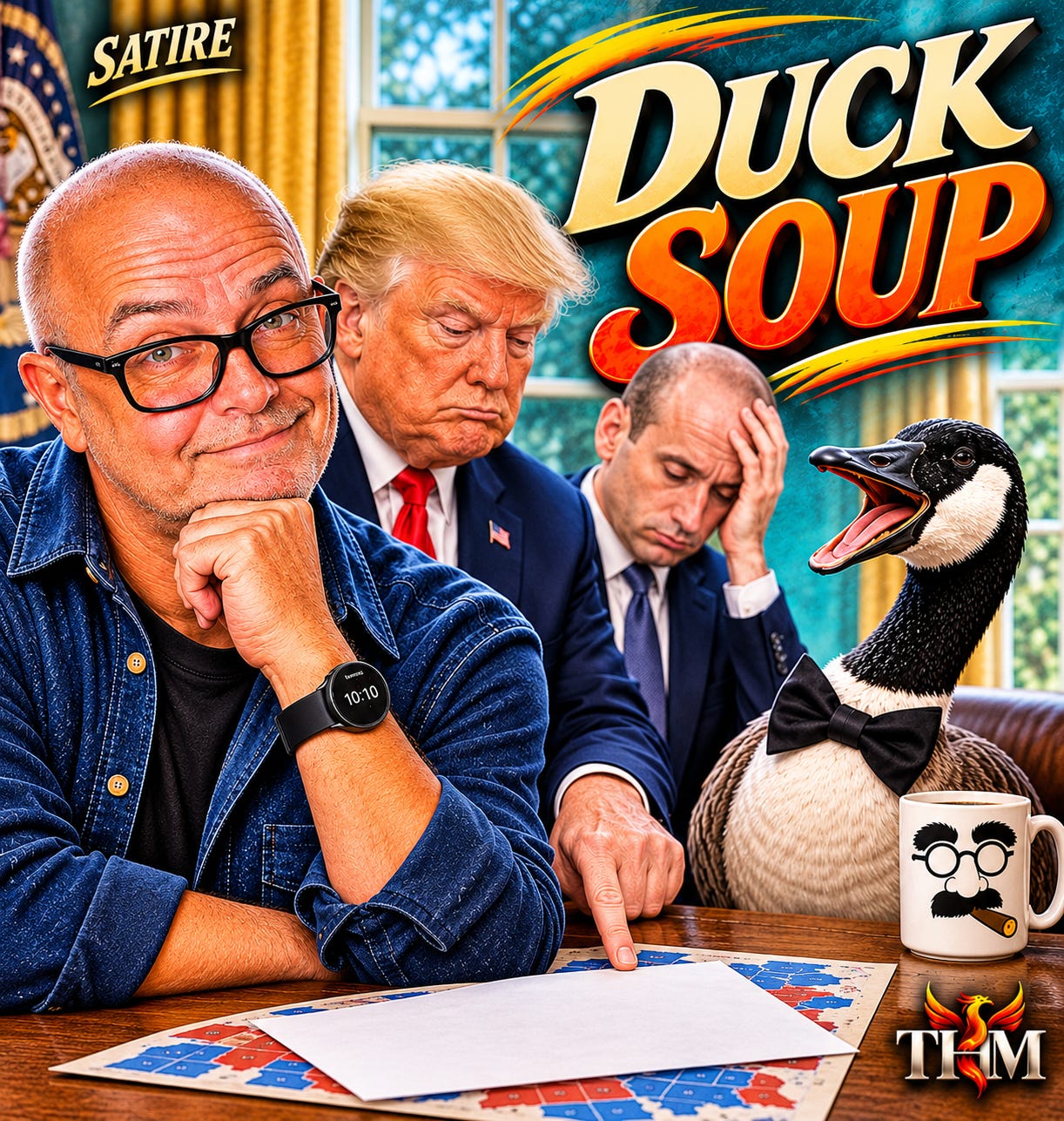
Miller is waiting in the Oval Office with a stack of returns, a large map of the country, and the face of a man who just found ketchup on his caviar. Trump is studying a photograph of himself.
“Who invited him?” Miller asks.
“I did,” Trump says. “He’s a writer. We need a statement.”
“We have speechwriters.”
“They wrote one. You said it was weak.”
“I said it mentioned the election.”
“Exactly. Get somebody who won’t.”
I point out that explaining a loss without mentioning it is a hard assignment. Trump says that’s why they’re hiring me. Miller says I haven’t been vetted. I tell him I haven’t been anything, and it’s one of my selling points.
Off to one side, a large goose in a bow tie is standing next to a nervous little man with a briefcase.
“Who’s that?” I ask.
“Henderson,” the little man says.
“The goose?”
“No, I’m Henderson. He’s Mr. Henderson.”
“Are you related?”
“Only professionally.”
“What’s his job?”
“He hasn’t got one.”
“Keep it that way. If the president spots him, he’ll be appointed to something.”
Miller slides a sheet of paper across the desk.
OFFICIAL WHITE HOUSE STATEMENT, DRAFT ONE:
The American people have once again demonstrated their overwhelming confidence in President Donald J. Trump’s leadership.
I read it twice. Stephen, I say, you’ve written a whole sentence about an election without the election in it. That’s the point, he says. I suggest we save time and issue a blank sheet of paper. Trump likes the idea until Miller warns that the press will take it as an admission that the administration has nothing to say. They’ve been taking your statements that way for years, I tell him, and they still can’t work out what you’re saying.
I leave the blank sheet on the desk and ask Miller what the rule is.
“The rule is that we don’t make specific claims that can be disproven.”
“So no numbers, no names, no dates.”
“Not unless they’re useful.”
“That’s not honesty, Stephen. That’s a hiding place with a letterhead.”
I write the next one.
DRAFT TWO:
The president remains extremely popular among Americans who support him.
“That’s meaningless,” Miller says.
“It can’t be disproven. I thought it was the house style.”
Trump wants to know how many Americans support him. All of them, I say. Good, he says, put that in.
Meanwhile, Mr. Henderson has noticed that the election map is two transparent overlays, one red and one blue. He gets his beak under a corner of the blue sheet and peels it off. Nobody sees it happen until Trump looks over.
“Look at that. All that red. Beautiful.”
Miller turns around, finds the Democratic districts gone, and goes for the overlay.
“Put it back! Anyone can check a map!”
“Anyone can check a statement,” I say.
“Nobody does.”
“Then why does the map worry you?”
“Because it’s a picture, Hicks. People remember pictures.”
He restores the overlay. Henderson waits until Miller is busy with his folders, takes it off again, and drops it in the wastebasket. Trump looks at the map and tells everyone to leave it that way.
I explain to Miller that we’ve found the perfect companion for his statements. He wanted an explanation with the loss removed, and the goose has delivered it in colored plastic. Miller says the map is a falsification and the statement is a communications strategy. I ask whether that distinction is written down anywhere, and he says it doesn’t need to be.
So I write Draft Three.
DRAFT THREE:
Following a comprehensive review of the results, the White House has determined that the president would have won every congressional district if the people who voted against his party had voted for it instead.
“That’s absurd,” Miller says.
“It’s mathematically airtight. You can’t argue with arithmetic.”
“It makes us look ridiculous.”
Trump takes the page and reads it with his finger.
“Did I win?”
“Every district,” I tell him.
“Release it.”
“Sir,” Miller says, “it’s political suicide.”
“Then fire Stephen.”
Miller goes pale. “Sir, I was appointed this morning.”
“Then you’re on probation.”
For the first time all day, Miller has to produce something the president loves and he himself can defend. He turns to me with the eyes of a man who’s been asked to carry a piano up a staircase made of soap.
“Write something he’ll like that nobody can challenge.”
“Stephen, that’s been the assignment since breakfast.”
That’s when Henderson crosses the desk, picks up my blank sheet from where I left it, and lays it flat across the map. The whole country vanishes under clean white paper.
Trump squints at it.
“What’s that?”
“Your election results,” I say.
“There’s nothing on it.”
“Exactly. Nobody won, nobody lost, and nobody has to explain a damn thing.”
Miller stares at the blank sheet. Something in his face changes, the way a man looks when he’s finally found the church of his dreams.
“Actually,” he says slowly, “if we present this as a forward-looking framework instead of a retrospective analysis...”
“Stephen, are you adopting the goose’s proposal?”
“It’s a strategic communications initiative.”
“I see. The goose is the consultant.”
Miller turns to an aide and orders a statement announcing that the administration is moving beyond the divisive maps of the past. I tell him that’s not unity, it’s stationery. Trump says he likes it, no blue anywhere, very clean.
Then he looks at me.
“Tom, you’ll present it. Monday, two o’clock, briefing room.”
“I’m not on the payroll.”
“Stephen, put him on probation.”
Miller, smiling for the first time, writes it down. I start explaining all the reasons a man with my résumé should never stand at that podium. Henderson honks once, loudly, and his assistant translates.
“Mr. Henderson says he found the solution, so he should be the one to present it.”
Trump nods. “Fair.”
I’m saved by a goose, which tells you most of what you need to know about the week.
DUCK SOUP is political satire. The factual premise is Trump’s November 6 announcement of Stephen Miller’s appointment as White House chief of staff, effective November 9, following Republican losses in both chambers of Congress, and Susie Wiles’s move to Trump’s political operation. The imagined meeting, dialogue, statements, election maps, and Henderson’s activities are fictional.
#DuckSoup #PoliticalSatire #StephenMiller #Trump #TomHicksMedia