

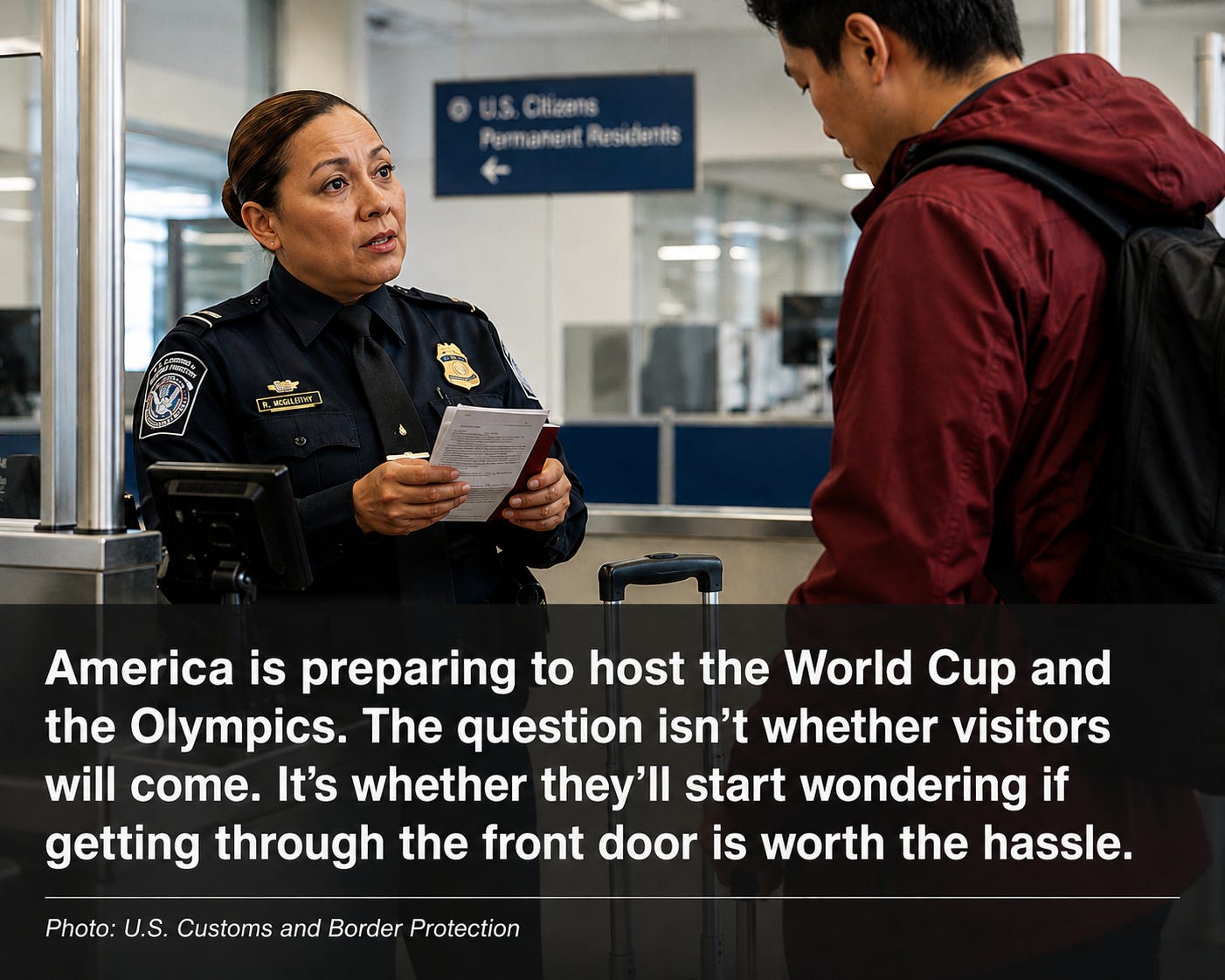

How the fuck are we planning to host the World Cup and the Olympics if we keep making international headlines about the people involved getting stuck at the front door?
Seriously.
Reuters reported this week that a FIFA referee from Somalia was denied entry into the United States despite holding a valid visa. Around the same time, Iraqi national team striker Aymen Hussein was detained and questioned for nearly seven hours before finally being admitted. An Iraqi team photographer reportedly spent more than ten hours being questioned before being denied entry altogether.
Now, before somebody starts hammering out an angry comment about open borders, immigration, sovereignty, or whatever other political hobby horse they rode into town on, that’s not what caught my attention.
What caught my attention was the contradiction.
We’ve spent years chasing these events. Cities compete for them. Politicians brag about landing them. Tourism boards practically break out the champagne when they win them. Everybody talks about the economic impact because everybody understands the math. Hotels fill up. Restaurants fill up. Airlines fill up. Local businesses get flooded with customers. The host country gets a month-long commercial broadcast to billions of people worldwide. That’s why nations spend years and billions of dollars pursuing these opportunities.
Then stories like this hit the wire, and I find myself wondering whether anybody involved in those earlier conversations bothered to think past the damn press conference.
The World Cup is not the Super Bowl. It’s not an American event that happens to attract a few foreign visitors. The entire damn thing depends on international movement. Players come from everywhere. Officials come from everywhere. Photographers come from everywhere. Broadcasters come from everywhere. Sponsors come from everywhere. Fans come from everywhere. The event literally cannot function without large numbers of foreigners entering the host country, which is why this whole situation feels so strange in the first place.
That doesn’t mean everybody gets admitted automatically. Every country has the right to control its borders. Every country has security concerns. Every country screens visitors. Nobody outside the most unhinged corners of the internet is arguing otherwise. The question isn’t whether border officials should do their jobs. The question is whether anybody has stopped to consider how those decisions interact with every other goal we’re simultaneously pursuing. Because right now it feels like different parts of the government are operating from entirely different instruction manuals and nobody’s bothering to compare the damn notes.
Maybe there are facts about these specific cases that aren’t public. That’s entirely possible. Immigration officials don’t release every detail behind every decision, and frankly, they shouldn’t. But if that’s true, then somebody still has a perception problem on their hands, because perception doesn’t give a shit about information nobody can see. Perception cares about headlines. Perception cares about stories. And the stories traveling around the world right now aren’t exactly helping the sales pitch.
What makes this more than an immigration story is that there are already signs people are paying attention. Tourism officials, hospitality groups, and host-city planners have spent months trying to reassure visitors that America is ready for the World Cup. At the same time, concerns about travel restrictions, visa processing, border scrutiny, and international perceptions have become part of the conversation surrounding the tournament. That’s not the kind of conversation anybody wants when they’re trying to convince millions of people to book flights, reserve hotel rooms, and spend money.
People don’t experience countries through policy papers. They experience countries through stories. A tourism campaign can spend millions telling people how welcoming a country is. One widely shared story about somebody being detained, denied, or interrogated for hours can undo a surprising amount of that work. Human beings are funny that way. They’ll ignore a hundred glossy advertisements and remember the one story that makes them think, “Yeah, maybe let’s not deal with that bullshit.”
If this kind of evidence-first journalism is worth supporting, consider subscribing. The Unredacted Bastard is rooted in evidence, allergic to bullshit, and accountable to readers rather than advertisers, corporations, or political parties.
If you’re sitting in Germany, Brazil, Japan, Australia, or South Africa thinking about spending several thousand dollars to attend a World Cup match, you’re probably not studying immigration policy. You’re asking a much simpler question: “Is this going to be a pain in the ass?” Most people can tolerate inconvenience. What they hate is uncertainty. A delayed flight is annoying. An unpredictable flight is stressful. A long line is irritating. A line where nobody can tell you what’s happening makes you want to climb the nearest wall. People can handle bad news far better than they can handle uncertainty, and stories like these create uncertainty, whether officials intend them to or not.

That’s why I keep thinking about the Olympics.
The World Cup is the headline today, but the Olympics are sitting just over the horizon like a giant flashing warning sign. Somewhere in Los Angeles, there are people whose entire job consists of making sure athletes, officials, media personnel, sponsors, and visitors can move smoothly through an event involving participants from virtually every corner of the planet. Those poor bastards should be paying very close attention right now because every one of these stories becomes part of the international conversation surrounding America’s ability to host global events.
And let’s be honest here: the United States isn’t hosting these events out of pure love for sport. If that were the case, we’d save ourselves a fortune and watch from the couch. We’re hosting them because they’re economic engines. They’re tourism engines. They’re prestige engines. They generate revenue, visibility, investment, and influence. We want the benefits that come from being the center of the world’s attention for a few weeks. There’s nothing wrong with that. Hell, it makes perfect sense. What doesn’t make sense is acting surprised when people notice the tension between inviting the world to visit and making headlines about turning pieces of that world away.
What drives me nuts is that nobody seems willing to acknowledge the obvious contradiction. On one side, we’re marketing ourselves as the destination for the world’s biggest international gatherings. On the other we’re generating stories that leave some international visitors wondering whether the trip is worth the potential headache.
And the stories aren’t limited to one referee, one player, or one photographer anymore. In just the past several days, we’ve seen reports involving visa disputes, ticket-allocation controversies, travel uncertainty, and entry problems affecting multiple countries connected to the tournament. Each incident may have its own explanation. But eventually, people stop evaluating the individual explanations and start noticing the accumulation.
Maybe somebody has a master plan that makes all of this fit together. If so, I’d genuinely love to see the damn thing because from where I’m sitting, it looks like two separate sets of policies sprinting in opposite directions and hoping nobody notices.

And maybe there are facts about these individual cases that would change how people view them. That’s entirely possible. But at some point, the individual details become less important than the pattern people think they’re seeing. Fair or unfair, justified or unjustified, perception eventually develops a life of its own. That’s the part governments screw up over and over again. They become obsessed with the policy itself and completely miss the story people are telling each other about the policy.
Policies produce outcomes. Outcomes produce stories. Stories produce perceptions. Perceptions produce behavior. That’s true whether we’re talking about government, corporations, sports leagues, or your local cable company. If enough people start associating travel to the United States with uncertainty, inconvenience, or risk, some percentage of them will simply decide they’d rather spend their money somewhere else. Not because they hate America. Not because they’re making a political statement. Not because they’re trying to prove some ideological point. They’ll do it because human beings naturally avoid situations that appear unpredictable. That’s not politics. That’s not activism. That’s just how people work.
The referee, the player, the photographer, the ticket disputes, the visa disputes, and the growing list of travel complications aren’t really the story. They’re the warning lights on the dashboard. The bigger story is whether anybody has noticed that we’re trying to accomplish two things at the same time that may be pulling in opposite directions. We want all the benefits that come from hosting the world, but we’re creating headlines that make some members of that world wonder whether showing up is worth the trouble.
It’s hard to host the world when the world starts wondering whether it’s welcome.
Maybe we’ll pull it off. Maybe this becomes a minor footnote that nobody remembers six months from now. But if I were responsible for planning the Olympics, I’d be watching these stories a hell of a lot more closely than I’d be watching medal projections. Because every denied entry, every seven-hour interrogation, every headline about visitors getting stuck at the border becomes part of a larger story about America itself. And once that story takes hold, it’s a hell of a lot harder to change than a policy.
If today’s article made you think, laugh, or mutter “what the hell?” under your breath, consider upgrading to a paid subscription.
Paid subscribers help fund deeper investigations, Sunday War Rooms, and the occasional act of professional shit-stirring.
For a completely different perspective on humanity’s endless ability to confuse itself, check out Lotus Purrspective, where the world’s wisest (and most judgmental) feline examines modern life one baffling human decision at a time.
If you enjoyed this article, please like, share, and subscribe. Every share helps more people find independent journalism rooted in evidence and allergic to bullshit.
Buy Me A Cup Of Tea: Keep the receipts hot and the bullshit detector fully operational.
#WorldCup #Olympics #Immigration #Travel #Tourism #InternationalRelations #Politics #TheUnredactedBastard