

Editorial Note
Every so often, science stumbles onto something that doesn’t just answer a question. It asks a better one.
This is one of those stories.
You’ve probably spent your whole life believing cancer isn’t contagious.
For humans, that’s still true.
But if you’re a brown bullhead catfish living in a lake that straddles Vermont and Quebec, the rule apparently has an exception.
Researchers recently confirmed something nobody had ever documented before: a melanoma spreading from one freshwater fish to another. Not because every fish independently developed cancer, and not because a virus was triggering tumors. The cancer cells themselves were moving between fish, carrying the same genetic fingerprint from one host to the next. That discovery made headlines because it’s genuinely astonishing. It should have made headlines for another reason too, and that’s the one almost nobody’s writing about. Nature, The New York Times
Join me every morning.
If you enjoy independent journalism that follows evidence instead of talking points, Subscribe to Off Script with Tom Hicks. Free subscribers receive every morning’s edition in their inbox. Paid subscribers help keep this publication independent while receiving exclusive content and subscriber perks.
The contagious cancer isn’t the part of this story that’s been bothering me.
It’s the fact that someone had to notice it in the first place.
Think about what actually happened here.
An angler spotted strange black growths on catfish more than a decade ago. Scientists collected specimens, preserved tissue samples, sequenced DNA, and compared the genetic signatures of healthy fish against diseased ones. They ruled out viruses. They ruled out fish independently developing identical tumors over and over again. Eventually they landed on a conclusion that sounded almost impossible: every one of those tumors descended from a single original cancer. The cancer had effectively become its own parasite, moving from host to host instead of dying with the fish that first developed it. Nature EurekAlert
That’s extraordinary science, and it’s also exactly how science is supposed to work. Nobody woke up intending to discover the world’s first transmissible melanoma in a freshwater species. They were simply paying attention long enough to notice something that didn’t fit, and moments like that rarely happen by accident. They happen because somebody has the time, the funding and the institutional patience to keep asking questions after everyone else has moved on.
That’s the part I can’t stop thinking about.
We celebrate discoveries.
We rarely think about the discoveries that don’t happen.
Every scientific breakthrough has an invisible twin: the discovery that never happened because the expedition was canceled, the lab closed, the equipment wasn’t replaced or the graduate student chose another career. Those stories never make the evening news because nobody knows they exist. Ignorance leaves remarkably little evidence behind.
Knowledge has a strange blind spot. When it isn’t created, nobody notices. If a bridge collapses because maintenance was deferred, everyone sees it. If a hurricane forecast misses because weather satellites weren’t replaced, people eventually connect the dots. But what happens when the next breakthrough in wildlife biology never occurs because the graduate student who would’ve made it lost funding? What happens when a field station closes, long-term ecological monitoring quietly ends, or an experienced researcher leaves because the grant dried up? There’s no headline announcing the discovery that never happened because there can’t be. That’s what makes scientific research different from almost every other public investment. Its greatest successes are often impossible to predict before they happen.
No grant proposal in America ever began with the sentence, “We think we’re about to discover the first contagious cancer in freshwater fish.” If it had, reviewers probably would’ve laughed. Instead, researchers studied a lake. They watched. They sampled. They analyzed. Eventually, nature handed them something nobody expected. That’s usually how discovery works. Not through lightning bolts, but through patience. Science
And patience is becoming harder to fund.
The current administration has proposed significant reductions to several federal science agencies while freezing or terminating thousands of research grants across multiple disciplines. Scientists have repeatedly warned that long-term ecological monitoring and basic research are especially vulnerable because they rarely produce immediate political or commercial payoffs, even though they often produce the discoveries that reshape our understanding of the world years later. Nature News Reuters
That’s the uncomfortable part.
The research most likely to change how we understand the world usually looks obscure right up until the moment it doesn’t.
Nobody knew this particular lake was hiding a biological first.
So what about the lakes nobody’s studying?
What about the forests? The wetlands? The rivers? The deserts? Think about everything we haven’t found yet. Not because it isn’t there, but because there may be fewer people left to look.
One thing this discovery doesn’t mean is that we should panic. There’s no evidence this cancer can infect people. You’re not going to catch it from swimming in Lake Memphremagog, and scientists haven’t found any reason to believe it poses a risk to human health. Wildlife officials still recommend avoiding fish with obvious tumors or lesions, but that’s the same advice they’d give about any visibly diseased wild animal. Vermont Fish & Wildlife Nature
The real lesson isn’t what this cancer could do to us. It’s what it teaches us about how little we actually know. For generations we’ve treated “cancer isn’t contagious” as a rule. It turns out that’s more accurately described as an overwhelming tendency with a handful of extraordinary exceptions. Dogs have one. Tasmanian devils have another. Several marine bivalves carry transmissible cancers of their own. Now a freshwater fish joins that very short list. Science didn’t fail because the old rule had an exception. It succeeded because someone found it. That’s how knowledge is supposed to work. Science Nature
We keep arguing over research funding by asking what the return on investment is. Sometimes the return is obvious: a new drug, a safer bridge, a better weather forecast. Sometimes the return is discovering that something we believed for decades wasn’t entirely true. That doesn’t fit neatly into a campaign slogan or a budget spreadsheet, even though it changes our understanding of life itself. The researchers who spent years collecting fish, sequencing DNA and comparing genomes weren’t chasing a viral headline. They were doing the slow, methodical work that almost nobody notices until the day everybody does, and that kind of work has always demanded patience, along with a society willing to value questions before it knows the answers. Nature EurekAlert
Every administration has the right to set priorities. Budgets are finite, and every dollar spent on one program is a dollar that can’t be spent somewhere else. That’s a legitimate debate. What’s harder to debate is the cost of the questions that never get asked. You can’t measure a discovery that never happened. You can’t count the species nobody studied. You can’t identify the disease nobody had the resources to investigate. You can’t understand a changing world if fewer people are watching it.
That’s the invisible cost.
Maybe another scientist somewhere else would’ve eventually found this contagious cancer.
Maybe not.
We’ll never know.
What we do know is that this discovery happened because enough people, over enough years, had the freedom to keep looking after the first odd-looking catfish came out of that lake. That’s worth remembering the next time somebody dismisses basic research as wasteful or irrelevant.
Nature doesn’t stop writing new chapters because we decide they’re too expensive to read. It keeps going anyway.
Whether anyone is there to notice is up to us.
One Question Before You Go
If the most important scientific discoveries are often the ones nobody expects, how should we decide which research is worth funding before we know where it’ll lead?
I’d love to hear your thoughts in the comments.
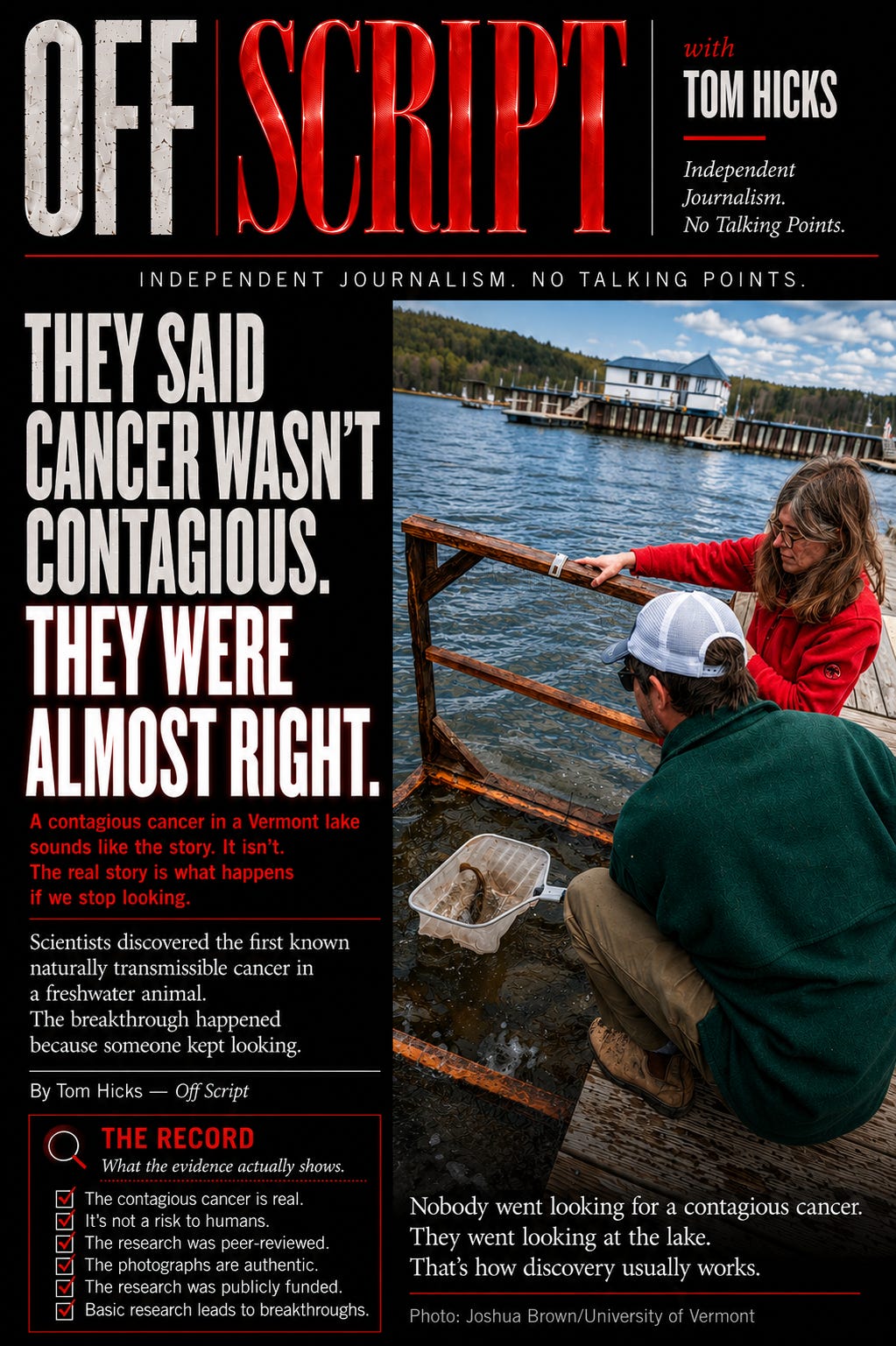
THE RECORD
What the evidence actually shows.
Researchers identified the first known naturally transmissible cancer in a freshwater animal, affecting brown bullhead catfish in Lake Memphremagog. Nature
Genetic sequencing showed the tumors share a common origin, meaning the cancer cells themselves are spreading between fish rather than each fish developing independent tumors. Nature EurekAlert
Scientists have found no evidence that the disease poses a risk to humans. Nature
Naturally transmissible cancers have previously been documented in dogs, Tasmanian devils and several marine bivalve species. Science
Researchers have warned that reductions in support for long-term basic research could limit future discoveries whose value isn’t immediately obvious. Nature News Reuters
The Bullshit Detector
Claim: “This proves cancer is contagious.”
Verdict: Mostly False.
This discovery doesn’t overturn decades of cancer biology. It documents an extraordinarily rare exception in a freshwater fish species. For humans, cancer remains a non-communicable disease. The bigger lesson isn’t that we’ve been wrong about cancer. It’s that science keeps refining what we know, and every so often those refinements are remarkable.
FREE FOR OFF SCRIPT SUBSCRIBERS
The Off Script Bullshit Detector
A practical guide to spotting misinformation, propaganda, and political nonsense before it fools you.
$4.95 in the Tom Hicks Media Store
More from Tom Hicks Media
If you liked thinking this hard before 9 am, I’ve got more for you. Panic Room Sports brings the same “slow down and look at the evidence” approach to the NFL. Tom’s Number Ones is a daily trip through Billboard history: pure nostalgia, zero politics. And if you need a break from humans overthinking everything, Lotus Purrspective is a cat’s unbothered take on the whole mess. All are free to subscribe.
☕ Buy Me a Cup of Tea
If Off Script makes your mornings a little smarter, a little more skeptical, or just a little more interesting, consider buying me a cup of tea. It helps support independent journalism without advertisers, corporate owners or political handlers.
If tea isn’t in the budget, sharing this article with someone who prefers evidence over outrage helps just as much.
Thank you for reading.

One Last Thing
The next breakthrough almost certainly won’t start with a press conference.
It’ll start with somebody noticing something a little out of place and having enough time, enough curiosity and enough support to ask, “That’s odd. I wonder why?”
Let’s hope there are still people around to ask.
#Science #CancerResearch #BasicResearch #Wildlife #Environment #ScienceFunding #PublicHealth #OffScript #TomHicksMedia