

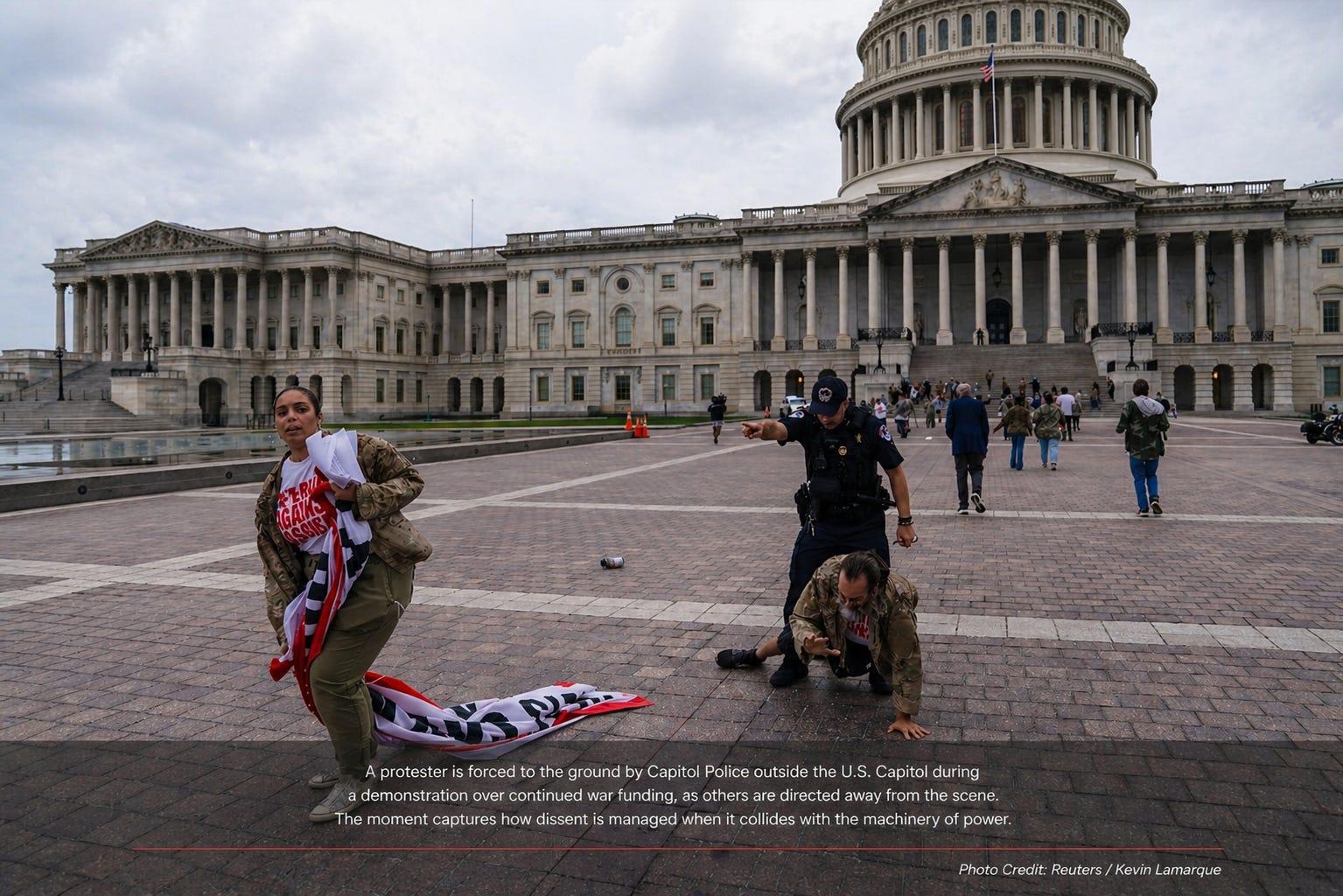


When every institution bends the same way under pressure, that’s not failure. That’s the direction they were built to bend.
Opening Statement
On April 20, Reuters reported that Capitol Police zip-tied and arrested 66 veterans and military family members inside the Cannon House Office Building after they gathered in the rotunda to demand a meeting with House Speaker Mike Johnson about the war in Iran. Many wore fatigues. Some were in wheelchairs. Some walked on prosthetics. They folded a flag for the 13 American service members already killed in the conflict and held red tulips for the Iranians. Capitol Police warned them. They didn’t move. So they got zip-tied and hauled out.
That same week, the Associated Press reported that President Trump spent several days publicly attacking the Supreme Court of the United States — the institution he spent years packing — calling his own appointees “weak, stupid, and bad” after the court’s 6-3 ruling struck down his tariff plan and ordered roughly $160 billion in refunds. He went on Truth Social. He went on CNBC. He misrepresented the vote margin. He demanded that the justices should have written one extra sentence to protect his money.
Meanwhile, federal agencies kept doing what federal agencies do when something ugly surfaces — issuing statements, promising reviews, running out the clock until the next disaster swallows the story whole.
Different events. Different players. At least that’s how it looks if you’re moving fast enough not to notice the pattern underneath all of it.
First Crack
Taken on their own, none of these stories demands a larger explanation. A president lashing out at a court can be framed as ego. An agency cycling through another round of allegations can be written off as bureaucratic inertia. Veterans getting removed from a congressional building can be dismissed as a security call — uncomfortable, sure, but procedural.
That’s how these moments survive. Each one gets its own lane, its own logic, its own reason for existing, separate from everything else.
But the moment you stop looking at them one at a time and hold them in the same frame, the explanations start feeling thinner. Not wrong. Just incomplete.
Because while the circumstances differ, the responses don’t.
That’s where it starts to get under your skin — not from what happened, but from how familiar the reaction is across all three.
This wasn’t a chaotic week.
This was alignment.
🔒 The rest of this report is for paid subscribers. The free version gives you the headlines. The War Room shows you the mechanism.
Upgrade — Don’t Confuse Access With Understanding
You’ve got access to the story.
You don’t yet have the full picture.
The deeper cuts, the War Room pieces, the pattern recognition—that’s where this actually clicks into place.
Upgrade if you want to stop reading events and start understanding them.
