

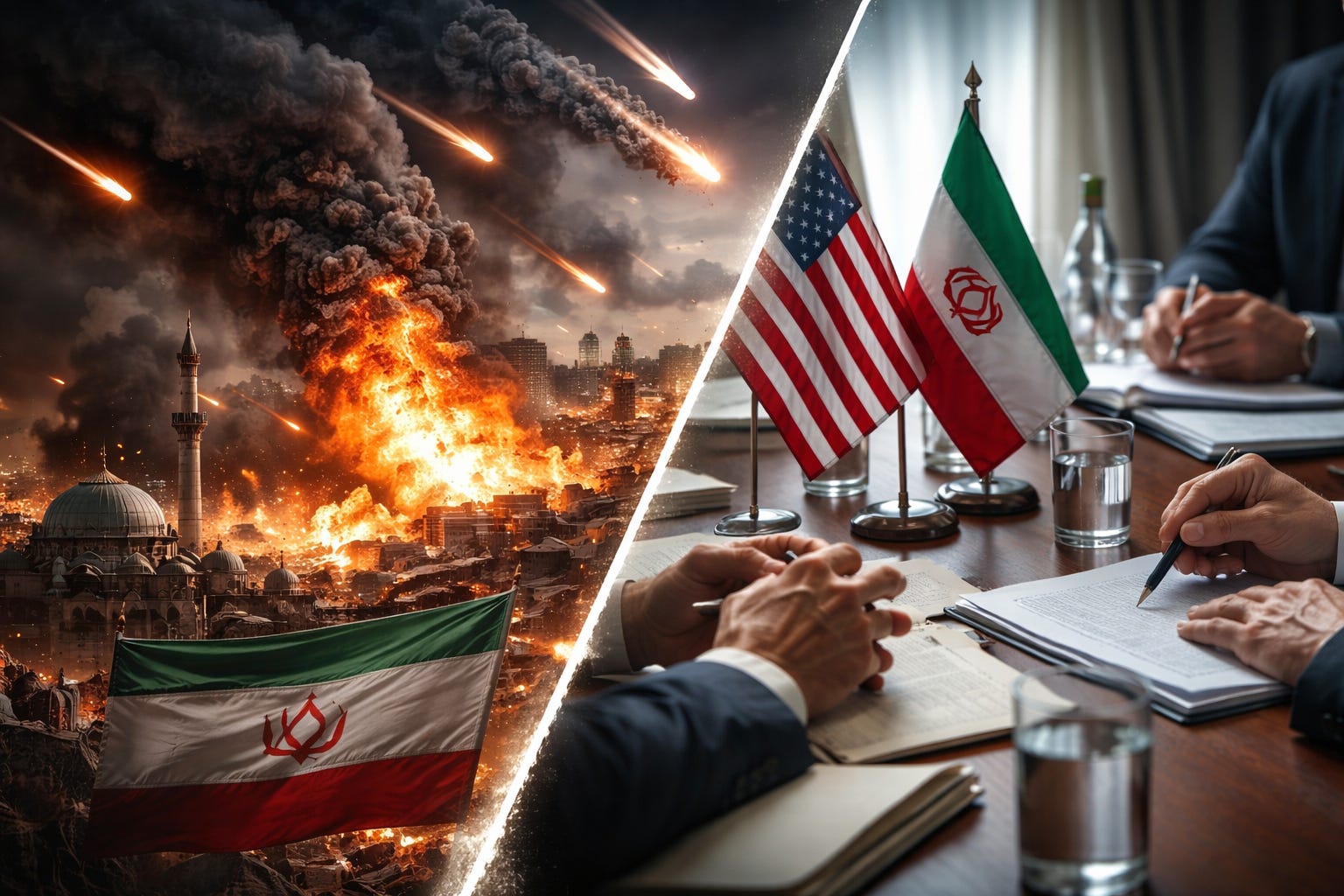
Here’s the part of this story that should make your blood pressure spike.
Diplomacy with Iran wasn’t collapsing.
It was working.
Not “maybe working.” Not “talks continuing.” Actually fucking working.
Just one day before the bombing campaign began, Oman’s foreign minister publicly announced that Iran had agreed to downgrade its enriched uranium stockpile and submit to full international verification. That is the diplomatic equivalent of the clouds parting and the choir singing. It means inspectors get inside the program, enrichment levels drop, and the international community can actually verify whether Iran is behaving or bullshitting.
That is literally the entire point of nuclear diplomacy.
And then Donald Trump decided to bomb the country anyway.
Not escalate negotiations.
Not test the deal.
Not even wait a week to see if verification would start.
He went straight to bombs.
The strikes killed Iran’s Supreme Leader, blasted military sites across multiple cities, and—according to multiple analysts—clearly aimed at regime change. That last part is important because the moment regime change becomes the goal, every incentive structure inside the target country flips from negotiation to survival.
And survival, in nuclear politics, usually means one thing.
Build the fucking bomb.
If you want coverage that actually follows the consequences of these decisions instead of just showing you the fireworks, hit subscribe now. The Bastard covers the part of the story that starts after the victory speeches end.
Reality Mechanism
Now let’s talk about the part of the operation that’s already looking like a spectacular strategic own-goal.
The International Atomic Energy Agency says it has no evidence that Iran’s nuclear facilities were actually destroyed in the strikes.
None.
That’s not because the IAEA is incompetent. It’s because Iran spent decades designing its nuclear infrastructure specifically to survive this exact scenario. Facilities like Natanz and Isfahan are buried under layers of reinforced concrete and rock so thick that conventional airstrikes mostly scratch the paint.
So while the bombing campaign absolutely killed people and wrecked buildings, the central question remains painfully unresolved.
Did it actually stop the nuclear program?
Right now, the honest answer appears to be: nobody fucking knows.
And here’s where things go from dangerous to truly stupid.
After earlier attacks on Iranian nuclear facilities, Iran kicked out UN inspectors. Those inspectors were the only people on earth who could independently verify the status of Iran’s enriched uranium stockpile.
Without them, the world loses the single most important safeguard in nuclear diplomacy: verification.
Which means we now have a nuclear program that may still exist underground, holding enough enriched uranium for more than ten warheads, and absolutely no one outside Iran can confirm what’s happening inside those facilities.
That is not a victory.
That is a geopolitical horror movie waiting for Act Two.
Who Benefits
The White House says the strikes were about stopping Iran’s nuclear ambitions.
But look at the scope of the operation.
The bombing campaign killed Supreme Leader Ali Khamenei, destroyed military infrastructure across multiple cities, and struck key regime assets tied to political control. Those are not the targets of a limited non-proliferation strike.
That’s the playbook for toppling a government.
Here’s the inconvenient historical reality: no American president has openly attempted regime change in Iran through direct military force.
Not Reagan.
Not Clinton.
Not Obama.
Not even George W. Bush, when the Iraq War brain worms were running rampant in Washington.
And the reason is simple. Iran is not Iraq. It’s a country of nearly ninety million people, with deeply entrenched institutions, rival factions, and armed networks across the region.
As analysts at Brookings have repeatedly warned, those structures do not simply disappear when leadership is decapitated. They fracture, they radicalize, and they often become far more violent in the process.
In other words, the idea that bombing Iran’s leadership would neatly “solve” the problem is about as strategically complex as trying to fix a leaking pipe with a fucking chainsaw.
Gaslight Zone
The global reaction to the strikes has been… let’s call it “not thrilled.”
Russia called the attack an unprovoked act of aggression.
China described it as brazen.
The UN Secretary-General said the operation “squandered an opportunity” for a diplomatic resolution.
That is diplomatic language for: what the hell were you thinking?
Meanwhile, the tone coming from Washington has been closer to a championship parade. Trump has been posting victory messages on Truth Social while allies on television insist the strikes demonstrated American strength.
Strength is an interesting word to use when nuclear experts are quietly warning that the situation may now be more dangerous than before the bombing began.
Because once diplomacy collapses, the logic inside a threatened regime changes fast.
And that leads directly to the most chilling part of this entire mess.
Democracy Damage Report
A nuclear scholar at the Middlebury Institute laid out the strategic lesson of this moment with brutal clarity.
If you are a country negotiating with the United States and the United States bombs you in the middle of those negotiations, what conclusion do you draw?
North Korea already figured this out.
You build the bomb as quickly as humanly possible.
Because once you have nuclear weapons, suddenly everyone wants to talk again.
It’s the ultimate deterrent, and it works.
Which means the lesson other governments may take from this moment isn’t “don’t pursue nuclear weapons.”
The lesson may be: get them faster.
Fork in the Road
The nightmare scenario isn’t simply Iran building a nuclear weapon.
It’s something far messier and far more dangerous.
A destabilized regime.
Competing factions fighting for control.
Unsecured nuclear material scattered across facilities that the international community can no longer inspect.
Those are the conditions where nuclear crises don’t just emerge—they spiral. Intelligence becomes unreliable, miscalculations multiply, and the odds of catastrophic escalation start creeping upward like a fucking horror movie soundtrack.
This is exactly the scenario global non-proliferation efforts have spent decades trying to prevent.
And we may have just kicked the door open to it.
Verdict
Strip away the patriotic music and the war graphics for a moment, and the timeline becomes painfully clear.
Iran agreed to reduce its enriched uranium stockpile.
International inspectors were preparing to verify the program.
Diplomacy was producing the outline of a deal.
Then the United States bombed the country in the middle of those negotiations.
Now the inspectors are gone.
Verification is impossible.
The nuclear program may still exist underground.
And the message to every government watching this unfold is unmistakable.
If you want to avoid becoming the next target of American bombs, you’d better build a nuclear deterrent before the negotiations start.
That isn’t strength.
It’s a reckless geopolitical gamble that echoes the logic of Iraq, launched by many of the same political voices who swore they learned something from that disaster.
Apparently, they learned jack shit.
And the rest of the world now gets to deal with the fallout.
Fuck.
Running a fully independent newsletter means no corporate sponsors, no billionaire owners, and no editorial leash. If you want to help keep the Bastard caffeinated enough to keep digging into stories like this, you can toss a little fuel in the tank.
🐈 Need a sanity break after all that geopolitical insanity?
Head over to The Unredacted Bastard’s feline counterpart, Lotus, where a judgmental tuxedo cat dissects human stupidity with considerably more elegance and far fewer explosions.
👍 If this piece made you think, swear, or question the official narrative, like, share, and subscribe so more people see it.
Because the stories that matter most are usually the ones someone hopes you’ll stop paying attention to.
#Iran #Trump #ForeignPolicy #NuclearWeapons #MiddleEast #Geopolitics #IAEA #Natanz #IranWar