

EDITORIAL NOTE
This is a pretty simple exercise. President Donald Trump used Labor Day to tell American workers his government is fighting for them, so Off Script checked that statement against White House documents, Labor Department actions, National Labor Relations Board records, and a federal appeals court decision. The evidence comes largely from his own government.
The nice thing about receipts is that they don’t care which party you voted for.
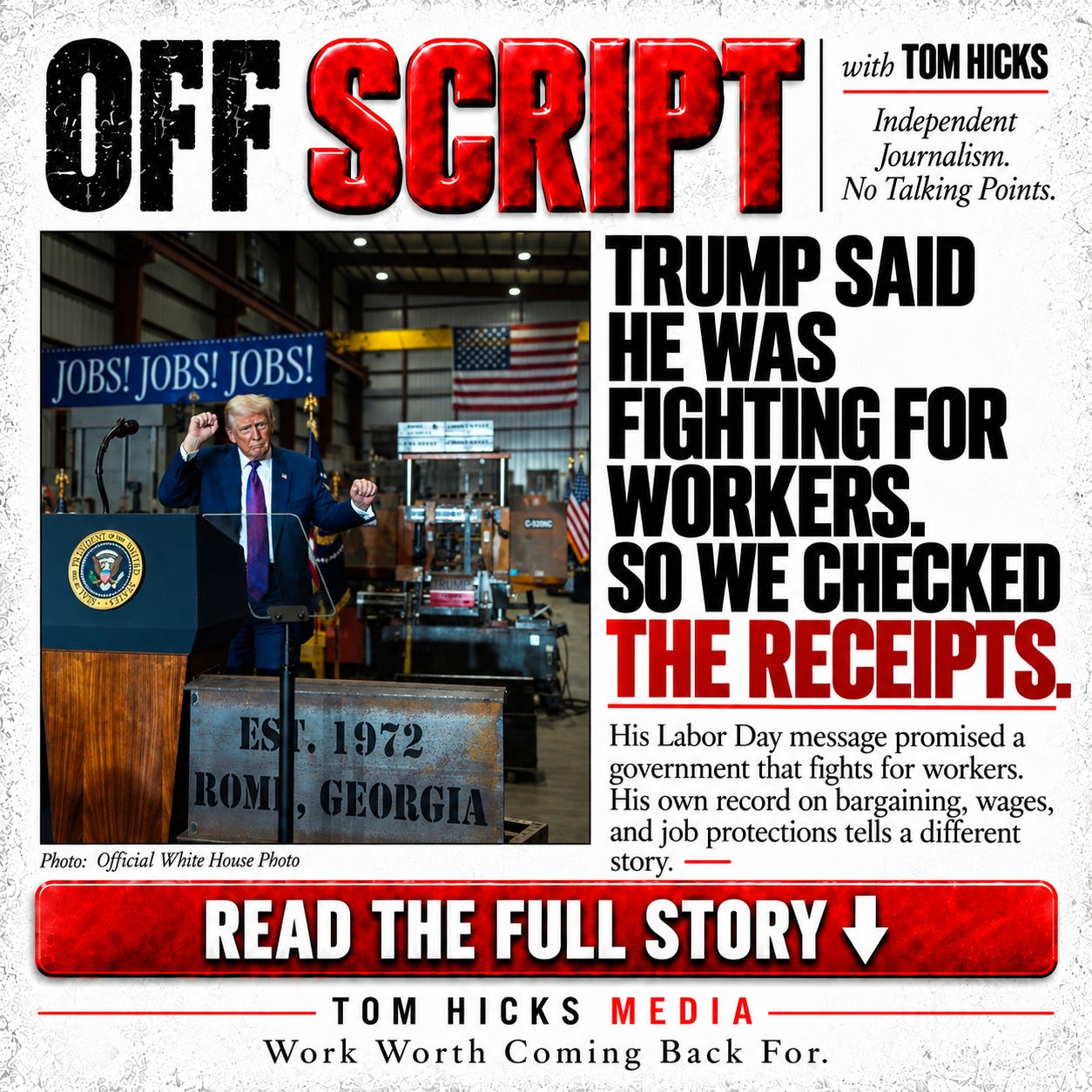
Labor Day ended a few hours ago. Apparently the holiday has a return policy.
On Monday, Trump issued the traditional presidential Labor Day proclamation, praising the “hard work, dedication, and unwavering commitment of the American worker.” Then came the sentence worth keeping: “The American worker deserves a Government that is determined to fight for them … and we are delivering.” That gives us something considerably more useful than another holiday speech full of flags and adjectives. It gives us a claim we can check.
So let’s check it.
WHAT TRUMP SAID
The White House makes its case largely through the economy. Trump points to tax cuts, tariffs, manufacturing investment, more than 900,000 jobs and six consecutive months of manufacturing expansion. He also argues that his trade policies and proposed H-1B changes protect American workers from foreign competition. Those are the administration’s chosen measurements of a government fighting for workers.
They belong in the conversation. A worker who lands a good factory job isn’t going to care that somebody on television dislikes the president who was in office when the plant opened. Jobs matter, wages matter, and domestic investment matters.
So does what happens after you punch the clock.
If the government says it is fighting for workers, bargaining power, wage protections, and the ability to keep a job seem like reasonable places to look.
RECEIPT NO. 1: COLLECTIVE BARGAINING
In March 2025, Trump signed Executive Order 14251, removing federal collective-bargaining requirements from a sweeping group of agencies and subdivisions. The affected workforce stretched through Defense, Veterans Affairs, State, Treasury, Justice and other parts of the federal government. Six unions representing roughly 800,000 civilian federal employees challenged the order.
The administration invoked national security, authority presidents do possess under federal law. A Ninth Circuit panel later vacated a preliminary injunction that had blocked the order, concluding that the unions had not shown at that stage that they were likely to prevail on their retaliation argument. That legal context matters because this isn’t a claim that Trump simply woke up one morning and illegally abolished unions.
Then you read the White House’s own explanation.
Its March 2025 fact sheet complained that certain federal unions had “declared war on President Trump’s agenda” and accused them of using grievances and litigation to obstruct administration policies. The White House said Trump supported unions willing to work constructively with him and would not tolerate what it called “mass obstruction.” That language makes the policy considerably harder to sell as a simple national-security housekeeping measure.
You can believe the president had the statutory authority and still ask who gained power from using it. Management did. Hundreds of thousands of workers lost bargaining protections they previously had.
That belongs on the receipt.
Your subscription helps fund reporting, research, publishing, new features, and the continued growth of every Tom Hicks Media publication.
RECEIPT NO. 2: THE FEDERAL CONTRACTOR WAGE FLOOR
Then there’s money.
In March 2025, Trump revoked President Biden’s Executive Order 14026, which had established a higher minimum-wage requirement for workers performing on or in connection with certain federal contracts. The Labor Department’s current guidance is unusually plain about the result. It says the department “is no longer enforcing Executive Order 14026” or its implementing rule.
That doesn’t mean every federal contractor suddenly slashed wages. Other wage laws and contract requirements remain, and some covered contracts fall under an older federal contractor wage order. For 2026, that older system establishes a $13.65 hourly minimum for covered non-tipped workers.
The policy choice is still obvious. A federal wage protection existed, and Trump removed it.
You can defend that as deregulation. You can argue Washington shouldn’t dictate a higher wage to companies doing business with the government. You can even argue that the old requirement distorted labor costs.
Just put it on the same table with the Labor Day speech.
RECEIPT NO. 3: WHEN THE CONTRACT CHANGES HANDS
Here’s one that received considerably less attention.
Under a Biden-era rule covering certain federal service contracts, an incoming contractor generally had to give qualified workers from the previous contractor the right of first refusal for jobs on the new contract. It wasn’t a lifetime employment guarantee. It meant the people already doing the work got a chance to keep doing it when Washington changed the company name at the top of the contract.
Trump revoked the executive order behind that protection on his first day back in office. In December 2025, the Labor Department rescinded the regulation itself, fully removing the requirement. The department’s own announcement described the action as restoring flexibility to contractors and subcontractors.
There’s a policy argument there too. A company taking over a federal contract may want complete freedom to build its own workforce. Employers got that freedom.
Workers lost the preference that had helped them keep their jobs.
When we’re grading who the government is fighting for, that seems worth mentioning.
RECEIPT NO. 4: THE LABOR BOARD THAT COULDN’T DECIDE LABOR CASES
The National Labor Relations Board exists to enforce the federal law protecting most private-sector employees who organize, bargain collectively or act together over workplace conditions. In January 2025, Trump removed Democratic board member Gwynne Wilcox before her Senate-confirmed term expired. Her removal left the board without the quorum it needed to decide contested cases.
The agency’s own numbers show what followed. During fiscal 2025, the board issued only 86 contested decisions, a 67 percent decline from the previous year. Pending cases jumped 92 percent, from 288 to 552, and the backlog of unfair-labor-practice and representation cases awaiting board decisions reached 129.
Most of the NLRB’s routine work continued during the quorum gap. Regional offices still processed cases, conducted elections and settled the overwhelming majority of meritorious complaints, so saying the entire agency shut down would be wrong. The problem hit cases that actually required a board decision.
Trump later nominated James Murphy and Scott Mayer; the Senate confirmed them, and the NLRB regained a quorum on January 7, 2026. It has since added another member and currently has four. The board works again.
The backlog didn’t materialize because somebody at MSNBC said so.
It’s in the NLRB’s own annual report.
SO WHAT DOES “FIGHTING FOR WORKERS” ACTUALLY MEAN?
This is where the argument usually turns into team sports.
Trump supporters can point to tariffs, manufacturing policy, immigration restrictions, tax cuts, and domestic investment and argue that those policies put American workers ahead of foreign competitors and multinational companies. The Labor Day proclamation makes exactly that case. There are workers who will judge the administration primarily by whether jobs came back to their town or whether their paycheck improved.
That record has another side.
The administration restricted collective bargaining across large parts of the federal workforce. It revoked a higher federal contractor minimum-wage order. It removed a job-retention preference for workers on certain federal service contracts. Its removal of an NLRB member also left the board unable to decide contested cases for most of 2025, contributing to a backlog documented by the agency itself.
I don’t need to tell you whether Donald Trump cares about workers. I don’t know what’s inside his head, and neither does anybody else filling three hours of cable television pretending they do. Policies leave a much cleaner trail.
On Labor Day, Trump told American workers his government was determined to fight for them.
After reading the receipts, I’m left with the same question workers have been asking bosses forever:
Doing what, exactly?
FROM OFF SCRIPT: THE BULLSHIT DETECTOR
The three-day weekend is over. The bullshit apparently worked straight through it.
THE CLAIM:
Michael Whatley says grocery prices, gasoline prices, and housing prices are down, and that there’s “no inflation.”
Bullshit, at least the way the current campaign ad presents it.
Roy Cooper’s North Carolina Senate campaign really does use Whatley’s own words. Several of those comments, however, came from July 2025, when the economic numbers were different, while Whatley’s separate January 2026 claim that there was “no inflation” was simply wrong. FactCheck.org found the new ad uses dated remarks as though Whatley were describing the economy today, turning a legitimate affordability argument into something considerably slipperier.
If your campaign ad needs a time machine, put the date on the screen.
THE CLAIM:
Trump posted a photograph of himself in a military uniform covered with medals.
Bullshit.
The image circulated online with the claim that Trump had posted it himself. Lead Stories checked Trump’s Truth Social activity and found no evidence that the picture came from his account. That distinction matters because Trump really has posted AI images of himself in military settings before, which probably made this one easier to believe.
A politician’s actual social-media feed provides enough material without giving him somebody else’s.
THE CLAIM:
Robert De Niro has apparently come around on Trump and posed with a “TRUMP IS MY PRESIDENT” shirt.
Bullshit.
Trump really did share the image Sunday and caption it, “Even this jerk is beginning to get it!” The problem is that De Niro never posed for the picture. The image was AI-generated, turning one of Trump’s most persistent celebrity critics into a fictional supporter for a social-media post.
Apparently political endorsements are now available without the annoying step of getting the endorser involved.
THE CLAIM:
A viral image shows Alexandria Ocasio-Cortez posing in tight workout clothes in her kitchen.
Bullshit.
The kitchen is real. The outfit isn’t. Lead Stories traced the image to an August 22 Instagram video in which Ocasio-Cortez was wearing a sleeveless brown dress with white polka dots, then matched details, including the background, her hair, and a bandage on her arm to the manipulated version.
We have now reached the point where even somebody’s pants require independent verification.
Already subscribed? The full Bullshit Detector guide is included with your subscription.
Not subscribed? You can get it separately for $4.95 at the Tom Hicks Media Store.
Keep the receipts hot and the bullshit detector fully operational.
EXPLORE MORE FROM TOM HICKS MEDIA
Off Script with Tom Hicks
Independent journalism that follows the facts, not the talking points.
Lotus Purrspective
Life, according to the only member of the household convinced she’s in charge.
Tom’s Number Ones
The stories behind the songs that reached No. 1 and the moments that made them unforgettable.
Panic Room Sports
A new issue drops today. Smart football coverage with attitude, with plenty for fantasy players who’d rather make the next move than panic about the last one.
Rabbit Ears Classic TV
The shows, moments, and wonderfully strange pieces of television history that refuse to stay buried in the rerun bin.
The Backlot Ghost
Hollywood history after somebody turns on the lights and starts opening the closets.
☕ BUY ME A CUP OF TEA
If you enjoy independent journalism that’s willing to check what politicians say against what they actually do, you can support my work by buying me a cup of tea. Every contribution helps fund reporting, research, publishing, new features, and the continued growth of every Tom Hicks Media publication.
Thank you for reading, subscribing, and sharing my work.
ONE QUESTION BEFORE YOU GO
Trump says his administration is fighting for American workers. Looking at the record, what should count most when deciding whether a politician is actually on workers’ side: jobs, wages, bargaining rights, workplace protections, or something else?
I’m interested in the answer, including from people who disagree with me.
Work Worth Coming Back For
#OffScript #LaborDay #Workers #Unions #DonaldTrump #LaborRights #FederalWorkers #NLRB #FactCheck #TomHicksMedia