

By Tom Hicks — Off Script with Tom Hicks
INDEPENDENT JOURNALISM • NO TALKING POINTS
I spent enough years working around the law to recognize a familiar maneuver.
When someone cannot get the authority they want through the normal process, they start searching for another door. Maybe there is an old regulation they can stretch. Maybe there is grant money they can hold hostage. Maybe they can frighten people into complying before anyone gets around to asking whether they have the legal power to demand it.
Sometimes the threatening letter is more useful than the law itself.
That appears to be where the Trump administration is heading with elections.
President Donald Trump went on national television Thursday night to demand passage of the SAVE America Act, a sweeping Republican election bill that has passed the House but remains stalled in the Senate.
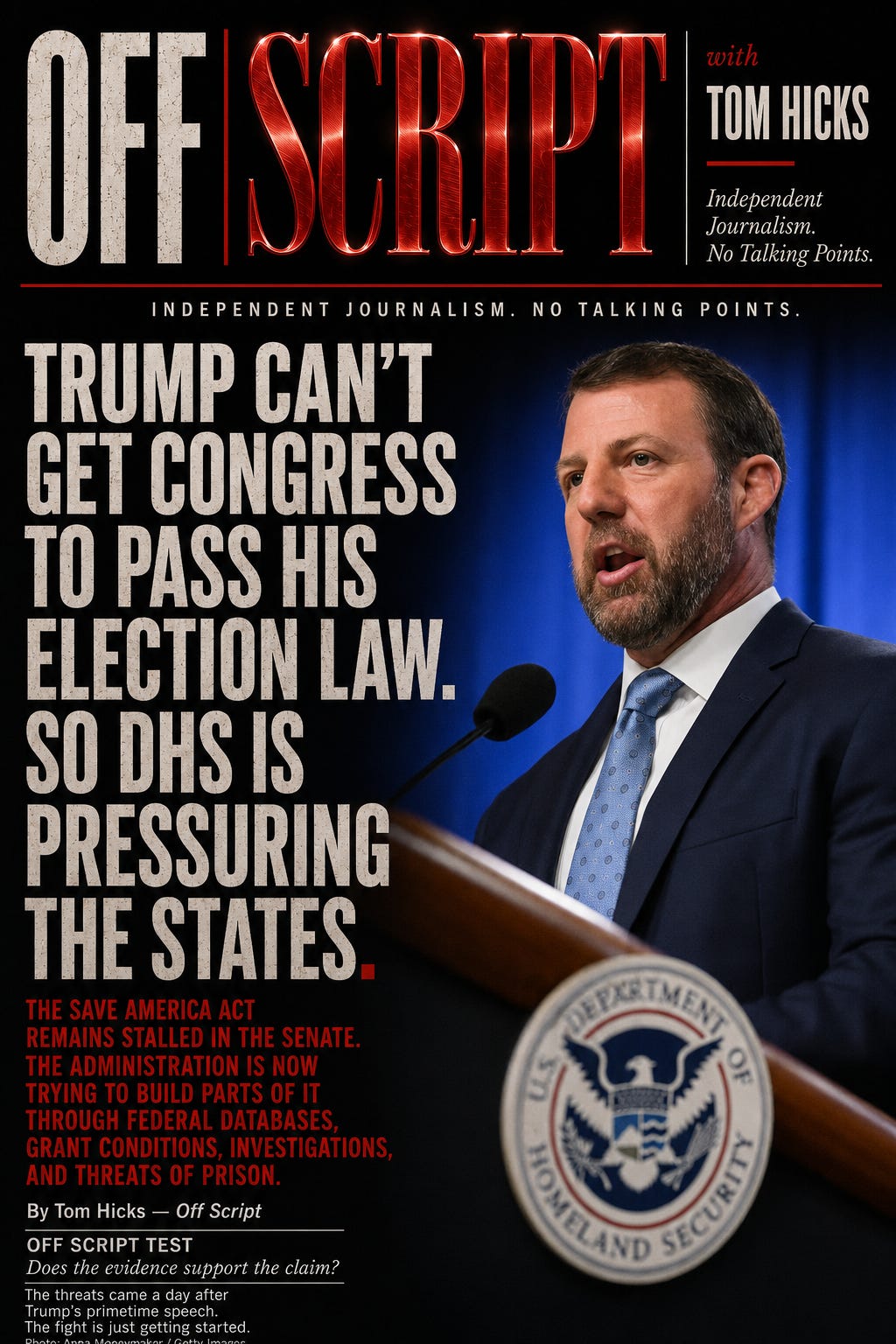
By Friday afternoon, Homeland Security Secretary Markwayne Mullin was standing inside the White House complex, threatening states that did not follow the administration’s election demands with lost federal funding, investigations, financial penalties, and, depending on how far officials resisted, prison.
Congress had not passed Trump’s bill overnight.
The administration had simply started acting as though it had. (Reuters)
THE BILL CONGRESS HASN’T PASSED
The SAVE America Act would require documentary proof of United States citizenship when registering to vote in federal elections. It would also impose new identification requirements, expand voter-roll verification procedures, and establish processes states would be required to follow when applicants cannot immediately produce the specified documents.
The House passed the legislation in February, but it has not cleared the Senate. That matters. The Constitution gives Congress a role in regulating federal elections, but Congress exercises that power by passing laws, not by watching the executive branch assemble a substitute out of databases, funding conditions, and press-conference threats. (U.S. House of Representatives)
Instead of waiting for Congress, DHS has begun tying certain federal grants to state compliance with the administration’s preferred election procedures. States seeking portions of FEMA’s homeland-security funding must use the federal SAVE system to check voter-registration records and meet new requirements involving voting equipment. DHS plans to withhold 20 percent of the affected grants until states demonstrate compliance. (Reuters)
Cybersecurity assistance turned into a leash.
This is what makes Mullin’s announcement more important than Trump’s speech.
Trump begged Congress to give him the election law he wants.
Mullin explained what the administration intends to do while it waits.
A SPREADSHEET WITH A SCARY FONT
Mullin said DHS had identified more than 250,000 potential noncitizens registered to vote in California, New Jersey, Nevada, and Pennsylvania. He sent letters asking election officials in those states to review their voter rolls and respond within two weeks.
That sounds alarming until you reach the part where DHS did not publicly explain its methodology, provide evidence supporting its totals, or establish that the people identified were actually noncitizens.
Potential matches are not confirmed cases. A database discrepancy is not a fraudulent voter. A record that does not contain complete citizenship information is not proof that the person attached to it is ineligible.
Without the methodology, this is a spreadsheet with a scary font. (Reuters)
Nevada Secretary of State Francisco Aguilar rejected the federal numbers as “wildly speculative at best” and said DHS had not provided evidence backing them up. Pennsylvania Secretary of State Al Schmidt said his office would examine whatever information DHS supplied but would not turn over citizens’ private data. Schmidt also noted that noncitizen voting is extremely rare in Pennsylvania and nationwide.
Those are not officials refusing to protect elections.
Those are officials asking the federal government to show its work. (Reuters)
The administration’s analysis reportedly relied on publicly available data that election experts say may be too incomplete or outdated to determine whether an individual voter is a citizen. That distinction becomes especially important when a preliminary match could lead to an investigation, removal from the voter rolls, or a criminal accusation. (Associated Press)
THE DATABASE IS NOT A VERDICT
The federal SAVE system was originally developed to help government agencies verify the immigration status of applicants seeking certain public benefits or licenses.
It was not designed as a national voter-roll purge machine.
The administration has since expanded the information available through SAVE by incorporating data from additional federal systems. Voting-rights organizations warn that some of those databases, including Social Security records, may contain incomplete or outdated citizenship information. A naturalized citizen can therefore appear in a record that still reflects an earlier immigration status.
That is not proof of fraud. It is proof that human beings maintain government databases. (Campaign Legal Center)
A responsible verification process treats a database result as a lead requiring further examination.
The Trump administration is treating preliminary matches as a headline, then using the headline to justify more federal authority.
That reverses the proper order of evidence. First comes the accusation. The supporting proof can apparently arrive later, assuming anyone still remembers to ask for it.
DO WHAT WE SAY OR FACE PRISON
Mullin said election officials could be held accountable through fines, penalties, and even prison if DHS gives them information and they choose not to act.
Think about what he was threatening.
These are state officials administering elections under state and federal law. They are not employees of the Department of Homeland Security. They do not report to Mullin. Yet the secretary stood at the White House and suggested that declining to follow federal instructions could expose them to punishment or incarceration. (Reuters)
Mullin did not identify the statute that would allow DHS to imprison a secretary of state for refusing to act on an unverified database match.
He did not explain what crime the official would have committed.
He did not specify who would investigate, who would prosecute, or how an election administrator exercising lawful state authority suddenly becomes a federal criminal.
The threat was the policy.
Whether the administration ultimately has the authority to carry it out may be less important, at least initially, than whether state officials believe resistance could cost them funding, consume their offices with investigations, or place them personally in legal danger.
You do not need to win every case when the threat itself produces compliance.
THE CONSTITUTION DOESN’T MAKE DHS THE NATIONAL ELECTION BOARD
The Constitution gives state legislatures the initial authority to determine the time, place, and manner of congressional elections. It also allows Congress to alter those regulations by passing federal law.
It does not assign that legislative power to the president or the Secretary of Homeland Security. (Library of Congress)
Congress has broad authority over federal elections, and the federal government may enforce valid voting laws. But the Supreme Court has repeatedly held that Washington cannot simply order states or state officials to administer a federal regulatory program.
In New York v. United States, 505 U.S. 144 (1992), the Court held that Congress could not force a state to enact or administer a federal regulatory program. The federal government may regulate directly, offer states lawful choices, or attach proper conditions to federal programs. It may not simply transfer its governing responsibilities to the states by command. (Oyez)
Five years later, in Printz v. United States, 521 U.S. 898 (1997), the Court struck down a federal requirement directing state and local law-enforcement officers to conduct background checks under the Brady Handgun Violence Prevention Act. Congress could create a federal system, but it could not conscript state officers to operate it. (Oyez)
The Court reaffirmed that anti-commandeering principle in Murphy v. National Collegiate Athletic Association, 584 U.S. 453 (2018), explaining that Congress may regulate private conduct directly but may not issue direct orders to state legislatures. (Supreme Court)
No court has ruled on every element of the precise DHS program Mullin described. I am not going to declare the entire plan unconstitutional before its details have been tested in court.
But the constitutional problem is obvious.
DHS may share credible evidence with state officials. The Justice Department may investigate actual violations of federal law. Congress may pass valid election legislation.
That is a long way from ordering state officials to adopt the administration’s preferred database, act on preliminary matches, surrender private voter information, and follow federal instructions or risk losing money and going to prison.
Mullin never identified the law that supposedly grants DHS that authority.
That is not a footnote he forgot.
That is the whole tell.
THE SHADOW VERSION OF THE SAVE AMERICA ACT
The SAVE America Act would require states to verify citizenship, expand federal influence over voter registration, and create new legal obligations for election officials.
Congress has not enacted that law.
The administration is now pursuing many of those same objectives anyway. DHS is pressing states to use a federal citizenship database, review voter rolls on Washington’s timetable, and comply with new federal expectations backed by threats of lost funding, investigations, fines, and even prison.
That is why I keep calling this a shadow version of the SAVE America Act.
It does not arrive as a single bill with a single vote and a single presidential signature. It arrives through grant conditions, agency directives, database searches, Justice Department investigations, and public threats.
The result is much the same. When Congress refuses to enact the president’s election policy, the executive branch begins implementing pieces of it anyway.
THIS IS NOT REALLY ABOUT NON-CITIZEN VOTING
Non-citizen voting in federal elections is already illegal.
When credible evidence shows that someone voted illegally, investigate it. Prosecute it. Present the evidence in court.
What we are seeing here is something else.
The administration announced an enormous number without demonstrating how it reached that number. It threatened officials before establishing violations. It attached election rules to anti-terrorism funding. It raised fears about foreign access to voting machines without providing evidence that foreign countries had manipulated American vote totals. (Reuters)
Mullin claimed foreign adversaries possess components used in American voting equipment and said they could potentially access or alter election information. Election-security experts have long recognized that electronic systems require safeguards, but state and local officials use equipment testing, physical controls, post-election reviews, and paper records in most jurisdictions to detect or prevent manipulation.
Mullin offered no evidence of a foreign government changing votes in an American election. (Associated Press)
This is not a normal evidence-first investigation.
It is an effort to establish the conclusion first: American elections are unsafe, state officials cannot be trusted, and only greater presidential control can save them.
Once that conclusion is accepted, almost any demand can be sold as election security.
THE PART WE SHOULD NOT MISS
Trump spent years insisting that the 2020 election was stolen from him. Courts, recounts, audits, election officials from both parties, and members of his own administration found no evidence of fraud capable of changing the result.
He never accepted that answer. (Reuters)
Now the country is approaching another election that could cost Republicans control of Congress.
Trump is not merely preparing his supporters to distrust an unfavorable outcome. His administration is building federal machinery that can be used to challenge voter rolls, pressure election administrators, withhold money, demand private information, and open investigations before and after ballots are cast.
That is the larger story.
A president who has never accepted an election loss is attempting to gain more control over how the next election is administered.
The danger is not limited to whether DHS successfully removes a particular voter or forces one state to use a particular database.
The danger is the precedent: when Congress refuses to enact a president’s election policy, the president’s agencies may attempt to impose it anyway.
CONGRESS SAID NOT YET
There is a reason legislation has to pass both houses of Congress and be signed by the president.
The process is supposed to force public debate, negotiation, amendment, accountability, and recorded votes. It is often slow and frustrating because handing the government new power is supposed to require more than one man demanding it during a television speech.
The Senate has not passed the SAVE America Act.
That does not mean the president gets to declare the legislative process defective and order his Cabinet to produce an executive-branch imitation.
Congress did not say yes.
For now, it said not yet.
The administration’s answer appears to be that it does not intend to wait.
ONE QUESTION BEFORE YOU GO
When Congress refuses to give a president the election powers he wants, should federal agencies be allowed to create those powers through grant conditions, databases, investigations, and threats?
Leave your answer in the comments.
SUPPORT INDEPENDENT JOURNALISM
Off Script is independent, reader-supported journalism without party talking points or corporate supervision.
Subscribe to receive every new investigation, analysis, and editorial directly in your inbox.
Join me every morning.
THE OFF SCRIPT BULLSHIT DETECTOR
Political language is designed to make power sound harmless.
The Off Script Bullshit Detector is a practical guide to recognizing manipulation, evasions, propaganda techniques, and claims that collapse the moment someone asks for evidence.
It is free for Off Script subscribers and available to everyone else for $4.95 through the Tom Hicks Media store.
BUY ME A CUP OF TEA
Independent reporting requires time, research, and enough caffeine to read federal election legislation without losing the will to live.
#ElectionSecurity #VotingRights #SAVEAmericaAct #DonaldTrump #MarkwayneMullin #DHS #Federalism #Constitution #Democracy #OffScript
We should stand behind our state election authorities by helping, however we can, to fight back. If any of them are threatened, we stand as civilian guards at their offices and homes to protect them and provide witness to what happens them. For states who contribute more federal taxes than receives them, we can withhold those taxes as protection against the administration attempting to withhold federal money from us.
'When Congress refuses to give a president the election powers he wants, should federal agencies be allowed to create those powers through grant conditions, databases, investigations, and threats?'
Absolutely not!