

By Tom Hicks — Off Script
Secretary of State Marco Rubio announced today, July 13, 2026, that the United States is launching what the State Department itself titled “State Department Launches Campaign to Dismantle International Criminal Court’s Threat to American Sovereignty.”
That’s not spin. That’s the actual headline they put their own name on.
The tools on the table, according to a State Department official who briefed Reuters: travel bans, visa revocations, expanded sanctions, and diplomatic pressure aimed at getting other countries to reject the ICC’s authority over Americans.
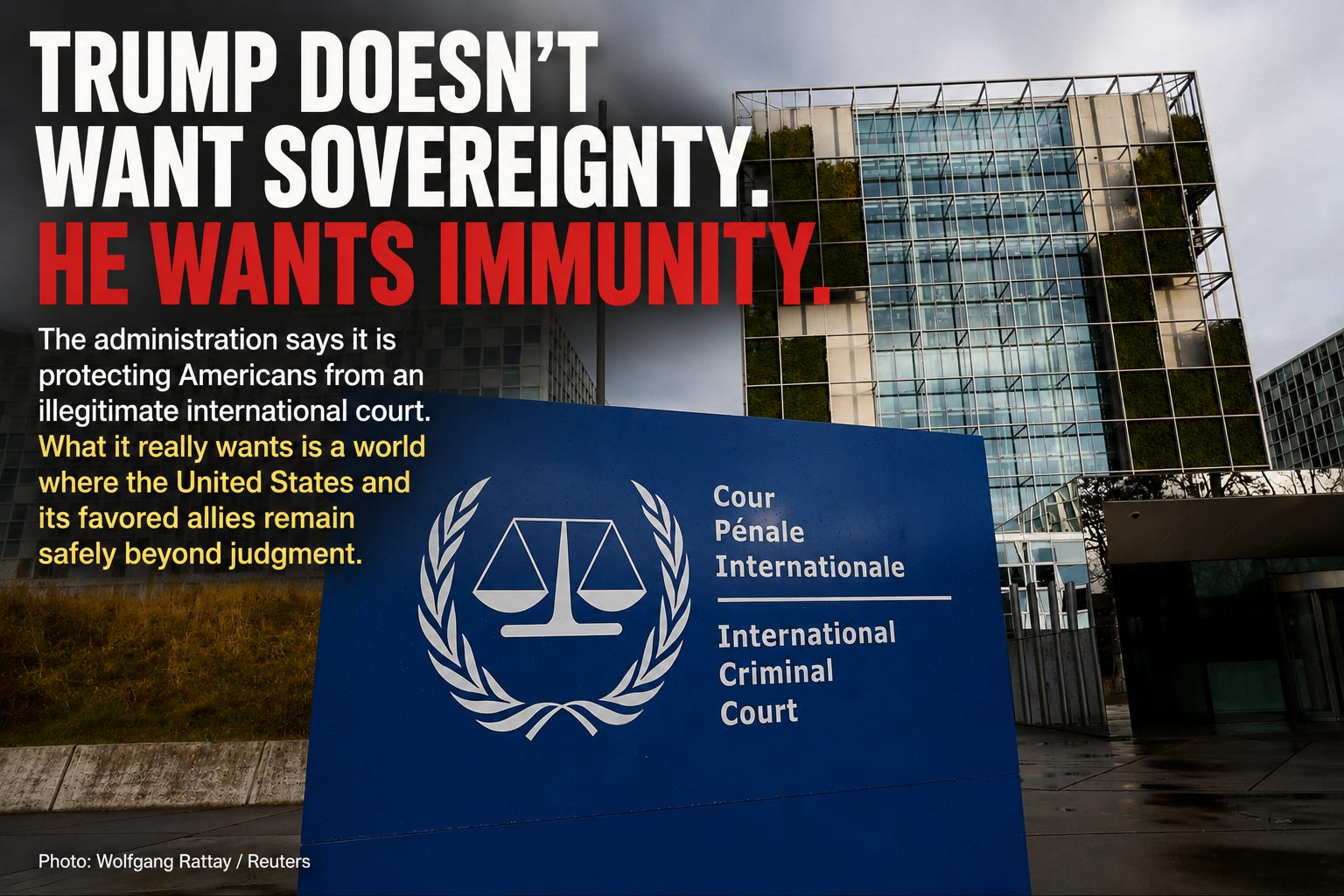
Suggested image: The International Criminal Court building in The Hague, with an American flag or a Trump administration official incorporated naturally into the composition.
Rubio isn’t hiding the ball on motive either. He’s framing this as sovereignty, full stop. Of course he is. Sovereignty is one of those magnificent Washington words that can make almost anything sound principled. Military intervention becomes national security. Economic coercion becomes diplomacy. Protecting powerful people from prosecution becomes a noble defense of the republic.
But sovereignty and immunity are not the same thing.
Sovereignty means the United States has legitimate authority over its own territory, laws, institutions, and citizens.
Immunity means Americans may act beyond our borders, affect people who never voted for our government, and remain untouchable by any institution our government cannot control.
Trump isn’t satisfied with saying the ICC has no jurisdiction over the United States. He wants the rest of the world punished for disagreeing.
Join me every morning.
Subscribe to Off Script and get the Bullshit Detector free of charge.
Not ready to subscribe? You can also buy it for $4.95.
Get yours in the Off Script store.
The United States has never joined the ICC. That matters. There are serious legal arguments about whether the court should exercise authority over citizens of a country that never ratified the Rome Statute. Those arguments deserve to be made. The court deserves scrutiny too — it’s been slow, politically vulnerable, and accused for years of leaning harder on weak countries than powerful ones.
But that isn’t where this stops.
The administration has already told the court it won’t cooperate with investigations involving Americans. Controversial, sure, but recognizable as a dispute over law. What’s happening now is something else entirely. It’s an attempt to make other sovereign nations adopt the American position through the threat of American retaliation — and I’m calling it that plainly because it’s exactly what a State Department official described to reporters this morning.
When Washington tells another country its continued support for an international court could jeopardize visas, aid, or access to the American financial system, it’s not defending sovereignty as a principle. It’s using American power to override somebody else’s.
That’s the part Rubio’s patriotic language conveniently leaves out.
America’s message, boiled down: we’re sovereign enough to reject the court. You are not sovereign enough to support it.
That’s not a legal standard. That’s a pecking order.
The ICC was created to prosecute genocide, crimes against humanity, war crimes, and the crime of aggression when national courts won’t act. It’s supposed to be a court of last resort, not a global district attorney wandering the planet looking for parking violations. Its defenders say atrocities don’t become legally invisible because the accused holds a government title. Its critics say the court lacks accountability and applies its authority selectively. There’s room for an honest argument here.
Trump has no interest in having it.
The current campaign’s roots go back further than people remember. CNN’s reporting today traces the administration’s hostility toward the ICC to Trump’s first term, when the court’s investigation into alleged war crimes by U.S. forces in Afghanistan first drew Washington’s fire. That history helps explain today’s animosity — it doesn’t excuse what’s happening now, but it’s honest to say this grudge has been building for years, not months.
Then came Netanyahu. On November 21, 2024 — before Trump returned to office — the ICC issued arrest warrants for Israeli Prime Minister Benjamin Netanyahu and former Defense Minister Yoav Gallant over alleged crimes connected to the war in Gaza. The United States rejected the warrants, and once Trump returned to power, the pressure escalated. He signed an executive order sanctioning ICC officials on February 6, 2025. More sanctions against ICC judges and prosecutors followed on August 20, 2025. Now comes the broadest move yet.
That pairing tells us plenty. Americans and Israelis aren’t being protected because international law suddenly became illegitimate. They’re being protected because they belong to the preferred category. They are ours. And “ours,” under this administration, increasingly means exempt.
Trump isn’t defending the principle that nations should govern themselves. He is demanding the power to decide which nations are allowed to judge anyone.
There’s a legitimate debate over whether the ICC handled the Netanyahu case correctly. Fine. Debate it. Challenge the warrants. Dispute the jurisdiction. Build a coalition to amend the Rome Statute. That’s how governments behave when they believe law matters.
Sanctioning judges, threatening prosecutors, and squeezing allied governments until they abandon the institution is what governments do when they believe power matters more.
The point is isolation. Make cooperation with the court feel risky. Make governments nervous about supporting it. Make lawyers, witnesses, banks, and institutions wonder whether contact with the ICC is worth the trouble. You don’t have to abolish an institution if you can make touching it feel radioactive.
The easiest response to all this is that the ICC is weak anyway — no police force, dependent on member states for arrests, and missing the U.S., Russia, China, and India from its membership rolls entirely. So why care?
Because weak accountability is still different from no accountability. The court has investigated or prosecuted atrocities connected to Darfur, Ukraine, Libya, the Philippines, Palestine, and Venezuela. For victims in those places, it’s sometimes the only institution even attempting to build a case. Destroying the ICC won’t produce a better court. It’ll produce a larger vacuum, and strong governments will keep prosecuting their enemies while dictators keep calling every investigation political.
Buy Me A Cup of Tea
Support Off Script and help keep the receipts organized and the bullshit detector calibrated.
There’s another problem here, and it’s bigger than the ICC. Other governments are listening. Russia can say the court is a Western political weapon. China can say international-human-rights scrutiny violates sovereignty. Every government accused of atrocities can borrow Washington’s vocabulary, swap the flag, and repeat the argument.
Why should anyone accept international judgment if the most powerful country on Earth considers itself exempt?
Every leader believes his circumstances are special. Every military insists its intentions were defensive. That’s exactly why courts exist — not because prosecutors are infallible, but because the accused can’t be the only authority deciding whether the accusation is legitimate. This administration rejects that premise whenever the accused belongs to its protected circle. It doesn’t want an impartial court. It wants a veto.
A court that can prosecute only the enemies of powerful countries is not an international court. It is an accessory.
The ICC may need reform — stricter limits, clearer jurisdiction, faster proceedings, a better answer to the charge that international justice lands hardest on countries with the least power to resist it. Dismantling the court does none of that. Threatening allied governments does none of that. Sanctioning judges and prosecutors does none of that. Those moves don’t improve international law. They teach the world that law survives only until it inconveniences Washington.
That lesson won’t stay confined to The Hague. Sooner or later, another government will use the same logic against American troops, American diplomats, or American allies. It’ll reject the institution, punish the investigators, pressure its neighbors, and call the whole thing sovereignty.
We’ll recognize the tactic. We taught it to them.
Trump doesn’t want sovereignty. He wants immunity — the kind backed by sanctions, money, military power, and a warning to every smaller country not to confuse its independence with permission to disagree. A world without any credible mechanism for judging the powerful isn’t a world made safe for America. It’s a world made safe for whoever has the biggest weapon and the fewest scruples.
ONE QUESTION BEFORE YOU GO
Should the United States be able to punish allied countries simply because they continue supporting an international court Washington rejects?
Join me every morning.
Subscribe to Off Script and get the Bullshit Detector free of charge.
Not ready to subscribe? You can also buy it for $4.95.
Get yours in the Off Script store.
#Trump #InternationalCriminalCourt #ICC #MarcoRubio #InternationalLaw #USForeignPolicy #Accountability #OffScript
Monday the Secretary of State promised to dismantle the International Criminal Court "brick by brick." Down in Evangeline Parish we've seen this maneuver before. Two minutes. We Aren't Stupid – Brick by Brick.
https://rossboulton1.substack.com/p/we-arent-stupid-brick-by-brick?r=2leuaj&utm_campaign=post&utm_medium=web&showWelcomeOnShare=true