

Editorial Note
Trade wars are usually sold with charts, patriotic slogans, and promises that somebody somewhere is finally going to stop screwing America. This one has something extra: an electoral map. Canada has decided that if Donald Trump wants an economic fight, it might as well make sure the people defending him feel some of the punches.
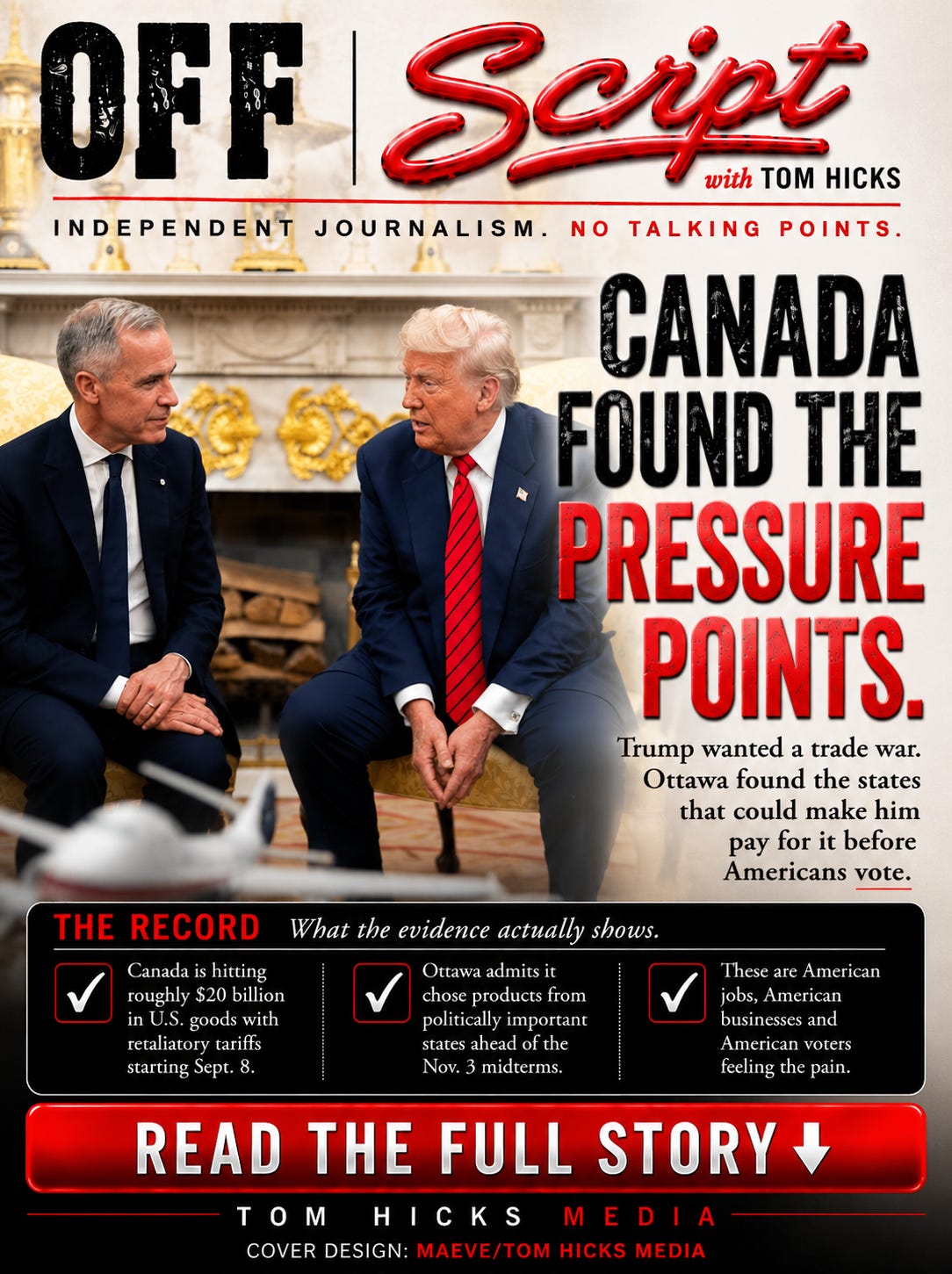
Donald Trump spent years selling tariffs as the economic equivalent of a magic trick. Put a tax on foreign goods, foreigners supposedly pay it, American factories roar back to life, and the Treasury fills up without anybody at home getting a bill. The trouble with magic tricks is that they become a lot less impressive once somebody explains where the rabbit was hiding.
Canada appears to have found the rabbit.
On Tuesday, the Canadian government announced retaliatory tariffs covering about $20 billion in annual U.S. imports, matching Trump’s newest tariffs on Canadian goods dollar for dollar. The Canadian duties will range from 15% to 50%, cover roughly 700 American products, and begin September 8. Steel, aluminum, furniture, clothing, cheese, appliances, seafood, electronics, tools, machinery, paper products, and plenty more are headed into the crossfire. (reuters.com)
That alone would be a major economic story. Then Canadian Industry Minister Mélanie Joly said the quiet part out loud.
Canada chose some of those products specifically because of where in the United States they are made. Joly said Ottawa was being “wise and strategic” by selecting goods that would put political pressure on particular states before Americans vote in the November 3 midterm elections. That changes the story from ordinary tariff retaliation into something considerably more interesting. (reuters.com)
Canada isn’t merely shooting back.
It is aiming.
INDEPENDENT JOURNALISM • NO TALKING POINTS
Your subscription helps fund reporting, research, publishing, new features, and the continued growth of every Tom Hicks Media publication.
THEY KNOW WHERE THE VOTES ARE
Maine has lobsters, blueberries and lumber moving through a deeply integrated Canadian market. Michigan sends roughly a third of its exports north of the border. Ohio, Alaska and Iowa also have important industries tied to Canadian trade, and several happen to be home to Senate races that could help decide who controls Congress next year. (apnews.com)
Republican Sen. Susan Collins isn’t pretending the danger is theoretical. “Imposing new tariffs on Canada is a mistake,” she said Monday while campaigning in Maine, warning that businesses and consumers in her state could pay for the confrontation. Collins is one of the Republican incumbents Democrats would dearly love to knock off in November. (apnews.com)
That’s the part Trump apparently forgot when he decided to turn one of America’s largest trading relationships into another loyalty test. You can declare that Canada is getting what it deserves, but a lobster boat in Maine doesn’t become economically invincible because somebody typed AMERICA FIRST in capital letters. Eventually somebody has to sell the damn lobster.
And Canada knows exactly which somebody.
TRUMP’S VERSION OF THE STORY
The White House says the 50% U.S. tariffs are justified by Canada’s treatment of American products. Its July 20 fact sheet accused Canada of discriminating against U.S. commerce, cited restrictions involving American vehicles and alcoholic beverages, and said the new tariffs would “level the playing field” for American exporters. Unlike many earlier tariff actions, these duties also apply to covered products that otherwise qualify under the U.S.-Mexico-Canada Agreement. (whitehouse.gov)
That’s the administration’s argument, and it deserves to be stated accurately. Countries absolutely fight over tariffs, quotas, subsidies, and market access, and Canada is hardly some innocent woodland creature that wandered into Washington carrying maple syrup. There are legitimate trade disputes between the two countries.
What Trump keeps skipping is the second half of the equation.
A tariff is a tax collected when goods enter the country. U.S. Customs and Border Protection administers those duties on imports, which means the cost enters the American side of the transaction before Canada ever sees a cash register. Businesses can absorb that cost, negotiate it away, change suppliers, cut somewhere else or pass some of it along to customers, but there is no little Canadian government booth at the border writing Donald Trump a check. (help.cbp.gov)
Then comes retaliation.
American companies suddenly discover that their products cost more in Canada. Canadian buyers look for alternatives. Farmers, manufacturers and exporters who had nothing to do with the original dispute get drafted into somebody else’s economic war.
Now Ottawa has added another twist: it is choosing some of those American casualties with November in mind.
THE BEAUTIFUL TRADE WAR MEETS POLITICS
Trump’s latest tariffs affect roughly 5% of Canadian exports to the United States, so this is not an economic blockade. The damage is concentrated instead, which may make it politically more potent because individual industries can get hammered while the national numbers still look manageable. Reuters reported that wood-product businesses, including kitchen-cabinet makers, are among those particularly exposed on the Canadian side. (reuters.com)
Canada is preparing for pain too. Ottawa announced a C$7.5 billion support package for affected businesses and workers, including interest-free loans for some companies. That tells you nobody involved believes tariffs are some painless machine that prints prosperity. (reuters.com)
And yet the American political sales pitch keeps coming back to the same idea: tariffs make the other guy pay.
If that were really how this worked, Canada wouldn’t bother targeting Maine.
It wouldn’t care about Michigan.
And Mélanie Joly wouldn’t be openly talking about putting political pressure on American states before the midterms.
You don’t aim at somebody’s voters unless you think those voters might feel something.
THEN TRUMP THREATENED THE CARS
Trump isn’t backing away. He has threatened to raise tariffs on Canadian automobiles, auto parts and steel to 50% in 2027, declaring on social media that “WE DON’T NEED CANADA, THEY NEED US!” Meanwhile, U.S. Trade Representative Jamieson Greer has said the administration does not expect a huge impact from the current dispute. (apnews.com)
Those two messages don’t sit comfortably together. Either Canada is economically unimportant enough that America won’t notice the fight, or Canadian trade is dangerous enough to require another round of 50% tariffs. Trying to argue both is how you wind up punching yourself in the face while announcing that the other guy looks terrible.
The auto threat is particularly reckless because the North American automobile industry isn’t neatly divided by a border. Parts and components can cross between the United States and Canada during production, and the economies have spent decades building supply chains around that integration. A tariff doesn’t consult a campaign speech before it lands on an invoice.
This is where the entire tariff fantasy finally runs into arithmetic.
CANADA’S REAL WEAPON
Canada’s most effective response may turn out not to be the tariff rate itself. It may be the decision to translate a giant international trade dispute into hundreds of smaller local stories.
A Maine fisherman doesn’t have to understand Section 338 of the Tariff Act of 1930. He only has to know that one of his best markets suddenly became harder to sell into. An Ohio manufacturer doesn’t need to study the finer points of trade negotiations if orders soften and somebody starts asking whether overtime is still available.
That’s how national policy becomes local politics.
Trump has built much of his economic appeal around the idea that he is willing to do things other presidents were too timid to do. Sometimes disruption is necessary. But disruption isn’t a policy by itself, and causing economic pain becomes a much tougher sell when another government figures out exactly which congressional districts should receive it.
Canada figured it out.
Donald Trump wanted a trade war.
Canada brought an electoral map.
THE RECORD
July 20: The White House announced additional 50% tariffs on certain Canadian goods under Section 338 of the Tariff Act of 1930, including some products that qualify under USMCA. (whitehouse.gov)
August 22: The latest U.S. tariffs took effect after negotiations between Washington and Ottawa collapsed. They cover roughly $20 billion in Canadian imports. (reuters.com)
August 25: Canada announced dollar-for-dollar retaliation on about $20 billion in U.S. goods, with rates of 15%, 25% and 50% across roughly 700 products. (reuters.com)
September 8: Canada’s counter-tariffs are scheduled to take effect. (reuters.com)
November 3: Americans vote in the midterm elections, and Canadian officials have acknowledged that their tariff strategy is partly designed to apply political pressure in targeted U.S. states before that vote. (reuters.com)
THE BULLSHIT DETECTOR
1. TIPPED WORKERS ARE SAVING $10,000 BECAUSE OF “NO TAX ON TIPS”
Bullshit: Nevada tipped workers are saving an average of $10,000 on their taxes because of Trump’s “no tax on tips” policy, while Georgia workers are saving more than $7,000.
Why: There is no federal data supporting those figures, and Trump appears to be confusing the size of a tax deduction with the amount of taxes actually saved. A $10,000 deduction for someone in the 12% bracket would save about $1,200 in federal income tax, not $10,000, and payroll taxes on tips still apply. The policy may save some workers money, but the numbers Trump is selling bear very little resemblance to what the tax code actually does. (factcheck.org)
2. SHERROD BROWN’S IMMIGRATION VOTES LED TO A DEADLY OHIO CRASH
Bullshit: Former Ohio Sen. Sherrod Brown’s immigration votes helped create the circumstances that led to an April interstate crash in which an immigrant was charged with vehicular homicide.
Why: There is no evidence connecting Brown’s votes to the suspect or showing that anything Brown did enabled the crash. The ad takes a real tragedy and manufactures a political chain of responsibility that the available evidence does not support. Immigration policy is fair game in a Senate campaign. Turning a fatal crash into campaign ammunition by inventing causation is bullshit. (factcheck.org)
3. POLITICS HAD NOTHING TO DO WITH THE ENERGY GRANT CANCELLATIONS
Bullshit: Politics played no role in the Energy Department’s cancellation of more than 280 federal energy grants.
Why: The department’s own lawyers acknowledged that the awards were selected for cancellation because the recipients were located in Democratic-voting states. You can argue all day about whether those grants should have existed in the first place. What you cannot honestly argue is that politics had nothing to do with which ones were killed when the government’s own filing says otherwise. (factcheck.org)
AROUND TOM HICKS MEDIA
Tom’s Number Ones
Every morning starts somewhere on the charts. Tom’s Number Ones goes back to another year, checks what was actually sitting at No. 1, and lets the music handle the time travel.
Lotus Purrspective
Lotus continues documenting the strange habits of humans from the safest possible location: somewhere above us, judging quietly. New observations from the cat arrive daily.
Panic Room Sports
Football season is getting close enough that every practice report is becoming either a prophecy or a nervous breakdown. Panic Room Sports sorts through the NFL and fantasy noise before anybody trades away half the roster because somebody limped once.
Rabbit Ears TV
Rabbit Ears TV returns Thursday with another trip into classic television, the people who made it, and the stories hiding behind shows we thought we already knew.
The Backlot Ghost
A new Backlot Ghost arrives today. Classic Hollywood always looks glamorous from the front of the theater. We prefer checking what was left behind after everybody went home.
Blind Spot
Sunday’s Blind Spot goes deeper into the story the daily news cycle was too busy, too distracted, or too comfortable to finish. It’s part of Off Script with Tom Hicks, built for the stories that need more than a headline and six minutes of outrage.
BUY ME A CUP OF TEA
Off Script doesn’t have a corporate parent, billionaire owner, or committee deciding which questions are impolite. If you appreciate independent reporting that checks the numbers before throwing the punch, you can help keep it going by buying me a cup of tea.
ONE QUESTION BEFORE YOU GO
Canada is deliberately targeting products from politically important U.S. states to make Trump’s trade war hurt before the midterms. Smart retaliation, dirty politics, or exactly what Trump should have expected?
Every day brings another headline, another outrage, and another flood of opinions. My goal isn’t to tell you what to think. It’s to give you the facts, the context, and the questions that too often get lost in the noise. If that kind of independent journalism matters to you, a paid subscription helps me spend less time chasing clicks and more time chasing stories. It also helps me continue building Tom Hicks Media into something readers can count on every day.
#OffScript #TomHicksMedia #Trump #Canada #Tariffs #TradeWar #Midterms2026 #USPolitics #IndependentJournalism #BullshitDetector
Carney is a genius. He already set up Canada to do less trade with USA. He set up more trade with EU. Still wishing it was feasible to move to Canada.