
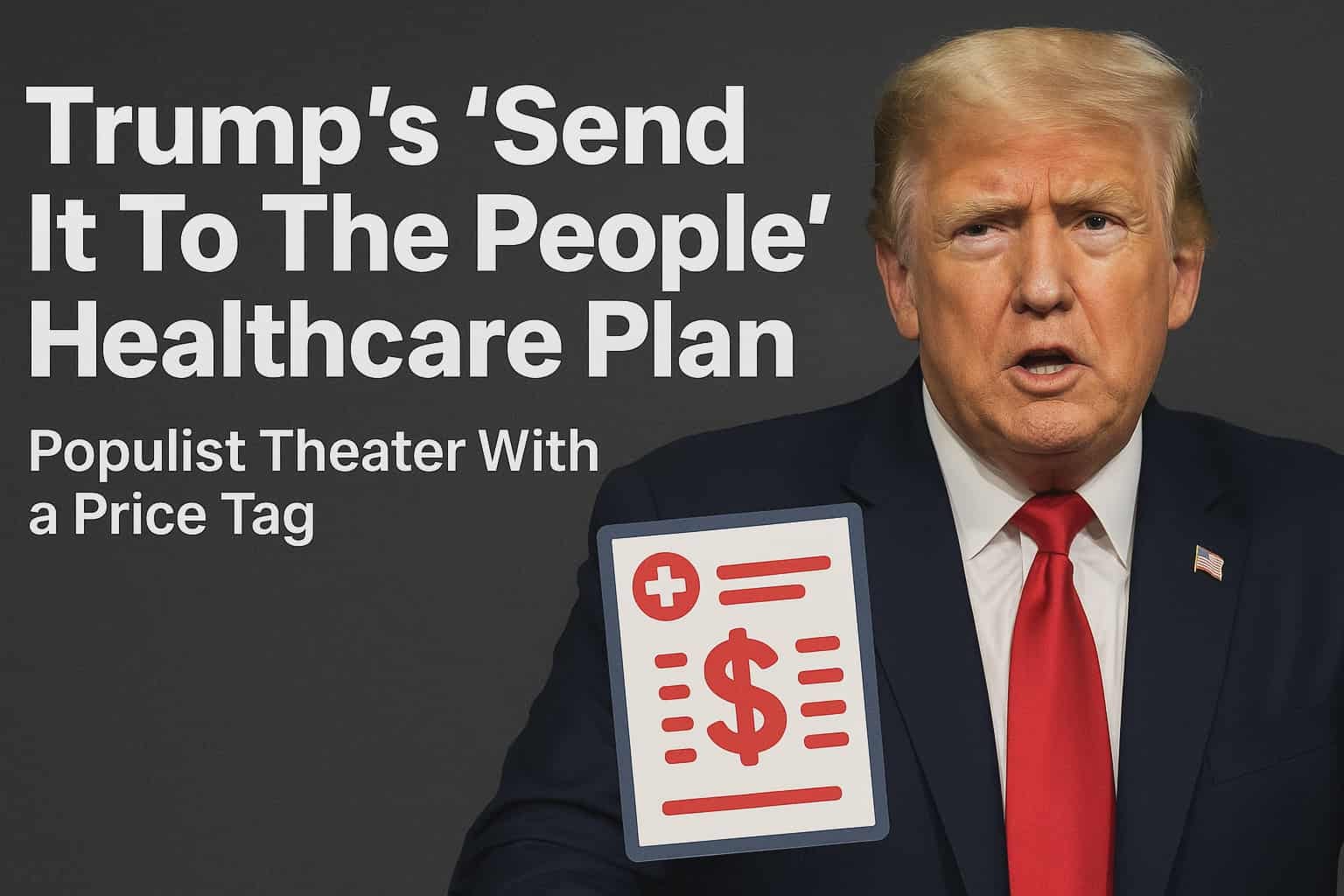
“I am recommending to Senate Republicans that the Hundreds of Billions of Dollars currently being sent to money sucking Insurance Companies... BE SENT DIRECTLY TO THE PEOPLE SO THAT THEY CAN PURCHASE THEIR OWN, MUCH BETTER, HEALTHCARE.”
— Donald J. Trump
Let’s sit down, grab a metaphorical beer (or a literal Xanax), and unpack this policy-shaped confetti bomb. Because what Trump just pitched isn’t so much a healthcare plan as it is a mood — specifically, the mood of a guy who found a calculator, a megaphone, and a grudge against ObamaCare all in the same drawer.
He’s saying: Insurance companies bad. Give money to people. ObamaCare worse. Also, kill the filibuster.
Simple, right? Too simple. Which means we’re about to peel this thing like an onion—layer by layer—until the tears are coming from the absurdity, not the fumes.
1. The Show, Not the Script
This post plays like a greatest hits medley of Trumpian populism:
Villain? “Money-sucking insurance companies.”
Hero? “The people.”
Solution? “Send them the money directly.”
Bonus track: “Terminate the Filibuster!” (which, apparently, is unrelated, just like my cat’s hairballs are unrelated to dinner but still ruin it).
💣 Truth Bomb #1: Populists love enemies they can name and promises they don’t have to explain. “Insurance companies bad” is a chant, not a policy.
“Make it sound simple, make it sound noble, and never, ever include math.”
— Every populist playbook ever written
2. The Emotional Hook
You can’t deny the psychological genius. Who doesn’t want to hear “you’ll get the money instead of them”?
It’s like Robin Hood, if Robin Hood kept the loot and live-tweeted about how generous he was being.
Trump’s post weaponizes simplicity. It makes you feel like healthcare could be easy if only those pesky middlemen vanished.
And who wants to be the person defending the “money-sucking” crowd? Nobody. It’s rhetorical blackmail.
💣 Truth Bomb #2: The less detail a proposal has, the more people nod along. It’s not persuasion — it’s hypnosis by exclamation point.
“When policy gets complicated, just yell louder.”
— Campaign strategy in a nutshell
3. The Reality Check (Welcome to Econ 101, Kids)
Currently, federal money flows to insurers through subsidies, Medicaid, Medicare, and risk adjustments. That system—messy as it is—pays for real people’s care. If you rip it out and say, “send it directly to the people,” you’ve just replaced a network with a bucket of cash and a wish.
Now what?
You think hospitals and drug companies are suddenly going to lower their prices because you got a check with your name on it? Please. These are the same people charging $30,000 for a two-day hospital stay and $14 for a single Tylenol.
💣 Truth Bomb #3: Giving people money to buy healthcare doesn’t fix the price of healthcare. It just gives them a front-row seat to how expensive it really is.
“The market will fix it!”
— Someone who’s never had a $4,000 ER bill for an inhaler
4. What Happens If You Actually Do This
Let’s say the plan goes through. People get money. Some buy insurance. Some don’t. Healthy people pocket it. Sick people scramble. Insurers get spooked because the pool just turned into a hot tub full of high-risk customers.
Premiums skyrocket. Markets implode. And in about 18 months, the same people cheering this “direct to the people” plan are back in ER waiting rooms asking, “Why doesn’t anyone cover me anymore?”
💣 Truth Bomb #4: Health insurance only works when everyone’s in. Cash giveaways don’t make systems stronger—they make actuaries cry.
“If everyone gets to decide when to buy insurance, no one can afford it when they actually need it.”
— Every actuary, quietly sobbing into spreadsheets
5. The Unrelated Filibuster Thing
Ah, yes, the “Unrelated, we must still terminate the Filibuster!” closer.
That’s like ending a recipe for lasagna with “Unrelated, we must also invade Canada.”
It’s not unrelated. It’s the whole point. Because without the filibuster, Trump and Senate Republicans could steamroll actual legislation through without compromise. So, the filibuster line isn’t a tangent. It’s the tell.
💣 Truth Bomb #5: Every time someone says “unrelated” in politics, it’s code for “I know this sounds sinister, but please don’t think about it too hard.”
“The rules are unfair… unless I’m the one breaking them.”
— The Autocrat’s Handbook, Chapter 1
6. Who Wins and Who Gets Screwed
Let’s be real:
Voters get a short-term sugar high: “The government’s giving me money!”
Insurance companies pretend to panic while quietly lobbying for carve-outs to protect their profits.
Hospitals and pharma keep prices high and laugh all the way to their next yacht conference.
Politicians get headlines and soundbites without doing any of the boring math.
It’s a brilliant scam: everyone gets to look like they care about the little guy while nothing changes except who’s holding the flaming bag of cash.
“When everyone’s pretending to fight corruption, corruption wins.”
— Old Washington proverb
7. The Underlying Con
This isn’t about healthcare. It’s about optics. About looking like you’re fighting corruption without touching the machinery that makes corruption profitable.
Trump’s message sounds anti-corporate, but it’s built on the same corporate-friendly logic: deregulate, decentralize, and privatize. In this case, “give people the money” really means “remove the guardrails.”
💣 Truth Bomb #6: Every time a politician says “let the people decide,” what they often mean is “let corporations charge whatever they want.”
“Freedom without oversight is just exploitation with better branding.”
— Modern Civics 101
8. The “Better Care” Mirage
“Much better healthcare,” Trump promises.
Define “better.” More choice? Lower cost? Fewer middlemen? Shorter wait times?
None of that happens magically. Better care requires investment, regulation, and boring infrastructure. That’s the stuff populists avoid because it doesn’t fit in a post.
This is a plan with all the detail of a wish scribbled on a cocktail napkin.
9. Why This Works (And Keeps Working)
Because it feels right. It tells a simple story with clear heroes and villains, and that’s emotional rocket fuel.
But policy isn’t a fairy tale. It’s plumbing. And Trump’s plan is basically: “Let’s blow up the pipes and hope the water finds its way back to your house.”
💣 Truth Bomb #7: Emotion wins elections. Math governs consequences. Ignore either, and you’re living in a country that tweets its own medical bankruptcy.
“Feelings are faster than facts.”
— Cognitive Science, and also every political strategist ever
10. The Bottom Line
Trump’s healthcare “proposal” isn’t a proposal. It’s a vibe check to see how far populist slogans can float before gravity reasserts itself.
It’s not evil in intent — it’s worse. It’s lazy.
Because if you really cared about fixing healthcare, you’d show the receipts. You’d talk about cost drivers, drug negotiations, hospital monopolies, and provider reform. Not emojis and adjectives.
So no, this isn’t the dawn of a new healthcare revolution.
It’s just another episode of “Make Healthcare Great Again: The Musical,” starring the same cast, still improvising, still selling tickets.
Call to Action
If you’re tired of slogans, demand schematics.
Ask your representatives how, not just what.
And when they start waving their hands like magicians pulling rabbits out of deficits, don’t applaud — ask for the math.
We can’t fix what we won’t quantify.
And we can’t afford another round of policy cosplay when people are literally dying from “market freedom.”
💣 Final Truth Bomb: Slogans don’t save lives. Systems do.
☕ Buy Me A Coffee
Because caffeine fuels resistance — and someone has to keep the receipts.
#TheUnredactedBastard #Trump #Healthcare #Populism #TheInsurgency #Politics #Accountability #TruthBombs #PolicyTheater #FactOverFiction #CivicEngagement