

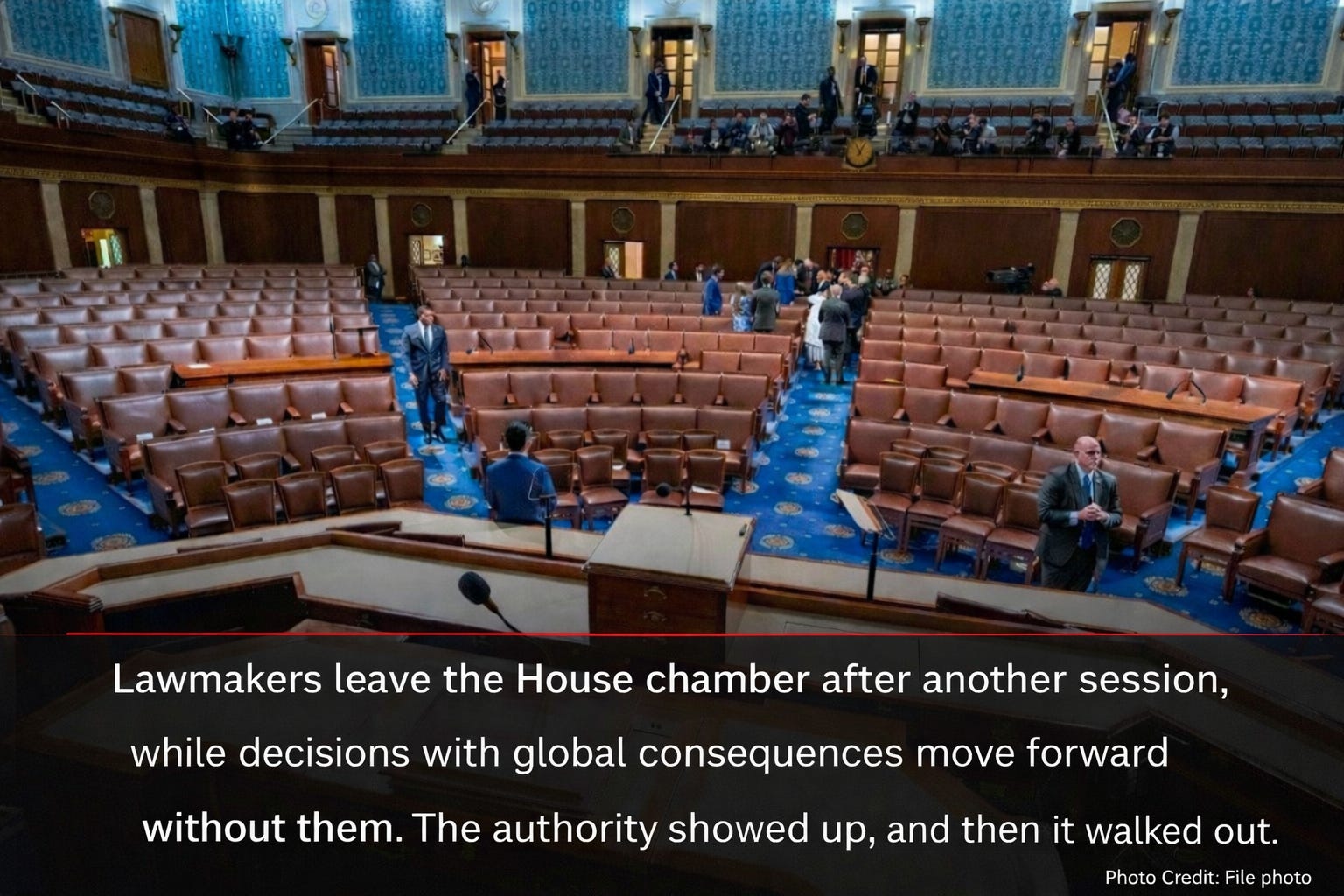
By Tom Hicks – The Unredacted Bastard | Independent Journalist • Democracy’s Fire Alarm • Professional Shit-Stirrer
Bastard’s Law
When power stops asking for permission, it doesn’t give it back.
There’s a version of this story that sounds responsible. You’ve heard it before. It leans on phrases like evolving threats, modern warfare, and flexibility, and it delivers all of it in that calm, measured tone that’s supposed to make you feel like adults are in charge.
That version is bullshit.
What’s actually happening is messier and a hell of a lot more dangerous. We don’t really decide to go to war anymore. We slide into it. One strike turns into a response. The response turns into a presence. The presence turns into a policy. And at no point does anyone have to stop, turn to the country, and say: this is war, this is why, and this is who’s accountable.
Instead, it just happens. And then we’re in it.
The Constitution didn’t leave this vague. Congress declares war. The President carries it out. That wasn’t some abstract theory the founders tossed in to sound smart. It was a guardrail built by people who had just finished dealing with a king and decided maybe giving one person that kind of authority was a terrible fucking idea. They knew exactly how fast things could spiral once one person acted first and explained later.
“The Constitution supposes, what the history of all governments demonstrates, that the executive is the branch of power most interested in war, and most prone to it.” — James Madison
That’s not poetry. That’s a warning. And we’ve been ignoring it long enough that it barely sounds urgent anymore.
The Machine Didn’t Break. It Got Better.
This is where people get it twisted. This isn’t about one president going too far, or one party bending the rules while the other performs outrage. That version is comforting because it suggests that an election will fix it.
It won’t.
This is a system that figured out it could move faster if nobody insisted on using the brakes, and then adjusted itself until that became the norm. Congress writes authorizations vague enough to stretch. Presidents stretch them. Courts mostly stay out. The public gets updates that sound serious without ever getting a real say.
That’s not dysfunction. That’s a machine running exactly the way it learned to.
We haven’t formally declared war since World War II. Korea. Vietnam. Iraq. Afghanistan. A long list of operations labeled in whatever way makes them sound smaller or more temporary than they turned out to be.
The names change. The pattern doesn’t.
If you’re not subscribed yet, you’re reading this the hard way.
The Damage
Strip away the language, and what you’re left with is a system where the biggest decisions happen in the smallest rooms, made by the fewest people, on the shortest timelines, and none of that is an accident.
What used to require a national debate now gets handled by a handful of people in hours. Congress doesn’t authorize anymore. It reacts. After the fact, with a statement strong enough to screenshot and weak enough to mean absolutely nothing. The public doesn’t participate. It gets briefed, maybe, if someone decides it’s owed that much.
And then we all nod along like that’s oversight.
It isn’t. It’s a fucking pantomime. The political version of looking busy while the outcome is already locked in. Everyone gets their lines, hits their marks, and the cameras catch just enough to make it look like a process happened.
Over time, that pantomime does something worse than just covering bad decisions. It rewires how people think about war. It stops feeling like a choice and starts feeling like weather. Something that happens to you. Something you check in the morning and adjust your plans around.
You don’t vote on the weather.
You just get wet.
Every time someone raises this, the same lines come back like they’ve been sitting in a queue.
Congress is too slow. The world moves too fast. This isn’t technically war.
That last one is doing all the goddamn work. Because if you never call it war, you never trip the wire that’s supposed to slow things down and force a real debate. You can strike, escalate, deploy, expand, and still stand there with a straight face, arguing nothing crossed the threshold that would require actual authorization.
It’s not semantics. It’s the operational core of how this whole shit stays running.
And nobody’s keeping it in place by accident. Presidents get speed and flexibility, which sounds great right up until you notice that speed has completely replaced accountability as the thing everyone’s optimizing for. Lawmakers get to skip the hard votes, which means they get to be outraged about outcomes they never had to own. Everybody’s hands stay just clean enough.
When it goes sideways, and it goes sideways, there’s no single throat to grab. That’s not a bug. That’s the whole fucking point.
Meanwhile, when conflict becomes the standing environment instead of the exception, the machinery built around it stops even gesturing toward peace. It assumes the next one is already loading. Budgets reflect that. Posture reflects that. Policy reflects that.
The public pays for all of it. Sometimes in dollars. Sometimes in other ways. Rarely in headlines.
The Part Nobody Announces
This doesn’t stay contained to war powers, and anybody who tells you it does is either naive or hoping you are.
Once a system demonstrates it can skip explicit approval on something this large, it has its answer for everything smaller. No announcement. No press conference. Just a quiet institutional understanding settling in like sediment: if it works here, why the hell wouldn’t it work somewhere else?
Power doesn’t expand on a schedule. It expands wherever it finds room, and it brings the same three justifications every single time. Urgency. Efficiency. We’ve got this, trust us.
War is the easiest place to run that play because fear shuts people up, and speed makes objections look reckless. Once that trade gets normalized, once the country accepts that some decisions are just too important and too fast for the actual decision-making process, it doesn’t get walked back.
It becomes the baseline. And the next thing gets measured from there.
The problem isn’t that we keep going to war. It’s that we no longer have to decide to.
Verdict
This didn’t happen in one moment, which is exactly why it’s so hard to point at and exactly why it keeps going.
Nobody stood up and declared we’re done asking permission. It crept through precedent and convenience and a thousand individual decisions to let the next step slide because it didn’t feel big enough to die on. Until the thing that needed fighting over was the entire architecture, and the architecture had already figured out how to run without anyone’s sign-off.
No clear start. No real authorization. No single point where accountability has to land, which means it lands nowhere, which means nobody’s especially motivated to fix it.
You want to know what a guardrail looks like after it’s been treated like a suggestion long enough?
You’re looking at it.
Nobody broke this. They just kept using it, and using it, and using it, until using it was the only thing anyone remembered how to do.
💣 TRUTH BOMB You don’t lose control of war powers in one moment. You lose it the first time nobody has to ask, and everyone decides that’s fine.
Upgrade to Paid I’m retired and reader-funded, which means this stays independent because people like you decide it matters. Paid subscribers get deeper dives, War Room briefings, and priority access when things start moving fast. Upgrade and keep this going.
Lotus Purrspective: If you want the same chaos explained with sharper claws and zero tolerance for human nonsense, head over to Lotus Purrspective. Even Lotus knows when something smells off, and right now the whole damn system reeks.
Like, Share, Subscribe If this hit, don’t just nod along. Share it. That’s how this grows.
☕ Buy Me A Coffee Because yelling “what the fuck are we doing?” at the news doesn’t pay for itself.
#WarPowers #Democracy #ExecutivePower #Congress #ForeignPolicy