



The moment an empire starts protecting the appearance of strength harder than strength itself, reality eventually kicks the fucking door in.
Opening Statement
For decades, the Pentagon sold Americans a fantasy so effectively that most people stopped recognizing it as propaganda.
Not military superiority. The United States absolutely possessed overwhelming military dominance for most of the post-Cold War era. The fantasy was invulnerability. Americans were conditioned to believe the U.S. military existed on a higher plane where wars happened somewhere else, casualties happened somewhere else, and consequences belonged to poorer countries unfortunate enough to stand in America’s path.
Hollywood fed that mythology constantly. Cable news polished it until it gleamed. Politicians wrapped themselves in it every election cycle like toddlers stomping around in daddy’s combat boots pretending they personally invaded Fallujah. The public absorbed all of it because people desperately want to believe somebody competent is still driving this flaming clown bus through history.
Then satellites showed up and ruined the fucking magic trick.
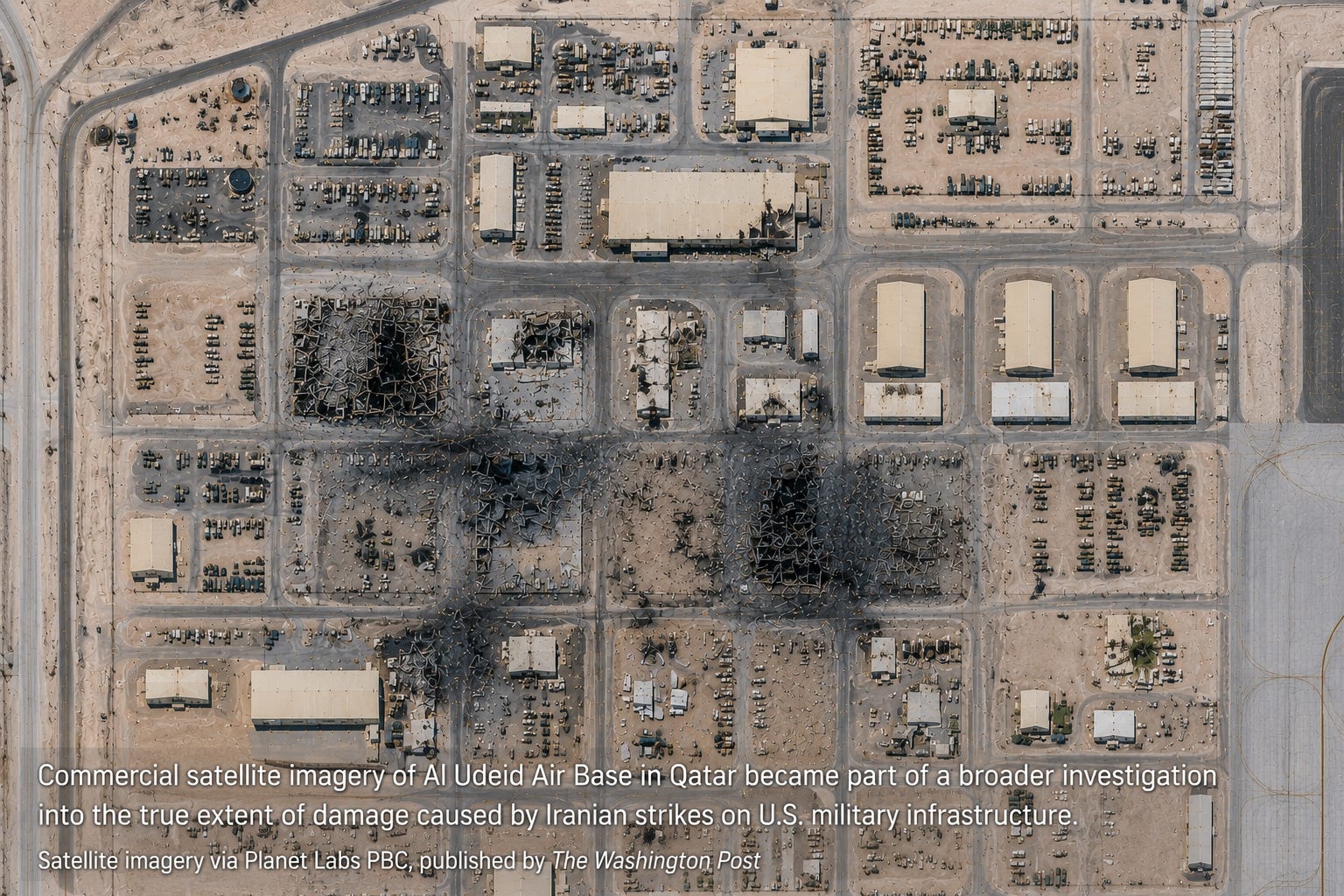
According to a Washington Post investigation using commercial satellite imagery and open-source intelligence analysis, Iranian missile strikes appear to have caused significantly more damage to American military infrastructure than early public messaging suggested. Analysts reportedly identified visible damage to operational buildings, radar-related systems, equipment areas, support structures, and other infrastructure spread across multiple U.S. facilities in the region.
Not rumors. Not anonymous whispers from “sources familiar with the matter.” Visible strike damage photographed from orbit by technology available to civilians with enough money and a dangerously fast internet connection.
That changes the story immediately, because once independently verifiable evidence starts circulating publicly, this stops being a story about Iran launching missiles. It becomes a story about whether governments can still control the public understanding of warfare at all.
That is a much bigger fucking problem.
Exhibit A: The Old Information Model Just Died
The Pentagon still communicates like it’s operating in the twentieth century. Government officials issue statements. Legacy media repeats them. The public absorbs the approved version of events. Maybe months later, a few inconvenient details leak out, but by then the emotional narrative has already hardened into public memory, and nobody’s going back to correct the record.
That system worked for generations because governments controlled access to information. Battlefield imagery was limited. Satellite reconnaissance was almost exclusively the domain of nation-states. Verification moved slowly enough that officials could usually shape public perception before contradictory evidence surfaced.
That era is dead as disco.
Now the battlefield is permanently visible from space. Commercial satellite companies photograph military infrastructure constantly. Open-source intelligence communities dissect strike locations in real time. Independent analysts compare before-and-after images before government spokespeople even finish rehearsing their carefully sanitized talking points. The information ecosystem evolved faster than governments psychologically adapted to it, and that’s the real crisis underneath this story. Not the missiles. The gap.
Because modern governments can still lie. They can still spin, strategically omit details, massage language, and manipulate timelines. What they increasingly cannot do is monopolize observable reality once thousands of independent observers gain simultaneous access to the evidence.
And Washington still looks wildly unprepared for that shift.
Exhibit B: America’s Addiction to Invincibility
Americans developed a deeply unhealthy emotional attachment to military mythology after the Cold War. Not military respect. Military mythology.
The United States spent decades fighting opponents who often lacked the ability to meaningfully strike back against American power projection. The public watched cruise missile footage on television like it was a fireworks show sponsored by Raytheon. War became psychologically abstract because the violence appeared distant, controlled, and overwhelmingly one-directional. That perception shaped an entire generation’s understanding of military power until the U.S. military wasn’t merely viewed as dominant. It was viewed as untouchable.
But warfare evolved while public imagination stayed frozen in the late 1990s.
Cheap drones changed warfare dramatically. Precision missiles spread far beyond traditional superpowers. Commercial satellites made military infrastructure permanently visible. Open-source intelligence networks transformed civilians into real-time battlefield analysts. Artificial intelligence is now accelerating targeting and reconnaissance, while Congress still behaves like attaching a PDF to an email requires divine intervention and a support hotline.
Meanwhile, America’s giant overseas military installations increasingly resemble extremely expensive fixed targets operating under constant observation. Those bases were designed around assumptions from an earlier era: slower intelligence gathering, limited public visibility, centralized information control, delayed battlefield verification, and weaker precision strike capability. Many of those assumptions are collapsing simultaneously, and neither Washington nor the American public seems emotionally prepared for what that means.
Upgrade Before the Paywall Hits
If you’re not subscribed yet, you’re reading this the hard way.
The rest of this War Room briefing goes much deeper into:
Why China and Russia are obsessively studying these strikes, how open-source intelligence permanently changed warfare, why fixed overseas bases may become the “battleships” of the drone age, how AI-assisted targeting could fundamentally reshape deterrence, why governments increasingly sound like investor-relations departments after military setbacks, and the terrifying strategic consequence nobody in Washington wants to publicly discuss yet.
Upgrade — Don’t Confuse Access With Understanding
You’ve got access to the story.
You don’t yet have the full picture.
The deeper cuts, the War Room pieces, the pattern recognition—that’s where this actually clicks into place.
Upgrade if you want to stop reading events and start understanding them.
