
EDITORIAL NOTE
Off Script is independent journalism and commentary built on verified reporting, public records, and plain English. The facts are sourced. The opinions are mine. Nobody signs off on this before you see it, and nobody’s going to.
For nine years, Rubi Lama’s job was keeping other people alive.
She counseled members of Nepal’s LGBTQ+ community about HIV. She helped sex workers get tested, handed out condoms, connected people with medical care, and went into the places everybody else had already written off because that’s where the work was.
Then the United States pulled the money.
Now Lama’s back on the same stretch of highway in central Nepal, where transgender women wait after dark for cars to slow down. Except this time she’s not carrying condoms or offering an HIV test.
She’s hoping somebody will pay her for sex.
Read that again, because the obscenity of it gets lost if you move too fast.
A woman who spent nine years trying to prevent HIV is now standing in exactly the kind of situation she once helped other people survive because the job that let her do that work disappeared.
If a novelist wrote that, you’d tell them to knock it off. Too obvious. Too cruel. Too perfectly fucking bleak.
It’s not fiction.
It’s a policy decision made by people who’ll never see this highway, never meet Lama, and never have to sit with what happens after a customer drives away.
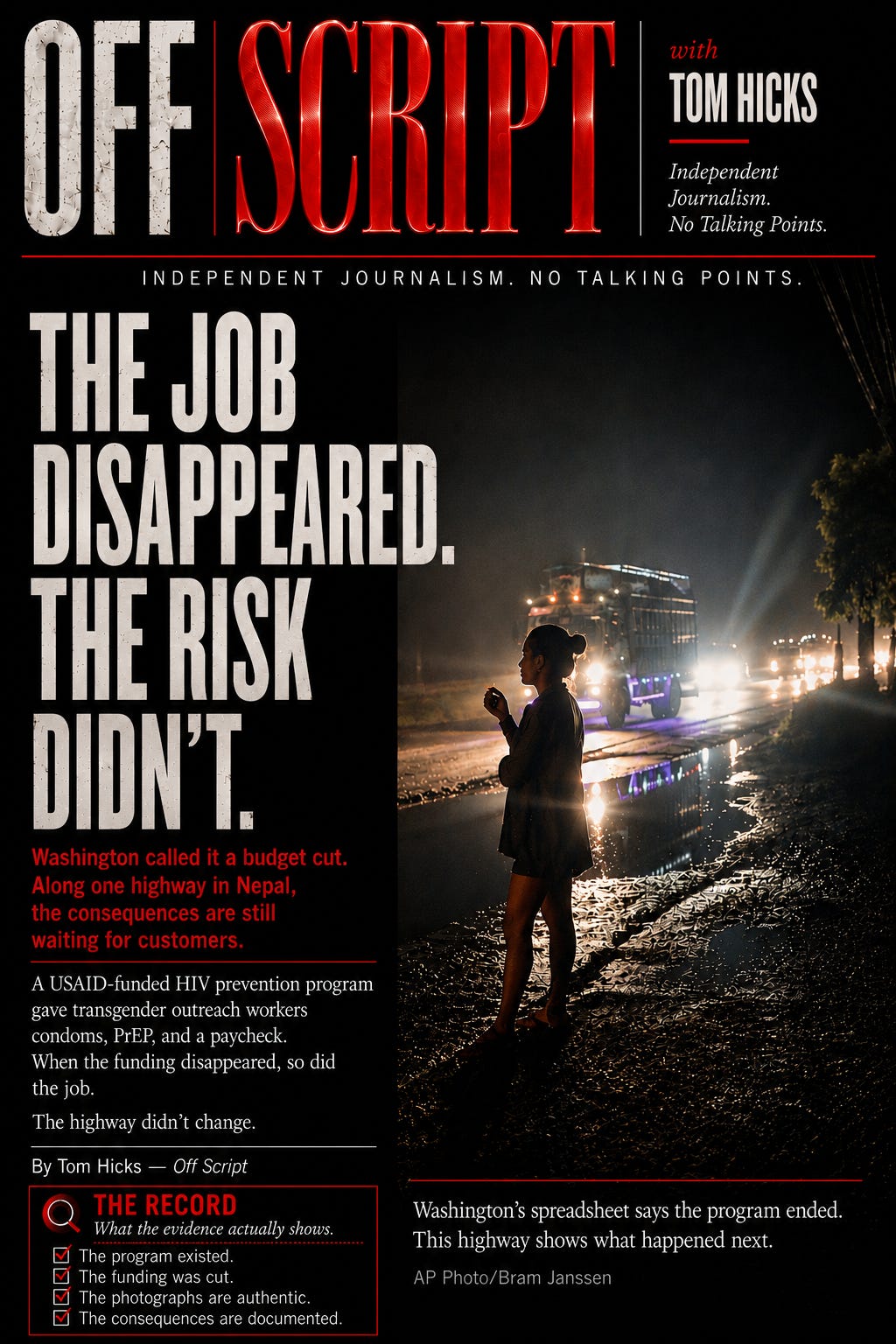
After the Trump administration gutted USAID and slashed foreign assistance in 2025, more than 280,000 aid workers worldwide lost their jobs. About 35,000 of those jobs disappeared in Nepal. The country’s leading LGBTQ+ organization says roughly 100 former workers have since entered sex work because they had nowhere else to turn. (Associated Press)
These weren’t pampered bureaucrats collecting fat checks in climate-controlled offices. They were local workers earning modest salaries to do the least glamorous jobs in public health: finding people society preferred not to see, persuading them to get tested, delivering medication, handing out condoms, and trying to make one dangerous night a little less dangerous.
Then somebody in Washington decided that work was a waste.
So the people doing it became disposable.
Join me every morning for independent journalism with no talking points.
The Highway After Dark
Associated Press reporter Kristen Gelineau and photographer Bram Janssen followed former aid workers along the highway near Hetauda, where trucks slow down after dark and transgender sex workers negotiate with men who may be customers, attackers, or both. (Associated Press)
Some are earning two or three dollars per client.
That isn’t a meaningful career choice. It’s what survival looks like after hunger has kicked down every other door.
The workers described sexual assault, beatings, robbery, police harassment, and customers demanding sex without condoms. They now face the same dangers they once helped other people navigate, except the health network behind them has been ripped out too.
There’s an easy way to read this story: sad, distant, unfortunate. That version is neat. Comfortable. Almost antiseptic. It’s also bullshit.
These circumstances didn’t just happen. Weather didn’t do this. Bad luck didn’t do this.
The United States did this.
A government can end a program. It can decide another country should fund its own clinics. It can argue that foreign aid became bloated, badly managed, or disconnected from American interests. Some USAID programs undoubtedly deserved scrutiny.
What it can’t honestly do is kill funding overnight, destroy the local network delivering the services, fire the people who understood the communities, and then act like the consequences fell out of the sky.
That isn’t reform.
It’s demolition with paperwork.
You Can’t Audit a Hospital With a Bulldozer
USAID was easy to attack because most Americans knew it only as an acronym.
Four letters on a briefing slide.
An acronym doesn’t have a face. It doesn’t tell you it’s hungry. It doesn’t stand on a highway at midnight hoping the next car contains a customer instead of somebody who wants to hurt it.
The campaign against foreign aid depended on keeping everything abstract. Billions overseas. A grant with a ridiculous title. One example yanked out of context and waved around long enough to make the whole operation look like a scam.
Some of the outrage was deserved. Any organization spending billions across dozens of countries will have waste, failed projects, bad contractors, and administrative bullshit. That deserves an audit.
But an audit is supposed to tell you what works, what doesn’t, and what needs to change.
You don’t audit a hospital by bulldozing it while the patients are still inside.
You sure as hell don’t call that efficiency afterward.
The attack on USAID made little distinction between bloated consulting contracts and frontline HIV prevention. Programs froze before anyone figured out who depended on them or what would replace them. Waivers meant to protect lifesaving services often failed because the organizations involved had already lost staff, contracts, authority, or cash flow. (KFF)
Washington congratulated itself for the savings.
Nepal got stuck with the bodies.
A Public-Health System Lives in People
The workers who lost their jobs weren’t just names on a payroll.
They were the system.
They had relationships inside marginalized communities that took years to build. They knew who’d missed an appointment, who needed medication, who was being abused, and who was too frightened to be seen walking into a clinic.
That knowledge doesn’t live in a filing cabinet.
It lives in people.
Once those people are scattered, impoverished, or forced into survival work, some future administration can’t wander back in with a check and pretend it fixed everything. Trust has to be rebuilt. Workers have to be rehired. Patients who disappeared have to be found.
The infections that happened during the gap don’t unhappen because Washington changed its mind.
In Nepal, clinics serving vulnerable communities closed or sharply reduced services. More than 1,200 people reportedly lost access to PrEP, the medication used to prevent HIV infection. Condom distribution collapsed. Outreach workers who once promoted safer sex now face customers offering desperately needed money on the condition that no condom be used. (Associated Press)
The sequence is almost too sick to believe.
Eliminate the job that allowed someone to prevent HIV. Eliminate the medicine and condoms used to prevent HIV. Then push that same person into a situation where catching it becomes far more likely.
Somewhere in Washington, a spreadsheet records a savings.
That spreadsheet doesn’t show the woman standing beside the road.
Foreign Aid Was Never Just Charity
Foreign aid was usually sold as generosity, and that may have been the mistake.
Generosity sounds optional. It sounds like something nice people do until meaner people show up with a chainsaw and call themselves serious.
Public health abroad is also national defense.
Viruses don’t stop at customs. Drug-resistant infections don’t care which country funded the clinic. Nepal shares an open border with India and has a large migrant workforce moving between countries.
An outbreak doesn’t politely stay contained among the people Americans have decided are somebody else’s problem.
The United States understood this when George W. Bush created PEPFAR. The program became one of the most successful global-health efforts in history, supporting treatment for more than 20 million people and building testing, prevention, and disease-surveillance networks many countries couldn’t have created alone. (National Library of Medicine)
Those networks protected people overseas.
They protected Americans too.
Now the damage is showing up in the numbers. A study presented at the 2026 International AIDS Conference found that roughly 77,000 fewer children received U.S.-supported HIV treatment between October 2024 and October 2025 than during the previous year. Another assessment found more than 1,700 clinics or service sites had closed across 46 countries, with over 16,000 workers laid off. (Reuters)
Nepal isn’t some isolated nightmare tucked into one corner of Asia.
It’s a close-up.
The Moral Accounting
There’s a danger in writing about people “turning to sex work.”
Sex workers aren’t props in somebody else’s morality play, and sex work itself isn’t proof that a person has lost dignity. Adults choose it under all kinds of circumstances.
The issue here is desperation narrowing the available choices until the word barely means a damn thing.
When somebody accepts a stranger’s two dollars because the alternative is hunger, “choice” gets pretty thin. When discrimination has already shut most conventional employment to transgender workers, eliminating one of the few organizations willing to hire them does more than cancel a paycheck.
It closes an escape route.
These aid jobs provided income, but they also gave people standing. They were counselors, educators, and outreach specialists with knowledge their communities needed.
Several told the AP they wanted those jobs back. The pay was modest. What they missed was the purpose, the chance to help people, and the ability to imagine a future beyond the next meal. (Associated Press)
Washington took that from them without learning their names.
We know some of those names now: Rubi Lama. Princy Tamang. Barsha Magar. Bharati Thapa.
Say them.
Government policy loves passive language. Funding was reduced. Contracts were terminated. Programs were suspended.
Nobody in that language actually does anything to anybody. It all just happens, clean and bloodless, like a printer running out of paper.
Rubi Lama standing on that highway puts the subject and the verb back where they belong.
The United States cut the program.
She paid for it.
The Bullshit Detector
Claim: USAID was wasteful, so eliminating it saved taxpayers money.
Reading: MISLEADING.
USAID deserved scrutiny. That doesn’t mean every program was a waste, and it sure as hell doesn’t mean blowing up the structure overnight was financially smart. Cutting prevention now can create far higher costs later through outbreaks, emergency relief, instability, and the destruction of infrastructure Americans already paid to build.
Claim: Other countries should take care of their own people.
Reading: INCOMPLETE.
Local ownership is a reasonable long-term goal. Destroying a working system before a replacement exists doesn’t create independence. It creates a vacuum.
Claim: These cuts put America first.
Reading: UNPROVEN.
Weakening disease surveillance, destroying strategic relationships, and handing rival powers an opening may do the opposite. Slapping “America First” on a bad policy doesn’t magically make it patriotic.
The Off Script Bullshit Detector is free for subscribers and available for $4.95 from the Tom Hicks Media Store.
What We Chose Not to See
Americans are allowed to debate how much foreign aid this country should provide. We can demand receipts, measurable results, and an honest explanation of how the spending serves American interests.
What we can’t honestly do is pretend the money existed in a vacuum.
Every budget contains a moral decision buried inside the arithmetic. The people making it owe the public a straight answer about who will absorb the loss.
In Nepal, we’ve got that answer.
Former HIV counselors are standing on a highway where they once handed out condoms. Some are taking two or three dollars from men who may refuse to wear one. The clinics that supported them have closed. The medicine they promoted is harder to find. The community they protected is more exposed now, and so are they.
This didn’t happen because nobody understood what foreign aid accomplished.
It happened because knowing would’ve made the cuts harder to sell.
The administration wanted a triumph of efficiency. It wanted photographs of canceled contracts, shuttered offices, and officials grinning beside chainsaws.
It needed the public to see an agency being destroyed.
It needed the people underneath it to stay invisible.
The cameras got their spectacle.
Rubi Lama got the highway.
One Question Before You Go
When the government says it saved money by cutting a program, shouldn’t it also have to tell us exactly who’s expected to pay that cost instead?
More from Tom Hicks Media:
If you liked thinking this hard before 9 am, I’ve got more for you. Panic Room Sports brings the same “slow down and look at the evidence” approach to the NFL. Tom’s Number Ones is a daily trip through Billboard history — pure nostalgia, zero politics. And if you need a break from all of us humans overthinking things, Lotus Purrspective is a cat’s unbothered take on human behavior. All free to subscribe.
Support independent reporting and commentary that follows the consequences after the political show moves on.
Buy Me a Cup of Tea
Off Script has no corporate sponsor and no billionaire hovering nearby with “helpful” editorial suggestions. A cup of tea helps keep the reporting independent and the Bullshit Detector properly calibrated.
One Last Thing
A country shows you its priorities through the suffering it’s willing to call somebody else’s problem.
#USAID #Nepal #ForeignAid #HIV #PEPFAR #PublicHealth #LGBTQ #TrumpAdministration #GovernmentCuts #OffScript
I have no words left to describe my upset over this situation. TrumPUS and cohorts that are propping him up have no regard for human life. I feel helplessness that is not how I have lived my life. Democratic Socialists need to lead us out of this fucked up regime. Vote in the mid terms! And voter fraud is as mythical as a unicorn. Don't believe the hype!
I never thought I'd see this in the US.