
EDITORIAL NOTE:
Gallup’s survey measures Americans’ perception of corruption. It doesn’t establish that 89% of government is corrupt, or even that everyone answering the question means the same thing when they use the word. What it does tell us is that almost nine out of ten Americans believe corruption is widespread in their country's government, and that perception has consequences of its own. (news.gallup.com)
We can’t agree on elections, immigration, taxes, wars, schools, guns, health care or what the hell to call a body of water. We can turn the price of eggs into a partisan argument and probably find somebody willing to fight over whether September is still technically summer. Yet Gallup appears to have stumbled across the great unifying issue in American politics: almost everybody thinks the government is crooked. That’s probably worth more attention than the latest poll showing somebody up three points in Wisconsin.
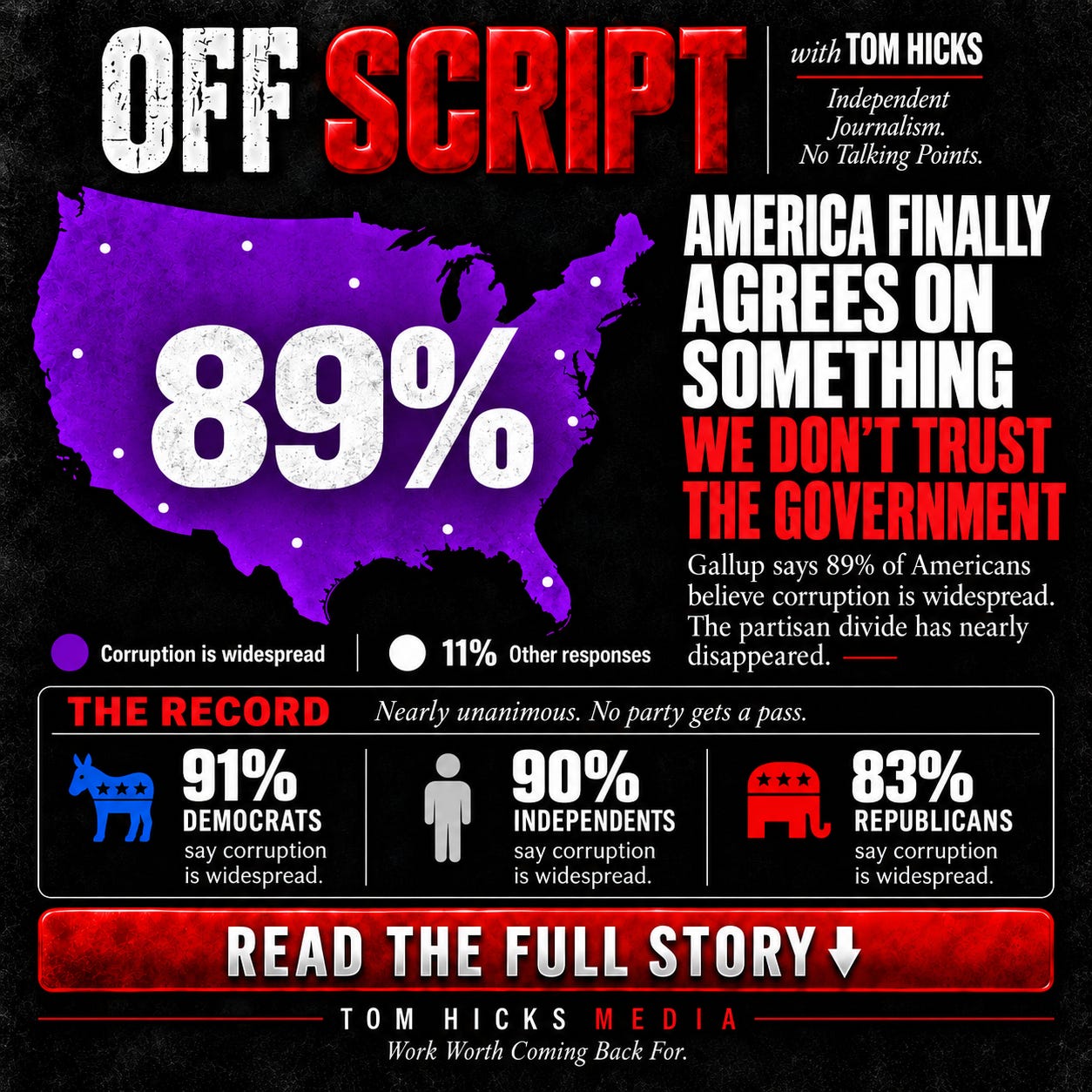
Gallup reported that 89% of American adults say corruption is widespread in government, the highest reading in the 20 years it has asked the question. That’s up 10 percentage points from 2025, after years in which the number generally sat between 72% and 79%. Whatever Americans have been seeing lately, it hasn’t restored their confidence. If anything, the floor just dropped out from under it. (news.gallup.com)
Your subscription helps fund reporting, research, publishing, new features, and the continued growth of every Tom Hicks Media publication.
The Partisan Divide That Barely Exists
This is where the poll stops being another depressing number and becomes remarkable. Among Democrats, 91% say corruption is widespread. Among independents, it’s 90%, while Republicans bring up the rear at a still-staggering 83%. Think about how difficult it is to get 83% of Republicans and 91% of Democrats to agree that Tuesday comes after Monday. (news.gallup.com)
The reasons behind those answers are almost certainly different, and Gallup’s breakdown makes that clear. Democratic perceptions have risen sharply with Donald Trump back in office, climbing from 57% during Joe Biden’s final year to 76% in 2025 and 91% this year. Republican concern has been much steadier, remaining around eight in ten even after Republicans won the White House and Congress. That makes this less a shared diagnosis than a shared conclusion reached by people who disagree about what caused the disease. (news.gallup.com)
One voter may be thinking about campaign money and corporate influence, while another means members of Congress trading stocks. Somebody else is thinking about government contracts, presidential power, prosecutors, lobbyists, regulatory capture, pardons, nepotism, bureaucrats, foreign money, or whatever scandal happened to be screaming from their television that morning. Gallup’s question can’t tell us which version each respondent has in mind. It tells us something more basic: they don’t trust the place.
This Didn’t Start Last Tuesday
The 89% figure would be easier to dismiss as a momentary political seizure if it stood alone. It isn’t, because Gallup reported in July that average public confidence across 14 major American institutions was just 27%, only one point above the record low reached in 2023. Confidence has remained below 30% for five straight years. That isn’t a bad week or a bad news cycle. (news.gallup.com)
Pew has found the same sickness from another direction. Its research shows roughly one in five Americans across different levels of political and civic engagement say they trust the federal government to do what is right always or most of the time. Being more politically engaged doesn’t seem to cure the problem, which matters because awareness alone clearly isn’t restoring faith in the system. The people paying attention may be every bit as suspicious as the people tuning out. (pewresearch.org)
Americans increasingly approach their institutions with suspicion already loaded in the chamber. When a court rules, somebody assumes the judge was bought, and when an agency releases statistics, somebody assumes the numbers were cooked. When Congress investigates something, half the country wonders what it’s covering up while the other half wonders who ordered the investigation. Eventually distrust becomes self-sustaining because every mistake, delay, or unexplained decision starts looking like evidence of something worse.
That’s a miserable way to run a republic, because institutions can survive disagreement much more easily than they can survive permanent disbelief. Once people assume bad faith before the facts arrive, almost every decision becomes harder to defend. Even honest institutions wind up paying the credibility bill for the dishonest ones. Every new scandal makes the next denial a little less believable.
Then There’s the International Comparison
Here’s the number that ought to embarrass Washington considerably more than another approval poll. Gallup compared the United States with the other members of the Organisation for Economic Co-operation and Development, and in 2025 the median share saying corruption was widespread in government across those countries was 59%. The United States was already at 79%, placing America at the top of the OECD on Gallup’s corruption-perception measure last year. That was before the U.S. number jumped another 10 points in 2026. (news.gallup.com)
Complete 2026 comparisons aren’t yet available, so we shouldn’t pretend there’s a finished international ranking for this year. Gallup does, however, offer another comparison that is hard to ignore. Among the 132 countries where it has asked the question annually since 2023, only four individual country-year readings have come in nominally above America’s current 89%: Lebanon at 92%, Peru at 92%, Ghana at 90% and Nigeria at 90%. That isn’t the company the country generally expects to keep when discussing public confidence in government. (news.gallup.com)
Americans also appear to distinguish government corruption from plain old corporate sleaze. Gallup found 71% saying corruption is widespread in business this year, itself an ugly number, but still 18 points below government. Gallup says that’s the largest government-versus-business gap it has recorded in the American trend. Imagine being the institution Americans trust less than big business. (news.gallup.com)
Perception Eventually Becomes a Governing Problem
There’s an easy response to all this. People are cynical, partisan media feeds the cynicism, social media spreads nonsense, and plenty of people shouting “corruption” couldn’t produce evidence if you stapled a subpoena to their forehead. Every bit of that can be true at the same time. It still misses the larger problem.
A democratic government depends on people believing that losing is sometimes legitimate. Your candidate loses an election, your case loses in court, Congress passes something you hate, or an agency makes a decision that costs you money. You’re allowed to think all of those decisions were stupid, unfair, or badly handled. The system gets into trouble when huge numbers of people assume the result was purchased, rigged, manipulated, or otherwise illegitimate before they’ve seen any evidence.
That’s why the Gallup number matters far beyond another poll about political mood. If 89% of the country believes corruption is widespread, every institution begins its next controversy with a credibility deficit. Government has to convince people of the facts before it can even begin arguing about the policy. When that happens often enough, governing becomes less about persuasion and more about surviving disbelief.
Washington has spent years behaving as though this were mainly a communications problem. It isn’t something a better slogan, sharper press secretary, or another television ad can fix. Trust comes back when institutions behave in ways that deserve it, when rules apply consistently, when conflicts are exposed instead of buried, and when people can see consequences for misconduct. There is no branding campaign for credibility.
Both Parties Should Hate This Number
There’s a temptation for Democrats to look at that 91% figure and say it proves what they’ve been saying about Trump. There’s an equally predictable temptation for Republicans to point at years of conservative distrust toward federal agencies and say they were right all along. Both reactions are politically understandable, and both are far too small for the number sitting in front of them. Everybody can win the argument, and the country can still have an 89% corruption problem.
Democrats don’t get to pretend distrust began January 20, 2025. Republicans don’t get to pretend an 83% corruption reading among their own voters is somehow a vote of confidence because their number happens to be eight points lower than the Democrats’. The public is delivering the same basic message from three different directions. Something smells rotten, even if everybody is pointing at a different garbage can.
That’s precisely why treating this as another partisan weapon would be stupid. If both sides simply use the number to confirm what they already believed, the poll becomes one more piece of ammunition instead of the warning it actually is. The more serious question is why mistrust remains this high even when political control changes hands. A country shouldn’t need to keep replacing the people in charge just to discover that almost nobody trusts the replacement either.
The Poll Washington Should Be Obsessing Over
Political coverage loves the horse race, and there are reasons for that. Who gained two points, which demographic moved four points, what suburban women in Pennsylvania think this week, and whether Wisconsin is leaning three-tenths of a percentage point toward somebody six weeks before Election Day can all matter. Elections have consequences, and polling helps us understand where voters are moving. But some numbers tell us more about the health of the country than who might win the next contest.
I have a hard time believing any poll matters more than learning that nearly nine out of ten Americans believe corruption is widespread in their government. Politicians eventually leave office, scandals eventually fade, and today’s political hero eventually becomes somebody else’s villain. Distrust stays behind, especially when people see no reason to surrender it. Once that hardens into the default setting, every institution inherits the damage.
If Americans reach the point where they no longer believe elections, courts, agencies, legislatures, or presidents are operating on the level, the argument stops being about which party should run the government. It becomes an argument over whether the government deserves to be believed at all. That’s a much more dangerous fight because there’s no easy electoral reset button for it. Changing the occupants doesn’t fix a house everybody thinks is rotten.
We finally found something Democrats, Republicans and independents can agree on. Nearly everybody thinks corruption is widespread, and nobody should be celebrating the consensus. Of all the issues that could have united the country, this is one hell of a choice. I really wish it had been baseball.
From Off Script: The Bullshit Detector
A few other claims making the rounds deserve considerably less respect. These are separate from the Gallup story, but they’re a useful reminder that suspicion works both ways. Government deserves scrutiny, and so do the people making claims about it.
The claim: Donald Trump posted an AI image of himself in a military uniform covered with medals.
Bullshit. The image circulated on X with the claim that Trump had posted it to Truth Social. Lead Stories checked Trump’s account, an independent archive of his Truth Social posts, and news reports and found no evidence that he posted this particular image. Trump has shared other AI-generated military imagery of himself, which probably helped this one seem believable, but believable and real remain two different things. (leadstories.com)
The claim: The armed man arrested after forcing his way toward Ohio Democratic gubernatorial nominee Amy Acton was immediately released with no bail.
Bullshit. Authorities say Patrick Havas pushed through a crowd toward Acton at the Canfield Fair, knocking people down before state troopers stopped him. Police said he had two pistols and other weapons, although none were brandished and investigators had not established his motive. Contrary to a widely circulated claim that he had already been released without bail, jail records showed Havas remained incarcerated with no bond set. (clevelandmonitor.com)
The claim: Michigan Democratic Senate candidate Abdul El-Sayed “pledged his support to the Muslim Brotherhood.”
Bullshit. Republican Senate candidate Mike Rogers made the allegation, but a Bridge Michigan review found no evidence El-Sayed ever pledged support to the organization or had explicit ties to it. El-Sayed did write about Egypt’s political revolution in 2011 and argued that fears of a Muslim Brotherhood electoral victory shouldn’t cause the United States to oppose democracy there. That’s something voters are free to judge, but it isn’t the pledge Rogers claimed occurred. (bridgedetroit.com)
The Bullshit Detector has one rule that matters: claims don’t get a pass because they flatter the side we like. If a story is wrong, sloppy or unsupported, the political jersey attached to it doesn’t rescue it. Suspicion without evidence is how distrust turns into gullibility. That’s exactly the trap an article about public corruption ought to avoid.
More From Tom Hicks Media
Tom’s Number Ones goes back through the charts one day at a time, digging into the songs, artists, and little pieces of music history hiding behind the numbers. It’s nostalgia with receipts, a jukebox and the occasional reminder that some truly strange records once ruled America.
Lotus Purrspective covers household management, human incompetence, and the daily burden of being the only responsible creature in the house. Lotus has opinions about nearly everything, most of them concerning her human’s obvious need for closer supervision.
Rabbit Ears Classic TV goes back to the shows, moments, and behind-the-scenes stories that made television worth remembering. Some were brilliant, some were ridiculous, and a surprising number were both at once.
The Backlot Ghost digs into what happened before the cameras rolled, after they stopped, and everywhere the official movie story gets considerably messier. Hollywood has always produced plenty of ghosts, and some of them have terrific stories.
Panic Room Sports delivers smart football coverage with attitude, including fantasy football, overreactions worth buying and overreactions worth throwing directly into traffic. Everyone reacts. We’ll check the tape first.
Tom Hicks Media — Work Worth Coming Back For
Buy Me a Cup of Tea
Independent work costs money even when reading it doesn’t. If you value Off Script and want to help keep the reporting, research, and rest of Tom Hicks Media growing, buying me a cup of tea is an easy way to help keep the lights on and the bullshit detector calibrated. Every bit of support helps keep this work independent and gives me more room to chase stories worth coming back for.
One Question Before You Go
When you hear the words “government corruption,” what is the first example that comes to mind? I’m especially curious whether people from different political sides are talking about the same things when they answer that question. If 89% of us agree there’s a problem, I’d like to know whether we’re even talking about the same problem.
#OffScript #Government #Corruption #Gallup #Politics #PublicTrust #IndependentJournalism #BullshitDetector #TomHicksMedia