
Tom Hicks | October 27, 2026
Editorial Note:
There’s a version of this story that’s just another argument about Donald Trump saying something outrageous. I’m more interested in the money. When a president says we’re making a fortune, I want to know who’s collecting it, who’s paying for it, and whether the people standing at the gas pump are included in that little word we.
The Fortune That Somehow Missed Your Wallet
You know that moment when you pull into a gas station, look at the prices, and briefly consider whether you really need to go wherever you were going? I’ve been there. At 70, I’ve lived through enough gasoline price shocks to recognize the routine. Prices climb, politicians explain why it’s somebody else’s fault, and we’re assured relief is coming. Eventually.
But this time, President Donald Trump has offered a different perspective. We’re apparently getting rich.
At a campaign rally in Perry, Georgia, on Saturday, October 24, Trump was talking about the enormous amounts of money American oil and gas companies were making as the war with Iran disrupted international energy markets. He explained that his advisers had warned him that celebrating those profits while Americans were suffering at the pump might produce unfavorable headlines. In other words, he knew perfectly well how it would sound. Then he said it anyway: “We’re making a freaking fortune.”
Those were his words, recorded in the transcript of his Georgia speech. He also claimed that the country was making hundreds of billions of dollars without presenting an accounting of where those amounts were going.
Well, congratulations to us. I’d just like to know where my check went.
Let’s Look at This Fortune
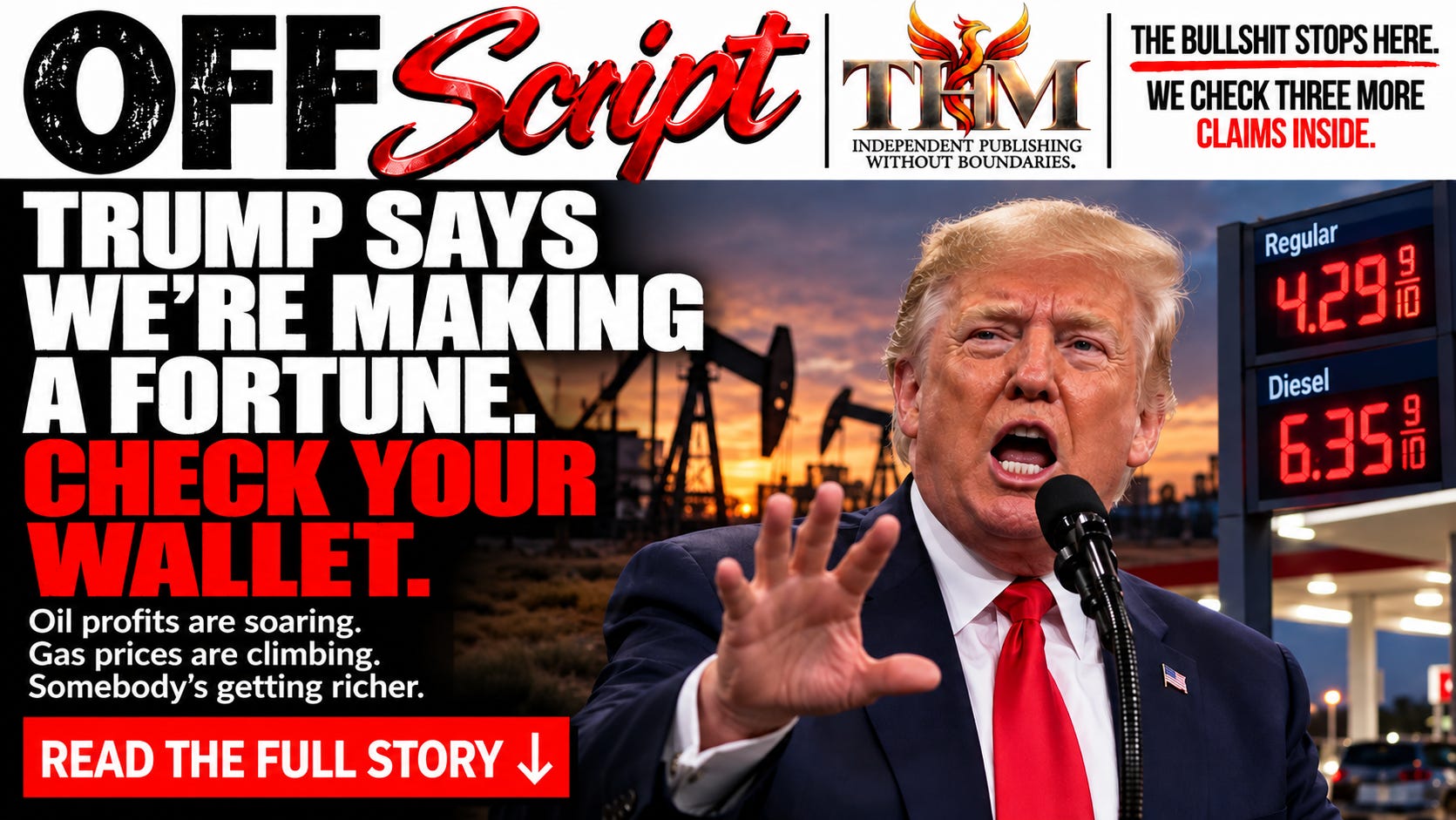
The numbers at the gas pump tell a rather different story. According to AAA’s national fuel-price data, regular gasoline averaged approximately $4.29 a gallon on October 26. Before the United States and Israel launched their war against Iran in February, the national average was approximately $2.98. That’s an increase of roughly 44 percent.
Diesel is worse. It has climbed from about $3.76 to $6.35 a gallon, an increase of approximately 69 percent. The Associated Press documented both increases in its October 26 report.
Put that into household terms. Someone buying 15 gallons of regular gasoline every week is paying approximately $19.65 more per fill-up than before the war. Over a year, assuming those prices held, that’s more than $1,000 in additional gasoline costs. For the same amount of driving, with no new car, no vacation, and no additional benefit. Just another thousand dollars out the door.
And gasoline is only the beginning. Diesel powers much of the machinery that moves food, consumer goods, and agricultural products across this country. When diesel prices rise, transportation becomes more expensive. Businesses can absorb some of those costs, but they can also pass them along to customers. The added costs reach consumers through freight charges, deliveries, and grocery prices. You might never buy a gallon of diesel in your life and still end up paying for it.
So Who’s Actually Making the Money?
Here’s where we need to separate the American economy from the American oil industry. They’re related, but they’re certainly not interchangeable.
American oil producers can benefit enormously when worldwide oil prices rise. Companies selling crude oil at higher prices generally collect more revenue for each barrel. Their profits can increase substantially, depending on production costs, refining operations, and other expenses. Some of the biggest companies have posted extraordinary results.
According to ExxonMobil’s second-quarter earnings release, the company earned approximately $14.5 billion in the three months ending June 30. Meanwhile, Chevron’s filing with the Securities and Exchange Commission reported second-quarter earnings of approximately $12.1 billion. Together, that’s roughly $26.6 billion. Not revenue. Earnings.
Now, to be fair, those companies employ Americans. They invest in equipment, pay taxes, and provide returns to shareholders. Some ordinary Americans own energy stocks through retirement accounts and mutual funds, and those benefits are real. The White House also has a legitimate point when it emphasizes American oil production and exports. Higher world prices can bring additional business to American suppliers.
But owning a little ExxonMobil in your retirement portfolio doesn’t mean you’re financially better off when gasoline, groceries, and transportation all become more expensive. Millions of Americans don’t own significant investments at all. When Trump says the country is making a fortune, he’s treating gains concentrated in one part of the economy as though they were shared equally by everybody. They aren’t.
The oil companies collect revenue. Shareholders may collect dividends. Governments collect certain taxes and royalties. The person filling a gas tank collects a receipt.
The War Changes the Equation
The war with Iran has disrupted international energy markets, particularly shipping through the Strait of Hormuz, a crucial passage for global oil supplies. The administration argues that military action was necessary to prevent Iran from acquiring nuclear weapons. Trump has repeatedly defended higher energy prices as a temporary cost of achieving that objective.
That argument deserves examination on its own terms, but it doesn’t transform higher gasoline prices into a financial windfall for ordinary Americans.
The president has also promised that fuel prices will come down. As the Associated Press documented in its chronology of Trump’s statements, he has alternated between celebrating the benefits of expensive oil for American producers and promising relief to consumers. Perhaps prices will eventually fall. But a prediction isn’t a price reduction, and Americans can’t fill their tanks with promises.
Here’s the contradiction. If expensive oil is wonderful because American producers make more money, then cheaper gasoline means giving up at least some of that advantage. If cheaper gasoline is the goal, celebrating expensive oil as a national triumph becomes a strange way to make the case. Both things can be true economically: American producers can profit while American consumers suffer. But somebody needs to acknowledge that they’re different groups of people.
Another Bill is Coming Due
One detail deserves more attention than it’s getting. On October 9, Trump announced an arrangement to purchase Russian diesel to help bring down fuel prices, a sharp reversal of years of American pressure on Moscow over its invasion of Ukraine. Lowering diesel prices would help American farmers, truckers, and consumers, which is a legitimate economic objective. But purchasing Russian fuel also raises questions about sanctions policy and the money available to Russia while it continues its war against Ukraine.
Then there’s the government’s other response. The administration has announced an $8 billion harvest fuel-relief program for farmers struggling with expensive diesel.
Think about that for a moment. We’re making a fortune from high oil prices, according to the president, while the government is preparing billions in assistance to help one industry cope with the consequences of those same prices.
There’s an economic argument for helping farmers. Food production matters, and farmers face costs they can’t simply wish away. But it’s worth asking how much of this supposed national windfall survives once we account for the additional expenses being imposed on everyone else.
The Part That Really Bothers Me
I’ve listened to politicians sell economic prosperity for most of my adult life. Sometimes they point to the stock market. Sometimes it’s corporate earnings. Sometimes it’s GDP growth or unemployment numbers. Those measurements matter, but they’re not the entire story.
A country can have profitable corporations and struggling households at the same time. It can produce more oil than any other nation and still have drivers paying painful prices for gasoline. It can boast about billions flowing into one industry while families wonder which expenses they can postpone until the next paycheck. And it can have a president who understands that contradiction well enough to predict the unfavorable headlines before making the statement anyway.
That last part is what stays with me. Trump wasn’t caught unaware that Americans were paying more at the pump. He acknowledged that his own advisers had warned him about the contrast. Then he celebrated the fortune.
Perhaps energy prices will fall. I certainly hope they do. The administration has promised relief, and Americans have every reason to want it. But until that happens, we should stop pretending that higher oil-company revenues automatically translate into prosperity for the country as a whole.
When a president says we’re making a fortune, the obvious follow-up question shouldn’t require an economics degree.
Who is we?
Because from where a lot of Americans are standing, the only thing getting bigger is the bill.
Keep the Questions Coming
Off Script isn’t here to repeat anybody’s talking points, including mine. It’s here to follow the evidence, challenge convenient explanations, and ask the questions people in power would rather avoid. Some days that means digging through government reports. Other days it means listening to a president celebrate a fortune and wondering why the rest of us are still waiting for our share.
If that’s the kind of independent journalism you want in your inbox, subscribe for free. You’ll get the next edition without paying a dime. If you’re able to become a paid subscriber, you’ll also help support the research, writing, and occasional industrial-strength headache that go into producing this work. Either way, I’m glad you’re reading.
THE BULLSHIT DETECTOR
💩 Misleading · 💩💩 Distorted · 💩💩💩 False
💩💩💩💩 Fabricated/manipulative · 💩💩💩💩💩 Potentially serious harm
Three claims unrelated to today’s oil-price story, because the political bullshit doesn’t stop just because gasoline is expensive.
1. Zero Illegal Crossings at the Southern Border
CLAIM: Trump has repeatedly asserted that no undocumented migrants have entered the country through the southern border for months.
BULLSHIT: 💩💩💩 — False.
WHY: Border crossings have fallen dramatically. That’s a genuine development, and the administration can fairly claim credit for some of the decline. But zero? Not even close.
As FactCheck.org documented on October 21, Border Patrol apprehended 8,870 migrants in August alone. The administration’s actual statistic concerns releases of apprehended migrants into the United States, not the total number of people crossing illegally. Those are two very different things, and the distinction shouldn’t disappear just because one version sounds better at a rally.
2. The Tariff-Funded $5,000 Check
CLAIM: Trump suggested that every adult American could receive a $5,000 payment if Republicans retained control of Congress, with tariffs helping pay for it.
BULLSHIT: 💩💩 — Significant distortion.
WHY: A check for $5,000 sounds wonderful. The problem is finding the money.
According to FactCheck.org’s examination of the proposal, sending that amount to roughly 245 million adult citizens would cost approximately $1.2 trillion. At the tariff-revenue levels examined, it would take more than six years to cover that expense, before accounting for other obligations or refunds.
The proposal isn’t an enacted benefit, and the arithmetic doesn’t support presenting it as an easy windfall.
3. The Drug Deals That Will Save Medicaid
CLAIM: Trump and administration officials have promoted their pharmaceutical agreements as a way to save Medicaid and rescue state budgets through enormous prescription-drug savings.
BULLSHIT: 💩 — Misleading framing.
WHY: The agreements could produce meaningful savings. But the amount depends on which medications qualify, how many states participate, and whether the negotiated prices improve on discounts Medicaid already receives.
As FactCheck.org explained on October 5, the administration’s projected initial savings to state budgets amount to less than 2 percent of their annual Medicaid spending. Important details of the drug-company agreements remain confidential.
Savings are good. Calling a relatively limited reduction a rescue operation is a considerably bigger claim.
The Conversation Doesn’t End Here
Come argue with me. Politely, if you absolutely must.
The Tom Hicks Media Discord is where we can keep talking after the column ends. Politics, current events, music, movies, sports, and whatever else happens to wander into the conversation. You don’t have to agree with me. In fact, it’s probably more interesting if you don’t. Just bring an argument you can defend and a willingness to hear somebody else’s.
Join the conversation: https://discord.gg/FXnPntTAwM
Around Tom Hicks Media
If you’ve had enough politics for one day, we’ve got other ways to occupy your brain. Off Script / Blind Spot keeps digging into the machinery of American elections, while What The Hell? explores the real-life absurdities that make you wonder how our species survived this long. Frank N. Krancke has also joined the household, bringing a remarkable ability to find something worth getting aggravated about. Frank doesn’t so much look for the silver lining as demand to know who stole the damned silver. You can check out his first contribution here:

Over at Chart Collision, the daily music trip has become a guessing game, with six chart clues and a mystery Bonus Track. Rabbit Ears Classic TV revisits the programs, performers, and commercials that occupied our living rooms, while The Backlot Ghost explores the movies that stayed with us long after the credits rolled. Sometimes for good reasons. Sometimes because we still can’t believe somebody approved the screenplay.
Panic Room Sports takes on the games, the hype, and the nonsense surrounding both. Lotus Purrspective offers daily dispatches from a tuxedo cat who believes the entire household would collapse without her supervision. Tomorrow, Eve Next Door joins us with a more personal conversation about relationships, independence, solitude, and the strange business of being human. Eve’s bringing the coffee. The rest of us are apparently bringing the complications.
Apparently, retirement has turned into a full-time publishing operation. Nobody warned me.
Buy Me a Tea
If you’d like to support the work without taking on another subscription, you can always buy me a tea. It helps cover the time spent researching, writing, checking, and occasionally staring at a presidential transcript while wondering whether the speaker has heard himself.
Every bit of support helps keep Off Script independent, and I appreciate it.
One Question
Trump says the country is making a fortune from higher oil prices. Oil companies are reporting enormous earnings, while millions of Americans are paying more for gasoline, groceries, and transportation.
When a politician tells you the economy is doing wonderfully, what matters more: the numbers they’re celebrating or the money left in your wallet?
Tell me in the comments. I’m especially interested in hearing how these prices are affecting your everyday life.

Hashtags: #OffScript #TomHicksMedia #Trump #GasPrices #DieselPrices #OilProfits #IranWar #CostOfLiving #AmericanEconomy #IndependentJournalism