

By Tom Hicks — Off Script with Tom Hicks
EDITORIAL NOTE
Off Script is independent journalism and commentary with no party script, no corporate leash, and no obligation to pretend obvious bullshit is complicated.
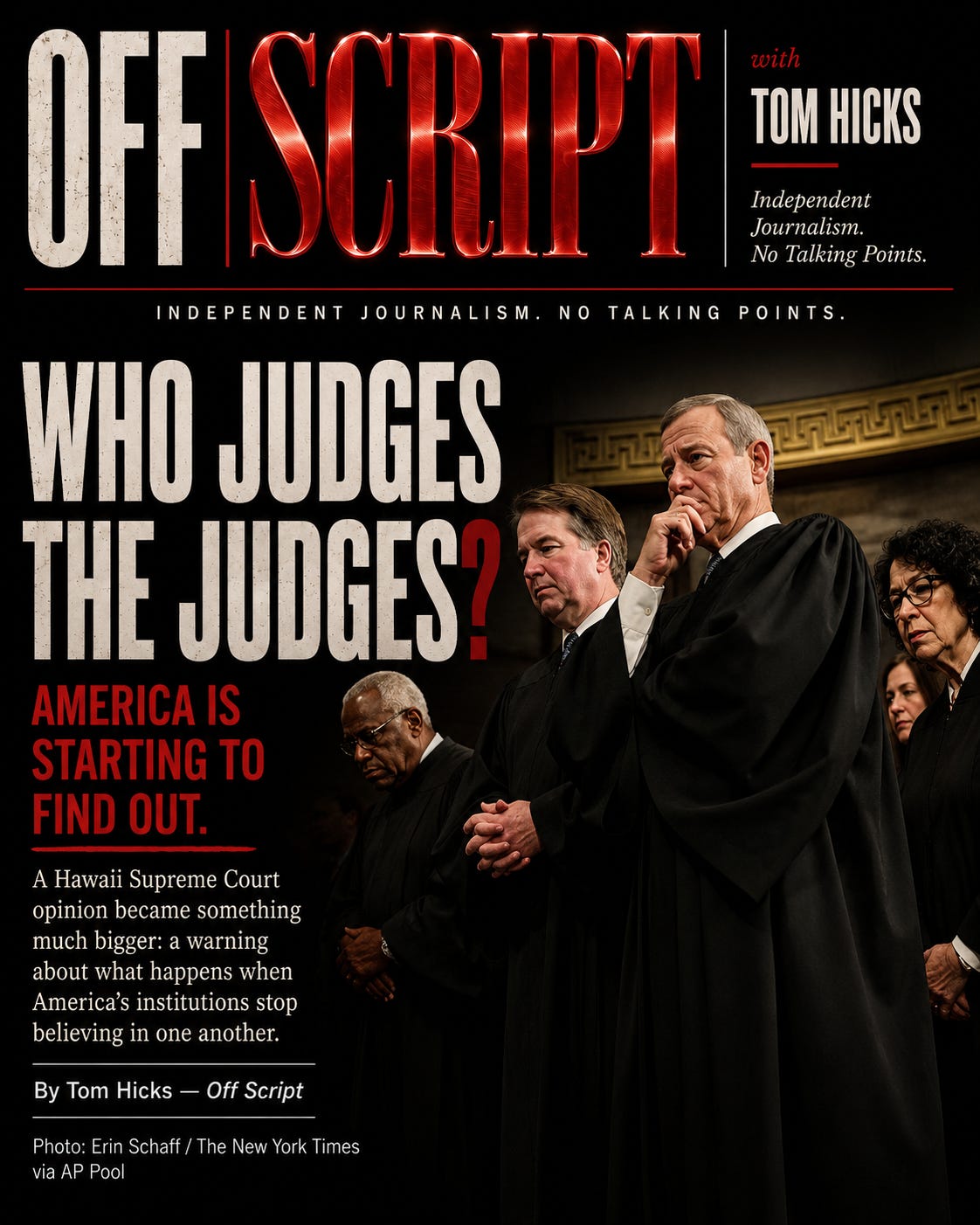
I read a lot of stories every day, and most of them wind up filed away in one of three categories: interesting, important, or “Jesus Christ, we’re doing this now?” This one landed squarely in the third pile.
The headline was about a Hawaii Supreme Court justice unloading on the United States Supreme Court. Predictably, the internet immediately divided itself into the usual camps. One side treated the opinion like the second coming of James Madison. The other acted as though Hawaii had declared judicial secession, planted a pineapple flag over the courthouse, and told Chief Justice John Roberts to send troops.
Neither reaction interested me very much because both managed to dodge the part that made me put down my phone and say, out loud, “What the fuck?”
The real story is that we have reached a point where nearly every major institution in the United States seems convinced it is the only one left that deserves to be trusted. Congress says presidents are lawless. Presidents say Congress is useless. Federal judges say state officials are violating the Constitution. State officials say federal judges are unelected tyrants. Politicians call the press corrupt, the press calls politicians liars, and a frightening number of Americans now treat elections, courts, prosecutors, universities, public-health agencies, and even basic arithmetic as legitimate only when they produce the result they were already rooting for.
Apparently, the only institution anybody trusts anymore is the one that agrees with them, which is a shitty foundation for a constitutional republic. The American system was designed around separate institutions fighting like hell while still recognizing that the other institutions have a legitimate job to do. It was never built on friendship. It was built on managed hostility, with ambition checking ambition and power checking power before any one branch became so dominant that the rest of the government turned into furniture.
The whole damned thing rests on an assumption almost nobody talks about anymore: the people inside those institutions have to believe the system itself is still worth preserving. I am no longer sure they do.
Support independent journalism that refuses to whisper when the story demands a raised voice.
Join me every morning.
The case that triggered all this is Granillo v. State, SCWC-22-0000740, decided by the Hawaii Supreme Court on July 15, 2026. Daniel Granillo was convicted in 1990 of kidnapping and sexual assault after an FBI expert testified about hair and fiber evidence that supposedly tied the complainant to Granillo’s car. Decades later, scientific reviews and the Justice Department concluded that this kind of microscopic comparison testimony had claimed to prove more than the science could actually support. The Hawaii court held that the evidence was false, important to the prosecution’s case, and damaging enough to require a new trial.
On that question, the court’s reasoning is hard to argue with. If the government used scientific evidence that later turned out to be bullshit, the defendant should not be forced to carry the burden of that mistake forever simply because everybody believed the bullshit at the time. Bad science does not become good science because a jury heard it thirty-six years ago.
Justice Todd Eddins wrote the majority opinion, and for most of it he did exactly what judges are supposed to do. He went back through the trial record, looked at what the later scientific reviews found, worked through the law, and explained why a conviction built partly on false forensic testimony could not be brushed aside as just another old case with some newly discovered evidence.
Then he got to the United States Supreme Court, and holy shit.
Eddins did not offer a polite disagreement with one case or write the usual judicial throat-clearing about respectfully declining to follow reasoning that was not binding under state law. He reached back through Dred Scott v. Sandford, 60 U.S. 393 (1857), Plessy v. Ferguson, 163 U.S. 537 (1896), and Brown v. Board of Education, 347 U.S. 483 (1954), then argued that the Roberts Court’s conservative majority had embraced the same kind of selective history once used to preserve slavery and segregation.
Then he wrote this:
“Hawaiʻi’s Constitution takes no instruction from it.”
That is seven words, and every one of them carries a fucking crowbar.
He accused the Roberts Court of overriding Congress, overriding voters and serving its own ends. He cited Citizens United v. Federal Election Commission, 558 U.S. 310 (2010), Dobbs v. Jackson Women’s Health Organization, 597 U.S. 215 (2022), New York State Rifle & Pistol Association v. Bruen, 597 U.S. 1 (2022), Rucho v. Common Cause, 588 U.S. 684 (2019), and Trump v. United States, 603 U.S. 593 (2024), among other cases, as evidence that the Court has weakened democratic safeguards while expanding the power of wealthy interests, presidents and gun owners.
He also wrote:
“The Roberts Court sees only white.”
That’s a state supreme court justice accusing the highest court in the country of looking at American history through a white lens and then using that distorted history to govern modern life. You can applaud that language, despise it, or think it is overdue, reckless, brave, and self-indulgent all before lunch. What you cannot honestly call it is ordinary.
This is where the right-wing headline writers started yelling that Hawaii intends to defy the Supreme Court, which is legally sloppy and politically convenient.
Here is what is actually going on. A state constitution can protect more rights than the federal Constitution does, and a state supreme court gets to interpret its own constitution. When the decision rests entirely on state law, Washington usually cannot come barging in and rewrite it just because the U.S. Supreme Court would have reached a different result under the federal Constitution.
That is federalism, the same federalism conservatives have spent generations praising whenever Texas wants to do something Washington hates. Funny how the majesty of state sovereignty suddenly becomes a national emergency the moment Hawaii uses it to protect rights instead of restricting them.
So no, Hawaii is not announcing that it can ignore binding federal law whenever it gets pissed off. Eddins says that Hawaii’s courts do not have to treat the Hawaii Constitution as a cheap photocopy of whatever the Roberts Court currently says about the federal Constitution.
And look, that distinction matters. There is a difference between saying, “Our constitution protects this right on its own,” and saying, “The people in Washington have become so full of shit that we are done taking constitutional guidance from them.”
The first one is normal constitutional law. The second one is a state judge firing a goddamn warning shot at Washington.
“That is not defiance. That is the design.”
That is Eddins’ defense, and he is not entirely wrong.
States have always been allowed to provide stronger privacy rights, better search protections, wider voting guarantees, and higher standards of fairness than the federal government requires. The federal Constitution is the floor. States do not have to lie down on it and pretend there is no ceiling.
What bothers me is where this goes next. There is a difference between a state court doing its own constitutional job and a state court digging a bunker because it has decided the United States Supreme Court is no longer a serious institution.
That is where this stops being just a Hawaii story.
The Roberts Court has earned a good deal of the contempt now directed at it. Let’s not polish that turd. The Court has spent years handing down decisions that often look suspiciously like Republican policy outcomes wearing rented historical costumes. Its conservative majority will dig through eighteenth-century statutes, nineteenth-century social practices, and whatever Samuel Alito found behind the refrigerator if that is what it takes to produce the desired result.
The Court’s ethics disasters have made everything worse. Lavish gifts, undisclosed travel, billionaire benefactors, politically active spouses, and a code of conduct with all the enforcement power of a strongly worded refrigerator magnet have done little to reassure the public that these people understand why anyone might question their judgment.
You cannot spend years acting untouchable and then clutch your pearls when another judge notices. You cannot overturn half a century of reproductive-rights precedent in Dobbs, invent sweeping presidential immunity in Trump v. United States, cripple voting-rights protections, expand gun rights through a history test that sends courts rummaging through laws written when women could not vote, and Black people could be owned, and then act surprised when state judges conclude that your constitutional compass may be lodged firmly up your ass.
That does not mean every Roberts Court decision is wrong. It means the Court has burned through an enormous amount of public trust and seems remarkably unconcerned about the smoke.
Here is the part that ought to bother people on the left who are currently cheering Eddins like he just hit a walk-off home run.
Imagine this same opinion coming out of Texas five years from now. Imagine a deeply conservative Texas Supreme Court declaring that a newly liberal United States Supreme Court had abandoned the Constitution, twisted history, embraced partisan outcomes, and forfeited any right to tell Texas judges how to think.
Then imagine that court announcing that the Texas Constitution “takes no instruction” from Washington because progressive justices had recognized broader abortion rights, gun restrictions, transgender protections, or federal voting safeguards.
Would liberals call that courageous state constitutionalism?
Bullshit.
They would call it nullification. They would call it judicial insurrection. They would want the Justice Department involved before the ink dried.
Now turn it around. The conservatives currently describing Eddins as unhinged would be selling commemorative coffee mugs if Alabama told a liberal Supreme Court to kiss its ass.
That is where all the grand talk about constitutional principles usually falls apart. Everybody loves independent institutions when their side controls them. The minute the other side gets the same idea, suddenly everybody rediscovers the importance of hierarchy, restraint, and respect for authority.
That is sports fandom in a robe.
The danger goes well beyond hypocrisy, although there is enough of that here to power the electrical grid. This kind of selective respect spreads. Every time one institution declares another one illegitimate, it hands the next guy a ready-made excuse.
Presidents ignore court orders because the judges are political. Legislatures reject election results because the voters were supposedly fooled. Governors defy federal policy because Washington has overstepped, while federal agencies bulldoze state objections because local officials are obstructing national law. Now courts are doing it to one another, with one bench looking across at another and saying, “Those people are hacks, so why the hell should we listen to them?”
Everybody calls it an emergency. Everybody says they had no choice. Everybody is somehow the last adult left in the room.
A room full of people screaming that they are the only adult is usually called a fucking bar fight.
That is what makes the Hawaii opinion so important. It did not create this crisis. It exposed it.
Eddins wrote down what millions of Americans already believe: the institutions controlled by the other side are not merely wrong. They are fraudulent, corrupt, and undeserving of respect.
That belief has been growing for years. Donald Trump poured gasoline on it by teaching his supporters that any institution capable of restraining him must be corrupt by definition. Elections he loses are rigged. Prosecutors who charge him are partisan. Judges who rule against him are crooked. Intelligence agencies are conspirators. Journalists are enemies. Civil servants are a deep state. Even Republican officials become traitors the moment they refuse to lie for him.
Trump did not invent the disease. He saw it, exploited it, and built an entire political movement around it.
The left has its own version, usually dressed in better grammar. Courts are illegitimate when conservatives control them. States are heroic when they resist Republican administrations. Executive power becomes necessary when Congress will not act. Norms that mattered yesterday become inconvenient little obstacles because the stakes are supposedly too high to keep following the old rules.
And I understand the temptation. Every side believes its emergency is the real one. Every side thinks this time is different.
Maybe it is.
The problem is that every moment starts looking different once enough people decide the rules are for suckers.
The Constitution does not enforce itself. It is paper, precedent, habit, and a collective agreement that the whole thing still counts. It works because presidents comply with rulings they hate, judges recognize authority they resent, legislatures accept electoral losses, states obey federal law, and citizens continue believing the system is something more than a rigged machine operated by their enemies.
Take away that belief, and the Constitution does not rise out of the National Archives and start smiting people. It just sits there while everybody ignores it.
That is why I cannot dismiss Eddins’ opinion as a liberal tantrum. He may be describing the Roberts Court accurately. Hell, I think he is right about a lot of it. State constitutions may be becoming the last meaningful line of defense for rights the federal courts no longer seem terribly interested in protecting.
But if that is where we are, then let’s stop pretending everything is basically fine.
We now have state supreme court justices openly saying the United States Supreme Court is racially distorted, hostile to democracy, and not worth taking constitutional instruction from. You can agree with every word and still recognize that this is a five-alarm legitimacy crisis.
And here is the bitch of it: ordering everyone to be more respectful will not fix it. Respect is not a fucking participation trophy. John Roberts cannot demand credibility while presiding over a Court that behaves as though transparency and accountability are things for lesser people.
The Court has to earn some of that authority back.
At the same time, state judges need to understand what they are opening the door to when a legal opinion turns into a declaration of war. Saying the quiet part out loud may feel wonderful for a day. The precedent for every state supreme court to dismiss Washington as just another bunch of partisan hacks could be with us for generations.
This is where I keep getting stuck. Eddins may be right about the Roberts Court. The Roberts Court may deserve every blistering word he wrote. But I still cannot pretend it is healthy when state judges start talking about the nation’s highest court like it is just another political outfit with nicer furniture.
Both things can be true, and that is the part everybody keeps missing because they are too busy deciding which robe to cheer for.
The real question is not whether Eddins was rude. It is whether he was right, and what the hell it means for the country if he was.
Hawaii absolutely has the right to interpret its own constitution. But there is a difference between using your own rulebook and deciding the referees in Washington are crooked, incompetent, and no longer worth listening to.
That is not some dry argument between judges. That is a country’s institutions beginning to look at one another with the same contempt the public already feels toward all of them.
I keep coming back to the same thought. The American constitutional system was built to survive disagreement, ambition, conflict, ego, corruption, and a staggering amount of human stupidity. It was not built to survive every participant deciding that nobody else has legitimate authority.
The referees can argue. They can call each other blind, reverse decisions, write brutal dissents, and point out every bad call in the book. But once they decide the other referees are crooked, the argument is no longer about the rules.
It is about whether there is still a game.
And all of us sitting in the stands cheering because our side finally told the other side to go fuck itself might want to think hard about what happens when nobody comes back onto the field.
ONE QUESTION BEFORE YOU GO
When does a court’s duty to defend constitutional rights become more important than its duty to preserve public respect for the judicial system?
THE OFF SCRIPT BULLSHIT DETECTOR
Political bullshit works because it arrives wrapped in urgency, outrage and selective facts before most people have time to ask who benefits from the story.
The Off Script Bullshit Detector is my practical guide to slowing the spin down, checking the evidence, and figuring out when somebody is trying to play you.
It is free for Off Script subscribers and available for $4.95 through the Tom Hicks Media store.
GET YOUR VERY OWN BULLSHIT DETECTOR
Independent journalism does not come with a corporate expense account. It comes with research, caffeine, and the occasional need to stare at a court opinion while muttering obscenities.
#OffScript #SupremeCourt #HawaiiSupremeCourt #JohnRoberts #ToddEddins #StateConstitutions #Constitution #Federalism #RuleOfLaw #JudicialLegitimacy #AmericanDemocracy #IndependentJournalism