

By TOM HICKS
EDITORIAL NOTE
This isn’t an argument against remembering the people who died on September 11, 2001. They deserve every name read aloud, every bell rung and every moment of silence. The harder question is whether honoring them requires us to be equally willing to remember what fear did to the country they left behind.
THE PART WE REMEMBER
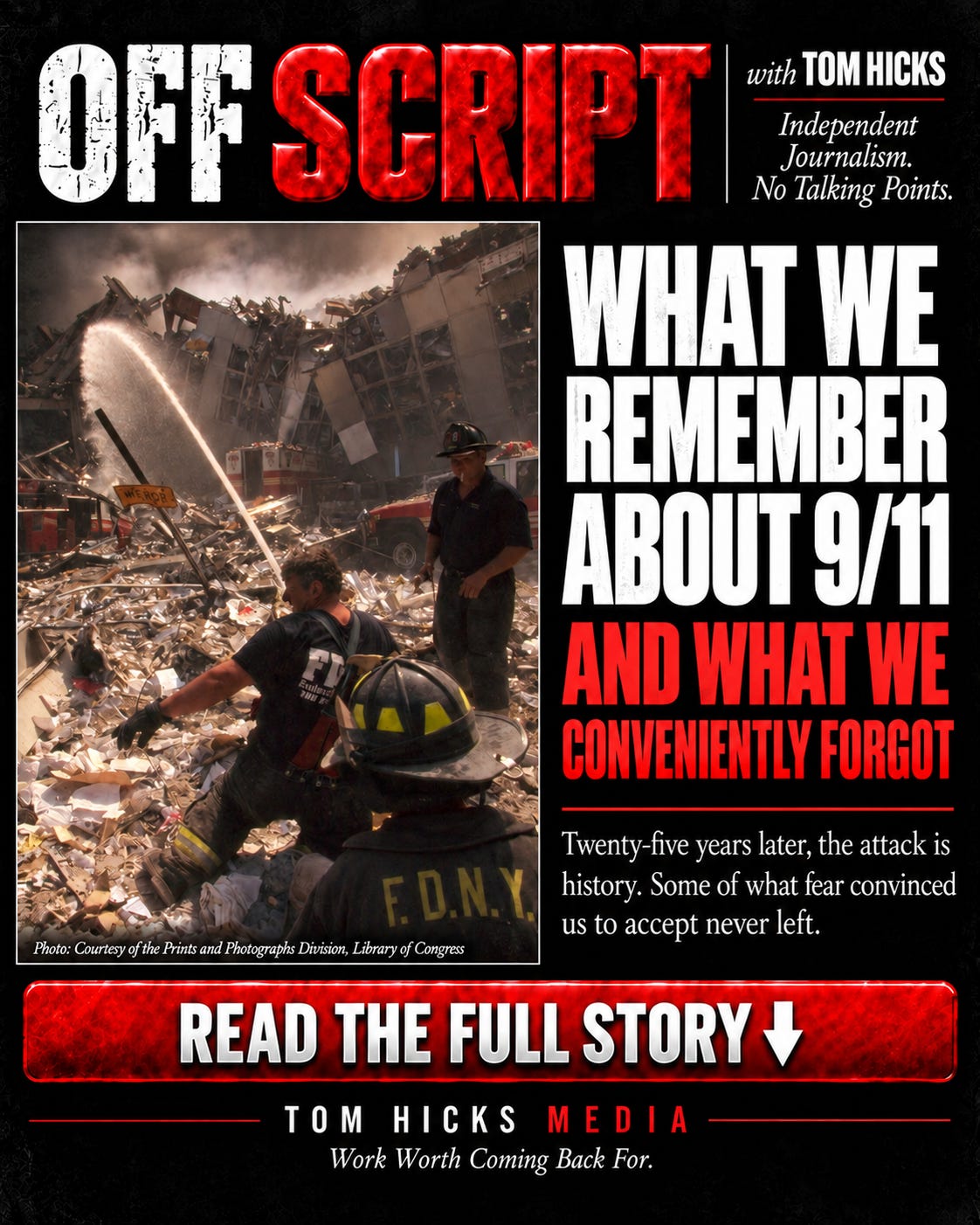
On September 11, 2001, 19 al-Qaeda terrorists hijacked four commercial airplanes. Two struck the World Trade Center, one struck the Pentagon, and passengers and crew aboard Flight 93 fought back before that plane crashed in Pennsylvania. The attacks killed 2,977 people from 90 countries. Source: National September 11 Memorial & Museum
We remember the firefighters climbing stairs while everyone else was trying to get down. We remember strangers helping strangers, passengers on Flight 93 deciding they weren’t going to sit quietly and wait to die, and ordinary people suddenly doing extraordinary things because there wasn’t anyone else around to do them. Those memories deserve to survive every bit as long as the images of the towers falling.
We also remember something that feels almost foreign now: for a brief period, Americans genuinely felt like they were on the same side. Nobody checking blood types at a hospital cared how somebody had voted. Nobody running toward a burning building stopped to ask whether the person trapped inside watched Fox News or MSNBC.
That part makes for good anniversary television.
The next part usually gets edited for time.
FEAR GOT A BLANK CHECK
Three days after the attacks, Congress approved the Authorization for Use of Military Force that gave the president authority to use “all necessary and appropriate force” against those responsible for 9/11 and those who harbored them. The authorization remains part of federal law 25 years later and became the legal foundation for military operations extending far beyond the immediate battlefield of Afghanistan. A measure written while the Pentagon was still smoking became one of the foundations of America’s post-9/11 presidency. Source: U.S. Government Publishing Office — 2001 AUMF
Then came the USA PATRIOT Act. President George W. Bush signed it on October 26, 2001, dramatically expanding government investigative and surveillance authorities in the name of preventing another attack. Among its provisions, Section 215 allowed the government to seek orders for “any tangible things” relevant to terrorism and intelligence investigations. Source: U.S. Department of Justice — USA PATRIOT Act
Years later, we learned just how elastic those words had become. The Privacy and Civil Liberties Oversight Board concluded that the NSA’s bulk telephone-records program lacked a viable legal foundation under Section 215, raised serious constitutional and privacy concerns, and had demonstrated only limited value. The government eventually ended that particular bulk collection system, but Americans learned something useful in the process: extraordinary powers have a funny habit of becoming ordinary once government gets comfortable with them. Source: Privacy and Civil Liberties Oversight Board
Here’s the part that should probably be printed in 72-point type on every 9/11 anniversary. On September 8, 2026, President Trump renewed the national emergency first declared after the September 11 attacks for yet another year. Twenty-five years after the attacks, the federal government still officially says the emergency and the powers adopted to deal with it must continue. Source: Federal Register — September 8, 2026 continuation notice
Twenty-five years.
We went from flip phones to smartphones. We elected five presidential administrations, found and killed Osama bin Laden, fought America’s longest war and eventually left Afghanistan. Yet on paper, the emergency created by September 11 is still an emergency this morning.
Maybe that should bother us more than it does.
THEN WE WENT LOOKING FOR ANOTHER ENEMY
Afghanistan followed directly from 9/11 because al-Qaeda had operated there under Taliban protection. Iraq was another matter entirely. The 9/11 Commission later reported that although there had been contacts between Iraq and al-Qaeda, it found no evidence that those contacts developed into a collaborative operational relationship or that Iraq cooperated with al-Qaeda in attacks against the United States. Source: The 9/11 Commission Report
That distinction didn’t penetrate very well at the time. In October 2002, 66 percent of Americans told Pew Research Center they believed Saddam Hussein had helped the terrorists responsible for 9/11. By February 2003, shortly before the invasion of Iraq, 57 percent still believed it. Source: Pew Research Center
Nobody had to stand at a podium and say, “Saddam planned 9/11” for the association to do its work. Say Iraq, terrorism, mushroom cloud, al-Qaeda, and September 11 often enough in the same national conversation and frightened people will connect the dots themselves. Millions did.
That should be one of the enduring lessons of 9/11. Fear doesn’t require a lie that can fit neatly on a fact-check card. Sometimes all it needs is a collection of true and half-true things arranged so the audience reaches the desired conclusion without anyone having to say the quiet part out loud.
AND THEN WE DECIDED WHAT WE COULD LIVE WITH
The CIA’s post-9/11 detention and interrogation program is another chapter that rarely makes the anniversary highlight reel. A Senate Intelligence Committee investigation found that so-called enhanced interrogation techniques were ineffective at obtaining accurate information or gaining detainee cooperation. It also found the interrogations were substantially more brutal than the CIA had represented to policymakers. Source: Senate Select Committee on Intelligence — Findings and Conclusions
Waterboarding. Prolonged sleep deprivation. Stress positions. Secret detention sites. Techniques that would have been described very differently had another government been using them on Americans.
We argued over what technically qualified as torture as though changing the vocabulary somehow changed what was happening in the room. That’s another useful thing fear can do. It can make a country spend more time debating the definition of a line than noticing it has already crossed it.
SOME AMERICANS BECAME SUSPECTS BY ASSOCIATION
The people who attacked the United States were al-Qaeda terrorists. Muslim Americans, Arab Americans, Sikh Americans and South Asian Americans had nothing to do with those attacks, but plenty of them paid a price anyway. The Justice Department later reported investigating more than 800 post-9/11 incidents involving violence, threats, vandalism and arson directed at those communities or people perceived to belong to them. Source: U.S. Department of Justice Civil Rights Division
That ugliness didn’t fit the story we preferred to tell ourselves about national unity. The unity was real, but so was the backlash. Both things happened in the same America at the same time.
Remembering one while quietly filing away the other isn’t history.
It’s editing.
THE COUNTRY WE BUILT AFTERWARD
The federal government reorganized itself around the threat of terrorism. The Department of Homeland Security began operations in 2003, bringing together 22 agencies and offices into a Cabinet department created in the aftermath of the attacks. Airport security changed, intelligence agencies changed, law enforcement changed, presidential power changed, and the vocabulary of American politics changed with them. Source: U.S. Department of Homeland Security
Some of those changes made sense. Some almost certainly made us safer. Pretending every post-9/11 decision was a mistake would be every bit as lazy as pretending every one of them was justified because Americans were frightened when we made it.
The real failure came later. Temporary measures became permanent habits, and a public that once argued fiercely over government surveillance gradually got used to carrying around devices capable of tracking every movement, search and conversation anyway. Fear opened the door, convenience held it open, and twenty-five years passed.
AND HERE WE ARE AGAIN
A Reuters/Ipsos poll released this week suggests Americans have learned at least some of the lesson. Sixty-five percent oppose warrantless domestic surveillance, while 61 percent say ideologically motivated domestic extremists pose a greater threat than foreign extremists. Only one-quarter supported the current war with Iran. Source: Reuters/Ipsos — 25 years after 9/11
That last number matters because the United States is once again fighting a Middle Eastern war with no obvious exit ramp. Reuters reported this week that the Iran campaign is increasingly drawing comparisons with the post-9/11 “forever wars,” including questions about mission creep, public support and what victory is actually supposed to look like. Source: Reuters — Trump’s Iran campaign echoes the post-9/11 “forever wars”
History rarely repeats itself wearing the same clothes. There won’t be another September 12, 2001, and the next bad decision won’t arrive labeled BAD DECISION in red letters. It will arrive wrapped in urgency, security, and the reassuring promise that extraordinary powers are only necessary until the emergency passes.
We’ve heard that one before.
WHAT “NEVER FORGET” SHOULD ACTUALLY MEAN
We should remember the 2,977 people who went to work, boarded airplanes, reported for duty or started an ordinary Tuesday morning and never came home. We should remember the firefighters, police officers, paramedics, passengers and strangers who showed what courage looks like when there isn’t time to rehearse it. That remembrance doesn’t need political qualifications attached to it.
But if “never forget” means anything beyond a bumper sticker, the memory can’t stop when the towers fall.
We should remember how frightened we were. We should remember what frightened people were willing to surrender, whom we were willing to distrust, which wars we were willing to support and how quickly temporary government power learned to make itself comfortable.
The dead deserve remembrance.
The living deserve the whole story.
FROM OFF SCRIPT: THE BULLSHIT DETECTOR
The claim: “Food prices and almost every other item are rapidly going down.”
Bullshit.
President Trump made that claim at the Republican midterm convention in Dallas this week, but PolitiFact found overall prices have risen about 4.3 percent since the beginning of his second term and grocery prices about 3.4 percent. Some individual products have fallen, but “almost every other item” simply doesn’t survive contact with the numbers. Source: PolitiFact
The claim: Tariff revenue can pay every American adult a $5,000 “Trump Dividend.”
Bullshit.
Trump promised the payment if Republicans retain control of Congress, but there is no enacted program and the arithmetic is several exits past Fantasyland. Reuters estimates the proposal would cost roughly $1.2 trillion, would require congressional approval, and far exceeds current tariff collections available to finance it. Source: Reuters
The claim: Trump brought hundreds of his construction workers to help at Ground Zero after 9/11.
There’s still no evidence for it.
Trump has repeated versions of the story for years and revived them ahead of the 25th anniversary, but PolitiFact found no documentation confirming that hundreds of Trump workers participated in the recovery operation. Trump was photographed and interviewed near Ground Zero on September 13, 2001, but that establishes his presence, not the army of workers he has described. Source: PolitiFact
The claim: Roy Cooper’s 2021 prison-release agreement freed the men responsible for two murders featured in Republican campaign ads.
Bullshit.
PolitiFact traced both cases and found neither accused killer was part of the 2021 North Carolina release agreement. One victim’s father said the ad had been edited in a way that made it appear he was blaming Cooper for something he had never actually said. Source: PolitiFact
MORE FROM TOM HICKS MEDIA
Lotus Purrspective
Daily life, human foolishness and household management as explained by the only member of the staff who is certain she’s qualified to run the place.Tom’s Number Ones
Six charts, one day in music history and enough forgotten records to make you wonder why you ever threw those albums away.Panic Room Sports
Smart football coverage with attitude. Everyone reacts. We’ll check the tape first.Rabbit Ears Classic TV
Classic television before “content” became something an algorithm dumped into your living room.The Backlot Ghost
Movies, forgotten stories, and the strange things that happened after somebody yelled cut.
BUY ME A CUP OF TEA
Off Script is independent and reader-supported. If today’s article gave you something worth thinking about, you can help keep the reporting and research going by buying me a cup of tea.
ONE QUESTION BEFORE YOU GO
Twenty-five years after 9/11, what do you think America learned from it, and what do you think we still haven’t learned?
#September11 #911Anniversary #CivilLiberties #WarOnTerror #IndependentJournalism #OffScript #TomHicksMedia
WORK WORTH COMING BACK FOR