

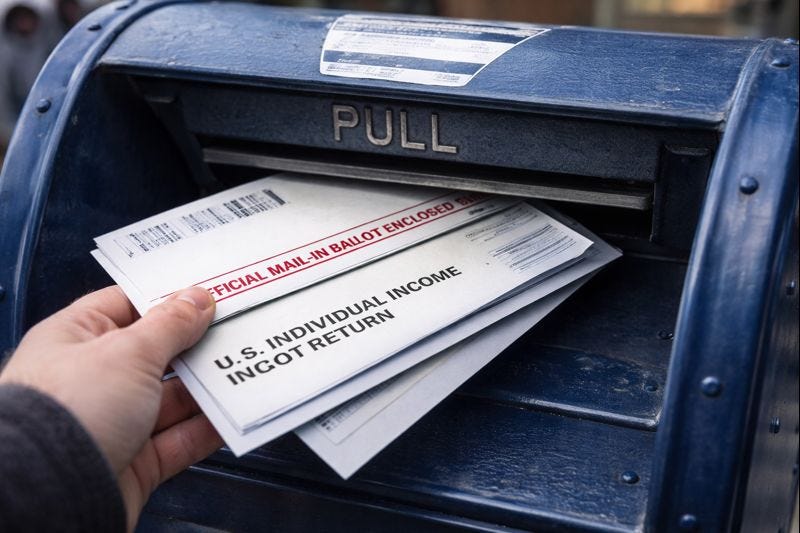
There are two kinds of threats to democracy.
The loud ones show up waving flags, screaming about fraud, and demanding cameras.
The dangerous ones show up as policy clarifications.
This is the second kind.
The U.S. Postal Service has quietly changed how it defines a postmark — and with that change, it has altered something most people assume is sacred and obvious:
When a deadline actually counts.
Not loudly.
Not dramatically.
Just a rule change, a footnote, and a shrug that says “that’s how the system works now.”
And if you think this is about stamps and sorting machines, you’re already behind.
This is about elections, taxes, bills, court filings, and who gets blamed when institutions fail.
The Change (No Spin, No Hysteria — Just Facts)
Under the new USPS rule, the “official” postmark date on most mail is no longer tied to when you hand it over to the Postal Service.
Instead, the postmark reflects the date the mailpiece first runs through automated processing at a USPS facility.
USPS explicitly acknowledges the problem:
The machine-applied postmark date is not a perfectly reliable indicator of when the customer actually mailed the item, because mail may sit or travel before being run on automation.
In plain English:
Your letter can sit in a collection box, ride around in a truck, or wait at a facility — and none of that counts.
The clock only starts when the machine notices it.
If you want a date that actually matches the day you handed your mail to USPS, you must now:
Go to a retail counter
Explicitly request a manual local postmark
Or use specific retail or tracked services
Otherwise, you’re trusting a system that has openly told you it is not designed to protect you.
And this is not a future problem.
This rule went into effect on December 24, 2025.
Which means ballots, tax payments, bills, and legal filings mailed right now are already operating under this new definition of “on time” — whether the people mailing them realize it or not.
Why This Is Not “Just a Postal Thing”
Deadlines don’t exist in a vacuum. They exist in law.
For decades, the rule was simple and intuitive:
If you mailed it by the deadline, you met the deadline.
That principle underpins:
Mail-in voting laws
IRS filing rules
Property tax payments
Court filings and appeals
Benefits enrollment
Charitable donations
The new rule quietly shifts the risk.
You act on time.
The system processes it later.
You pay the price.
🗳️ Democracy Damage Report: Mail-In Voting
Many states treat mail-in ballots as valid if they are postmarked by Election Day, not received by Election Day.
That distinction matters — or at least it used to.
Now consider the chain reaction:
A voter drops a ballot in a collection box on time
The ballot doesn’t hit automated processing until days later
The postmark reflects the processing date, not the mailing date
The ballot appears late
The ballot is rejected
No poll worker interfered.
No official touched the ballot.
No law was technically broken.
The system just worked differently than voters expected.
And the risk is not evenly distributed.
It is highest for:
Rural voters far from processing centers
Elderly and disabled voters who rely on collection boxes
Voters in states with strict postmark rules and limited grace periods
This isn’t voter suppression by brute force.
It’s procedural disenfranchisement — quiet, clean, and legally deniable.
💸 The Tax Trap (Where This Gets Personal Fast)
The IRS relies on the “timely mailed, timely filed” doctrine under Internal Revenue Code §7502.
Translation:
If your return or payment arrives late, the postmark proves you mailed it on time.
But what happens when the postmark no longer reflects when you mailed it?
Tax specialists are already warning that:
Returns dropped on deadline day could be deemed late
Payments could trigger penalties and interest
Taxpayers could lose appeal rights
The government controls the deadline.
The government controls the mail.
The government controls the definition of the date.
And the taxpayer is told: you should’ve known better.
That’s not efficiency.
That’s liability laundering.
⚖️ Quiet Consequences: Courts, Bills, and Rights
This change doesn’t stop with ballots and taxes.
It affects:
Court filings dismissed as untimely
Appeals denied without ever being heard
Bills marked late despite timely mailing
Benefits delayed or denied
There’s no headline for this.
No viral clip.
Just a clerk or judge pointing at a date and saying, “The record is clear.”
Except it isn’t.
The Admission That Collapses the Defense
USPS has acknowledged — in writing — that the postmark date may not reflect when the customer actually mailed the item.
Once an institution knows its process creates false deadlines and proceeds anyway, the harm is no longer accidental.
It’s accepted.
And acceptance is policy.
“But There Are Workarounds” (Yes — And That’s the Problem)
USPS will tell you:
Ask for a manual postmark (free, if you know to ask)
Use certified or registered mail
Mail earlier
All true.
Also revealing.
Because those options:
Require time, mobility, and awareness
Shift responsibility from the institution to the individual
Penalize people who rely on normal, advertised services
A system that only works if you know the loopholes is not neutral.
It’s hostile by design.
💣 TRUTH BOMB
When deadlines stop meaning what citizens think they mean, democracy becomes a technicality.
What You Should Do Right Now (Because Reality)
This isn’t advice. It’s damage control.
For ballots:
Go to the counter. Ask for a manual postmark. Every time.For taxes and legal documents:
Get proof of acceptance — certified mail, receipt, or counter-printed postage.For anything with a hard deadline:
Mail earlier than you think you need to.
As of December 24, 2025, the system no longer assumes good faith.
Neither should you.
The Thing Beneath the Thing
This isn’t really about the Postal Service.
It’s about a broader pattern:
Institutions redefining responsibility downward
Systems optimizing for efficiency over fairness
Citizens blamed for trusting public infrastructure to function normally
Nobody has to rig an election if they can just redefine “on time.”
Nobody has to deny your rights if the clock does it for them.
And the most dangerous part?
Most people won’t realize it until it happens to them.
If this made your stomach drop, good.
That means you’re paying attention.
If you want more reporting that exposes the quiet rule changes reshaping democracy while no one’s looking, like, share, and subscribe using Substack’s button.
Paid Upgrade — Keep This Independent
I’m retired, reader-funded, and have no sponsors telling me which institutions I’m allowed to criticize.
Paid subscribers keep this reporting alive and get deeper dives, early access, and fewer filters.
If this work matters to you, upgrade now.
Buy Me A Coffee
If this saved you from a missed deadline or a rejected ballot, consider fueling the next investigation. ☕
For the quieter, sharper, judgment-heavy take on human systems failing exactly as designed, check out Lotus — same facts, fewer swear words, much more side-eye.
Hashtags:
#Democracy #VotingRights #USPS #MailInVoting #Taxes #DueProcess #QuietCorruption #InstitutionalFailure #TheUnredactedBastard