

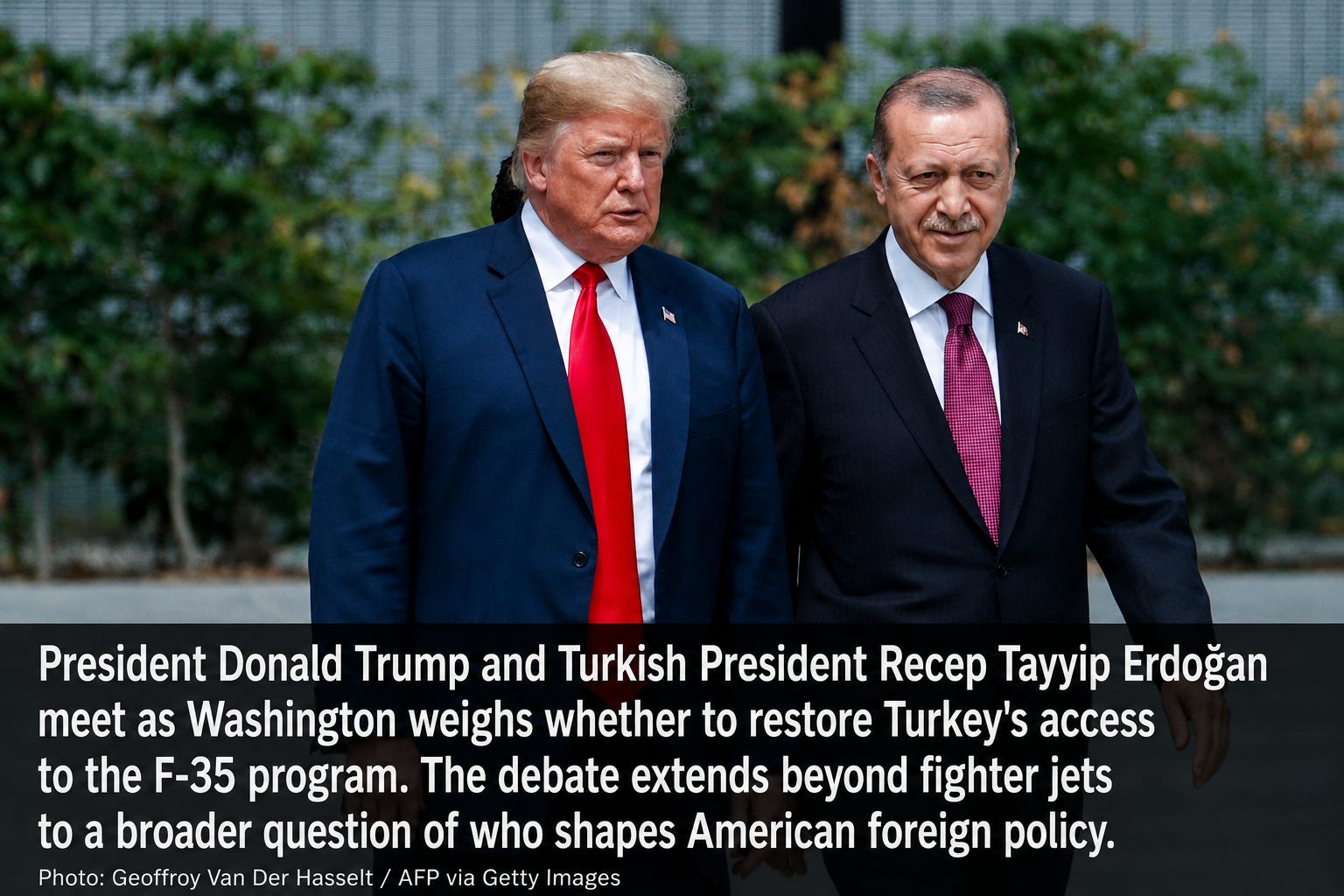

Benjamin Netanyahu does not want Turkey to get F-35s.
That’s the headline. That’s not the story.
The story is that the prime minister of Israel went on American television and urged the American government not to sell American fighter jets to Turkey, a NATO ally, because it might threaten Israel’s military edge in the Middle East. The Trump administration is reportedly reviewing whether Turkey can rejoin the F-35 program after getting booted in 2019 for buying Russia’s S-400 missile defense system.
Fine. That’s a real concern. A NATO member running Russian air defense while shopping for America’s most advanced fighter jet isn’t exactly a nothing-to-see-here situation. Even by NATO standards, where the family reunion always has a drunk uncle and three unresolved border disputes, that one earns scrutiny.
But it’s still not the big question.
The big question: when did American foreign policy become something every ally gets to negotiate from the passenger seat?
Who’s driving?
Join Me Every Morning.
Every country looks out for its own interests.
Israel does. Turkey does. Ukraine does. Saudi Arabia does. Every European country lecturing America about democracy while quietly hoping we keep underwriting the neighborhood does too.
None of that is scandalous.
That’s foreign policy.
The scandal is that Americans rarely get invited to ask whose interests our own government is protecting when these calls get made.
Because this isn’t just about jets. It’s about the machinery behind the jets: who gets listened to, who gets ignored, who gets a meeting, who gets a call, who gets a “strategic relationship,” and who gets told to shut up and pay the bill.
Turkey isn’t some minor player. It runs NATO’s second-largest military and sits in one of the most strategically important spots on earth, bordering the Middle East, the Black Sea, the Caucasus, and the general neighborhood where empires go to develop a drinking problem.
It matters.
So does Israel, whose security has anchored U.S. Middle East policy for decades, with Congress writing Israel’s “qualitative military edge” into law and requiring review of major regional arms sales.
So yes, this is complicated.
But complicated isn’t a magic spell that makes the American public disappear.
Washington has a habit of turning foreign policy into a private conversation among governments, defense contractors, lobbyists, think tanks, and TV guests wearing their serious faces.
The public gets handed the receipt after the money’s gone, the weapons are shipped, the alliance is strained, and somebody on cable insists we had no choice.
Funny how often we have no choice after everyone important already chose.
“The American taxpayer is always treated like the last person who needs to know what American power is being used for.”
Everyone in this fight has a real argument and a selfish reason for making it.
Turkey can say it’s a NATO ally that shouldn’t be treated like a permanent second-class member of the club. Israel can say arming an increasingly hostile regional power threatens its security. Washington can say Turkey’s S-400 purchase created a legitimate risk to the whole F-35 program.
All true enough, and none of it answers the only question that actually matters.
Where’s the American argument?
Not the Israeli argument delivered in English.
Not the Turkish argument dressed up in NATO paperwork.
Not the defense industry’s argument hiding behind words like “interoperability” and “regional balance.”
What serves the United States?
That question should come first.
Instead, it wanders in late, looking confused, like it got the wrong address, wondering who’s driving this thing and why nobody waited for it.
The problem isn’t that Netanyahu spoke up. Of course he did. Speaking up for Israel is his job. The problem is that American leaders have spent decades teaching the entire planet the same ugly lesson: you don’t need to persuade the American people to get what you want from the United States.
You need to pressure the American power structure. Find the right administration. Buy the right committee. Court the right donors. Rent the right lobbyists. Book the right cable-news segment. Wrap your national interest in American language and wait for Washington to salute it like the idea was ours all along. Then, if anyone objects, call them naive.
That trick has worked for decades. Wars, weapons packages, blank checks, sanctions, bases, aid, intelligence sharing—every tool sturdy enough to turn “national security” into a phrase big enough to smuggle a piano through customs. The public nods along because the adults are handling it.
The adults, you may have noticed, have not been having their best century.
“Every foreign government has a national interest. The question is whether America still does.”
There’s a lazy version of this article that turns into “Israel bad,” “Turkey bad,” “Trump bad,” or “NATO bad.” That version can go stand in the corner and think about what it did.
The sharper version is about leverage. America built a global system where everyone depends on American power, then acts surprised when everyone tries to influence American power. That’s what power attracts: requests, threats, flattery, warnings, emergency briefings, moral blackmail, strategic guilt trips—the whole diplomatic bake sale. Washington, meanwhile, has spent so long enjoying being the indispensable nation that it’s started mistaking dependency for influence.
That’s how you end up with a foreign leader publicly telling the United States what weapons it should sell to another foreign country while the American public is left trying to figure out whether this is about NATO, Israel, Russia, Iran, Erdoğan, Gaza, defense contractors, Trump’s personal relationships, or some classified bullshit we’ll finally read about twelve years from now in a report that’s half black ink.
The answer?
Probably yes.
That’s the problem.
Keep the receipts hot and the bullshit detector fully operational.
If this piece was worth the read, buy me a cup of tea. It keeps the lights on and the receipts coming.
The F-35 isn’t just a plane. It’s a floating argument with wings.
Who gets it? Who doesn’t? Who gets punished, who gets forgiven, and who suddenly gets waved through on the grounds of “strategic necessity”? Who gets told to wait, and who gets told America has already moved on?
Those decisions shape the world because they reveal the real hierarchy. And right now, that hierarchy is a mess.
America says Turkey is an ally, but maybe not the kind trusted with the good toys. America says Israel is a partner, but sometimes behaves as if Israel has a reserved seat inside U.S. decision-making. America says Congress provides oversight, but half the time that oversight looks like lawmakers discovering the fire after somebody unplugged the smoke alarm and sold it to a donor.
Meanwhile, the public gets patriotic wallpaper: flags, troops, security, stability, deterrence, partnership, shared values.
Shared values are lovely. I’d just like to see the invoice, because every time Washington starts talking about “shared values,” there’s usually a weapons system, a regional bargain, or a campaign donor standing nearby trying not to look too excited.
That’s why this F-35 story matters. Not because Turkey definitely should get the jets. Maybe it should. Maybe it shouldn’t. Not because Netanyahu is necessarily wrong to sound the alarm. Maybe he is. Maybe he isn’t.
It matters because the whole conversation exposes how rarely American foreign policy actually begins with America.
Instead, it begins with alliance management, regional balance, strategic commitments, historical obligations, domestic political pressure, lobbying, military contracts, and personal relationships between leaders who shouldn’t be trusted to split a dinner check, let alone redraw the security map of the Middle East.
Somewhere near the bottom of that list—after the briefing papers, the donor calls, and the strategic talking points—somebody remembers to mention the American taxpayer.
Not as the boss.
As the funding source.
That’s backwards.
The next time somebody tells you America “has to” do something overseas, ask a question so simple it’ll make the room uncomfortable.
Who decided that?
Who asked for it? Who benefits? Who lobbied for it? Who gets the weapons? Who gets the contracts? Who gets the political win? And when all the speeches are over, what does the American taxpayer get besides another bill and another lecture about why asking those questions is somehow irresponsible?
Foreign governments are supposed to fight for their own interests. That’s literally their job. American presidents are supposed to fight for America’s.
Somewhere along the way, Washington got so busy managing everyone else’s priorities that it forgot something embarrassingly basic.
The customer is supposed to come before the vendors.
The people paying for the aircraft carriers, the aid packages, the intelligence operations, the military bases, and the fighter jets aren’t sitting in Jerusalem, Ankara, or Brussels. They’re sitting in places like Ohio, Arizona, Georgia, Michigan, Texas, and Connecticut, wondering why they’re always the last ones consulted about where their money—and their country—are headed next.
Maybe Turkey should get the F-35s. Maybe it shouldn’t. Maybe Netanyahu is right. Maybe he’s wrong. Those are legitimate debates, and reasonable people can disagree about every one of them.
But there’s an even bigger question hiding underneath all of it.
Who gets a vote when America decides what America does?
Lately, it feels like everybody has a seat at that table: allies, lobbyists, defense contractors, think tanks, campaign donors, regional experts, and former officials who somehow keep rotating through the same revolving door.
The American people seem to get invited only after the decisions have already been made, when it’s time to applaud, pay the bill, and be told there was never any other option.
That’s backwards.
A government can have allies all over the world without forgetting who hired it. It can honor alliances without surrendering its own judgment. It can listen to every foreign leader on Earth, then close the door, look at the map, and ask one question before making a decision:
What serves the United States?
That should be the first question asked in every Situation Room meeting.
Too often, it feels like it’s the last.
And if America ever reaches the point where everyone else’s national interest automatically outranks our responsibility to define our own, we won’t have lost our military.
We’ll have lost the reason for having one.
A republic can’t outsource its judgment without eventually outsourcing its sovereignty.
ONE QUESTION BEFORE YOU GO
When American weapons, money, and power are on the table, who do you actually think gets the final say?
And if you’re not sure, ask yourself who’s driving.
If you want the version of this newsletter that doesn’t hold back, upgrade.
Paid subscribers get every Bastard piece first, uncut, with nothing softened for the algorithm.
Bastardonia Fact: In Bastardonia, allies may offer advice, warnings, and strongly worded statements. They may not grab the steering wheel from the back seat.
#ForeignPolicy #F35 #Turkey #Israel #NATO #Netanyahu #Trump #MilitarySpending #NationalSecurity #TheUnredactedBastard