

Tom Hicks | October 10, 2026
Editorial Note:
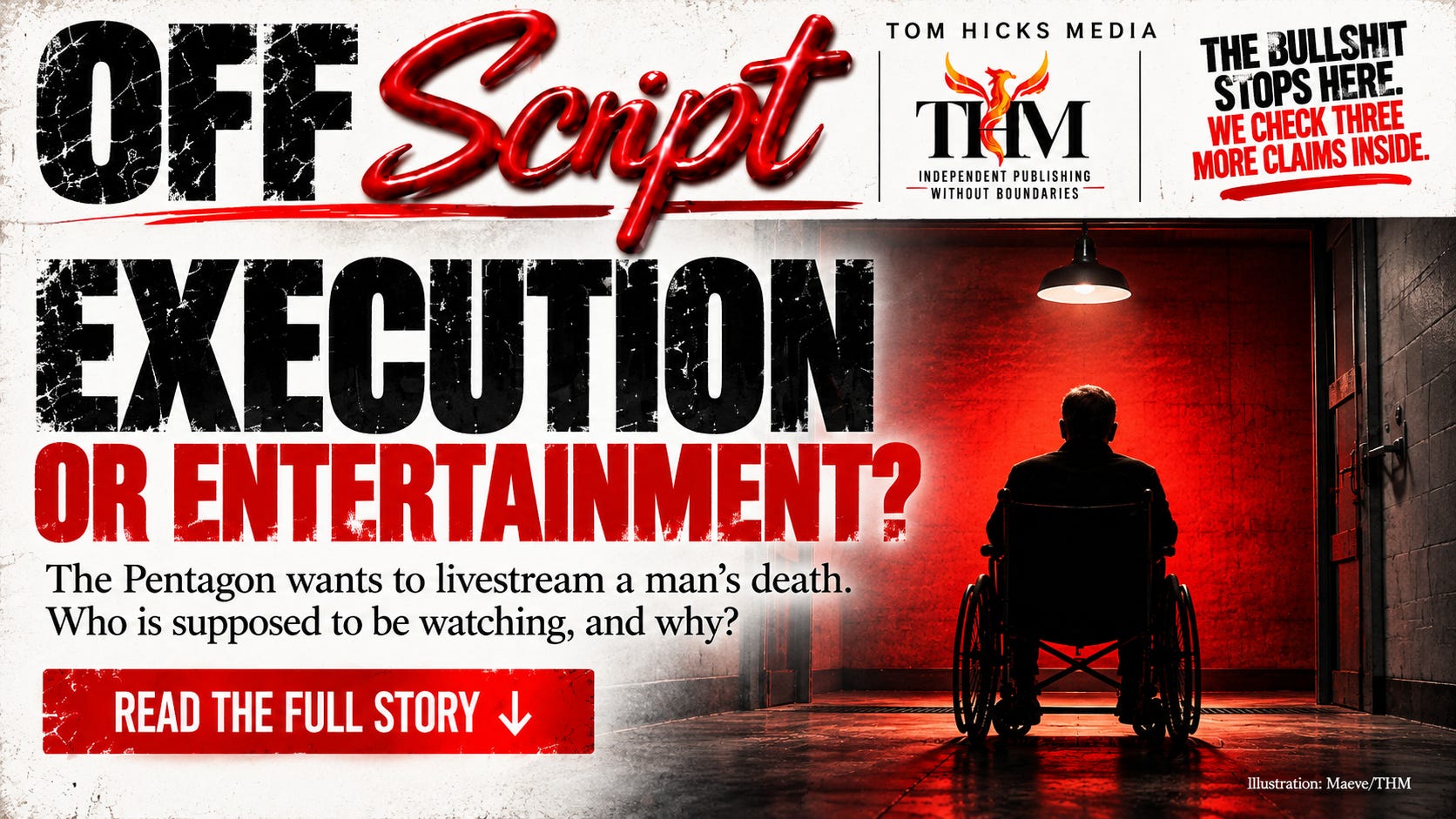
The Pentagon has confirmed plans to livestream the December 3 execution of Nidal Malik Hasan. The execution could still face legal challenges, and the broadcast itself remains uncertain. On Friday, Vice President JD Vance publicly questioned whether the livestream would actually happen, while President Trump reaffirmed his support for the execution without addressing the broadcast. Reuters, October 9
I’ve been going to auto races since the 1960s, when I was a kid watching cars go around the local tracks. I loved the racing. Still do. But even back then, I noticed something about certain people in the stands. They weren’t particularly interested in who won. They were waiting for somebody to crash, preferably spectacularly. The worse the wreck, the happier they seemed.
Even as a kid, I thought those people were assholes.
Nearly sixty years later, I haven’t changed my opinion. And now I’m wondering whether we’re about to discover just how many of their spiritual relatives are willing to tune in to watch the United States government execute somebody.
Because that’s apparently what the Pentagon intends to offer us.
On December 3, at 1 p.m. Central Time, the United States Army plans to execute Nidal Malik Hasan by firing squad at Fort Hood, Texas. Hasan, a former Army psychiatrist, was convicted of murdering 13 people and injuring 32 others during the November 2009 shooting at that installation. President Donald Trump approved the firing-squad execution on Defense Secretary Pete Hegseth’s recommendation. It would be the military’s first execution since 1961 and its first by firing squad since World War II. CBS News, October 8
Those facts alone would make this a significant story. But Hegseth apparently wasn’t satisfied with simply carrying out the sentence. He announced that the execution would be public, explaining that people needed to understand the serious consequences of such crimes. A Pentagon official subsequently confirmed that the proceedings would be livestreamed, with further details to come. CBS News, October 8
And somebody has given considerable thought to the presentation.
The execution is scheduled for the same military installation where Hasan committed his murders, at approximately the same time of day. Hegseth acknowledged that those details were intentional. Meanwhile, the Army had previously been preparing for an execution by lethal injection at a federal facility in Indiana. The decision to use a firing squad at Fort Hood required a significant change in those plans. ABC News, October 8
I don’t know about you, but when somebody starts coordinating the location, timing, method, and broadcast of a man’s death, I begin wondering whether we’re still talking about the administration of justice or something that looks suspiciously like a production schedule.
Before we go any further, though, I want to get something out of the way.
Hasan murdered 13 people. He wounded dozens more. The victims had families, friends, plans, and futures that were stolen from them. The survivors have lived with the consequences for nearly seventeen years, and nothing in this article is intended to diminish what happened to them.
Nor am I interested in entertaining the inevitable accusation that questioning the broadcast amounts to defending Hasan. That’s a convenient little trick people use when they don’t want to address the actual argument.
You can believe Hasan deserves to die and still question why the government wants millions of people watching it happen. Those positions aren’t contradictory, no matter how badly somebody might want to pretend otherwise.
And that distinction isn’t confined to one political party. Republican Senator Thom Tillis has criticized the livestream plan while supporting Hasan’s execution. Democratic lawmakers have also condemned the proposed broadcast. On Friday, Vice President JD Vance added an interesting wrinkle. Asked about the livestream, he said, “I don’t know that that’s actually going to happen.” Then he made his own viewing plans perfectly clear: “If it’s ultimately livestreamed, I’m not going to be watching it.” Vance also reminded reporters of the brutality of Hasan’s crimes, so this wasn’t an objection to holding Hasan accountable. Meanwhile, Trump reaffirmed that Hasan would face a firing squad but said nothing about televising it. When ABC News asked whether the president supported the broadcast, the White House referred the question to the Pentagon. That’s a rather revealing distinction: the administration is unequivocal about the execution, but considerably less unified in its public messaging about turning it into something people can watch from their living rooms. Associated Press, October 9 | ABC News, October 9
So what is the broadcast supposed to accomplish? Hegseth says people need to understand the consequences of committing such crimes. That’s the stated justification, and we should take it seriously enough to examine whether it makes sense.
Hasan was sentenced to death in 2013. His case has spent years moving through the military justice system, and the Supreme Court declined to review his case in 2025. If the execution takes place, the punishment will be precisely the same whether it is witnessed by a small group of authorized observers or broadcast to millions of people. CBS News, October 8
The bullets don’t become more lethal because there’s an audience.
Perhaps Hegseth believes the broadcast will deter future mass murderers. That’s one possible reading of his explanation, although the evidence for deterrence is hardly settled. In 2012, the National Research Council reviewed the available research and concluded that existing studies couldn’t reliably determine whether capital punishment increases, decreases, or has no effect on homicide rates. That finding doesn’t prove executions have no deterrent effect. It means the research wasn’t adequate to establish one. And it certainly doesn’t establish that broadcasting an execution provides some additional benefit. National Academies, Deterrence and the Death Penalty
Maybe the administration sees the broadcast as a demonstration of strength, an opportunity to show Americans that this government is willing to exercise its authority in ways previous administrations avoided. Perhaps officials believe the public display will reassure people who have grown frustrated with what they consider an overly cautious justice system.
Those are possibilities, not established motives. But public punishment has a long history of communicating state authority to people who weren’t accused of committing any crime. The condemned person received the punishment, while everyone watching received a demonstration of what the government was capable of doing.
That doesn’t mean Trump and Hegseth are secretly planning to execute political opponents, and I wouldn’t make that accusation without evidence. But a public display of lethal state power can carry implications beyond the official explanation. The administration may intend to communicate justice, deterrence, resolve, or some combination of those things. Different audiences may hear a very different message.
And if we’re going to ask those questions seriously, we also have to consider what happens when the images leave the United States and reach people who don’t share our political assumptions, our history, or our understanding of the case.
A brief word before we go further: You can subscribe for free and keep reading, or become a paid subscriber to help support the work that goes into every edition.
Either way, I’m glad you’re here.
The man being executed is a Muslim American of Palestinian descent.
Hasan was born in Virginia to Palestinian parents. He served in the United States Army, became a psychiatrist, and eventually committed an atrocity against fellow service members. His religion and ancestry neither excuse those murders nor establish that the punishment is discriminatory. His responsibility for his crimes rests on what he did, not who his parents were or which religion he practiced.
But are we seriously going to pretend those facts have no bearing on the images the Pentagon wants to distribute?
Consider what the proposed broadcast could look like to people watching outside the United States. American military personnel preparing to execute a Muslim man of Palestinian descent by firing squad at an American military installation, while the United States government provides the footage.
There’s another detail that makes the potential imagery even more troubling. Hasan was paralyzed from the waist down after being shot during the attack. He uses a wheelchair. If the execution goes forward, the government will be putting a wheelchair-using prisoner before a firing squad. Associated Press, October 8
I’m not suggesting those circumstances make Hasan innocent, or that the government selected him for execution because he’s Muslim. The record establishes why he was convicted and sentenced. But the symbolism of broadcasting his death is another matter entirely.
How might Muslim Americans, the overwhelming majority of whom have nothing whatsoever to do with Hasan’s crimes, interpret those images? How will they be received in countries where American military power is already viewed with suspicion? What happens when someone takes the footage, removes the context, and circulates it as proof that the United States is waging war against Muslims?
And here’s something that ought to concern the Pentagon regardless of anyone’s position on the death penalty: Hasan’s own conduct and statements during his prosecution raised concerns that he welcomed a death sentence. His standby attorneys feared he was deliberately pursuing that outcome. If he is portrayed as a martyr after his execution, a government-produced broadcast could provide extremist propagandists with extraordinarily powerful material. That’s a potential consequence, not a prediction, but it’s one the Pentagon ought to have considered before announcing this plan. CBS News, October 8
Once the government broadcasts an execution, it loses control of what happens to the images afterward. They can be copied, edited, replayed, celebrated, or turned into propaganda. And if somebody thinks the Pentagon can somehow manage the narrative after the footage reaches the internet, I’d suggest they haven’t spent much time on the internet.
We’ve actually been down this road before, although the technology was considerably less sophisticated. Public executions were once a familiar part of American life. Crowds gathered to watch hangings, sometimes traveling considerable distances for the occasion. What officials intended as solemn demonstrations of justice could become public entertainments, complete with vendors, spectators, and the kind of morbid curiosity that makes you wonder what people were thinking.
One of the most notorious examples occurred in Owensboro, Kentucky, in August 1936, when Rainey Bethea was hanged before an enormous crowd. The event became infamous for its carnival atmosphere and is widely recognized as America’s last fully public execution. Public access to executions had already been restricted in much of the country, and the spectacle helped illustrate why. NPR, October 9
Ninety years later, we’re contemplating bringing the audience back without requiring anybody to leave the house.
The Romans had a phrase for keeping the public entertained while the serious business of governing went on: bread and circuses. We’ve borrowed the expression for centuries, usually to complain about politicians distracting people with spectacles. But I wonder what the Romans would make of this. We may be approaching the point where the government doesn’t even have to provide the bread. Just schedule the spectacle, turn on the cameras, and let the audience supply its own popcorn.
And I have to wonder what the hell we’ve learned.
I can understand a relative of one of Hasan’s victims wanting to witness his execution. I wouldn’t presume to tell somebody who lost a loved one that they shouldn’t feel satisfaction when the sentence is carried out. Some may regard witnessing the execution as a form of closure. Others may want nothing to do with it. That’s their decision, and they deserve to make it without having their grief turned into somebody else’s political argument.
But what about the people who have no personal connection to the murders and simply want to watch somebody die? I’ve seen enough of that appetite at racetracks to know it exists. Most racing fans want to see great competition and drivers walk away from wrecks unharmed. A smaller, uglier contingent wants the wreck itself. The possibility of someone getting hurt is part of the attraction.
Now imagine that appetite with the uncertainty removed. The death is scheduled, the method selected, the time announced, and the government preparing to provide the pictures.
What the fuck are we doing?
There’s a legitimate argument for transparency, and I’m not going to dismiss it simply because I find the proposed broadcast repulsive. If the government is going to take a human life in the name of its citizens, shouldn’t those citizens be allowed to see what that actually involves? There’s something to be said for confronting the reality of capital punishment rather than treating it as an abstract legal procedure conducted somewhere behind prison walls.
Secrecy can protect institutions from scrutiny. Independent observers and journalists can help ensure that executions are conducted according to law, that abuses are documented, and that the public receives an accurate account of what happened.
But does accountability require an unrestricted livestream?
Military regulations already contemplate witnesses, including victims’ relatives and representatives of the news media. Those rules were designed around a controlled execution setting, not a potentially worldwide broadcast. Legal experts have questioned whether the Pentagon’s plan is compatible with the existing framework, particularly when it comes to minors and the public distribution of graphic images. ABC News, October 8 | Bloomberg Law, October 9
Those aren’t trivial objections. Nor are they necessarily insurmountable legal barriers. The Pentagon may have an interpretation of the regulations that permits the broadcast, or it may seek changes or waivers. But announcing an execution will be livestreamed doesn’t, by itself, settle whether the government has the authority to do so.
And the execution itself isn’t guaranteed to happen on December 3. Hasan’s attorney has raised objections to the execution arrangements, and further litigation could affect the schedule. Meanwhile, the vice president’s public skepticism makes clear that even senior administration officials aren’t presenting the livestream as a certainty. ABC News, October 8 | Associated Press, October 9
Which raises another question I’ve been chewing on.
Why announce the public broadcast before those legal and logistical questions have been resolved?
Maybe officials are confident the arrangements will withstand scrutiny. Perhaps they believe there’s sufficient time to work through the remaining issues. But announcing something dramatic can also have political value even if the event is delayed or never takes place. The public hears the promise, supporters celebrate the toughness, opponents react, and the announcement becomes a spectacle of its own.
I’m not claiming that’s the purpose here. I’m saying the distinction between announcing an exercise of power and actually carrying it out is worth remembering.
There’s something else about all this that bothers me, and it goes beyond whether Hasan deserves to die.
The United States has spent decades criticizing governments and extremist organizations that turn executions into public demonstrations of power. We recognize the disturbing implications when other countries use death as a political spectacle. We understand why footage of killings can become propaganda, why crowds can be encouraged to celebrate violence, and why the dignity of a justice system depends partly on how it exercises its most terrible authority.
Yet here we are, contemplating a government-produced livestream of a firing squad.
I’m not arguing that every public execution is morally or legally identical, regardless of the crime, the process, or the country conducting it. Those distinctions matter. But the comparison ought to make us uncomfortable enough to ask why we’re adopting a practice we have so often condemned elsewhere.
And perhaps that’s what bothers me most. The possibility that somewhere along the way, the solemn responsibility of carrying out a death sentence has become entangled with the desire to demonstrate toughness, attract attention, or satisfy an audience.
Whether Hasan deserves execution is a separate argument, and one I’m not trying to settle here. The military court imposed that sentence, and the legal process has brought the case to this point. People can disagree about capital punishment without disagreeing about the horror of his crimes.
What I do know is that when a government deliberately takes a human life, it ought to approach that responsibility with extraordinary seriousness.
There shouldn’t be any swagger involved. No promotional atmosphere. No suggestion that the death itself is something the public ought to tune in for.
The administration’s stated explanation deserves examination, and the people making it deserve to be questioned about the evidence supporting it.
But I keep coming back to the same problem.
What does showing the execution accomplish that carrying out the sentence wouldn’t?
I think about those people at the racetracks when I was a kid. The ones who jumped to their feet when a car hit the wall, hoping for something spectacular, then settled back into their seats when the driver climbed out unharmed.
I thought they were assholes then. I think they’re assholes now.
What I never imagined was that someday I’d be wondering whether the United States government was preparing to give their spiritual descendants a front-row seat to somebody’s execution.
And if this broadcast goes forward, there’s one question I hope we’re still willing to ask after the rifles have fired and the cameras have stopped rolling.
What happens when somebody in power discovers there’s an audience for this shit?
If this was worth your time, hit Like, Restack or share it. That’s how independent work like this finds new readers.
THE BULLSHIT DETECTOR
1. Being President Is Costing Trump Money
CLAIM: Homeland Security Secretary Markwayne Mullin told an Oklahoma rally that Donald Trump hasn’t financially benefited from the presidency and that holding office has actually cost him money.
BULLSHIT: 💩💩💩💩💩
WHY: Somebody might want to show Mullin a calculator. Financial disclosures and independent analyses show substantial revenue flowing through Trump’s businesses, and estimates of his net worth have risen. Revenue isn’t profit, and an increase in estimated wealth isn’t proof that every business venture succeeded. But Mullin’s sweeping assertion that the presidency has brought Trump no financial gain isn’t supported by the available evidence. PolitiFact reporting, October 2026
2. Republicans Passed the Biggest Tax Cut in American History
CLAIM: Iowa Republican Congressman Zach Nunn said Republicans had delivered the largest tax cut in U.S. history.
BULLSHIT: 💩💩💩💩
WHY: That’s what happens when you measure tax cuts in enormous dollar figures and forget that the economy has grown since Ronald Reagan was president. Economists generally compare tax cuts as a percentage of the economy. By that measure, the new cuts in the 2025 Republican tax law rank tied for sixth-largest since 1980. Include the extensions of Trump’s 2017 cuts, and the law ranks third. Those are substantial tax cuts, but neither calculation makes them the biggest in American history. PolitiFact rated Nunn’s statement Mostly False. PolitiFact, October 7
3. Trump’s Drug Deals Are Rescuing State Budgets
CLAIM: CMS Administrator Mehmet Oz said the administration’s prescription-drug pricing program was “rescuing state budgets,” while Trump said the savings would help save Medicaid.
BULLSHIT: 💩💩💩💩
WHY: The agreements could produce genuine savings, and nobody should complain about Medicaid paying less for prescription drugs. But according to the administration’s own projections, the initial savings for states would amount to roughly 2% of their annual Medicaid spending, declining in subsequent years. Even that estimate depends on which drugs are covered, how many states participate, and confidential agreements whose details remain largely unknown. There’s a considerable difference between helping a budget and rescuing one. Apparently, somebody at the White House misplaced that distinction. FactCheck.org, October 5
MORE FROM TOM HICKS MEDIA
Blind Spot | Off Script — The Election Before the Election. Who gets to vote, who gets left out, and what happens long before Election Day?
Lotus Purrspective — Life, humans, and their questionable judgment, examined by a cat who has seen enough.
Chart Collision — Music, memories, and the stories behind the songs.
Panic Room Sports — Smart coverage with attitude. Everyone reacts. We’ll check the tape first.
Rabbit Ears Classic TV — Revisiting the television that entertained us, surprised us, and occasionally left us wondering what the writers were smoking.
The Backlot Ghost — The stories behind the movies, including the ones Hollywood would rather you forgot.
What The Hell? — True stories so ridiculous you’d swear somebody made them up.
BUY ME A CUP OF TEA
Independent reporting takes time, research, and a few tools that stubbornly refuse to work for free. You can subscribe for free, or help fund the research and tools we use every day by becoming a paid subscriber or buying me a cup of tea.
ONE QUESTION BEFORE YOU GO
Should the government ever livestream an execution to the general public, or does that cross a line regardless of the crime?
#OffScript #MilitaryJustice #DeathPenalty #GovernmentAccountability #MediaEthics #TomHicksMedia