

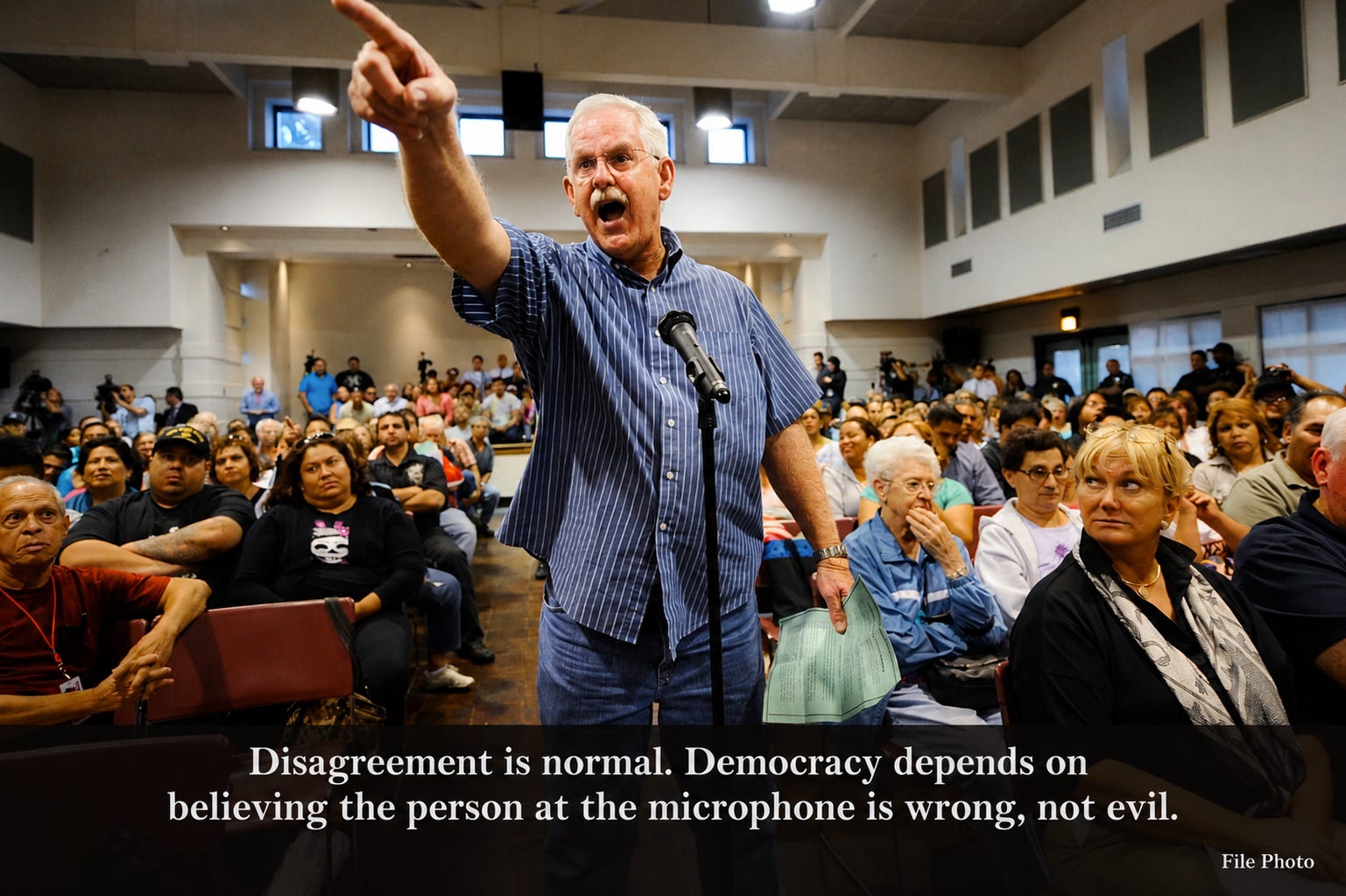

Ever notice how every disagreement now comes with an amateur psychological evaluation?
You can’t just be wrong anymore. You can’t just have a bad idea. You can’t just arrive at a different conclusion. No, now you have to be lying. Or brainwashed. Or secretly plotting something. Or part of some larger tribe of morally defective assholes actively trying to ruin the country.
I was reading a Washington Post piece about Americans increasingly viewing members of the opposing political party as bad people, and halfway through it I found myself thinking, “Well, no shit.”
Not because the polling surprised me. Because I’ve been watching this happen in real life for years.
We keep calling this polarization, but I don’t think polarization is the right word. Polarization is disagreement. America has always disagreed. Hell, if arguing were an Olympic sport, we’d have enough gold medals to build a second Fort Knox. We’ve fought over taxes, religion, wars, schools, immigration, unions, civil rights, foreign policy, and approximately seventeen thousand other things. Arguing isn’t the problem.
What we’re dealing with now feels different.
We’ve stopped assuming people are wrong. We’ve started assuming they’re bad.
That’s not a political problem. That’s a “how the fuck do you maintain a society?” problem.
What struck me about the Washington Post data wasn’t what it said. It was how familiar it felt. You’ve probably seen it too. Maybe it was at Thanksgiving. Maybe it was on Facebook. Maybe it was at work. Maybe it was standing in line somewhere when a casual conversation suddenly turned into an ideological background check. One minute, people are talking. The next minute, somebody is being treated like they personally caused inflation, climate change, the national debt, and the cancellation of your favorite television show.
The crazy part is how normal this feels now. We barely notice it. Somebody says something we don’t like, and instead of wondering why they believe it, we immediately start questioning their motives. We don’t ask whether they’re mistaken. We ask what they’re trying to pull. We don’t wonder whether they reached a different conclusion. We wonder what kind of person would reach that conclusion in the first place.
That’s a hell of a shift, and frankly, it’s more than a little fucking disturbing.
Long before I spent years buried in legal research and court records, my first job in radio was covering town meetings, school board meetings, county government meetings, and all the other assignments guaranteed to convince young journalists that glamour was not included in the compensation package.
I eventually moved into the anchor chair and later became a news director, but those early years sitting through zoning disputes, budget hearings, and public comment sessions taught me something I’ve never forgotten.
If you’ve never attended a four-hour town meeting about drainage, parking, snow removal, zoning setbacks, or whether the new stop sign should be twelve feet farther to the left, count your fucking blessings. Those meetings can make a hostage negotiation look like premium entertainment. After a while, you start rooting for a fire alarm, a power outage, or the sudden appearance of a loose goat just so something unexpected happens.
But as mind-numbingly dull as some of those meetings could be, they taught me something important.
People argued constantly. They got angry. They interrupted each other. They rolled their eyes. They occasionally acted like complete assholes. If you’ve ever attended a contentious local government meeting, you know exactly what I’m talking about. But there was still a line. The school board member who opposed your proposal wasn’t automatically evil. The neighbor who wanted a different zoning decision wasn’t automatically your enemy. The guy speaking during public comment wasn’t presumed to be part of a secret conspiracy. People disagreed, sometimes loudly and sometimes passionately, but there was still an underlying assumption that most of them were trying to do what they thought was right.
I’m not sure we still have that anymore, and if I’m being honest, that scares the shit out of me more than most of the political stories I write about.
If you’re tired of political food fights masquerading as analysis and want journalism that digs beneath the daily outrage cycle, this is exactly the kind of story I write about here.
Politicians come and go. Scandals come and go. Administrations come and go. Trust is different. Trust is infrastructure. It’s the invisible shit that allows everything else to function. You don’t really notice it when it’s working any more than you notice the foundation underneath your house. You notice it when it starts cracking.
What worries me is that the damage doesn’t stay in politics. It follows us home.
Friendships get smaller. Families start tiptoeing around the whole subject. Conversations get guarded, and then they get shorter, and then they stop happening. Social circles shrink. People stop saying what they really think because they’ve decided the risk isn’t worth the headache, the argument, or the inevitable assumption that they’re secretly some kind of bastard. Most of that doesn’t happen through some dramatic explosion. It happens quietly through missed invitations, avoided conversations, and friendships that gradually become people you used to know.
There are people I no longer discuss certain subjects with because I already know how the conversation is going to go. Not because either of us is going to change the other’s mind. Because the moment one of us says something the other doesn’t like, there’s a good chance we’ll stop talking about the issue and start talking about motives. Once that happens, the discussion is over. You’re no longer debating an idea. You’re defending your character.
And that’s where this stops being a political story and starts being a human story.
Curiosity requires the possibility that the other person arrived at their conclusion honestly. It requires enough humility to admit their experiences might have taught them something yours didn’t. Once you’ve decided somebody is stupid, malicious, brainwashed, or crazy, curiosity packs its bags and leaves town. You don’t ask questions when the verdict’s already in.
Now let’s talk about social media, because holy shit did social media figure out how to make money from this problem.
The platforms didn’t invent tribalism. Human beings were dividing themselves into teams long before Silicon Valley showed up. What social media did was take an ugly human tendency and build an entire business model around it. The algorithms learned something politicians, marketers, and cable news executives have known forever: fear sells, outrage sells, anger sells, and contempt sells. Understanding doesn’t. Giving somebody the benefit of the doubt doesn’t. Calmly listening to an opposing viewpoint doesn’t.
Nobody ever became a billionaire by creating an app that rewards people for saying, “That’s an interesting point. Tell me more.” If somebody launched a social media platform dedicated entirely to thoughtful discussion and intellectual curiosity, Wall Street would short the stock before lunch.
Instead, we’re fed a steady diet of the loudest activists, the dumbest tweets, the craziest videos, the most inflammatory clips, and the biggest assholes the internet can locate on any given day. Then we’re encouraged to believe those people represent millions of our fellow citizens.
That’s a hell of a business model.
It’s also cynical as fuck.
And it’s a hell of a way to poison a country.
What drives me nuts about this whole conversation is how disconnected it is from the people I actually know. Most Americans aren’t spending their days plotting the destruction of democracy. They’re trying to survive the next goddamn bill. They’re trying to figure out why groceries suddenly require a small business loan. They’re trying to survive another insurance increase. They’re trying to keep the car running. They’re trying to figure out whether retirement is ever going to look remotely like the brochures promised. They’re trying to make it to payday.
That’s it. That’s the whole agenda.
The average American isn’t masterminding a secret plan to destroy the country. The average American is wondering what the hell happened to the price of eggs. And somehow we’ve convinced ourselves that millions of our neighbors are secretly monsters.
What struck me most about the polling wasn’t the politics.
It was the loneliness hiding underneath it.
Because a country doesn’t become healthier when everybody retreats into smaller and smaller circles populated entirely by people who already agree with them. That’s not community. That’s self-segregation with Wi-Fi. It feels safe. It feels comfortable. It feels reassuring. It’s also lonely as hell, and I don’t think we’ve fully reckoned with how much of our collective misery comes from this constant low-grade suspicion of one another.
And before anybody starts nodding along while mentally assigning all responsibility to the other side, save it.
This is one of the few genuinely bipartisan accomplishments left in America.
Everybody does it. Everybody thinks they’re the exception. Everybody can produce a stack of receipts, screenshots, stories, grievances, and horror stories proving why the other side is worse.
That’s exactly why the problem keeps getting worse.
A country can survive disagreement. Hell, disagreement is often how societies solve problems. What becomes dangerous is the moment disagreement itself starts being treated as evidence that the other person is morally defective. Once that happens, listening feels like surrender, compromise feels like weakness, and understanding starts looking suspiciously like betrayal.
That’s when the real damage begins.
I keep coming back to something I learned sitting through those godforsaken town meetings all those years ago.
Communities don’t run on agreement. They run on trust.
People vote differently. They support different candidates. They want different things. They argue. They complain. They lose elections. They win elections. The whole system only works if most people believe the people around them are participating honestly, even when they’re wrong. The same thing is true for friendships, families, neighborhoods, and countries. None of them requires agreement. All of them require trust.
The Washington Post data isn’t really telling us that Americans disagree. We already knew that. It’s telling us something far more troubling. Americans are increasingly losing trust in Americans.
And once a society starts assuming the worst about one another, the damage doesn’t stay in Washington.
It follows us home.
I’m retired. No sponsors. No corporate leash. War Room is where the deeper patterns live. Not just what happened, but how it works and where it’s going next. If you want the full picture, upgrade.
If not, you’ll still get the headlines. Just not the part that actually explains them.
Same reality, different delivery. Go check out Lotus Purrspective. Less profanity. Sharper judgment.
Buy Me A Cup Of Tea, because yelling “what the fuck are we doing?” at the news doesn’t pay for itself.
#Politics #Culture #Trust #Community #Media #TheUnredactedBastard