

By Tom Hicks | Off Script
Sometimes I wonder if I’m reading the same news as everybody else.
Not because I think I’ve stumbled onto some grand conspiracy nobody else noticed. Hell, most days the story is exactly what everybody says it is. The weird part is that my brain has this annoying habit of getting hung up on one little detail while everybody else is busy talking about the big picture, and this morning it was one word.
Reunited.
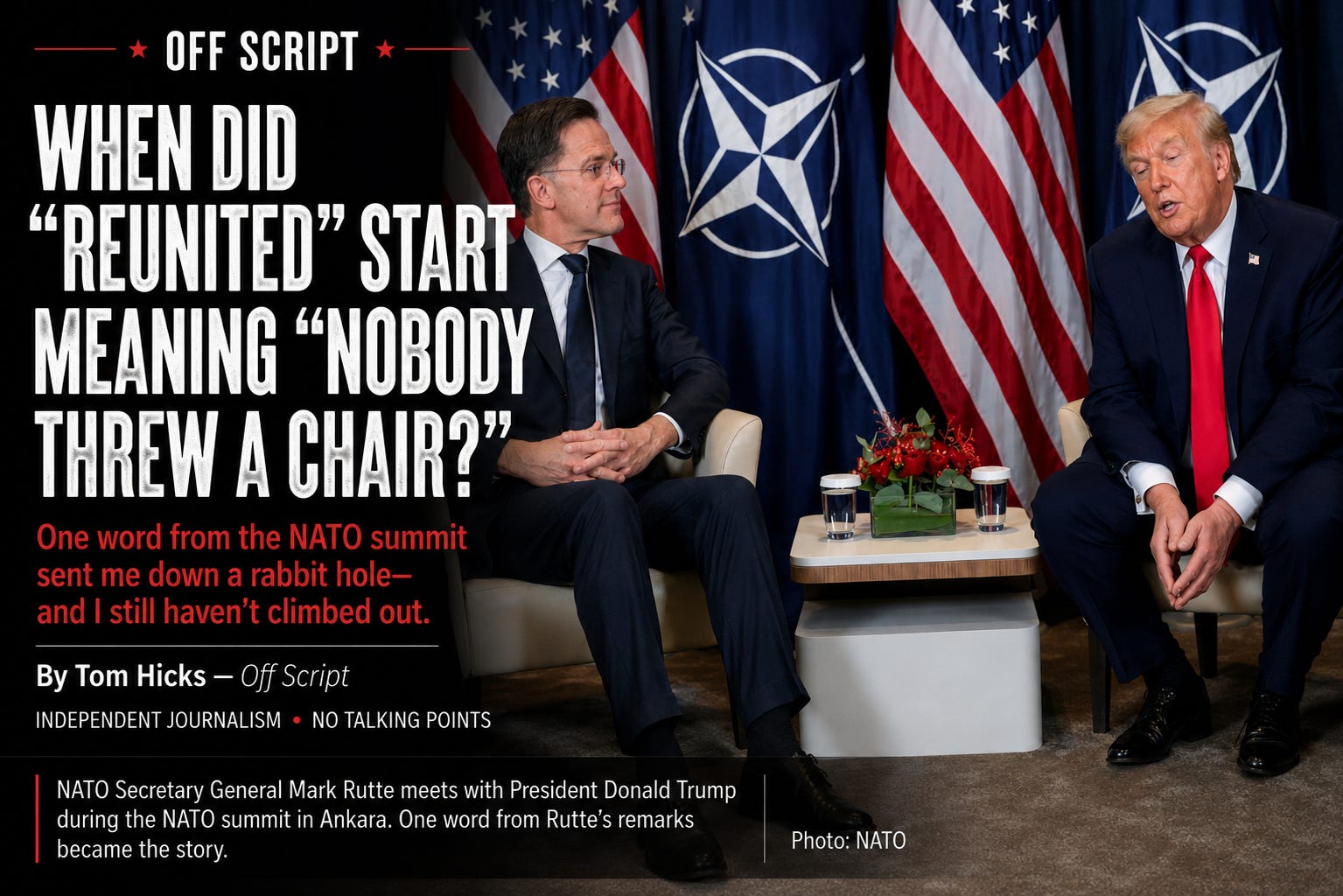
According to NATO Secretary General Mark Rutte, the alliance came out of its summit in Ankara “reunited,” and I damn near laughed.
Not because I think NATO is collapsing, and not because I think Rutte’s an idiot. Hell, if I had his job, I’d probably need bourbon with my breakfast. What got me was that one little word.
Reunited?
Really?
Maybe I’m getting old. That’s entirely possible. I reached the age where I can walk into the kitchen looking for something, get there, and spend five minutes trying to remember what the hell I came in for. But unless my memory has completely gone to shit, “reunited” used to mean people who’d actually been separated.
Families reunite.
Old friends reunite.
The cast of an old television show reunites because somebody figured out they could make another twenty million bucks selling our nostalgia back to us.
That’s a reunion.
Thirty-two countries spending two days arguing over defense spending, trade, military commitments, and who ought to be paying for what?
Hell, that’s every condo association meeting in America.
If you enjoy looking at the news from an angle the talking heads usually miss, pull up a chair. Join me every morning for Off Script.
See, this is the kind of crap that fascinates me. I’ve always been a word guy. Give me one interesting word, and I’ll happily ignore the rest of the article while I chase that poor bastard around the page trying to figure out what it’s doing there. Words aren’t just words. They’re little windows into the way people want us to see the world.
Take “right-sizing.”
That’s layoffs with better public relations.
“Revenue enhancement?”
That’s taxes after somebody put on a necktie.
“Unexpected challenges?”
That’s government-speak for, “Well... we screwed something up.”
Now we’ve apparently added “reunited” to the list.
I don’t think that’s an accident. Nobody reaches into a bag of Scrabble tiles, pulls out seven random letters, and accidentally creates the perfect diplomatic talking point. Somebody looked at that summit, thought about everything that happened, and decided “reunited” was the word they wanted the rest of us carrying around in our heads.
That’s interesting as hell.
“I’ve always been a word guy. Give me one interesting word and I’ll happily ignore the rest of the article while I chase that poor bastard around the page trying to figure out what it’s doing there.”
Look, I’m not naïve. I understand why Rutte chose that word. His job isn’t just running meetings. His job is reassuring allies, discouraging adversaries, calming markets, and trying to keep thirty-two countries moving in roughly the same direction. Walking up to the microphone and saying, “Well... nobody called anybody an asshole and nobody threw a fucking chair, so I guess we’ll take the win,” probably isn’t considered proper diplomatic language.
Still, there’s a hell of a difference between survived the meeting and reunited, and that’s what keeps bugging me. Not because I think he’s lying. I don’t. It’s because I think institutions have a habit of reaching for the friendliest word in the dictionary, even when it’s doing a hell of a lot more work than it ought to.
WAIT... WHAT?
Apparently, the new diplomatic definition of “reunited” is:
“Everybody argued for two days, smiled for the cameras, and nobody threw a chair.”
I’m just checking, because my dictionary says something completely different.
Think about how often this happens. Companies don’t shrink the product. They “refresh the packaging.” Politicians don’t reverse themselves. They “evolve.” Nobody gets fired anymore. They’re “transitioning to new opportunities.” Hell, if my electric company ever sends me a notice saying they’re “reimagining my monthly billing experience,” I’m hiding my wallet.
Everybody’s got a dictionary these days, and somehow every dictionary just happens to make the speaker look a little better.
That’s bullshit.
Not because the words are always false. It’s because they’re often carefully chosen to sand the sharp edges off reality until the whole damn thing feels easier to swallow. The event doesn’t change. The language does. Before long, people aren’t arguing about what happened anymore. They’re arguing about the carefully wrapped version that got delivered to the evening news.
Maybe NATO is more united today than it was before the summit. I honestly don’t know, and neither do you. That’s another thing that cracks me up about modern commentary. Everybody acts like they know what happened inside closed-door meetings. They don’t. They know what they were told happened. Those are two very different things, and confusing them is how perfectly intelligent people end up arguing over press releases like they’re eyewitness accounts.
What I do know is this: if I’d watched my family spend two days arguing over money, responsibilities, who wasn’t pulling their weight, and whether Uncle Frank had once again brought that damn potato salad nobody actually likes, then everybody smiled for one picture before getting back in their cars, I wouldn’t tell my neighbors we’d had a reunion.
I’d tell them Thanksgiving was over.
That’s not me insulting my family.
That’s me using the word that actually fits.
Maybe that’s what bothers me so much. Somewhere along the way we started treating plain English like it wasn’t sophisticated enough. Every institution now seems to have its own dialect. The government has one. Corporations have one. The military has one. Universities have one. Spend enough time listening to any of them and you begin to realize they’re all playing the same game.
They’re not always changing the facts.
Sometimes they’re just changing the labels.
And labels matter because labels shape pictures.
Say “reunion,” and I picture hugs, laughter, old memories, maybe somebody crying at the airport. Say “survived another ugly meeting” and I picture something completely different.
Same event. Different movie playing in my head.
That’s the power of one little word.
If today’s rabbit hole made you smile, think, or mutter, “Son of a bitch...,” you can help keep the coffee hot and the bullshit detector fully operational.
There are days when I think being a word guy is a pain in the ass. Normal people read an article and move on with their lives. I read one sentence, trip over a single word, and spend the next hour wandering around my living room talking to myself like a lunatic.
Then again, maybe that’s exactly what I’m supposed to be doing.
Because once you start paying attention to the words people choose, you start seeing things you would’ve missed otherwise. You notice when “temporary” quietly becomes “indefinite.” You notice when “mistake” becomes “miscommunication.” You notice when “we’re still arguing” somehow morphs into “we’re reunited.”
And once you notice it...
Good luck unseeing it.
ONE QUESTION BEFORE YOU GO
What’s one word or phrase you’ve heard recently that made you stop and think, “Aw, come on... that’s not what that means?”
ONE LAST THING
I’m perfectly willing to believe NATO came out of that summit in better shape than it went in. What I’m not willing to do is hand over perfectly good words without asking a few questions first.
Call me old-fashioned.
I’ll keep the dictionary.
#OffScript #Politics #Language #Media #NATO #Commentary